Apple's M5 Ultra Mac Studio: A Real Local AI Machine, at Last
Apple's M5 Ultra Mac Studio: A Real Local AI Machine, at Last
Apple finally made the local AI machine I've been waiting for. The new Mac Studio tops out at 512GB of unified memory with 1.2TB/s of bandwidth, and the M5 Ultra is Apple's first quad-die chip. I wrote a skeptical post about a Xiaomi AI Cube prototype last week; this is the opposite story — the memory princess gets an open-sourced software stack to actually use it.
Let me be clear about what "real local AI machine" means to me, because it's the whole point of this post. Not a box that runs one vendor's chat app. A machine where I can pull any open model, load it as a GGUF or an MLX build, run, fine-tune, and even cluster. Apple announcing huge memory numbers is one thing; making that memory useful for the open ecosystem is the thing I actually care about.
The numbers that justify the price
| Config | CPU / GPU | Memory (max) | Bandwidth | Start price |
|---|---|---|---|---|
| Mac Studio M5 Max | 18-core / up to 40-core GPU | up to 128GB | 614 GB/s | $2,499 (36GB) |
| Mac Studio M5 Ultra | up to 36-core / up to 80-core GPU | up to 512GB | 1.2 TB/s | $5,499 (96GB) |
Official announced pricing and specs from Apple's August 25, 2026 press release.
The headline is the M5 Ultra's 512GB ceiling. That's up from nothing close in the current line — the M3 Ultra's memory ladder stops at a paltry 96GB after Apple quietly cut the 256GB and 512GB options this spring. To get 512GB of usable unified memory in a Mac workstation before today, you couldn't. This is the first Mac that can hold a genuinely large model plus your whole dataset at once.
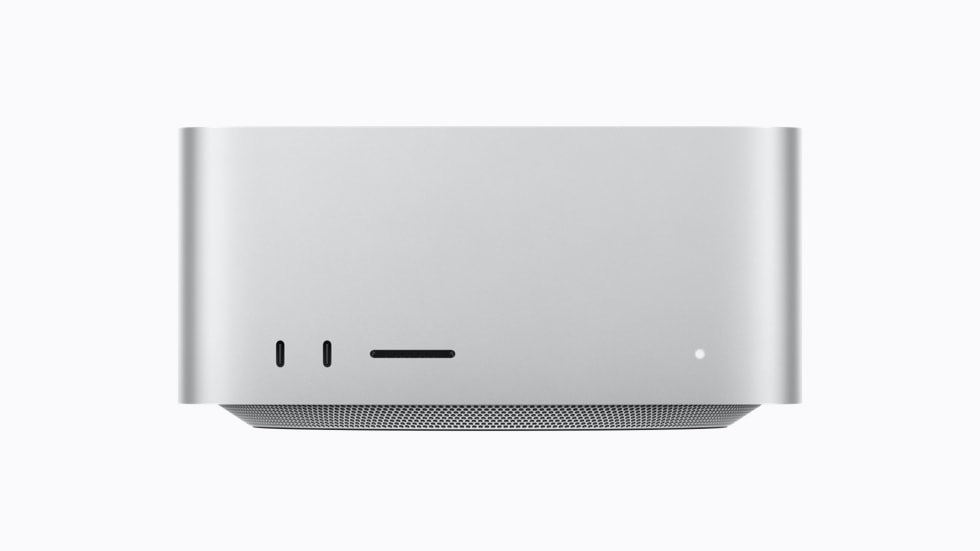
The new Mac Studio — same pocketable aluminum box, a different class of machine inside (image: Apple).
Why memory bandwidth beats TOPS for local LLMs
I keep coming back to this because it's the single most misunderstood spec. For a local LLM, tokens-per-second is decided by memory bandwidth, not by peak TOPS. Every token the model generates means re-reading the weights from memory. A 4-bit 120B model is roughly 60GB of weights; 512GB memory means you can hold the weights and a long context and your data in one place instead of paging.
The M5 Ultra's 1.2TB/s is 50% more than the M3 Ultra's 819GB/s. That's the token-speed number. On paper — and I won't pretend it's measured — that's a machine that can feed a frontier-class open-weight model fast enough to be genuinely usable for daily interactive work, not just batch-y slow cooking.
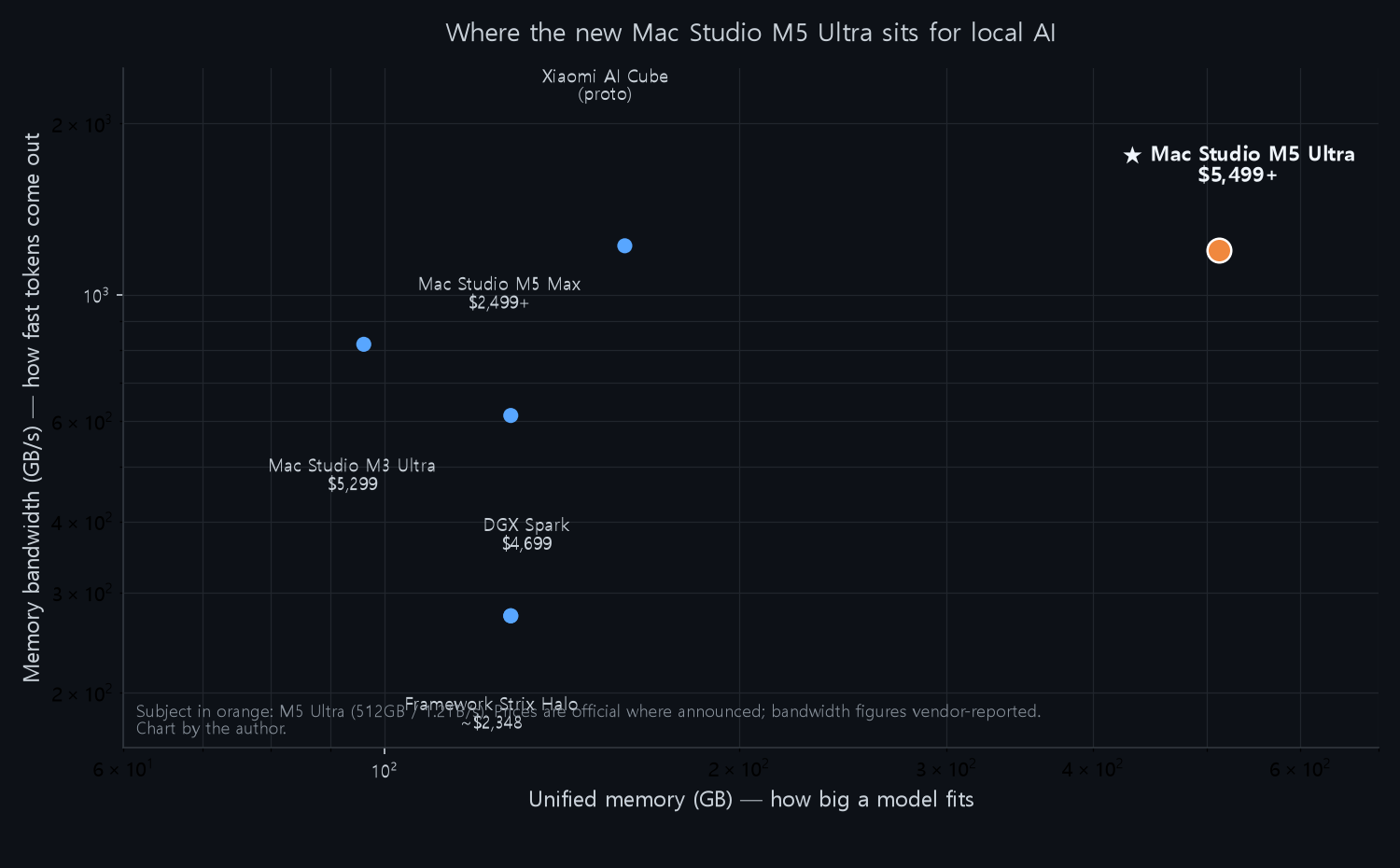
For local AI, the two axes that matter are memory (how big a model fits) and bandwidth (how fast tokens come out). The M5 Ultra is the top-right outlier. Chart by the author; prices official where announced, bandwidth vendor-reported.
And critically — Apple's AI-performance claims (4.3x vs M3 Ultra peak AI compute, 1.8x graphics) are all vendor-reported. I'll treat those as directional, not gospel. What's not vendor-speak is the physical memory capacity and bandwidth, which is the part that matters most for the use case I care about.
The software is the part that changed
This is where the M5 Ultra story is genuinely different from every other "big AI box" announcement. Apple isn't pitching a walled garden this time — it's leaning into the open stack that actually runs local models.
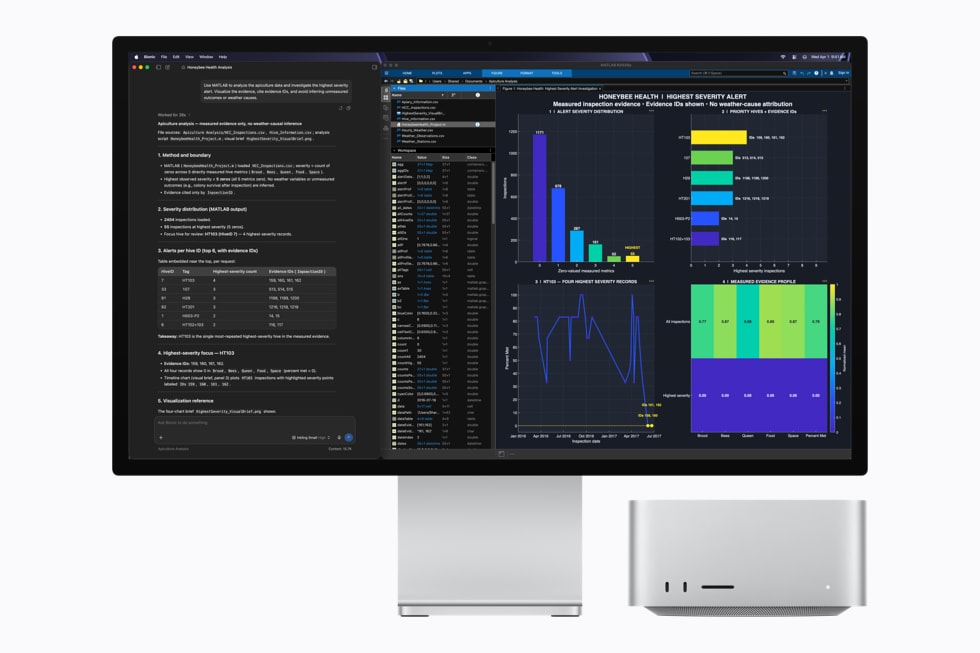
Apple's own launch material shows LM Studio running a model on the M5 Ultra — a sign they're courting the open-ecosystem crowd, not just Apple Intelligence (image: Apple).
MLX, Apple's open-source ML framework, is first-class on Apple silicon and it's where a huge share of open-weights users run local models today. LM Studio ships a Metal/MLX backend. llama.cpp has a Metal path. Apple also introduced Core AI, a new framework to deploy LLMs lean — but the open-ecosystem reality is MLX and Metal, both of which are real and used daily.
What this means practically: when I want to run, say, an open 120B model on my desk, on the M5 Ultra I load a GGUF or MLX build and go. No CUDA dependency, no vendor lock-in to a specific chat app. The memory is usable by the tools the local-AI community already lives in. That's the thing Xiaomi's AI Cube conspicuously couldn't promise, and it's the entire reason this Mac is interesting to me while the Cube was not.
Clustering is the sleeper feature
Apple added clustering over Thunderbolt 5 with RDMA — you can hook up multiple Mac Studios and share one memory pool, with Apple claiming up to 3x faster AI inference on a 4-system cluster. That's aimed straight at the crowd that would otherwise buy one DGX Spark and wish it were bigger. If it works as described, it turns four $5,499 heads into a pooled-memory workhorse — still pricey, but a genuinely different capability than any single-box option.
The honest reality check
I want to be straight with you, because this machine is expensive and hyped. The M5 Ultra at $5,499 starts with only 96GB; the 512GB configuration Apple's touting is a build-to-order bump that has no announced price yet, and availability for those configs slips to late October. Given the memory shortage that's been squeezing every high-RAM Mac, expect the 512GB price to be painful — possibly well into five figures.
So here's the honest split. If you live in the open local-AI ecosystem (GGUF, MLX, fine-tuning, open weights) and you need to run a big model plus keep your dataset resident, the M5 Ultra is the first Mac that's actually in the running — without the 512GB option, it's back to being a fast 96GB machine that can't do what I'm describing. And if you're on a budget like me, watch out: the M5 Max's $2,499 starting price only gets you 36GB. Getting up to the 128GB that makes it a serious 70B-class machine is a paid upgrade — and with the memory shortage driving RAM prices up, the 128GB config is nowhere near that $2,499 headline.
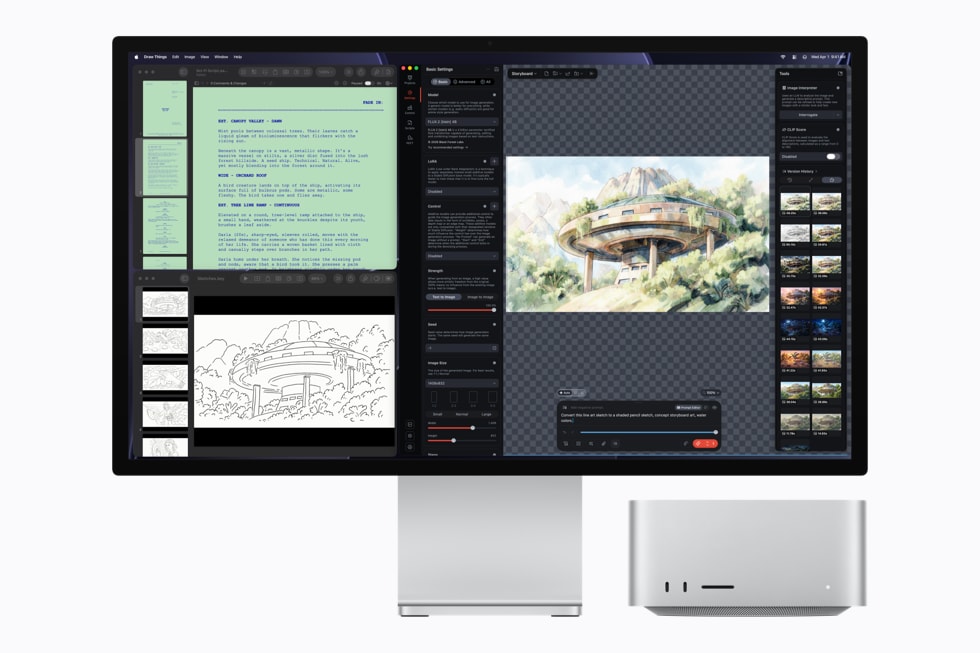
Apple's launch imagery leans into practical creation tools — Draw Things local image generation on the M5 Ultra (image: Apple).
My take
I've been the person running local models on a 1080 Ti with 48GB of system RAM, sweating about which MoE actually fits. So when a machine shows up with 512GB of unified memory, 1.2TB/s, and an open software stack that already runs my tools, my bias is real and I'm fine admitting it. This is the most compelling local AI desktop Apple has ever made — the memory finally matches the chip's ambition, and unlike the AI Cube I wrote about last week, the software actually serves the open ecosystem instead of fencing it off.
The 512GB price is the thing I still can't vet, and I will not pretend otherwise. If Apple prices the high-memory configs sanely, this resets the whole "what can I run at home" ladder. If it does the usual Apple tax on RAM, it stays a tool for people with real budgets and labs. I'll do an actual hands-on the moment I can get my hands on a 512GB unit — no vendor bench-number theater, just me loading real open models and timing them. That's the follow-up this post is promising.
Related on this blog: Xiaomi AI Cube: 120B Local Models at 4.5× DGX Spark's Bandwidth · FreeToken Wants to Put Frontier MoE Models on Your Edge Machine
Sources: Apple Newsroom (Aug 25 2026) — "Apple introduces new Mac Studio with M5 Max and M5 Ultra" and "Apple introduces M6 and M5 Ultra"; The Verge preorder pricing; MacRumors/Fello AI for memory-ceiling history. All Apple performance multipliers are vendor-reported. Pricing reflects announced US starting prices; 512GB configuration price and Korean retail availability were not published at the time of writing.
Comments
Post a Comment