OpenCode Go vs Command Code GOAT: Both $10, But They're Not the Same Deal
OpenCode Go vs Command Code GOAT: Both $10, But They're Not the Same Deal
September 1, 2026 · by OpenSource Factory · pricing data verified against the official docs on the day of writing
I've been paying for OpenCode Go for months, and this week someone in the Command Code Discord asked me why I hadn't switched to GOAT. Fair question — both cost $10 a month, both hand you a bucket of coding-model credits, both plug into any OpenAI-compatible agent. Same price, same shape. So which one is actually better value? I dug through both official pricing docs and the answer is: it depends entirely on which models you actually use.
The short version: GOAT gives you more raw credit ($70 vs $60 of usage), a bigger catalog, and a few permanent discounts that can stretch your $10 several times further. OpenCode Go answers with cheaper requests on the models that matter most to me — DeepSeek V4 Flash and the MiMo line — plus one model that's flat-out free on Go and nowhere else. Neither is "better." They're two different answers to the same $10.
The plans, side by side
Both subscriptions work the same way: your $10 buys a credit allowance measured in dollars, and each request burns credits at the model's per-token rate. Cheap models stretch, expensive ones burn. The difference is in the numbers:
OpenCode — the open-source agent behind Go. (image: opencode.ai)
Command Code — the agent behind GOAT. (image: commandcode.ai)
| Dimension | OpenCode Go | Command Code GOAT |
|---|---|---|
| Price | $10/mo ($5 first month) | $10/mo |
| Monthly usage value | $60 (6x) | $70 (7x) |
| 5-hour window | $12 | $14 |
| Weekly window | $30 | $35 |
| Models on the plan | 26 | 45 of a 63-model catalog |
| API access | OpenAI-compatible endpoint | OpenAI + Anthropic compatible |
| Overage | Zen balance fallback (pay-as-you-go) | On-demand credits, roll over, never expire |
Both plans roll their windows from first use, not on a clock, and both keep working on free models once you're capped. Neither is unlimited, and neither is a trick — the "6x" and "7x" multipliers are real: they reflect negotiated bulk pricing and shared GPU capacity, passed on as extra credit. The exact multiplier varies by model (a few Go models only stretch 1.5x), so the headline is a blend.
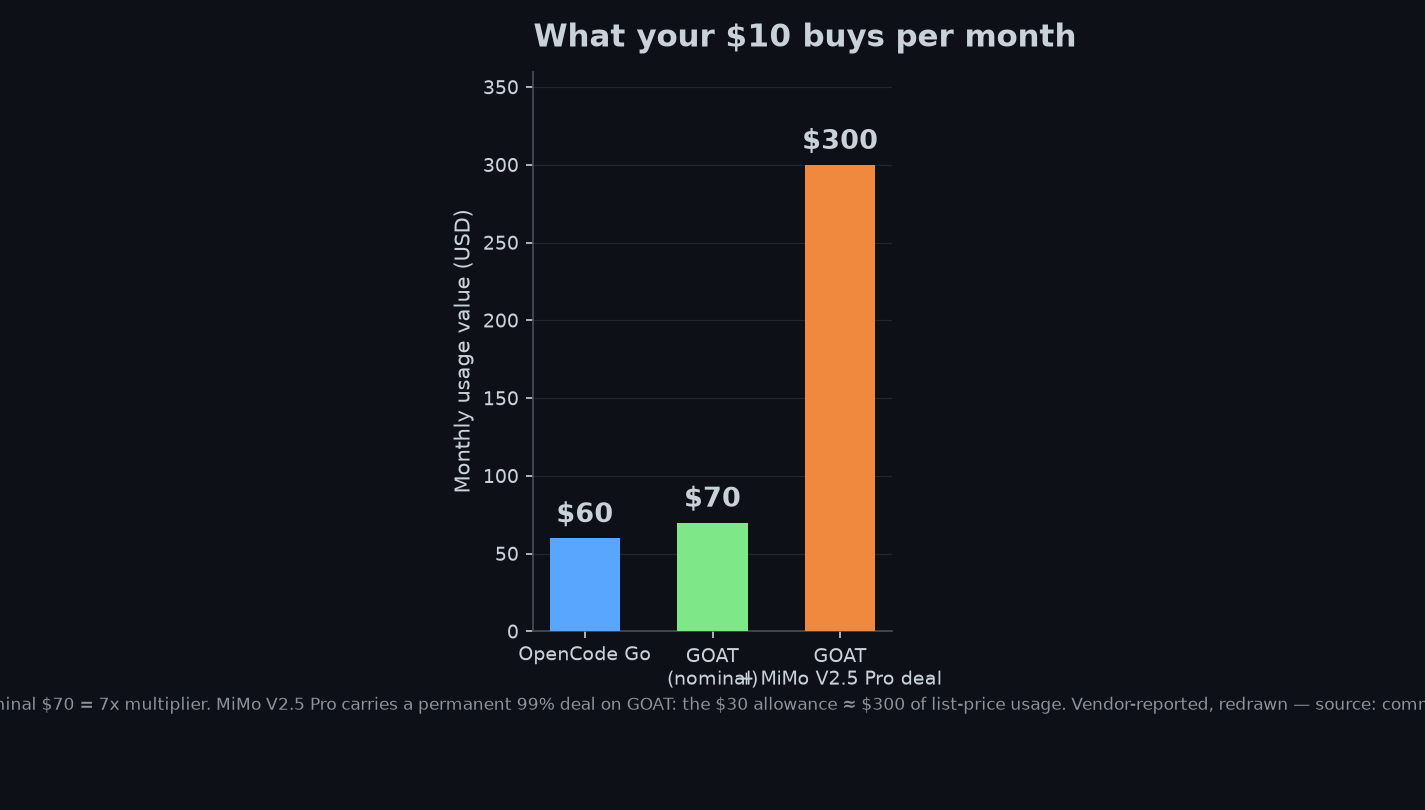
What your $10 buys per month, in usage value. GOAT's nominal $70 becomes ~$300 of list-price usage if you route through its permanent MiMo V2.5 Pro discount. Vendor-reported, redrawn from the official pricing pages.
Where GOAT pulls ahead: the catalog and the discounts
GOAT's model list is nearly double Go's — 45 of a 63-model catalog, versus 26 on Go — and several of the extras are headliners: GPT-5.6 Sol, Gemini 3.7 Flash, Grok 4.6, Step 3.7 Flash. Go has a couple of exclusive workhorses too (LongCat-2.0, Qwen3.8 Flash), but its closed-model bench is basically Grok 4.6 plus GPT-5.6 Luna.
The bigger GOAT weapon is its permanent discounts. These are baked into the per-model allowances — no codes, no toggles:
- MiMo V2.5 Pro — 99% off, permanent. Output drops from $4.00 to $0.28 per million tokens. GOAT gives it a $30 monthly allowance, which is roughly $300 of list-price usage. This is the single best deal on either plan.
- MiMo V2.5 — 98% off, permanent. Same idea, slightly less extreme. ~$100 of list usage per $10.
- MiniMax M3 — 50% off, permanent. Effectively doubles your M3 credit.
- Gemini 3.7 Flash — 50% off until Dec 31, 2026. Time-limited, but it's a closed frontier model at half price.
- Laguna S 2.1 (Poolside) — 100% free while capacity lasts. Zero tokens billed. Real, though first-come.
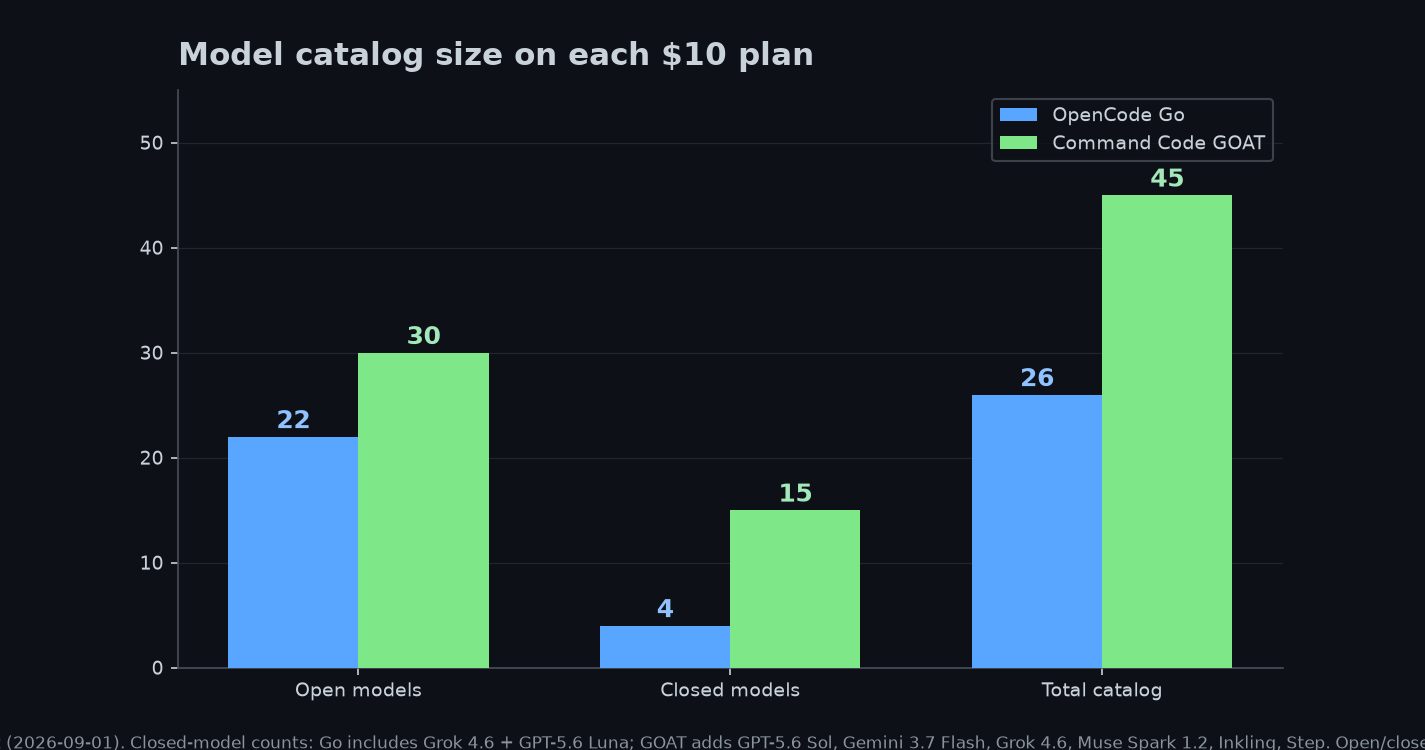
Catalog size on each $10 plan. GOAT carries most of the closed-model bench (Sol, Gemini, Grok 4.6, Step); Go's closed pair is Grok 4.6 + GPT-5.6 Luna. Open/closed split is approximate by license. Sources: commandcode.ai, opencode.ai (2026-09-01).
Where Go wins: the workhorses are cheaper per request
The catalog math cuts the other way on the models people actually run daily. Look at the request estimates both vendors publish — same typical agent pattern (~800 input tokens, ~50K cached, ~200 output per request), so the numbers are directly comparable:
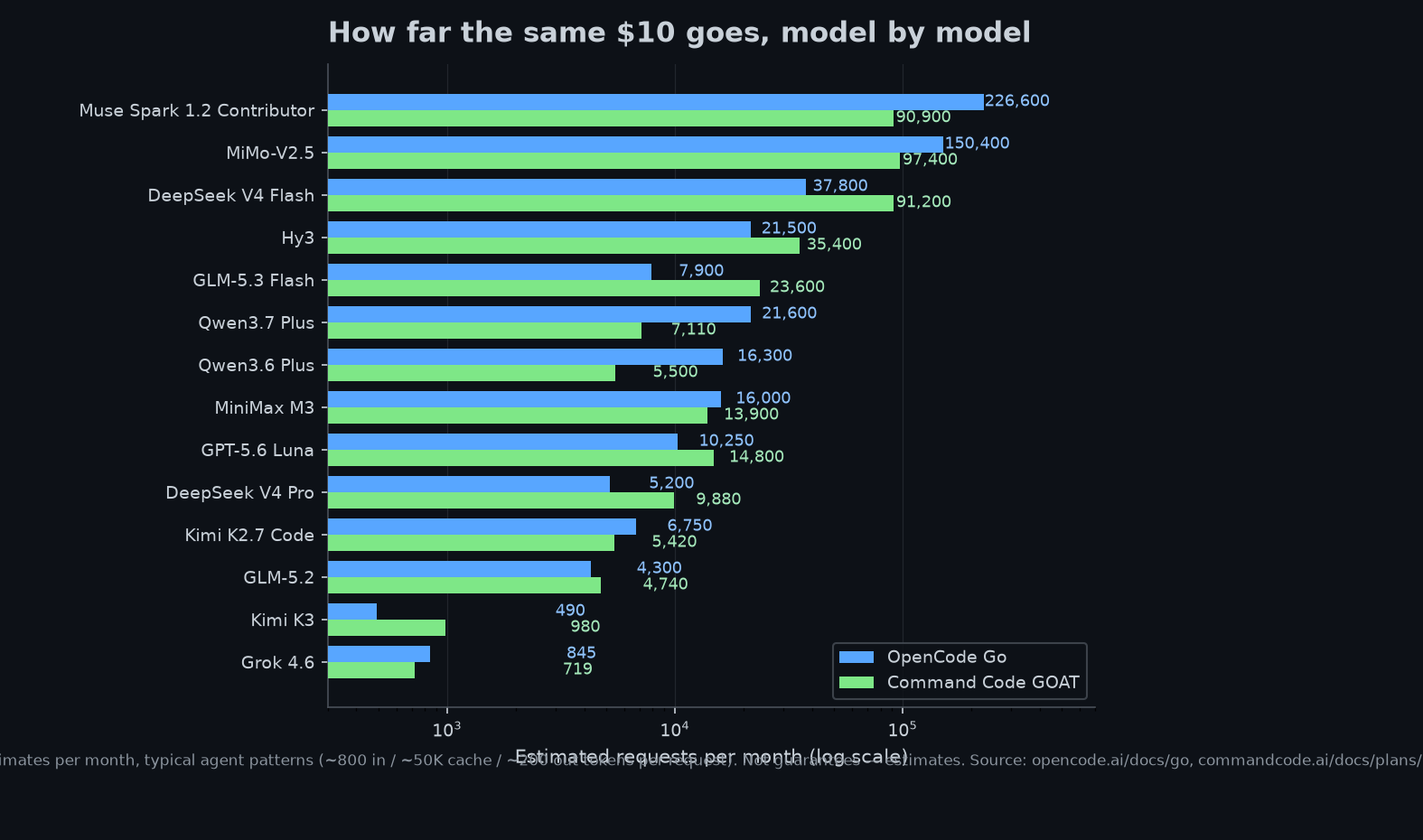
Official monthly request estimates, same typical agent pattern on both plans. Not guarantees — estimates. But the direction is clear: Go stretches the cheap workhorses further, GOAT stretches the mid-tier and frontier models further. Sources: opencode.ai/docs/go, commandcode.ai/docs/plans/goat (2026-09-01).
A few concrete splits that matter:
- DeepSeek V4 Flash: 91,200 requests/month on GOAT vs 37,800 on Go — GOAT gives 2.4x more of the single most popular coding workhorse.
- DeepSeek V4 Pro: 9,880 on GOAT vs 5,200 on Go — nearly double.
- GLM-5.3 Flash: 23,600 on GOAT vs 7,900 on Go — 3x more.
- MiMo-V2.5: 150,400 on Go vs 97,400 on GOAT — Go wins this one, 1.5x.
- Muse Spark 1.2 Contributor: 226,600 on Go vs 90,900 on GOAT — Go wins big, and it's basically free-tier volume. The catch: Meta trains on your prompts.
- Qwen3.7/3.6 Plus: both ~3x more on Go (21,600 vs 7,110; 16,300 vs 5,500).
The pattern is almost a law: the cheaper the model, the more Go stretches it; the pricier the model, the more GOAT does. That's because Go's multiplier is roughly uniform while GOAT concentrates its boosted allowances on the expensive end — then adds permanent discounts on top.
The fine print that actually decides
Before you switch on credit math alone, three gotchas:
1. "7x" is the ceiling, not the floor. GOAT's $70 assumes you spread across its typical model mix. New models and already-discounted ones carry a plain 2x allowance ($20 on your $10). If you live on one brand-new model, your multiplier is closer to 2x than 7x — same on Go, where a few models only stretch 1.5x.
2. Request estimates are averages, not quotas. A long reasoning session re-reads the full context every turn and burns credits 5-10x faster than the typical pattern. Both vendors say this plainly; treat the tables as order-of-magnitude guides.
3. The Muse Spark free tier is not free. Muse Spark 1.2 Contributor gives you enormous volume on Go (226,600 req/mo) because Meta gets to train on your prompts and completions. Fine for throwaway experiments; a hard no if your code is sensitive. (It's also region-limited to Meta's allowed geography.)
Privacy and the ecosystem
Both promise not to train on your code. Go's fine print is more varied: Grok 4.6 and GPT-5.6 Luna retain 30 days (not zero-retention), Muse Spark Contributor trains on you, everything else is 0-day, and the DeepSeek zero-retention agreement renews monthly (currently through Aug 31, 2026). GOAT's defaults are mostly ZDR with monthly renewals too, plus a CMD_ZDR=1 flag that enforces it on every request.
Ecosystem-wise they're different animals. OpenCode is the giant: ~198K GitHub stars and millions of monthly users, with Go as one optional provider beside BYOK and Zen pay-as-you-go. Command Code is the smaller, more opinionated harness — it obsesses over context efficiency (a Read tool that filters out irrelevant file content, free tool-call repairs, ~95-98% claimed cache hit rates) and is open-sourcing its CLI this month. If you already live in one agent, that's a real tiebreaker.
So, which $10 should you pay?
Scenario-based, because there's no single winner:
- You route a lot through DeepSeek V4 Flash or V4 Pro (my case): GOAT. 2.4x more Flash requests per month is the whole argument.
- You want frontier models in the same $10 (Sol, Gemini 3.7 Flash, Grok 4.6): GOAT. Go doesn't carry them at all.
- You live on MiMo-V2.5 or the Qwen Plus line: Go. More requests, and Go has no reason to push you anywhere else.
- You want raw volume on free-tier-ish models, and privacy isn't a concern: Go, for Muse Spark Contributor's 226K requests.
- You use both agents anyway: both plans expose OpenAI-compatible APIs, so you can literally plug one into the other. Cheapest real answer: run GOAT inside OpenCode, or Go inside Command Code.
My take: I'm switching to GOAT this month. This isn't a "Go is bad" move — it isn't, and 37.8K Flash requests a month has honestly been plenty. It's a curiosity move. I've spent months routing around the same four workhorses, and for $10 I finally get to poke at the models I've never had access to: Sol, Gemini 3.7 Flash, and a MiMo discount that's basically printing credits. Worst case, I learn why Go's workhorses are cheaper per request and switch back next month — canceling costs nothing, which is the whole charm of these plans. I'll report back after a month of real GOAT usage, numbers and all, whether I stay or crawl back.
Related on this blog: Meta's Muse Spark 1.2 Landed in OpenCode Go — and Most of the Value Is in the Free Tier · Qwen3.8-Max is official — 2.4T parameters, and this time the price is right
Sources: opencode.ai/go · OpenCode Go docs · Command Code GOAT plan · Command Code pricing & limits · TorchTree comparison · request estimates are vendor-published. All pricing verified against the official pages on September 1, 2026.
Comments
Post a Comment