OpenCode Go vs Command Code GOAT: One Month, 2% of the Cap
OpenCode Go vs Command Code GOAT: One Month, 2% of the Cap
A month ago I put these two $10 coding plans side by side and ended the post with a promise: I'd move to Command Code's GOAT for a month and come back with real numbers, "whether I stay or crawl back." The month is up. The numbers are in, and the boring headline is the actual headline — neither plan ever stopped me.
Not once did I hit a limit on either plan. A typical 30-minute agent run — DeepSeek V4.1 Flash chewing through a real program while I did something else — burned about 2% of GOAT's 5-hour window and about 3% of OpenCode Go's. Total spend across both plans: roughly $21 including tax, with zero top-ups. So when OpenCode launched the $40 Go Plus tier on September 28, my first honest thought was: my entire month of work fits inside the cheapest bucket either company sells.

OpenCode Go on the left — the plan from last month's post. (image: OpenCode)
Command Code GOAT on the right — where my $10 went this month. (image: Command Code)
What the month actually looked like
No benchmarks, no vibes — small programs I actually use, built with an agent over about four weeks. Almost everything ran on DeepSeek V4.1 Flash, with Meta's Muse Spark Contributor as the second choice. My sessions look like most people's agent sessions: fire off a task, let it grind for half an hour, check the diff, repeat. Some days two sessions, some days none.
I only know the 2% number because I planned to write this post and watched the usage meters while I worked. Normally nobody checks whether they're at 2% of anything — that's the whole point of a subscription. Mine is a rough read from the dashboards, not an instrumented measurement, but the direction is unmistakable: on both plans I finished the month with the tank basically full.
Two things did annoy me along the way, and I'd rather lead with them than bury them. Muse Spark would occasionally just cut off mid-session with no warning, and DeepSeek went dark roughly once a week for a few hours. Both are platform-side problems, and both plans showed them — the subreddit's "Is OpenCode Down?" threads are a recurring genre. When you're using 2% of the cap, uptime matters more than headroom, and that's the real lesson of this month. It's also why I keep two plans instead of one.
The two plans, by the numbers
| OpenCode Go | Command Code GOAT | |
|---|---|---|
| Price | $10/month, flat | $10/month (about $11 with VAT where I live) |
| Structure | Per-model monthly limits, $15–$60 each | $70 of usage per month; per-model credits $10–$70 |
| 5-hour window | 20% of the model's monthly limit ($12 on DeepSeek V4.1 Flash) | $14 flat |
| Weekly window | 50% of the monthly limit ($30) | $35 |
| My main model | DeepSeek V4.1 Flash: $60/month | DeepSeek V4.1 Flash: $60/month (boosted, no end date) |
| Models | 30 | 30+, with a deeper closed-model bench |
| My measured burn | ~3% of the 5-hour window per 30-minute session | ~2% of the 5-hour window per 30-minute session |
On the model I actually live in, GOAT's 5-hour window is $14 against Go's $12, and the vendor-published request estimates run about 18% higher at every horizon: 30,800 vs 26,000 requests per 5 hours, and 154,000 vs 130,000 per month. That is the entire difference I felt in a month of daily use. Not a different experience — the same experience with a slightly bigger bucket.
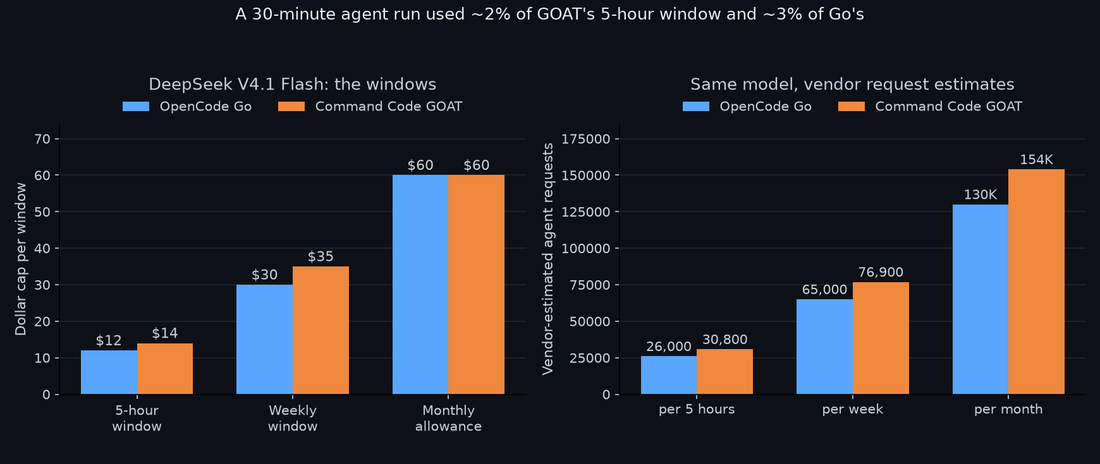
Same model, two plans: the dollar windows (left) and each vendor's own request estimates (right). Roughly 18% more headroom on GOAT, and I never used the last 97% of it. (chart: my own render, data from both vendors' docs, September 30, 2026)
So the two plans are basically the same?
For how I use them, yes — and the reason is worth knowing if you're choosing between them, because it's not really a plan-vs-plan decision. It's a model-vs-model decision. The allowance each plan hands you for the same model swings in both directions.
OpenCode Go is the better bucket for MiMo-V2.6-Flash and Muse Spark Contributor ($60 vs GOAT's $20), and for GLM-5.3-Flash ($60 vs $40). GOAT is the better bucket for DeepSeek V4 Flash ($60 vs $30), for GLM-5.2 ($70 vs $60), and it gives a bit more room to the fancy-but-expensive models like Grok 4.7 ($20 vs $15). My workhorse — DeepSeek V4.1 Flash — is a dead tie at $60 on both. That's why the month felt like using the same plan twice.
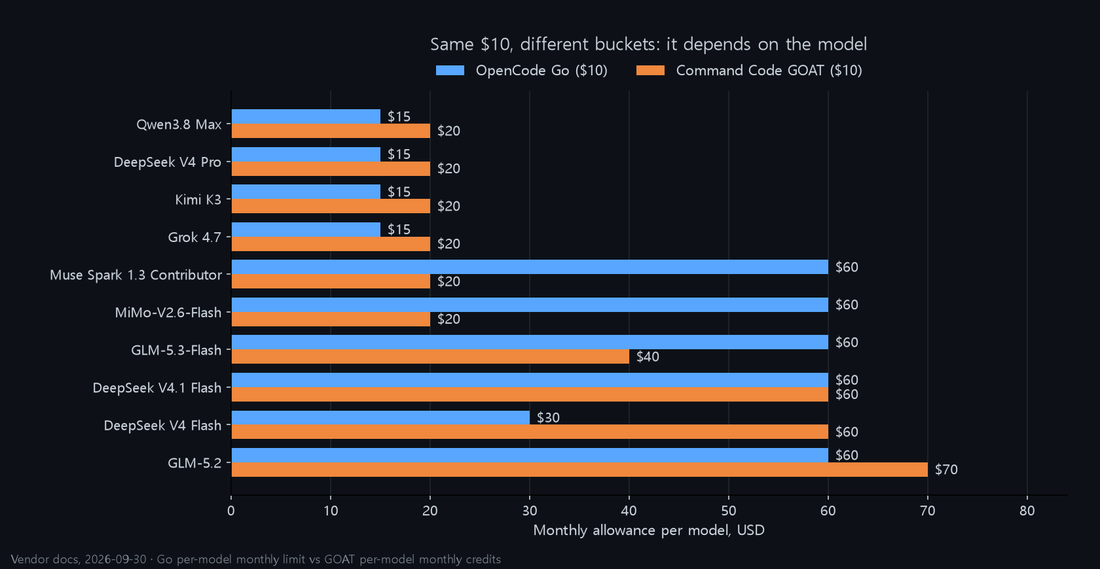
The real difference between the two $10 plans is per-model, not per-plan. Pick the plan by the model you live in. (chart: my own render, both vendors' docs, September 30, 2026)
What $10 doesn't buy
Frontier models. They're in the catalogs and they're borderline unusable as workhorses. Grok 4.7 gets $15 of monthly usage on Go — by OpenCode's own estimate, that's 845 requests per 5-hour window against DeepSeek V4.1 Flash's 26,000. On GOAT the numbers are kinder but the shape is the same: the expensive models are treats, not staples. And Claude isn't in either $10 tier at all — Opus lives on the pricier plans.
I did use the expensive models for spot checks, and the quality jump is real. But every time I did the mental math, one long agent session was eating a meaningful slice of a $15 allowance, and I went back to Flash. If your work is "a few hard questions a day," the frontier rows are fine. If it's agent sessions measured in hours, they're decoration — and that's true on the $40 tier too, where the same model prices meet bigger but still finite buckets.
Meanwhile, the $40 tier landed — and the reception is brutal
On September 28, OpenCode announced Go Plus: "Go Plus is here. $40/month, higher limits." The plan page sums up the pitch as "higher limits and fewer interruptions." The announcement post has been viewed over 630,000 times, and the replies are worth reading as an anthropology of subscription pricing, because the community did the math before the applause finished.
Here's what they found. Go Plus adds no models and changes no per-token prices — the only thing 4x the money buys is a bigger monthly allowance, and that allowance is not scaled by a uniform 4x. I counted the official tables myself: 28 model families, of which 5 get 2x the monthly limit, 6 get 3x, 16 get exactly 4x, and one — GLM-5.3 — gets 8x. A GitHub issue opened the next day put it flatly: per dollar, Go Plus is worse than Go for 11 of the 28 paid models. You also can't just stack four $10 plans, because OpenCode's own docs say only one member per workspace can subscribe.
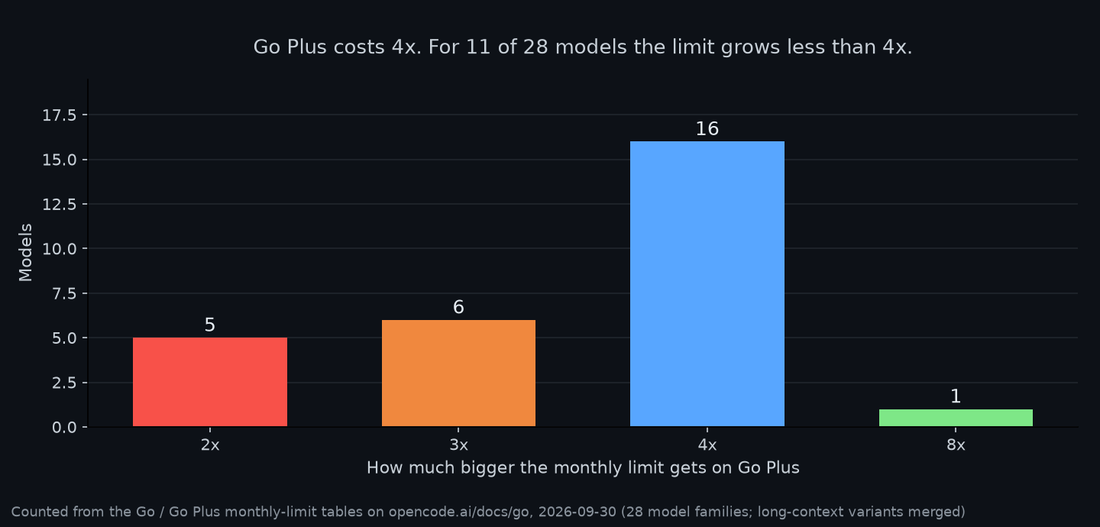
Go Plus costs 4x. For 11 of 28 models, the monthly limit grows by less than 4x. (chart: my own count of the Go / Go Plus tables on opencode.ai, September 30, 2026)
The thread under the announcement is a greatest-hits of exactly these complaints. "So it's 2x the limits for 4x the price. DOA." — "Why would you pay 4x when not all models give you 4x usage? Some only give 2x or 3x. Why not just pay for four separate subscriptions?" — "so all the good models are 2x only. What a fantastic deal..." And then the mood shifts from arithmetic to prophecy, which is what always happens to subscription pricing: "They will start gradually lowering the limits and/or degrading performance on the regular 10$ sub, in order to push the users to the more expensive 40$ sub."
That last one isn't pure vibes, by the way. The sub has already watched OpenCode move a Flash-series allowance mid-month back in September, which is the kind of thing people remember when a new tier shows up. Someone else clocked the official wording — "fewer interruptions" — and went off: "Why tf would I pay $40 for 'fewer interruptions'. How about NO interruptions?" And when one user asked whether Go Plus is even competitive with Command Code, the answer was one word: "Absolutely not."
The fairest comment in the thread might also be the least dramatic: "Still piss cheap for what you get but currently I'd rather go claude opus 5.5." Which, honestly, is my position too. If you're genuinely maxing out Go every single window, Go Plus is the only official upgrade path and the 4x-neutral models make it a wash. If you're anything like me — 2% to 3% of a window per session — it's a $30 surcharge on a problem you don't have yet.
My take
I'm staying on GOAT for October. Same ten-ish dollars, about 18% more headroom on the one model I live in, and a deeper bench for spot checks when I want to poke at Sol for an afternoon. The difference between the plans is small and real; the difference between my usage and the limits is enormous. I'd rather spend the decision budget elsewhere.

The mascot stays. A month in, GOAT's slightly bigger bucket on my main model is the tie-breaker. (image: Command Code)
Where I actually want to spend it: I'm tempted to add Anthropic this month. Opus 5.5 is the model everyone keeps telling me I should be using, and neither $10 plan carries it — that's the gap the two cheap plans keep pointing at. So October's report might be written from three subscriptions, which is starting to feel like the real answer to "$10 plan or $40 plan": one cheap plan for the workhorse, one frontier plan for the hard 10% of the work.
I'll report back at the end of October — worst case I'm out another $10 and I write one more of these. Cancel-anytime still isn't going to get me to do the math in advance.
Related on this blog: OpenCode Go vs Command Code GOAT: Both $10, But They're Not the Same Deal · DeepSeek V4.1 Flash: 748B Parameters, 8B Active, 70% Cheaper · MiMo V2.6 Pro: The Best Open Model, 45x Cheaper Than Opus 5 · Muse Spark 1.3: 88.8 on Terminal-Bench, at 1/6 of Opus 5's Price
Sources: opencode.ai/go and OpenCode Go docs · Command Code GOAT plan and pricing & limits docs · GitHub issue anomalyco/opencode#52026 (Go Plus multipliers) · r/opencodeCLI Go Plus thread (community quotes, attributed by platform) · OpenCode's September 28 announcement post on X. All plan numbers verified against both vendors' pages on September 30, 2026. Request estimates are vendor-published, and the two vendors assume slightly different token mixes, so cross-vendor request counts are approximate; the dollar windows are exact. The 2% and 3% burn figures are my own dashboard readings from a month of use, not instrumented measurements. I ran no benchmarks for this post.
Comments
Post a Comment