Qwen-Image-2.1: 10,000 Images for $24, License Not Included
Qwen-Image-2.1: 10,000 Images for $24, License Not Included
Twelve days ago I priced 10,000 images on the closed models and got $527 at high quality and $2,110 at max. Qwen's answer arrived yesterday: a 7B open-weights image model that, by the numbers I can actually check, does the same 10,000 images for somewhere between $10 and $24 in rented GPU time. It generates real transparency, it takes ten reference images, and ComfyUI, Diffusers, vLLM and SGLang all shipped support on day zero. On paper it is the best value in the whole Qwen image line, which is exactly what Qwen's own announcement says.
Then I read the license, and the value proposition changed shape. Qwen-Image-2.1 ships under the Qwen Research License Agreement — non-commercial, research and evaluation only. Every open Qwen image model before it, going back to August 2025, was Apache 2.0. This one is free to download and not free to use, and that single line matters more than any benchmark number below.
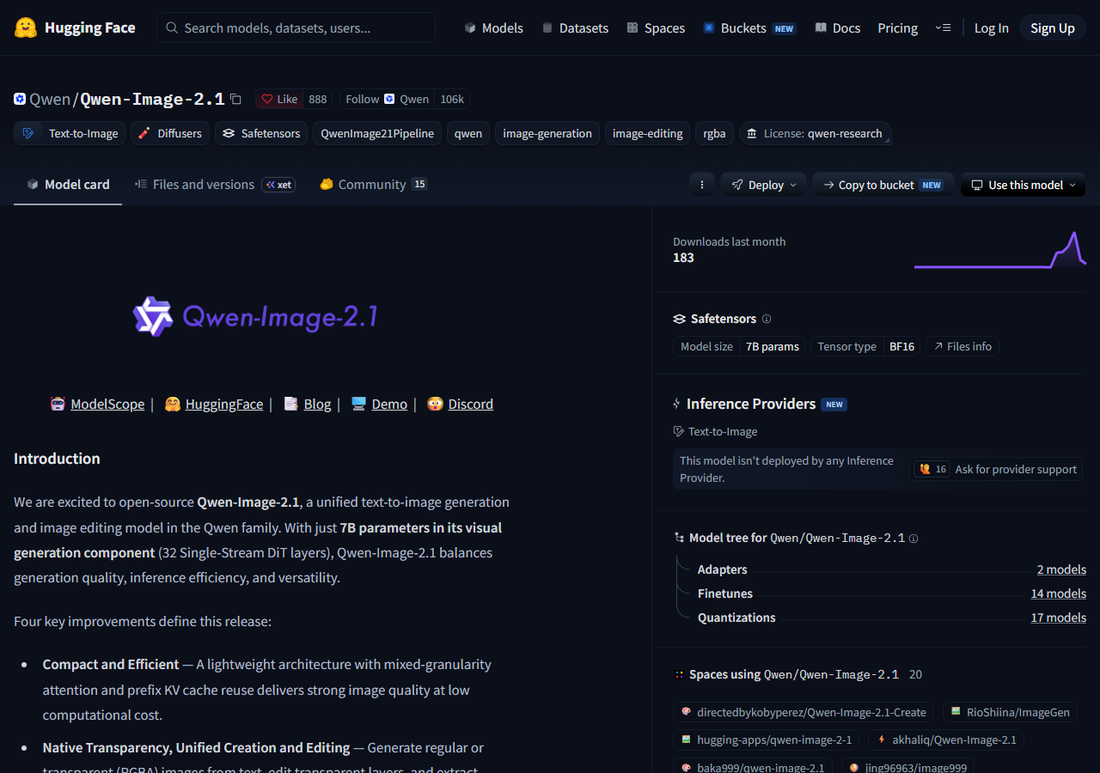
What Qwen actually shipped
This is the open-weights member of a family that went closed for a while. Qwen-Image shipped in August 2025, then a run of edit models, then Qwen-Image-2512 in December. The 2026 releases skipped the open path: Qwen-Image-3.0 shipped in July as a hosted model with no weights published, and the first open model since December is this one.
| Piece | What it is | Notes |
|---|---|---|
| Image transformer | 7B, 32-layer single-stream DiT | Block-causal attention, prefix KV cache reuse across steps |
| Text encoder | Qwen3-VL 8B | Reads the prompt and up to 10 reference images |
| VAE | 64-channel RGBA, 16x compression | The transparency comes from here |
| Output | 2K native, up to 2752x1536 | 40 denoising steps by default |
| Extras | Two prompt-rewriting models (Qwen3.5-VL 9B fine-tunes) | For expanding short prompts, shipped as separate checkpoints |
Two things about this release are genuinely new rather than marketing. The first is native RGBA: this model samples a real alpha channel instead of generating a flat image and hoping you cut it out later. I checked the official transparency samples myself — the ones I downloaded carry 33% to 53% fully transparent pixels and another 23% to 38% partially transparent, meaning the alpha is soft-edged, not a binary mask.

The second is the editing side. Up to 10 reference images in one request, local edits through circles or painted marks, and identity preservation for people and products. The sample that convinced me is a group photograph assembled from six separate portraits, and the one I keep coming back to is a generated academic figure — a full multi-panel paper diagram with axis labels and a caption, rendered as an image.
The 7B on the label is not the 33 GB in the box
Every write-up leads with 7B, and 7B is accurate for the transformer. It is not the model you download. I pulled the file listing and added it up: the text encoder alone is 17.5 GB, the 7B transformer is 14.2 GB, and the VAE adds 1.4 GB — 33.1 GB of bf16 weights before you generate anything. The encoder is literally larger than the part the headline is about, because it is an 8B vision-language model sitting in front of a 7B generator.
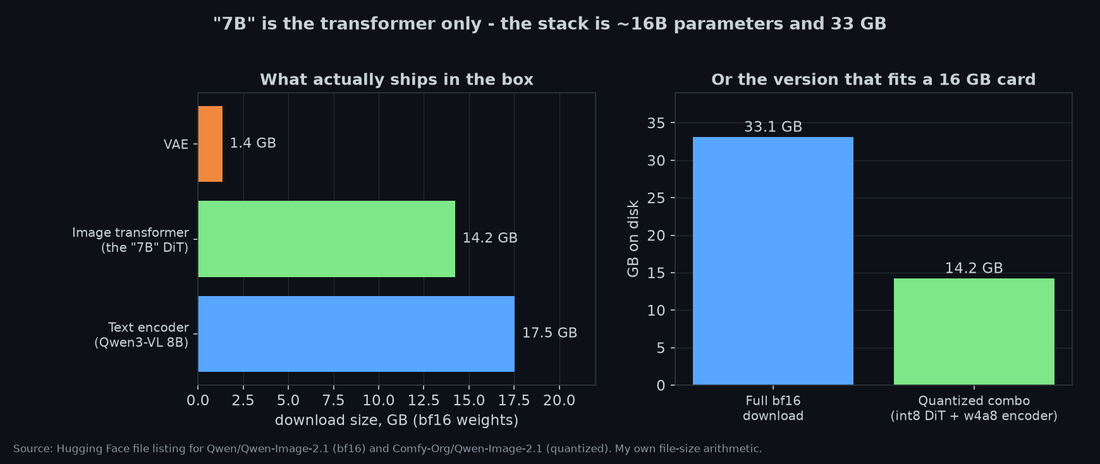
A user who measured it on a 16 GB card put it better than I can: "The '7B' is less than half the download. The text encoder is ~8.75B params — bigger than the 7B DiT." He also found the constraint that decides whether the standard offload trick works at all — at bf16 the encoder does not fit on the card by itself, so CPU offloading cannot place it; dropping the encoder to FP8 (~8.8 GB) is what makes the offload path usable.
Does it run on your card?
Mostly yes, with a resolution cliff. The 16 GB measurement again: 25 seconds for a 1024x1024 image at 20 steps, peaking at 13.9 of 15.9 GB. Ask for the 2048x2048 resolution the model advertises and the same card takes 146 seconds — the per-step cost goes from 1.23 seconds to 7.29. Native 2K is a feature you can turn on and a throughput you may not want.
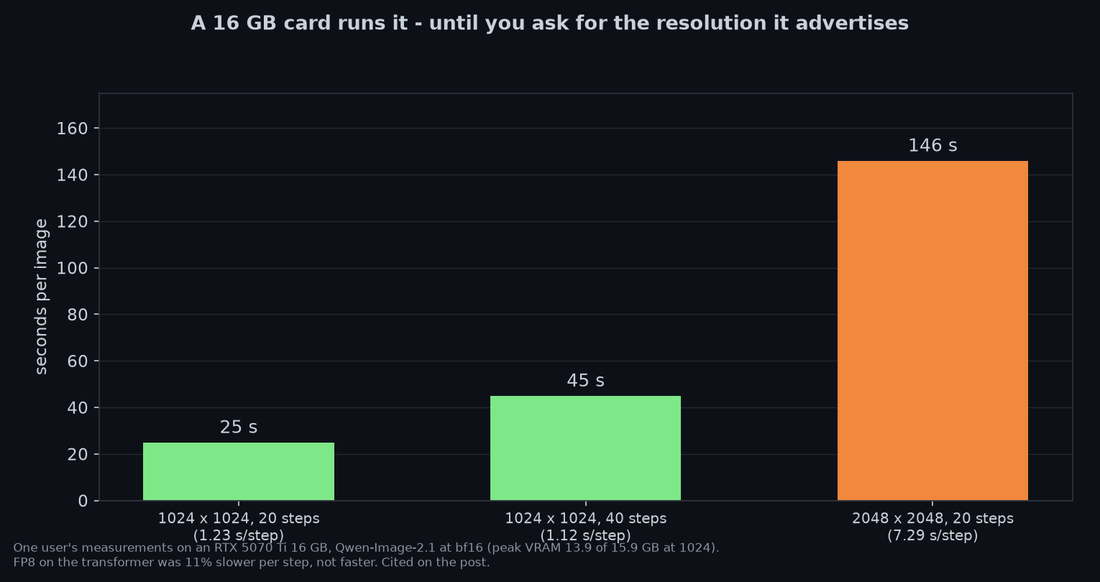
That FP8 result is the kind of thing I would have got wrong. Quantizing usually buys speed; here it buys 4 GB of headroom and pays for it in dequantisation on every matmul. If your card fits bf16, bf16 is the faster path.
Which is where I have to be honest about this desk: my 1080 Ti cannot play. Pascal has no bf16 support at all and the quantized minimum is 14 GB against 11 GB of VRAM, so the only honest thing I can report is other people's measurements plus my own file arithmetic. For anyone with a 16 GB card from the last two generations, this is the friendliest 7B-class image model yet; for a 12 GB card, expect to fight.
Ten thousand images for $24
Now the number I actually care about. Take the one measurement I trust — 25 seconds per 1024x1024 image at 20 steps — and price 10,000 images as rented GPU time. That is 69.4 GPU-hours. At the marketplace floor of $0.14 an hour it costs $9.72; at a mainstream provider rate of $0.34 it costs $23.61. The same 10,000 images through the API I priced in September were $527 at high quality and $2,107 at max.
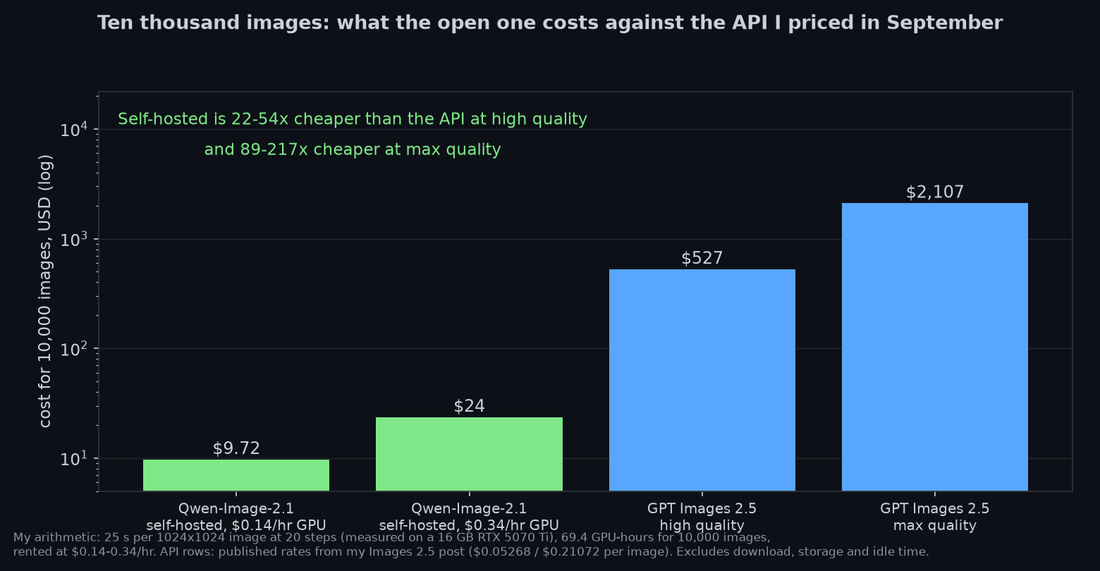
Two caveats keep this honest. The first is that the API's real advantage at low volume is friction rather than price: 200 images at these rates still cost about $10.50 on the API against $0.47 in GPU time, but the API does not ask you to download 33 GB and build a workflow first. The second is that there is no hosted Qwen-Image-2.1 you can just call. Qwen published weights, not a service. fal's catalogue carries the closed Qwen-Image-3 and the older 2512 model but not 2.1; the practical ways in are the official demo Space, a local ComfyUI install, or a cloud GPU you set up yourself. Anyone quoting a "Qwen-Image-2.1 API price" is quoting somebody's rented GPU.
The license is the catch
Here is the text, from the license file in the model repository: "You are granted a non-exclusive, worldwide, non-transferable and royalty-free limited license … FOR NON-COMMERCIAL PURPOSES ONLY." Commercial use needs a separate grant, requested by email. Their own definition of non-commercial is "for research or evaluation purposes only".
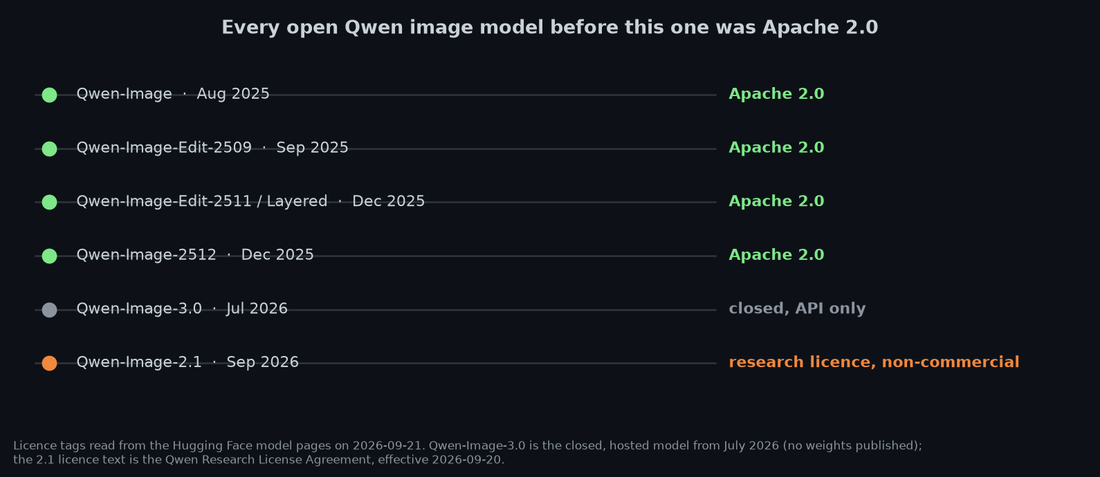
The Hacker News thread kept coming back to this across its 157 comments, and it is the part that decides what the model is for. One commenter's summary is the one I would keep: calling it open-weights is generous — "technically it would be more accurate to call it weights-available." Another reply in the same thread: "the last image models with Apache 2.0 license seem to be from 2025, recent Qwen models are 'non-commercial use'." That is not a small drift; it is the difference between a model you can build a product on and a model you can evaluate.
What it does not block: personal projects, evaluation, benchmarks, research, and anything you can honestly call not-commercial. Training a LoRA on it, generating assets for your own game or your own blog, testing whether it beats what you pay for — all inside the grant. Shipping it in a client deliverable or a paid product is where you need to talk to Qwen first. And no, the "just tune the weights a bit and call it a derivative" workaround that shows up in every license thread is exactly the kind of thing that gets answered by lawyers, not by engineers.
Does it beat the closed models?
Qwen's own launch chart puts this model at 60.28 on their in-house Qwen-Image-Bench, top of the open models and below four closed ones — GPT Image 2.5 Sunburst at 67.01, GPT Image 2 at 64.69, Grok Imagine 2.0 at 63.47, and Qwen's own closed Qwen-Image-3 Pro at 62.36. It is a vendor-built benchmark, on a launch banner, and I would treat the ordering as a claim rather than a result — but it is a vendor telling you, in its own graphic, that the free one is not the strongest one it makes.
The community complaints are worth listing, because they are specific. Prompt adherence is uneven — one user asked for 3D glass lettering in a named city and got broken 3D text on a white background; another reply in the thread suggests writing the prompt in Chinese, because the model follows Chinese instructions noticeably better. The VAE is finally fixed after holding back the line for two years, but still "produces artifacts … a slight dot pattern in midvalues", per a commenter who traced the latent format change (16 channels at 8x compression to 64 channels at 16x). None of these are dealbreakers at this price; all of them are the difference between a tool and a product.
My take
I am treating this as the best free-ish image model you can run locally right now, with a license that keeps it out of client work. Personal projects, transparent PNG assets for my own equipment, storyboards, testing what open models can do with text rendering — all fair game. Anything that ends up in a paid deliverable, not until I have a commercial grant in writing.
The thing I want to test next does not need new hardware: the int8 transformer plus the 4-bit encoder is about 14 GB, which is over my 11 GB but not by much, and the offload path is supposed to make it possible. If I can get a single 1024 image out of a 2017 card in a sane amount of time, that is a much more interesting post than another price table — and this time I will be measuring it myself rather than quoting someone else's 16 GB card. If the license moves, or a host starts offering 2.1 with commercial terms attached, that is the other post I owe you.
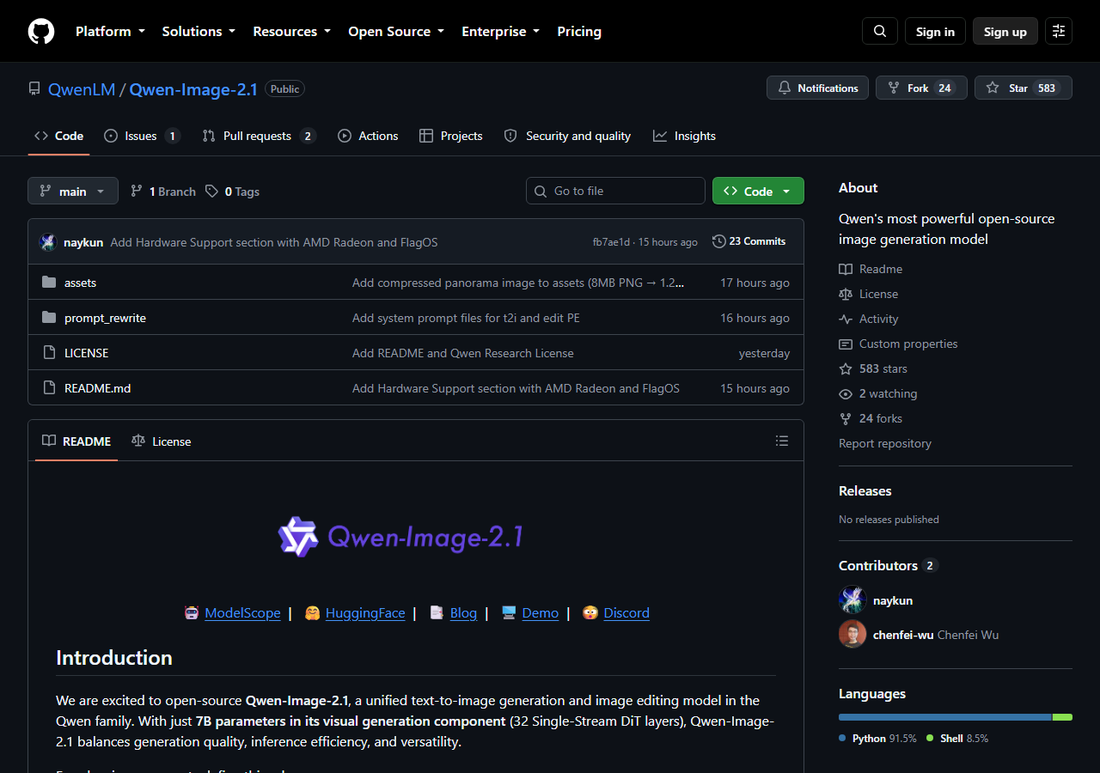
Sources and method: every figure labelled as mine in this post comes from work I did today, 2026-09-21 — the 33.1 GB weight breakdown is my sum of the Hugging Face file listing for Qwen/Qwen-Image-2.1, the alpha-channel percentages are pixel counts I ran on the three official transparency samples (53.1% / 32.8% / 41.8% fully transparent), and the cost chart is my arithmetic on the assumptions printed in its footnote. The generation times (25 s / 45 s / 146 s) are one user's measurements on an RTX 5070 Ti 16 GB, quoted verbatim from the launch-day thread; I did not run the model — my card is a GTX 1080 Ti, which has neither bf16 support nor the 14 GB of VRAM the quantized weights need. Model facts come from the model card, the GitHub repository (release note dated 2026-09-20, day-zero support list), the Qwen announcement on X (6,070 likes, 1.19M views), and the ComfyUI blog post that shipped with it; quantized sizes come from the Comfy-Org weights repository. The licence text is quoted from the Qwen Research License Agreement in the model repository, effective 2026-09-20; the family licence tags were read from each model's Hugging Face page the same day. GPU rental rates used in the cost chart ($0.14/hr marketplace floor, $0.34/hr branded provider) come from September 2026 pricing roundups and move constantly — check them before you budget. API rates in the comparison are the published OpenAI rates from my earlier post, Images 2.5: $527 vs $2,110 for 10,000 Images. Hacker News quotes are verbatim from thread 49775499 (2026-09-20), attributed by platform only. Earlier Qwen coverage on this blog: Qwen3.8-27B: 27B Dense, Vision Included, Apache-2.0.
Comments
Post a Comment