MiMo V2.6 Pro: The Best Open Model, 45x Cheaper Than Opus 5
MiMo V2.6 Pro: The Best Open Model, 45x Cheaper Than Opus 5

Xiaomi MiMo — the V2.6 series went up on Hugging Face under the MIT license. (image: Xiaomi)
Xiaomi published the receipt. Launch pages with big benchmark charts are normal; a lab telling you what the reinforcement-learning run behind the model actually cost, step by step, crashes included, is not. That is what landed today alongside MiMo-V2.6-Pro and Flash — and the number attached to the receipt is $3,474,715 for both runs, six days, 30 training steps each.
Here is the part that made me stop scrolling. MiMo-V2.6-Pro scores 46 on the Artificial Analysis Intelligence Index, which makes it the highest-ranked open-weights model on the board — one point ahead of GLM-5.3, two ahead of Kimi K3. On Artificial Analysis's own measurement it costs $0.13 to run one index task against it. Claude Opus 5, five points higher at 51, costs $5.86 per task on the same board. That is a 45x gap, measured by a third party, with the weights on Hugging Face under a license you can actually use.
It is not the best model in the world, and I will show you exactly where the seams are. What is genuinely new is the position on the cost curve — and the fact that the company also handed over the training log.
What actually shipped
Three downloadable checkpoints and a hosted speed tier, all released together on September 21–22:
| Model | Size (total / active) | Context | License | Price per 1M tokens (in / cached / out) |
|---|---|---|---|---|
| MiMo-V2.6-Pro MiMo-V2.6-Pro-RL | 1.02T / 42B | 1M | MIT | $0.435 / $0.0036 / $0.87 |
| MiMo-V2.6-Flash MiMo-V2.6-Flash-RL | 310B / 15B | 1M | MIT | $0.14 / $0.0028 / $0.28 |
| MiMo-V2.6-Pro-UltraSpeed | same 1.02T checkpoint | 1M | hosted tier | $4.35 / $0.036 / $8.70 |
| MiMo-V2.6-Distill-Qwen-9B | 9B (SFT of Qwen3.5-9B) | — | MIT | open weights, run it yourself |
Both flagships are sparse mixture-of-experts models — Pro activates 8 of 384 experts per token, Flash 8 of 256 — and both take text, image, video and audio in, emit text, and return reasoning traces. Prices are unchanged from the V2.5 generation; the same table on Xiaomi's platform has looked like this since summer.
That $0.87 output price is the number to keep in your head, because everything else in this post hangs off it: the model that leads the open-weights board costs less per million output tokens than Kimi K3 ($15), GLM-5.3 ($4.40) and Claude Opus 5 ($25).
The 46 is a measurement, not a press release
Almost every launch number in this category arrives from the vendor's own harness, and you learn to discount it. This one is different in a useful way. Artificial Analysis ran its own suite against MiMo-V2.6-Pro — ten evaluations covering reasoning, knowledge, math and coding — and the score it returned is 46. That is the same score Grok 4.7 got on the same board, except Grok's row still shows no speed or cost measurement while MiMo's is fully populated.
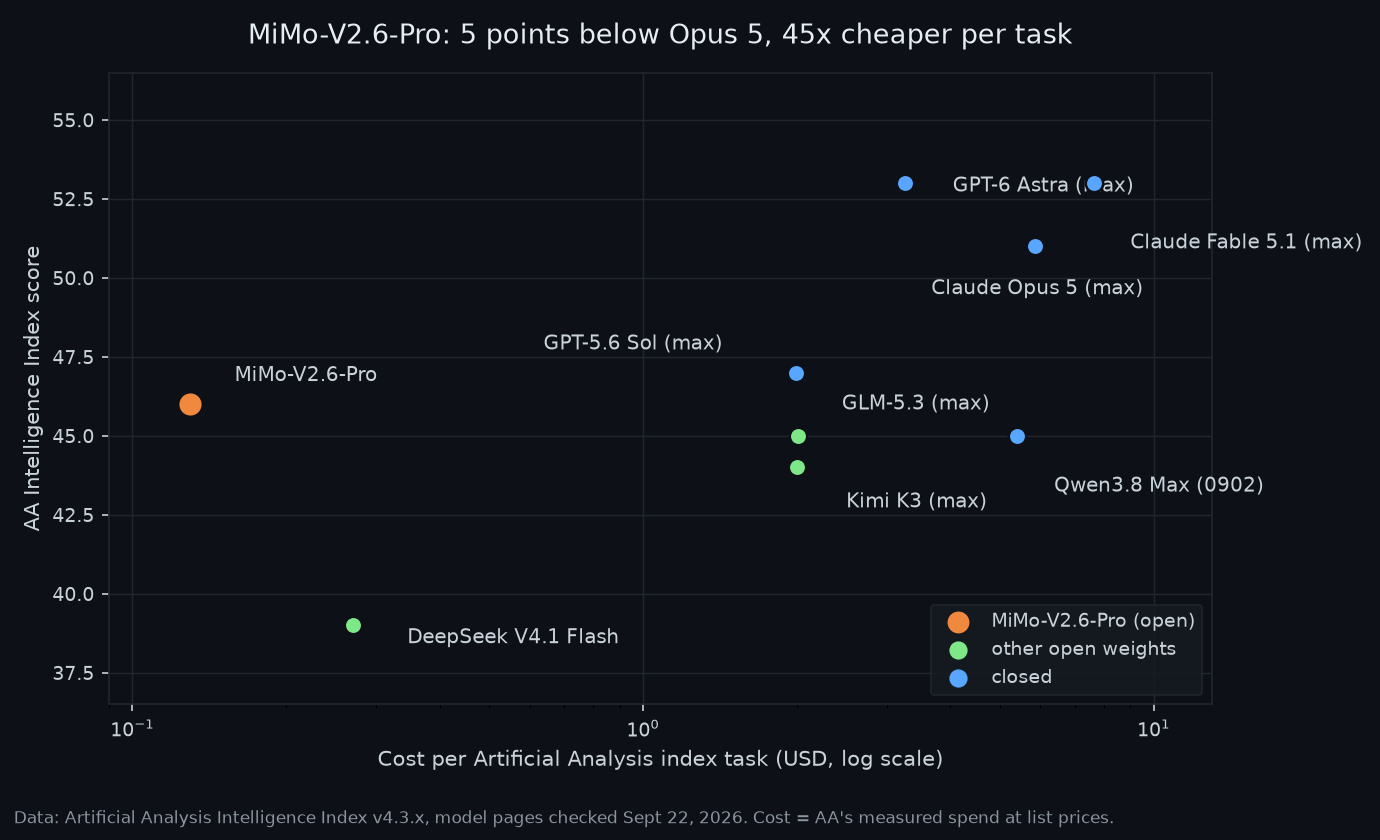
Intelligence against cost per index task, on Artificial Analysis's measured numbers. The interesting quadrant is the bottom-left one MiMo now owns: open weights, 46 points, $0.13 a task. (chart: mine, redrawn from Artificial Analysis, checked Sept 22, 2026)
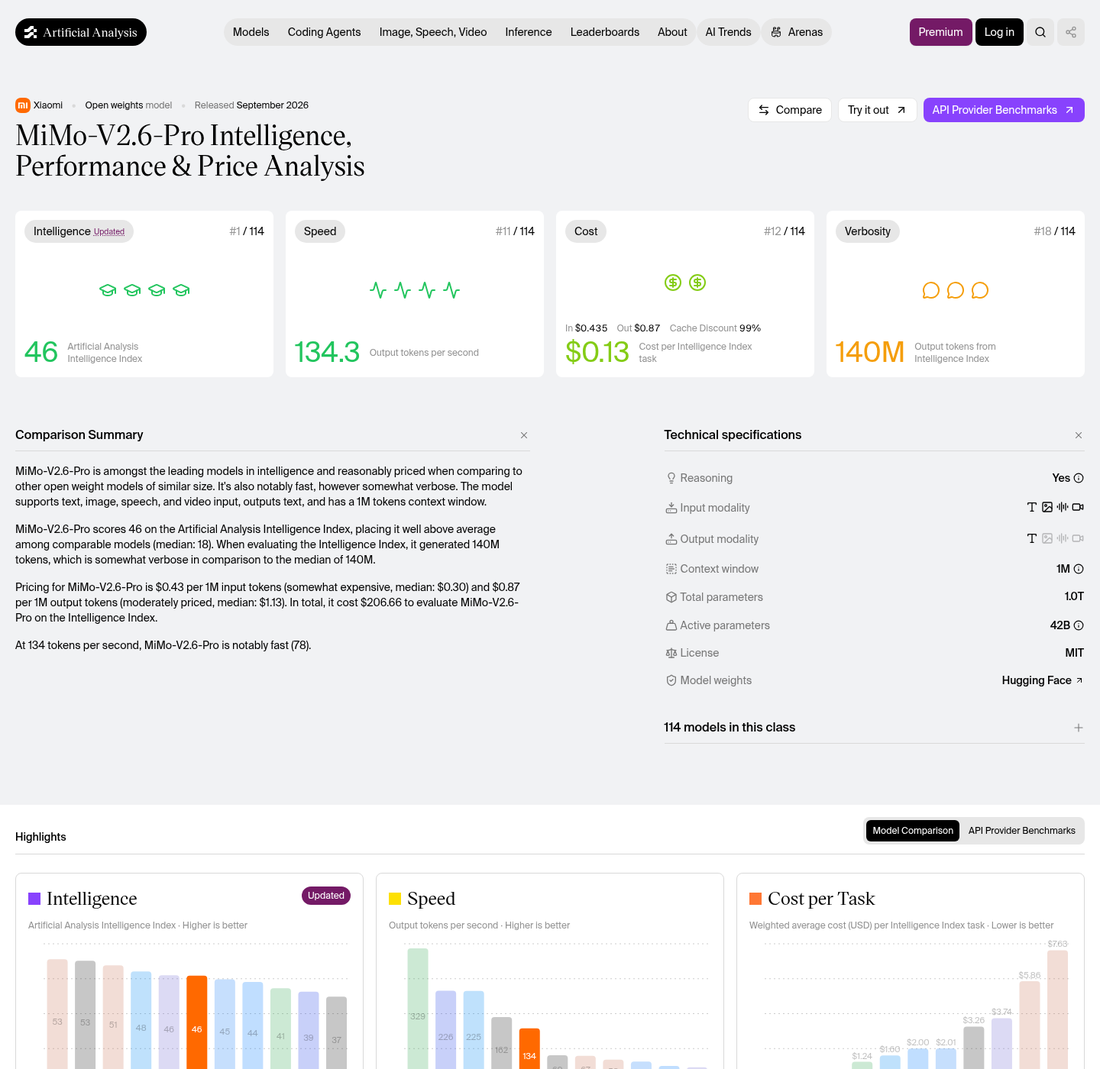
Artificial Analysis scores its own suite: 46 on the index, 134.3 output tokens per second, $0.13 per task, MIT license, 1.0T parameters. (screenshot: Artificial Analysis model page, Sept 22, 2026)
AA's operating numbers are the part I care about more than the composite. MiMo-V2.6-Pro served 134.3 output tokens per second — eleventh fastest of the 114 models on the board, against a 77.9 median for its size class — with 2.15 seconds to first token. Running the entire index on it cost $206.66. The same suite cost $7,274.74 on Claude Opus 5 at max effort and $13,128.86 on Claude Fable 5.1. One honest black mark in the same data: the model is verbose, burning 140M output tokens to get through the evaluation. Low per-token prices matter less when the model writes more of them.
Xiaomi's own table disagrees with Xiaomi's headline
The launch post says Pro performs "on par with Claude Opus 5 and GPT-5.6 Sol across most agent benchmarks." Xiaomi's own appendix table is where that claim gets its edges sanded off. Against Opus 5, on the fourteen evaluations both appear in, MiMo-V2.6-Pro leads three, ties one, and trails ten. Against GPT-5.6 Sol it leads eight of fourteen. Both of those can be true at once, and the second one is the real story of the release.
| Benchmark (vendor-run) | MiMo-V2.6-Pro | MiMo-V2.6-Flash | MiMo-V2.5-Pro | Claude Opus 5 | GPT-5.6 Sol |
|---|---|---|---|---|---|
| DeepSWE v1.1 | 71.9 | 67.9 | 19.0 | 74.0 | 73.0 |
| Terminal-Bench 4.0 | 34.9 | 28.8 | 1.5 | 49.0 | 39.9 |
| Terminal-Bench 2.1 | 89.9 | 87.6 | 65.2 | 89.1 | 88.8 |
| AutomationBench v1.0.6 | 53.1 | 52.3 | 16.0 | 50.3 | 45.8 |
| Toolathlon-verified | 76.9 | 73.6 | 49.1 | 80.6 | 74.9 |
| OSWorld-Verified | 82.0 | 80.8 | 61.5 | 83.4 | 83.0 |
| JobBench | 62.0 | 61.2 | 25.0 | 65.7 | 45.4 |
| CyberGym | 94.0 | 95.1 | 40.0 | — | — |
Xiaomi launch appendix (vendor-run harness, unreproduced). Dashes mean Xiaomi published no result. Note Terminal-Bench 2.1, a nearly saturated test where everything clusters at 84–90 — and Terminal-Bench 4.0, the harder version, where MiMo's 34.9 sits 14 points under Opus 5. Long-horizon agent work is still the frontier's home turf.
The open-model comparison is where the value case is strongest, with one honest caveat baked into the same table: on DeepSWE v1.1, DeepSeek V4.1 Flash actually beats MiMo-V2.6-Pro (74.2 vs 71.9) for $0.27 a task, and Kimi K3's OSWorld result (84.8) is higher than MiMo's 82.0. If your work is repository-level agent runs, test DeepSeek and MiMo side by side before you commit to either. Pro's margin over Kimi K3 is wide — it wins 15 of the 16 rows Xiaomi published for both — but "beats K3" and "beats every model you might actually use" are different sentences.
Six days of RL, with the doors open
Now the part that has Hacker News talking more than the score: Xiaomi streamed the post-training run live. For the better part of a week there was a public dashboard — loss curves, benchmark scores after every checkpoint, token counts, cost ticking upward — and it is still up, at mimo.xiaomi.com/rl, frozen at step 30.
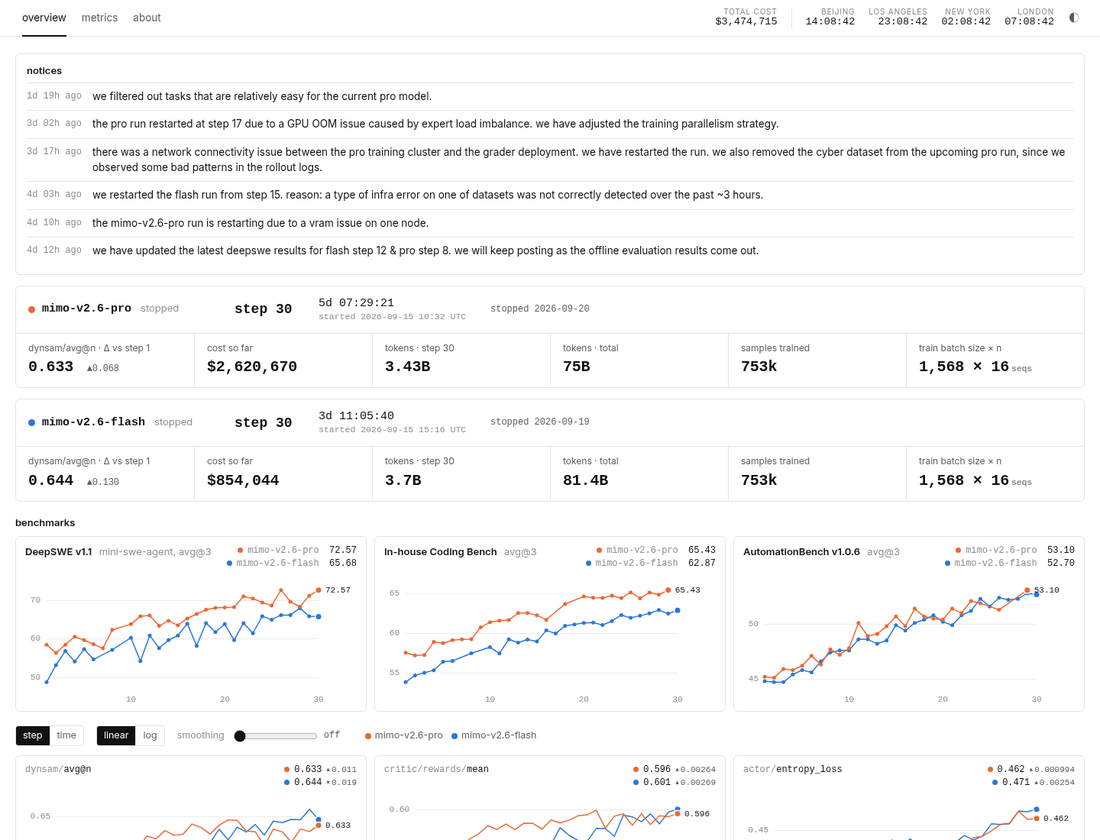
The live RL dashboard at the end of the run: $3,474,715 total, 753k samples per model, 30 steps, both runs stopped. The notices feed is the best part — it logs every restart and why. (screenshot: Xiaomi MiMo live RL dashboard, run ended Sept 20, 2026)
The scale, per Xiaomi's own numbers: 1,568 samples per update, training context up to 1M tokens, 3.5–3.7B tokens per step, roughly 750,000 trajectories per model. Pro burned $2,620,670 across five days and seven hours of wall clock; Flash burned $854,044 across three and a half days. Flash improved its pass rate 25% relative over the run, Pro 12%. To keep the run from drifting at that scale they froze the MoE router, and they built a reward-hacking defense layer — adversarial evaluation, anomaly detection, cross-checking between verifiers — because at 30 steps of this size, a reward exploit compounds.
And then the notices, which is the part no marketing team would have approved:
"the pro run restarted at step 17 due to a GPU OOM issue caused by expert load imbalance."— Xiaomi MiMo live RL dashboard, notices feed
"there was a network connectivity issue between the pro training cluster and the grader deployment. we have restarted the run. we also removed the cyber dataset from the upcoming pro run, since we observed some bad patterns in the rollout logs."— same feed. A cybersecurity training set was pulled mid-run because it was making the model worse at coding.
The community noticed. On Hacker News (690 points, 300+ comments), the thread's top-voted observation is not about benchmarks at all:
"I really like how transparent they've been about the training of this model. The realtime dashboard they shared during training … was an incredible learning and teaching tool for me, and they've been unusually comprehensive in sharing details about their methodology … and benchmark scores (even the stuff they didn't do well on)."— rao-v, on Hacker News
"The best thing they did is being open about all the setbacks they had to deal with. They logged every restart with a reason, talked about dropping a cyber dataset after it degraded coding benchmarks."— tancop, on Hacker News
Alongside the checkpoints, Xiaomi open-sourced the RL environments (7,000+ tasks across software engineering, vulnerability reproduction, knowledge work and web design), the training framework built on verl and mini-swe-agent, and a 44-page technical report. That is the part of "open" that usually stays closed even when the weights ship, and it is why people are treating this release differently. A skeptic on the same thread put the counterweight well — "the chinese labs are getting good at advertising model releases. The moat is thin" — which is fair, and the two things are both true: this is excellent disclosure of a run that is still a vendor-run benchmark.
What the six days actually bought
Xiaomi measured its own progress on DeepSWE v1.1, a long-horizon software engineering benchmark, with the same harness before and after the RL run: Pro went 58.4 → 72.57, Flash 48.8 → 65.68.
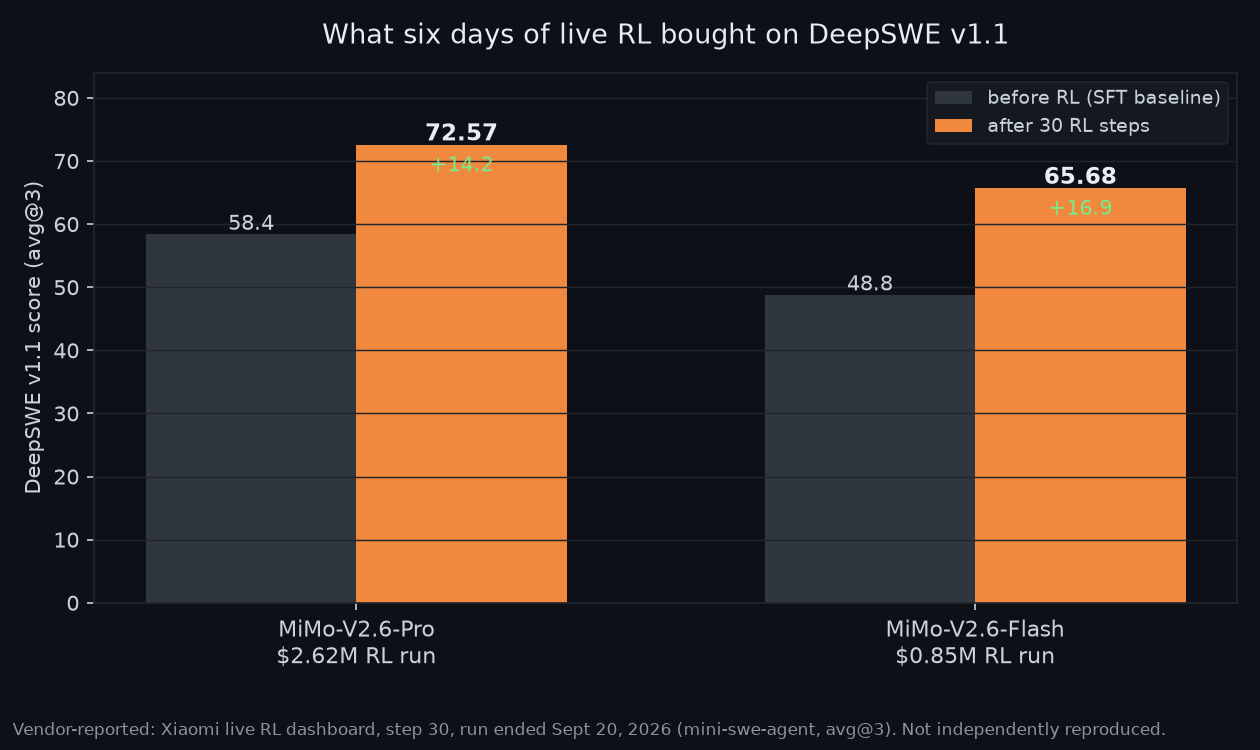
Vendor-reported gains from the live run: +14.2 points for Pro, +16.9 for Flash, on a held-out benchmark. Not independently reproduced — the RL environments shipped with the models, so reproduction is at least possible now. (chart: mine, from Xiaomi's dashboard and launch-page figures)
The more interesting artifact to me is the 9B model. MiMo-V2.6-Distill-Qwen-9B is a supervised fine-tune of Qwen3.5-9B on MiMo-generated data, published specifically as the starting point for this RL recipe — and Xiaomi ran the recipe on it publicly as proof. On Terminal-Bench 2.1 it goes 27.0 (base) → 37.1 (SFT) → 52.8 (after RL). MiMo Cyber Bench: 5.7 → 31.3 → 47.0. Swe-bench Verified: 60.0 → 61.1 → 66.2. All eleven benchmarks improved. That is a 9B model you can run locally, with a published, reproducibly-trained recipe, gaining 15 points on a terminal benchmark from an RL stage you can inspect. If you self-host anything this year, that is the file to watch.
None of the numbers in this section are independent. They are Xiaomi's harness, Xiaomi's grader, and while the 46 on Artificial Analysis is a third party's measurement, the 72.57 on DeepSWE is not. It has not been submitted to a public leaderboard and nobody has reproduced it yet. The environments are out now, which means someone will — and the result will be more interesting than the claim.
Beyond code: robots, materials, music
The capability demos are worth a minute because they tell you what Xiaomi thinks this model is for. The launch film spends its opening minutes inside a DAW — an eight-track session with the model's arrangement mapped out bar by bar — which is the most human-verifiable demo in the whole release: you either like the music or you don't, and no harness can grade that for you.
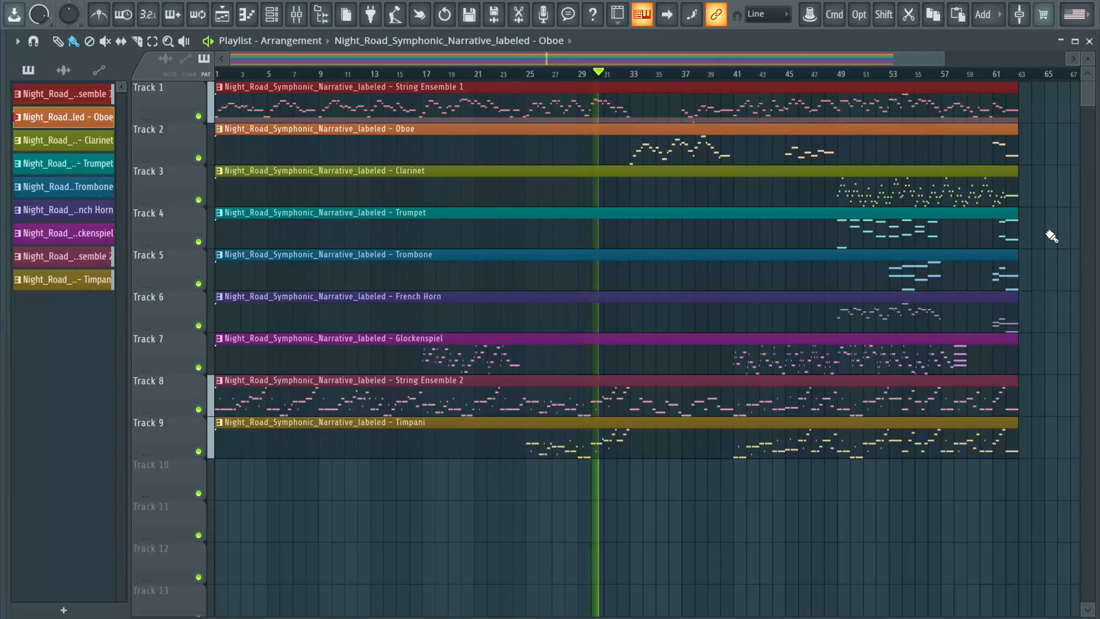
The launch film's music segment: an eight-track arrangement. Xiaomi's demo case has the model composing an orchestral piece and exporting it as MIDI. (frame: Xiaomi MiMo-V2.6 launch film)
The research demos are the more unusual claim. Xiaomi's materials team had V2.6-Pro screen metal-organic framework candidates for capturing PFAS "forever chemicals" — literature and patent retrieval, hypothesis generation, then automated simulation to rank binding strength before anything gets tested in a lab. Separately, the model helped formalize the main theorem of the classic Period Three Implies Chaos paper in Lean 4, producing over 6,000 lines of kernel-verified proof with no unproven placeholders. Neither task had specialized post-training. Both are the kind of thing I would normally expect to see with a human researcher doing the driving — and the honest reading is that they did: this is assistive work in a loop with domain experts, not an autonomous discoverer.
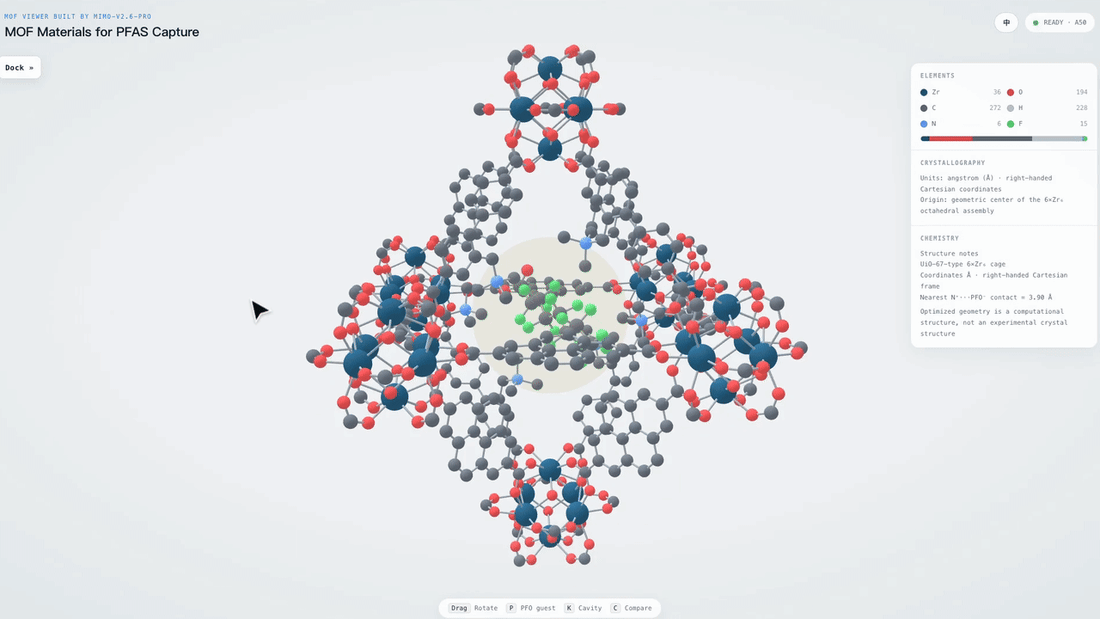
The PFAS capture demo: a metal-organic framework structure with the candidate adsorption site highlighted, and the crystallography panel the model was working against. (image: Xiaomi MiMo-V2.6 release demo)
The price list hasn't moved, and that is the whole point
Xiaomi kept the V2.5 prices exactly. Same rate card as the previous generation, unchanged since summer — the new checkpoints simply took the old slots on the price page.
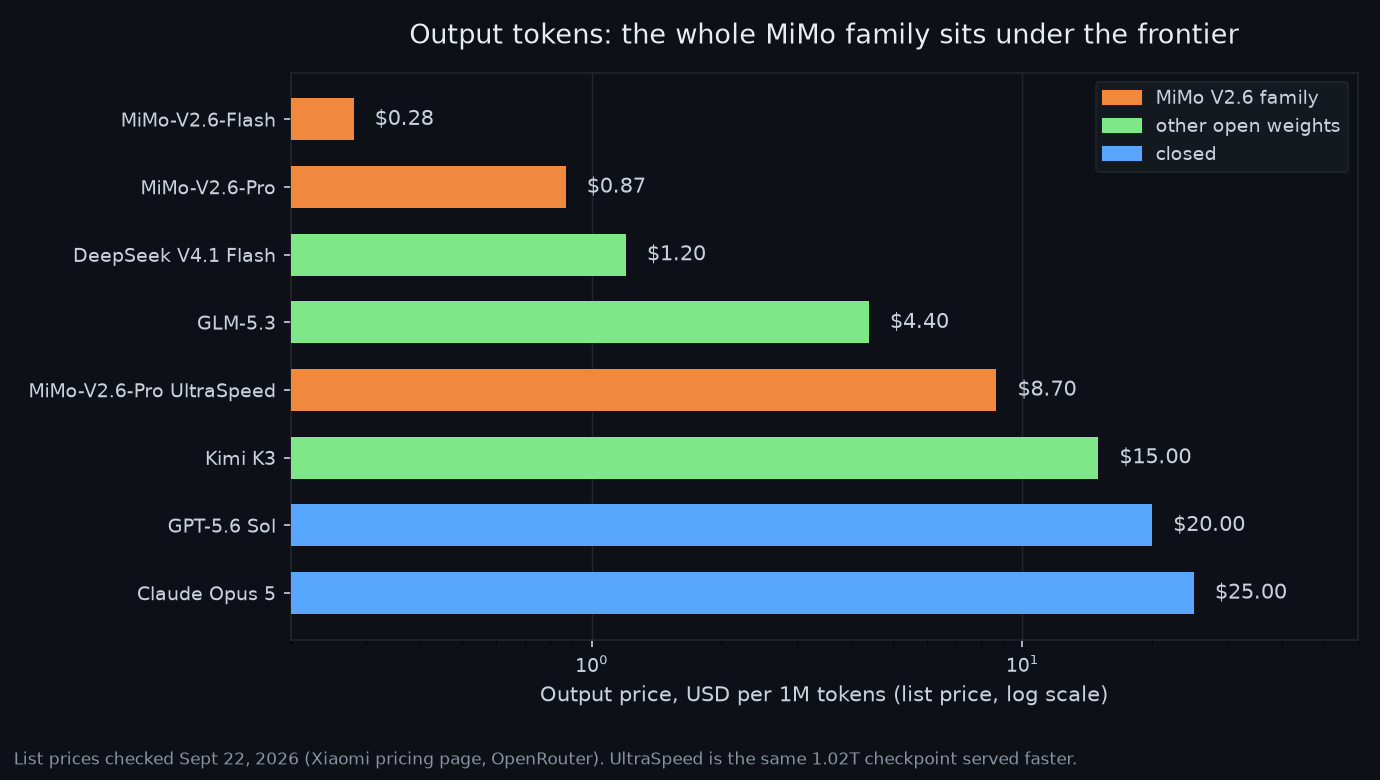
Output-token list prices, log scale. The entire MiMo family — including the premium UltraSpeed tier — sits under Claude Opus 5 and GPT-5.6 Sol. Pro is a fifth of GLM-5.3's output price, and both are open weights. (chart: mine, prices checked Sept 22, 2026)
The one genuinely new commercial thing is UltraSpeed: the same 1.02T checkpoint, served faster, at ten times the standard rate. Xiaomi's material claims "up to 20x" the output speed of the standard tier; third-party listings describing the same model say roughly 10x; nobody has published latency distributions that reconcile the two. Do the arithmetic honestly and you see what the tier really sells: at 10x price for 10x speed, you pay ten times more per token to finish in a tenth of the time. Nothing about the weights changes. For batch work that trade is bad; for an interactive agent loop where each turn gates the next, wall-clock time is the product and the price is defensible. Just measure the multiplier yourself before you pay for it.
Two things worth knowing before you try it: MiMo-V2.6-Flash is currently free on OpenCode's Zen tier (model id mimo-v2.6-flash-free) and on AIHubMix, so the cheap model costs nothing to evaluate. Which, if you followed the Ox Alpha mystery on this blog, is a nice parallel — the last nobody-will-claim-it free model on OpenCode turned out to be GLM-5.3-Flash. This time the name is on the tin.
So, can it replace Opus 5?
For routine agent work, on price, yes — and that is the boring, correct answer for a model at $0.13 a task. The splits that matter are narrower than the headline:
- High-volume agents, document pipelines, coding assistants: MiMo-V2.6-Pro is the obvious thing to test this week. Nothing else scoring 46 or above is anywhere near $0.13 a task.
- Long unattended terminal and repo work: keep a frontier model as the baseline. Even Xiaomi's own table shows a 14-point gap to Opus 5 on Terminal-Bench 4.0, and the 22-point ExploitBench gap says the security-testing ceiling is still theirs.
- Anything latency-critical: the free Flash tier at 128k max output and a 1M context is an honest starting point; UltraSpeed is a decision you make after you measure.
- Production routing: AA counted a single API provider for MiMo-V2.6-Pro at the time of writing. One route means no failover, and that is an availability risk, not a quality one.
Self-hosting is a datacenter exercise: 1.02T parameters means roughly a terabyte of memory at 8-bit precision before you allocate KV cache for a 1M-token context. The MIT license makes that legal; the hardware makes it a different budget conversation. The 9B distill is the realistic local option.
My take
The thing I keep coming back to is not the 46. It is that a lab let the internet watch its training run for six days, published the crashes and the cost, and then shipped the environments so the run can be attacked by anyone with the compute to try. That changes what a launch claim means: when your training log is already public, the benchmarks get read differently.
None of this ends the frontier gap. Five points on a composite, and fourteen on the terminal benchmark, is not a rounding error — it is the difference between a model you hand a refactor to and one you supervise. What Xiaomi proved this week is narrower and more useful: an open-weights model in the same conversation as the frontier, at a twentieth of the per-task cost, with the training recipe attached.
I am going to run my own tasks through the free Flash tier on OpenCode Zen this week and report what actually breaks. If a second provider route shows up on Artificial Analysis, or someone reproduces the DeepSWE numbers, I will update this post — the environments are public now, so that is a race I can actually watch instead of waiting on a press release.
Sources: Xiaomi MiMo-V2.6 launch page and release notes (mimo.xiaomi.com/mimo-v2-6, dated Sept 22, 2026) · Hugging Face collection (MIT-licensed Pro-RL / Flash-RL / Distill-Qwen-9B, plus the 44-page technical report) · Artificial Analysis model page and rival model pages, checked Sept 22, 2026 · OpenRouter for provider pricing · Xiaomi's official pricing table · Hacker News discussion (Sept 21–22) · GeekNews. Everything vendor-reported is labeled as such; the two data charts are mine, redrawn from the sources named in their captions. I have not run MiMo-V2.6-Pro myself — that is the follow-up.
Earlier on this blog: Grok 4.7 — Terminal-Bench 20% → 38%, same $2/$6 price · Ox Alpha is free on OpenCode — is it MiMo or GLM? · Xiaomi AI Cube — 120B local models at 4.5× DGX Spark's bandwidth
Comments
Post a Comment