Xiaomi AI Cube: 120B Local Models at 4.5× DGX Spark's Bandwidth
Xiaomi AI Cube: 120B Local Models at 4.5× DGX Spark's Bandwidth
Xiaomi showed a desktop box on August 24 that pulls 1.22 TB/s of memory bandwidth out of 150 watts. That's roughly 4.5× the DGX Spark's figure, it holds up to 160 GB of unified memory, and it runs a 120-billion-parameter model locally. Then I found the catch nobody led with — and it's a big one.
Let me be direct about where I land, because I ran this product idea against what I actually do all day. The AI Cube is a serious piece of silicon engineering. Whether it's serious for you depends entirely on the words "local AI machine," and the gap between those two things is the whole story.
Three custom chips in one box
The AI Cube isn't a Mac mini with a big NPU bolted in. Xiaomi wired three of its own chips together to make the point that it now controls the whole AI stack — the phone SoC, a high-bandwidth model accelerator, and an automotive chip all working on the same workload.
| Chip | Role | Specs that matter | Status |
|---|---|---|---|
| XRING O3 | General-purpose SoC | 10-core all-big-core CPU, 16-core G2-Ultra NX GPU, 200 TOPS NPU, first LPDDR6 support | Ships this fall in the 18 Fold |
| XRING O100 | High-bandwidth AI accelerator | 6nm 3D wafer-on-wafer stacking, 28,672 data lines, 1.22 TB/s near-memory bandwidth, ~330 tok/s with Xiaomi MiMo | Commercial 2027 |
| XRING D100 | Automotive AI chip | 3nm, 20-core CPU, 16-core NPU, up to 160 GB unified memory, 200B-parameter models | Commercial 2027 |
The three XRING chips inside the AI Cube, vendor-reported specs from Xiaomi's August 24 presentation.
The O100 is the interesting one. Xiaomi stacks three wafer layers — two high-speed AI DRAM wafers on top of a compute wafer — and bonds them vertically with 1.4µm hybrid bonding. The data paths go straight up instead of out to a memory channel, which is how it reaches 1.22 TB/s where a flagship phone's LPDDR5X manages maybe a sixteenth of that.
What it actually looks like
It's a small tower in aerospace-grade aluminum, machined with 33,874 CNC-drilled holes because that case keeps 150 W of sustained work cool while it looks like a pebble-grey slab of Swiss cheese. Xiaomi frames it as a DGX Spark-shaped thing for the desk, but the box actually looks more like a compact NAS than a GPU workstation.
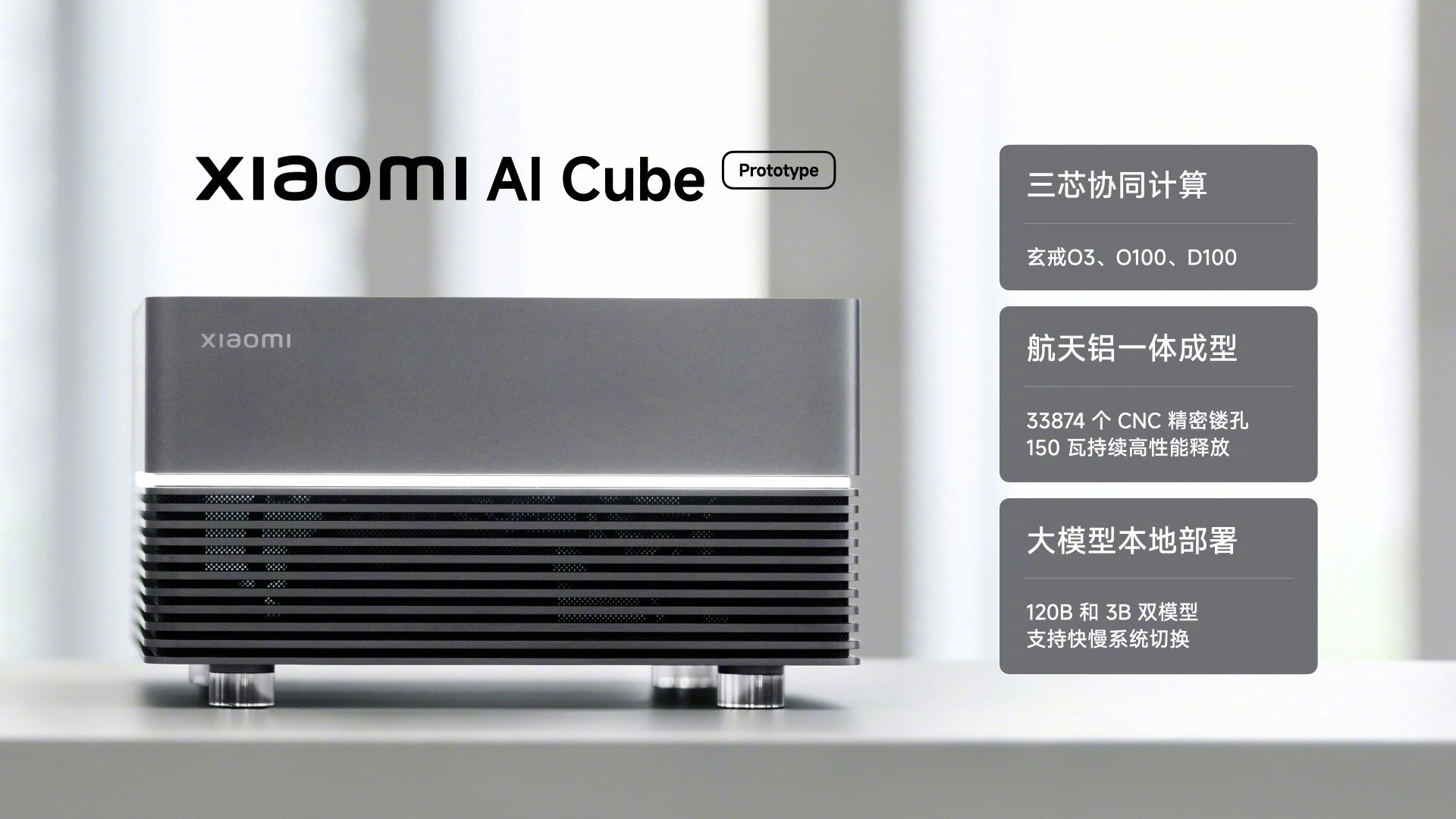
The AI Cube prototype. Aerospace-grade aluminum, 33,874 CNC precision holes, 150 W sustained (image: Xiaomi / Lei Jun).
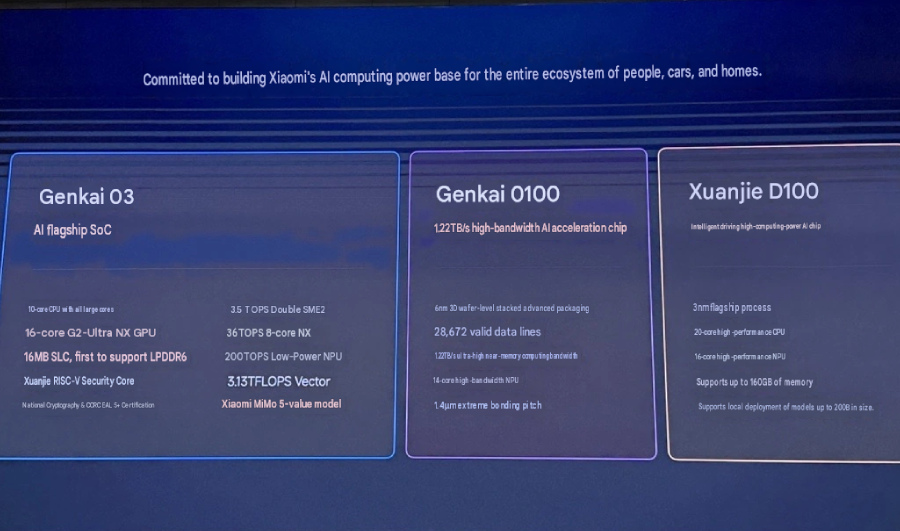
The pitch, on one slide: O3 for phones, O100 for model inference, D100 for driving — all competing for the same package (image: Xiaomi, presentation slide).
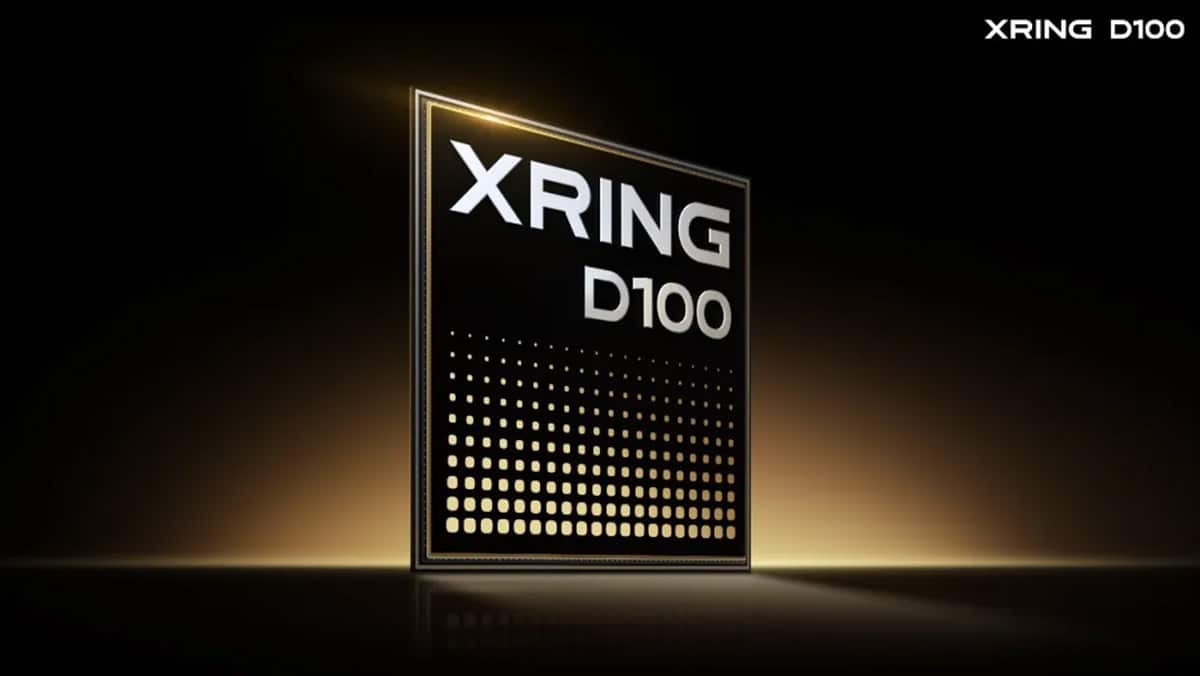
The D100, Xiaomi's first 3nm in-house driving chip, shown as a render on stage (image: Xiaomi).
Why bandwidth is the whole argument
For a local LLM, the number that decides how fast text comes out isn't TOPS — it's memory bandwidth. Every token a model generates means re-reading the model weights from memory. A 120B model at 4-bit quantization is roughly 60 GB of weights, and the faster you can feed them to the compute, the faster tokens land. Xiaomi ate the cost of the pipeline at the physical layer instead of just clocking the NPU.
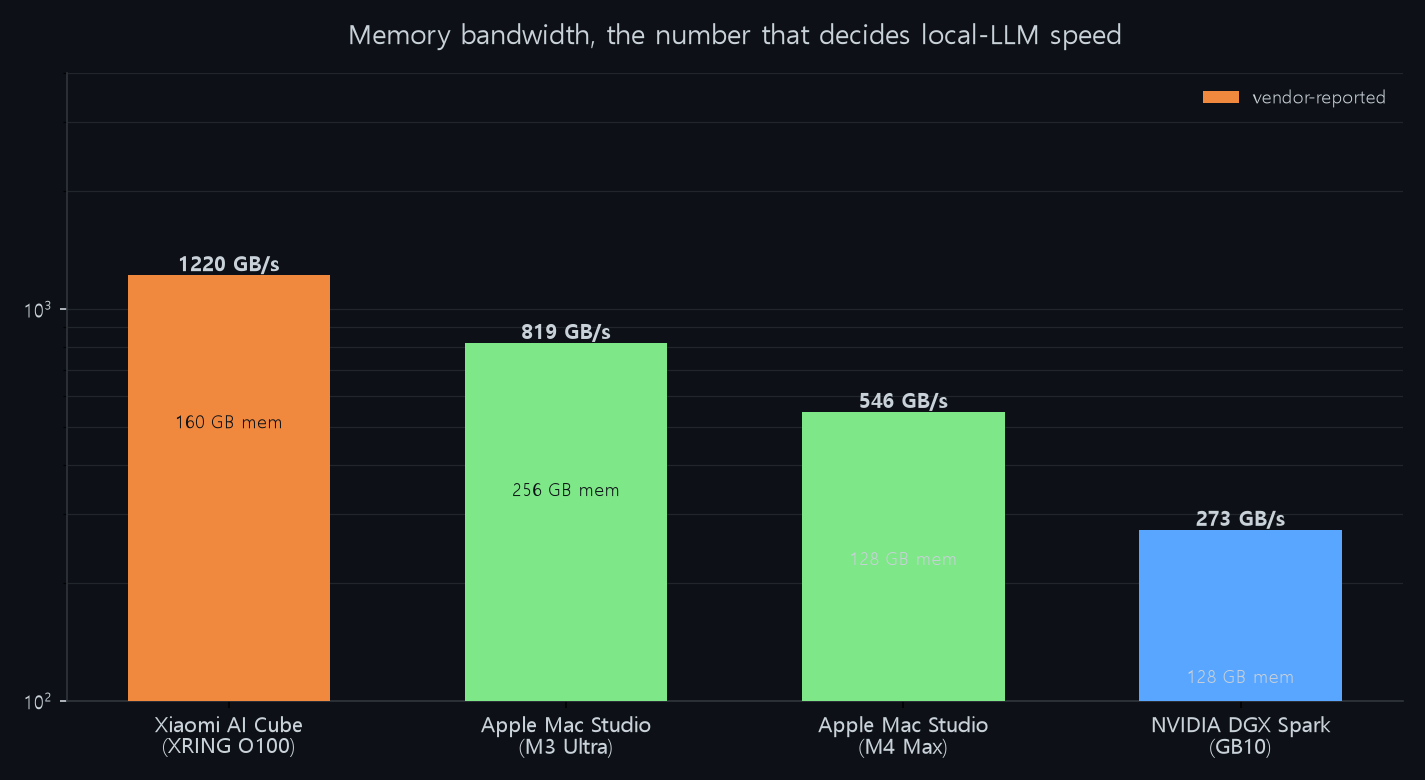
Memory bandwidth, the number that decides local-LLM speed. The AI Cube's figure is vendor-reported; DGX Spark and Mac Studio values are official (chart by the author).
The result is a local box Xiaomi says runs a 120B + 3B model pair, switching between them based on the task — the small model for millisecond everyday commands, the big one for deep reasoning. That dual-model fast/slow scheme is the same idea the big AI labs run in the datacenter, just on your desk at 150 W.
Now the catch
Here's what the launch coverage glossed over. The number everyone quotes — 330 tokens per second — is a Xiaomi-lab number on Xiaomi's own optimized runtime running Xiaomi's MiMo models. That's a closed stack. The AI Cube has no CUDA, there's no XRING backend in llama.cpp, and the NPU's fast path is only reachable through Xiaomi's walled garden.
What does that mean in practice? If you want to load a random GGUF of the model you actually like, or run vLLM, or fine-tune, you're not going to get that 1.22 TB/s magic — you're offloading to whoever wrote a runtime for this chip, and right now that's Xiaomi. The hardware headline is real, but the software is the piece that makes or breaks a "local AI machine."
This is precisely where DGX Spark keeps an edge that the spec sheet doesn't show. NVIDIA's box has its own limits, but at least it speaks CUDA and the whole open-ecosystem stack shows up. Xiaomi built a faster memory pipe, then built the fence around it.
My take
I want this hardware to be what it sounds like. A 150-watt desktop that runs a 120-billion-parameter model with near-datacenter bandwidth would be the most interesting local box of the year, at a price Xiaomi has historically used to undercut everyone. But the honest read is that the AI Cube as announced is a local LLM appliance, not a local AI machine — it's great if you want to chat with 120B on your desk and don't care how, and nearly worthless if you live in the open ecosystem. There's no price, no release date, and the two chips that power it aren't commercial until 2027. I'll rewrite this the day Xiaomi opens the runtime or ships a retail unit with a real number on it. Until then, admire the engineering — the bandwidth is legit — and hold your wallet.
Related on this blog: Apple's M5 Ultra Mac Studio: A Real Local AI Machine, at Last · FreeToken Wants to Put Frontier MoE Models on Your Edge Machine
Sources: Xiaomi (Lei Jun, Aug 24 2026), VideoCardz, CnEVPost, IT之家, 36Kr/爱范儿. All performance figures are vendor-reported until independently verified. The memory-bandwidth chart draws on official figures for DGX Spark (273 GB/s, GB10) and Apple Mac Studio (M3 Ultra 819 GB/s, M4 Max 546 GB/s).
Comments
Post a Comment