DeepSeek V4.1 Flash: 748B Parameters, 8B Active, 70% Cheaper
DeepSeek V4.1 Flash: 748B Parameters, 8B Active, 70% Cheaper
A couple of days ago I wrote a post about a model whose own name was a deadline. deepseek-v4.1-flash-expires-on-0910 — DeepSeek had dropped an intermediate build into the live API and given it two days to live. That post ended with a promise: if the official numbers held up, I would follow the release the same week.
It landed on September 10, on schedule, and it came with something I did not expect in the same announcement: DeepSeek is switching off V4-Pro. The flagship model is being retired in an orderly manner, in DeepSeek's own words, and from September 14 every request aimed at deepseek-v4-pro gets routed to the cheap Flash model instead. That arrangement stays in place until V4.1-Pro shows up.
The company that spent August raising its prices just cut them, and the model it is cutting them for is the one it is now using to replace its own flagship.
So what actually shipped? A 552B-parameter multimodal mixture-of-experts with a 1M-token context window, MIT-licensed weights, a 51-page technical report, and a new rate card. It beats V4-Flash and V4-Pro on the agentic benchmarks all three share, it reads images natively without a separate vision build, and it is billed at 70% to 86% below what V4-Pro cost for the same tokens. It also loses to Opus 5 on the newest agentic tests, and no independent lab has scored it yet. All the numbers below are DeepSeek's own unless I say otherwise.

What actually shipped on September 10
The mechanics matter as much as the model, because DeepSeek made this a migration rather than a launch. Three things changed on Wednesday.
First, the model name. The model to call is now deepseek-flash. The old names deepseek-v4-flash and deepseek-v4-flash-vision-exp still work, but they are aliases — the models behind them are retired and the requests get served by V4.1-Flash at Flash prices. That is the cleanest way to retire two models without breaking anyone's code, and it is also a small warning shot: V4-Flash, the workhorse a lot of people built on this summer, is simply gone.
Second, the weights. The Hugging Face repository went up the same morning with 48 safetensors shards, an FP8 quantization config, an MIT license and the technical report. 510 GB of files, fully open download, no gate. There is also a prompt-encoding library and a DeepSWE reproduction folder, which is a level of "here is how to check us" that most launches skip.
Third, the prices. The new Flash rate card took effect at 04:00 UTC on September 10, and the Pro routing kicks in at 04:00 UTC on September 14.
| Spec | V4-Flash (July) | V4-Pro (August) | V4.1-Flash (now) |
|---|---|---|---|
| Total parameters | 284B | 1.6T | 552B + 196B Engram |
| Active per token | 13B | 49B | 8B prefill / 16B decode |
| Context / max output | 1M / 384K | 1M / 384K | 1M / 384K |
| Vision | separate bolt-on build | no | native, in the base model |
| Concurrency limit | 2,500 | 500 | 2,500 |
| License | MIT | preview weights only | MIT |
| Status | retired, alias only | retired Sept 14 (planned) | the only model you call |
One line in the announcement is worth reading twice: V4.1-Flash is described as "the smallest model in our new architecture family, with native visual understanding" and "scaling to larger models". Translation: this is the small one. Whatever DeepSeek has been training at Pro scale is a different, bigger thing.
Wait, the cheap one beat the flagship?
That is the headline, and it is not a marketing sleight of hand about a couple of cherry-picked rows. On the five agentic benchmarks where all three DeepSeek models have published scores, V4.1-Flash wins every one of them.
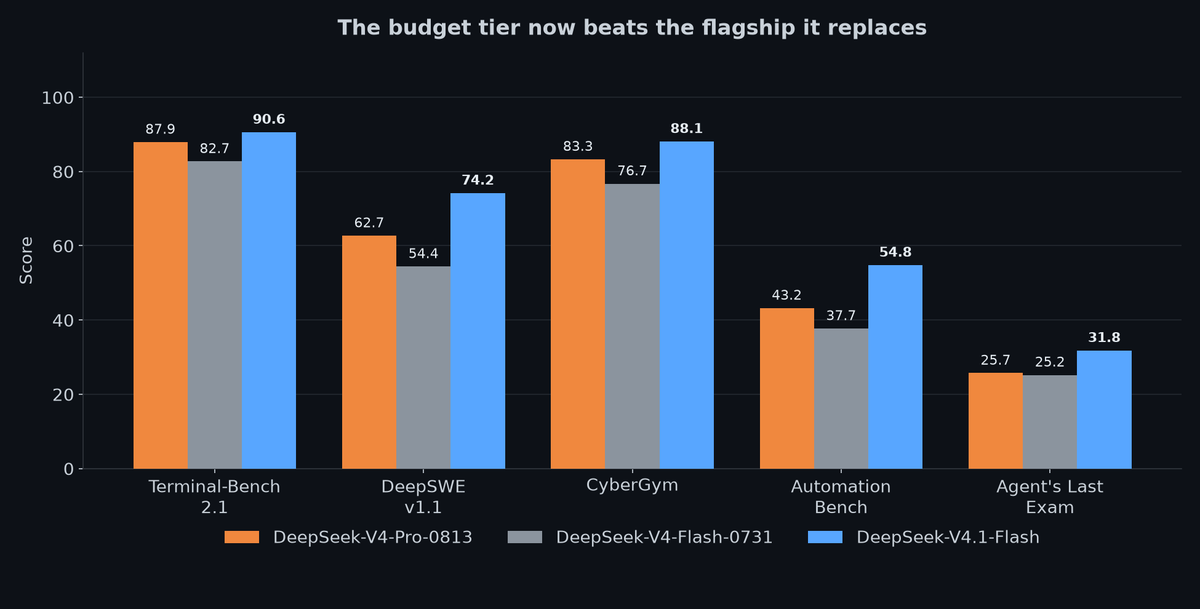
The jump from V4-Flash is the one that matters for anyone with production traffic, because that is the model being replaced underneath them. DeepSWE v1.1 goes from 54.4 to 74.2. Terminal-Bench 2.1 goes from 82.7 to 90.6. CyberGym, the security-exploit benchmark, goes from 76.7 to 88.1. AutomationBench runs from 37.7 on V4-Flash and 43.2 on V4-Pro to 54.8.
It is not a clean sweep of the whole table, and I would rather tell you where it loses inside the family too. On the reasoning benchmarks V4-Pro still leads GPQA Diamond (92.4 to 90.9) and the text-only HLE subset (42.7 to 39.1). The agentic rows are where the ordering flips, and the agentic rows are what most of us are paying for.
Against the closed frontier it is a mixed bag, and I would rather show you the bag than the bag's best row. V4.1-Flash edges Opus 5 on Terminal-Bench 2.1 (90.6 to 89.1), essentially ties it on DeepSWE (74.2 to 74.0), and beats it on AutomationBench and Agent's Last Exam. Then Opus 5 takes the newer tests by a wide margin — Terminal-Bench 3.0 is 43.3 to 30.0, Terminal-Bench 4.0 is 51.8 to 31.2, ProgramBench is 37.0 to 20.3, NL2Repo is 75.3 to 64.0. GPT-5.6 Sol owns SEC-Bench Pro (74.3 to 62.8) and ExploitGym (33.7 to 15.3). DeepSeek's own report says the quiet part out loud: a gap remains on science-heavy agentic tasks that need expert domain knowledge.
So the accurate sentence is: V4.1-Flash is frontier-adjacent on everyday coding and agent work, and clearly behind on the tasks that need a giant. Which, given that it costs a fraction of a cent per thousand tokens, is a trade a lot of people will take.
How do you make a model bigger and cheaper at the same time?
This is the part I actually found interesting, because the numbers look like a contradiction at first glance. V4.1-Flash carries 748B parameters total — 552B in the backbone plus 196B of "Engram" conditional memory — where V4-Flash had 284B. It is a much bigger model. And it activates fewer parameters per token than the old one did.
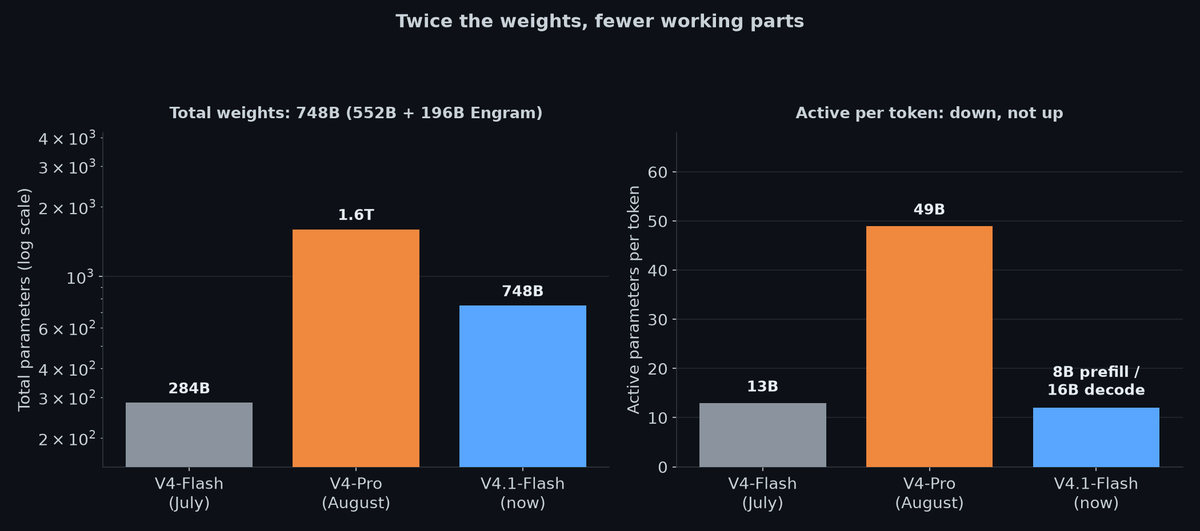
The architecture is called Causal Encoder-Decoder, and it splits the 40-layer network into a 20-layer encoder and a 20-layer decoder. Prompt tokens stop at the encoder. The decoder does not compute its own global KV cache from scratch — it projects it from the encoder's final hidden state. That is why input costs 8B active parameters and output costs 16B: you prep an input-heavy agent prompt with the cheap path and pay the expensive path only for the tokens you generate.
Then there is the cache, which is where agent bills actually come from. DeepSeek reused KV work across layers with Compressed Sparse Attention 2, where each layer is statically assigned one of three modes: Full (compute the cache and the attention indices), Reindex (reuse the cache but re-pick the indices), or Reuse (borrow both). On top of that, the main KV cache is quantized to FP4, and a deployment trick called SWA Bounded Replay lets the model reconstruct its sliding-window state by replaying only the last 128 tokens instead of persisting it to SSD.
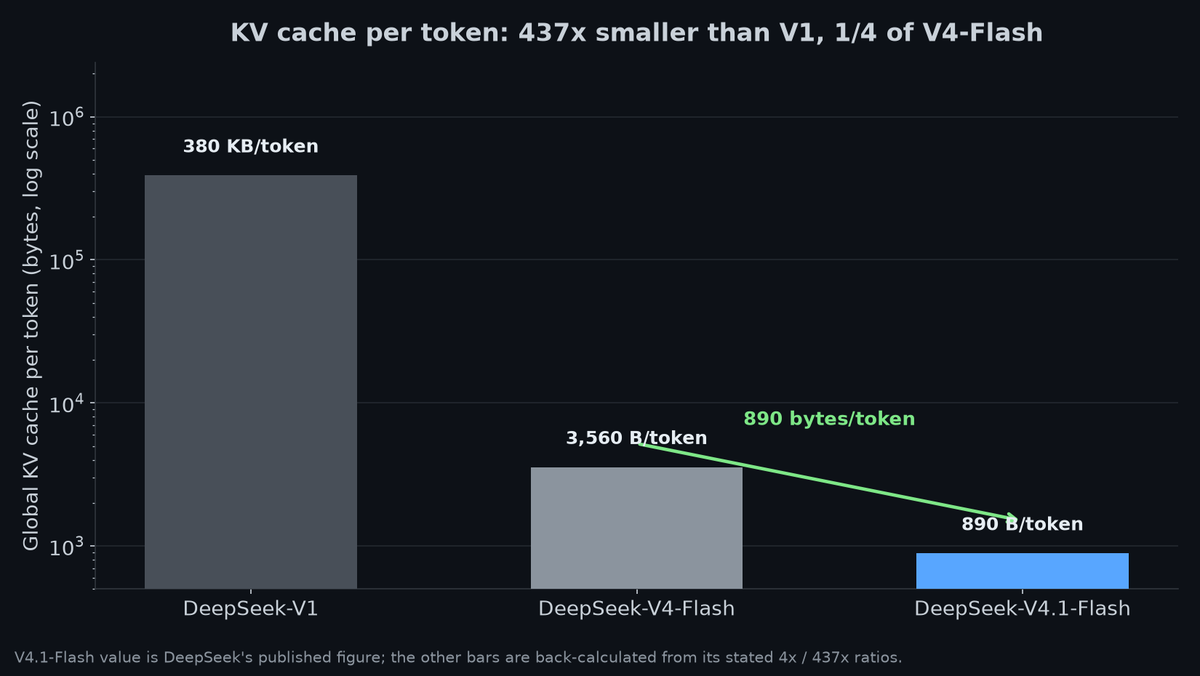
The result: 890 bytes of KV cache per token, roughly a quarter of V4-Flash's runtime cache and an eighth of its persistent cache. DeepSeek says that translates into a quarter of the HBM and an eighth of the SSD footprint per session. For agents that keep million-token contexts alive across hundreds of calls, that is the difference between "we can host this" and "we cannot afford to host this".
The report also notes that stretching context from 4K to 1M tokens increases single-token decode compute by only about 25%. V4-Flash's curve climbs much steeper. That is the whole reason a Flash-tier model can now sit in a Pro-tier seat.
The price cut, in numbers
Back on August 16 DeepSeek raised prices and I wrote about how badly the cache-hit rate got hit. Twenty-five days later, here is the reversal.
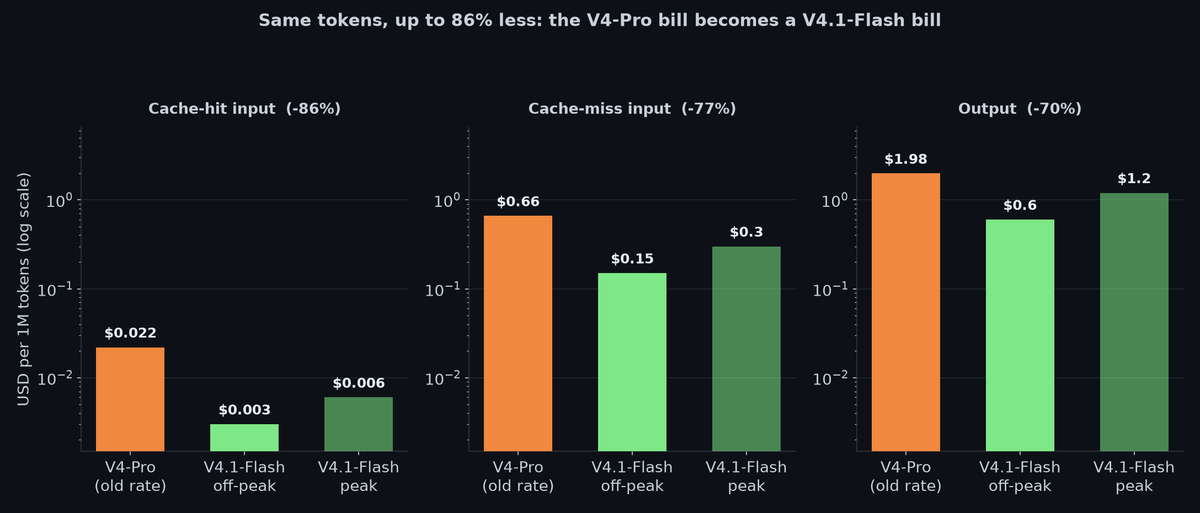
Compared with the model it is replacing for Pro traffic, the new card is 86% cheaper on cache-hit input ($0.003 off-peak and $0.006 peak, against $0.022 and $0.044), 77% cheaper on cache misses ($0.15/$0.30 against $0.66/$1.32), and 70% cheaper on output ($0.60/$1.20 against $1.98/$3.96). Compared with V4-Flash's own August card the cut is smaller but real: cache-hit input drops 57% (from $0.007 to $0.003), cache-miss input 32% (from $0.22 to $0.15), and output 9% (from $0.66 to $0.60) at off-peak rates. Peak rates are exactly double off-peak.
One footnote changed quietly and I nearly missed it. Peak hours are 01:00–04:00 and 06:00–10:00 UTC, Monday through Friday. Weekends are entirely off-peak now; the August card did not mention weekends at all. If you batch your heavy jobs on a Saturday, nothing you do that day counts as peak.
My own arithmetic on a month that moves 100M input tokens (90% of them cache hits) and 20M output tokens, all off-peak: about $13.77 on the new Flash card, versus about $48.18 under the old V4-Pro card for the same volume. That is not a DeepSeek figure, it is me with a calculator, and your mix will land somewhere else — but the shape of it is right.
How fast is it, really?
Here I have to be careful, because every impressive number in circulation is a community measurement rather than a published spec. During the two-day beta, testers reported sustained output in the 280–500 tokens-per-second range, with individual peaks above 500 on light-concurrency runs. My own post from the beta window quoted a 507 tok/s peak and roughly 420 average on long generations.
Set that against the baseline it replaces: Artificial Analysis measures the public V4-Flash 0731 endpoint at around 120–140 tok/s. So the direction — roughly 2x to 4x — is consistent across everyone who tested it, and the exact multiple is not something I would put in a contract. Tokens per second depends on the prompt, the concurrency and the provider's mood.
There is a billing subtlety worth saying out loud, because it bit people during the beta. Faster output does not automatically mean a smaller bill. Per-token prices are what they are; a model that emits tokens twice as fast drains your balance twice as fast per wall-clock minute. The saving has to come from finishing tasks in fewer tokens or fewer retries, and that is exactly what a two-day speed test cannot prove. DeepSeek's claim that V4.1-Flash wins on "total time" is about the whole task, not the meter.
The 1-to-100 dial
V4.1-Flash takes a continuous reasoning_effort value from 1 to 100 and trades tokens for accuracy on demand. DeepSeek published the curves, and they are unusually honest about the trade.
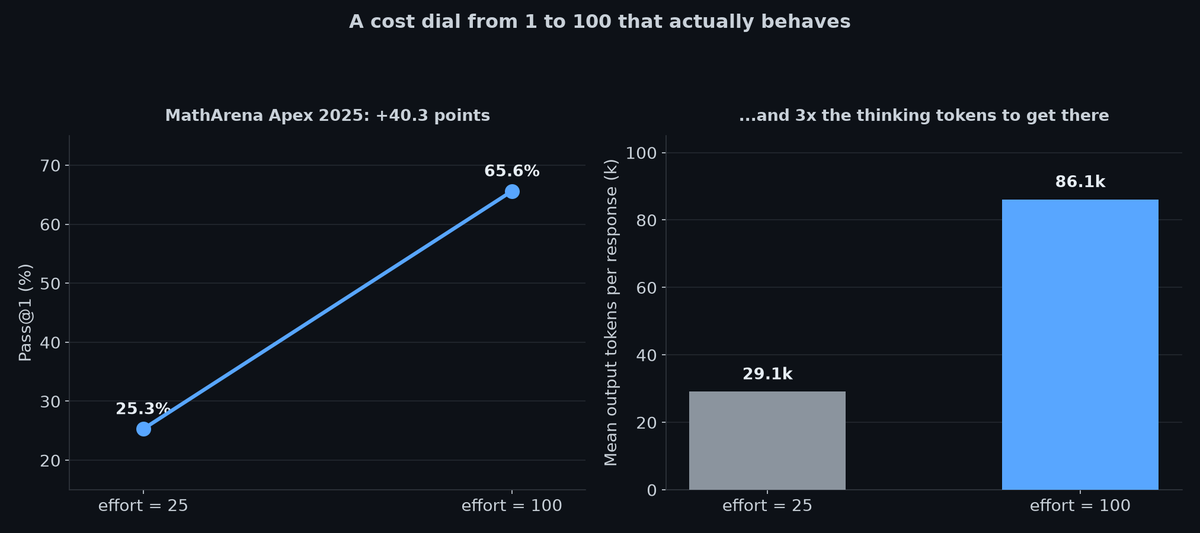
Across eight reasoning benchmarks, raising effort from 25 to 100 scales output length by a predictable 2.0–3.1x with no runaway behaviour, so you can estimate the cost of a tier before you pick it. Accuracy moves in the right direction everywhere, and AIME 2026 saturates at 100%.
The caveat is in the appendix and it is the kind of caveat I wish more vendors published: for agentic tasks, accuracy "tracks this growth only loosely", with plateaus and dips at intermediate settings, and scaffold choice matters about as much as the effort tier once a benchmark is nearly saturated. Same checkpoint, same task: DeepSWE v1.1 ranges from 65.5 under OpenCode to 74.2 under mini-SWE. If you tune the dial and ignore the harness, you are tuning half a system.
Can you run it at home? Not really.
The repository is 510 GB. That is the FP8 download as published, before anyone quantizes it, and the local-inference crowd on Hacker News did the math within an hour of release. One commenter's breakdown: roughly 306 GB for the backbone in FP4, another 204 GB for the FP8 Engram tables, and the Engram part does not have to sit in RAM at all — it behaves like a lookup table read per token, so it can live on a fast SSD.
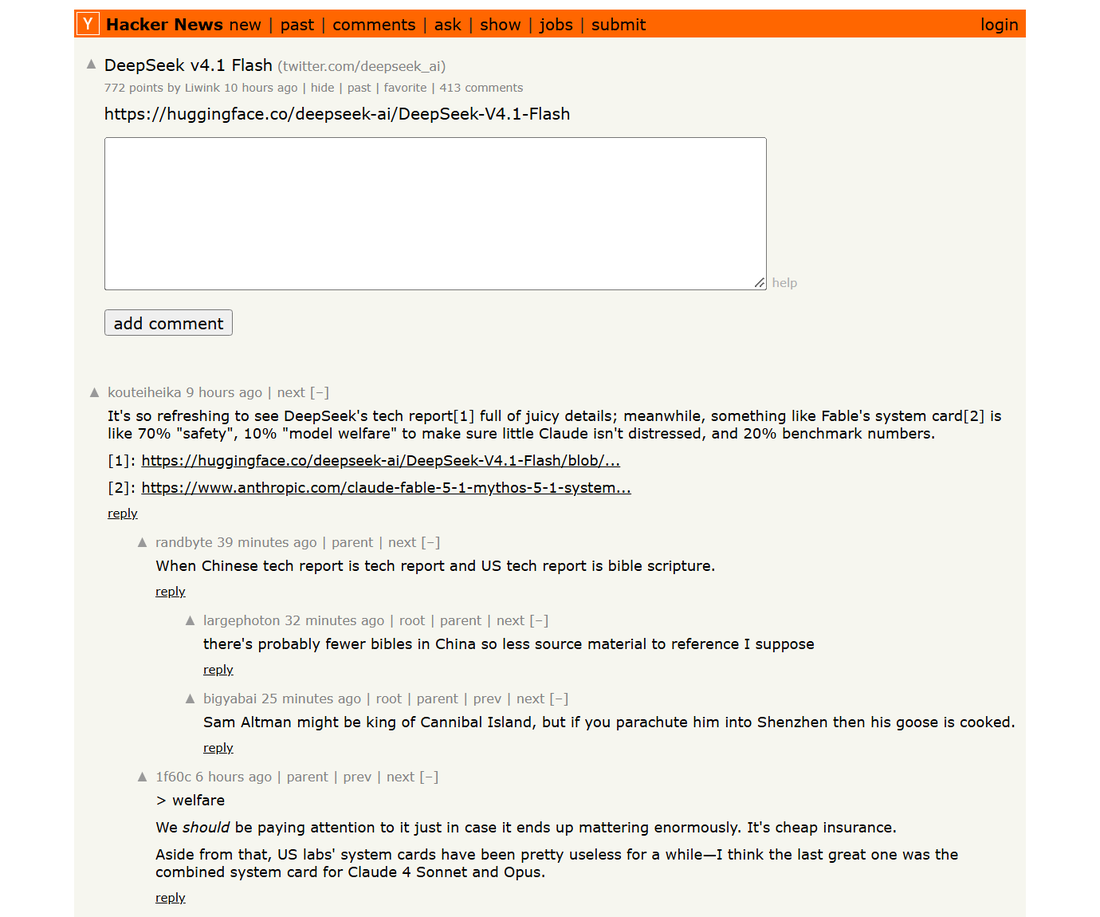
"The bad news is that the original v4 flash was 284B, which was large but still somewhat reasonable for running locally. This one is 552B so almost twice that, so the huge gains in benchmark scores make sense — it's not really flash anymore, imo." — revolvingthrow, Hacker News
The counter-argument in the same thread is fair: it activates fewer parameters per token than V4-Flash did, so "Flash" still describes the serving side. Whether it describes your desk is a different question. The consensus guess in the thread was 384 GB of memory for useful speeds — three DGX Sparks, or a quad of the big RTX cards, before you start talking about quantized Engram offload. On a single 11 GB card like mine this is not a local model in any sense. It is a datacenter model with a cheap API, which is precisely the bargain DeepSeek is selling.
"I'd take a slightly worse model that's 2x faster for most product use cases." — Hacker News, on the beta thread
My take
What DeepSeek did here is less "new model" and more "collapse the product line". A year ago this company sold you a cheap model and a smart model and let you pick. Today it is telling you the cheap model is the smart one, turning the smart one off about a month after it launched, and cutting prices on the way out. That is a strange thing for a company to do while its rival's flagship is $25 per million output tokens, and it only makes sense if the architecture work is real — cheaper serving is the whole business case for retiring the expensive tier.
I am not going to pretend the evidence is complete. Every benchmark in this post comes from DeepSeek's own harnesses, and there is still no independent score from Artificial Analysis or anyone else. The technical report's own limitations section admits that the new pieces — sparse-attention selection, the approximate replay of sliding-window state — create "robustness boundaries that have yet to be fully characterized", and that matched benchmark scores do not mean matched capability on hard edge cases. Retiring Pro is also a migration, not just a discount: a model trained from scratch does not inherit the old one's quirks, and if your prompts and tool schemas were tuned against V4-Flash-0731, test them before you swap production traffic.
What I am doing about it: I am moving my own agent traffic to deepseek-flash this month and watching the bill, because the numbers on the card are the ones that decide my usage anyway. I will post what a real month costs, and I will rewrite this piece the moment an independent lab publishes V4.1-Flash numbers or V4.1-Pro shows up — whichever comes first, and the way DeepSeek has been moving this year, probably both.
Sources: DeepSeek news post Introducing DeepSeek-V4.1-Flash (deepseek.com, Sept 10 2026) · DeepSeek API docs, Models & Pricing (api-docs.deepseek.com) · DeepSeek-V4.1-Flash model card and DeepSeek-V4.1-Flash: Pushing the Limits of KV Cache Compression technical report (Hugging Face, MIT) · Hacker News thread 49639090 (763 points) · TechNode, Sept 10 2026. All benchmark figures are vendor-reported unless labelled community-measured; the parameter, KV-cache and price charts are my own renderings of DeepSeek's published numbers.
Related on this blog: the two-day beta that expired on schedule · the bolt-on vision build V4.1-Flash replaces · the August price hike this card reverses
Comments
Post a Comment