DeepSeek Flash Vision: Read the Text Gains as a Comparison
MODELS & COSTS
DeepSeek Flash Vision: Read the Text Gains as a Comparison
Several text-agent scores rose in DeepSeek's vision release even though those tasks used no images. That makes the vendor table interesting to inspect. It does not isolate vision training as the cause, because the released models and their training can differ in more than one way.
In this article
The release is deepseek-v4-flash-vision-exp, an experimental multimodal variant of the Flash line. It accepts images alongside text for tasks such as screenshot reading and chart analysis. The experimental endpoint and the text model should be compared as distinct releases.
on the text-only agent benchmarks — the ones with no images at all — the vision model beats the text-only Flash-0731 released three weeks ago. Not ties. Beats.
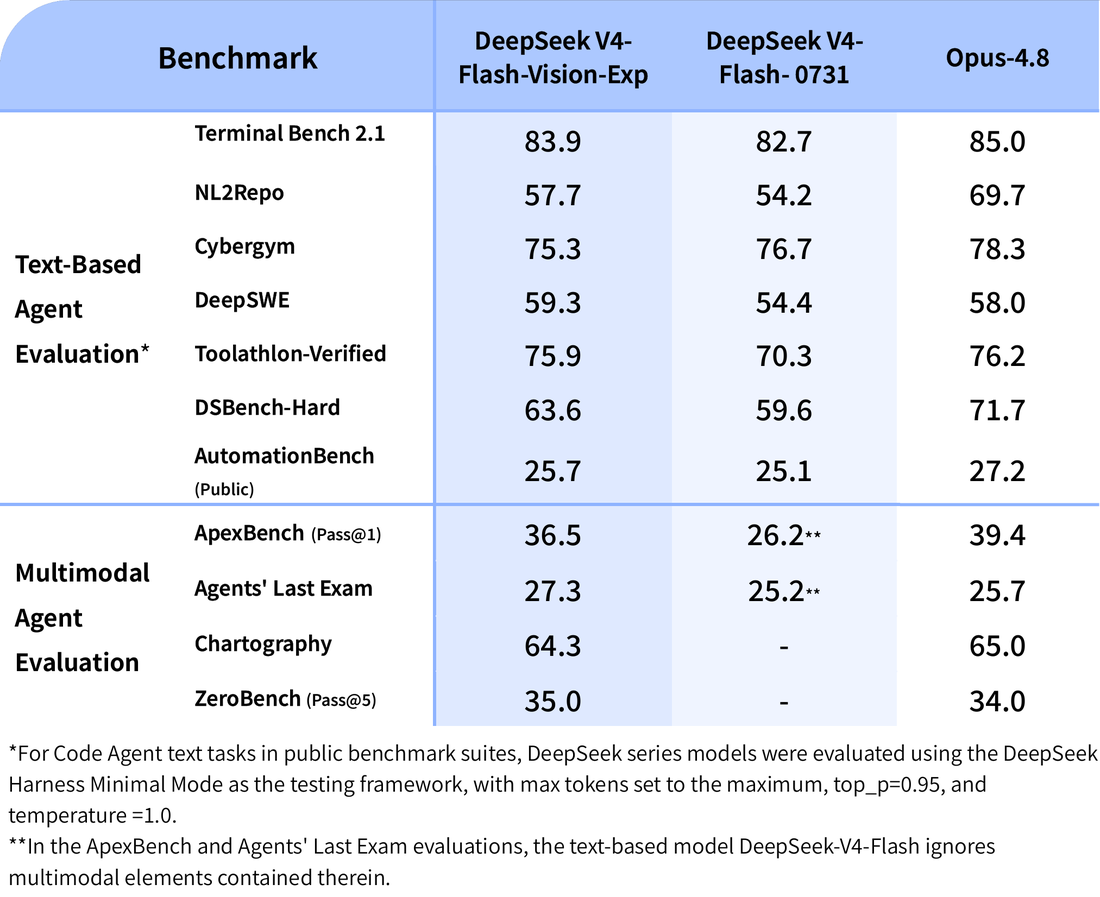
Vision and text-only Flash in the vendor table
On the seven text-based agent evaluations, yes, in six of them:
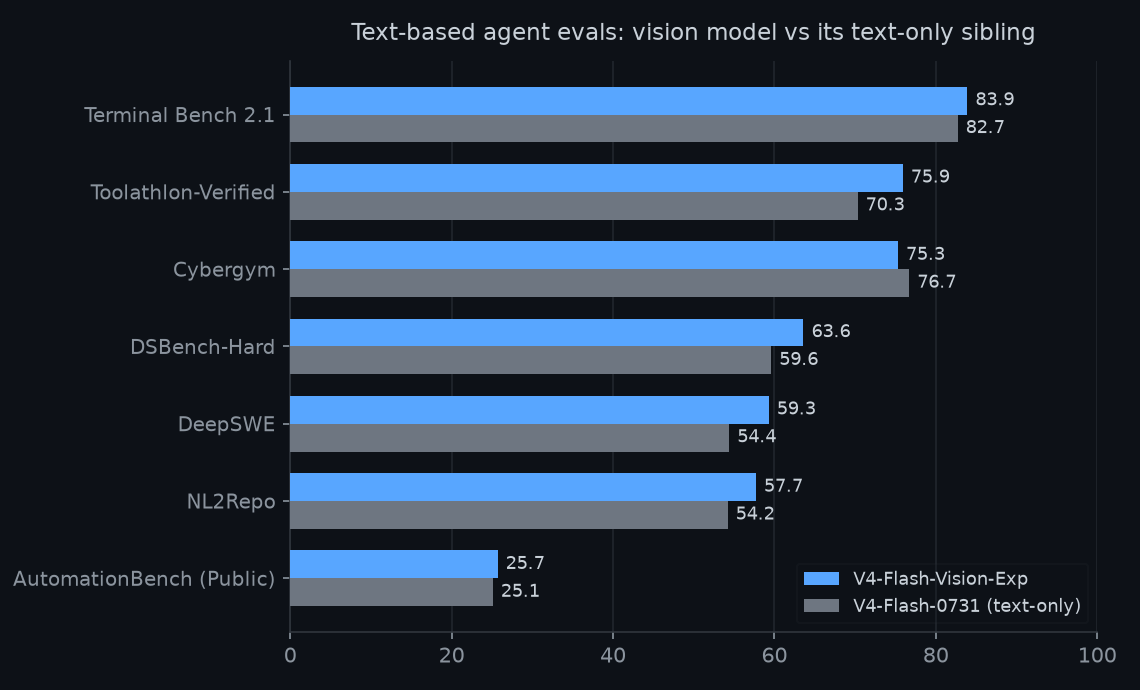
The jumps aren't cosmetic either. Toolathlon goes 70.3 → 75.9 (+5.6). DeepSWE goes 54.4 → 59.3 (+4.9).
DSBench-Hard +4.0, NL2Repo +3.5. Terminal Bench 2.1 creeps up 82.7 → 83.9.
Cybergym falls from 76.7 to 75.3, a 1.4-point difference. Without repeated runs or uncertainty estimates, it is not possible to label that difference as noise. Four other suites are multimodal, where a text-only model cannot take the same inputs; those rows do not establish a text-reasoning advantage.
The Opus-4.8 comparison
DeepSeek's table also includes Opus-4.8. Read the comparison row by row: a smaller price does not change the scoring method, and a few close results do not establish parity across workloads.
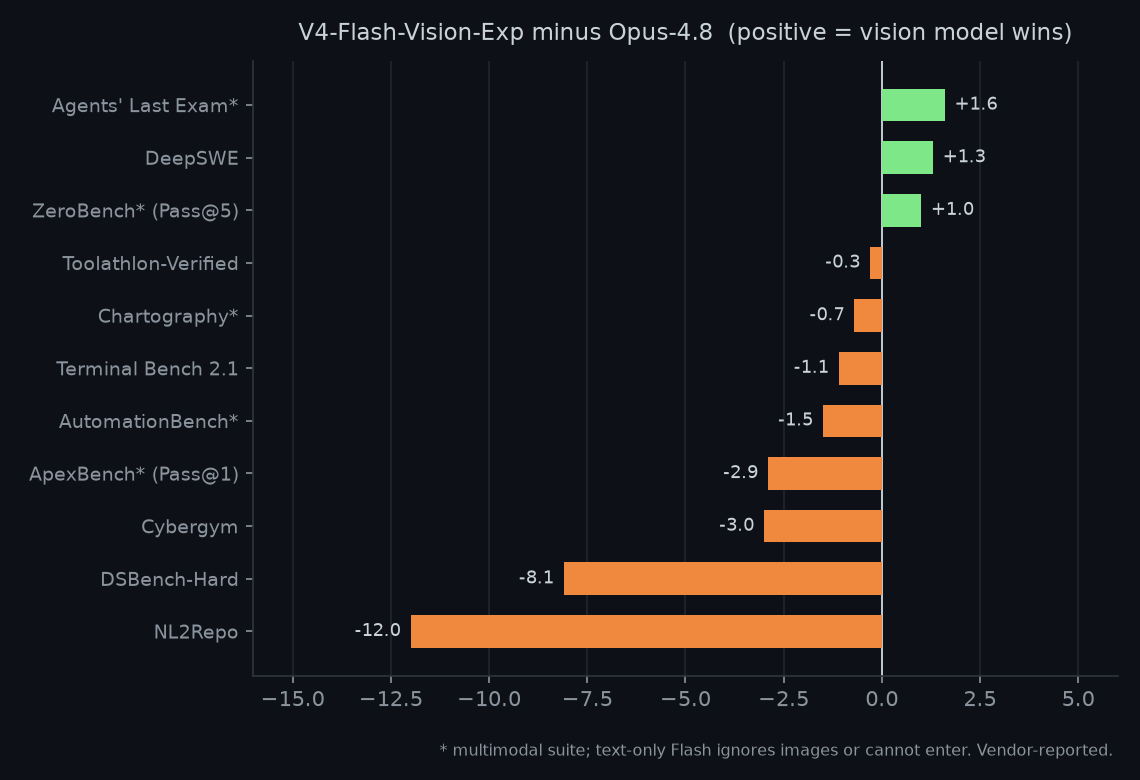
It straight-up wins three rows: Agents' Last Exam (27.3 vs 25.7), DeepSWE (59.3 vs 58.0), and ZeroBench (35.0 vs 34.0). It loses eight, and most losses are razor-thin — Toolathlon by 0.3, Chartography by 0.7, Terminal Bench by 1.1. The real gap is NL2Repo, down 12 points, and DSBench-Hard at −8.1. So "close to Opus" is fair on agent-flavored tasks and generous on repo-scale coding.
Now the price part, which is where this stops being a curiosity. Flash pricing means output tokens cost $1.32 per million at peak, $0.66 off-peak. Current GA Claude Opus 5 charges $25 for the same million output tokens. That's a 19x gap at peak, 38x off-peak, on a model that trades blows with last generation's Opus on agentic benchmarks.
DeepSeek's own framing in the announcement is that multimodal agent performance now sits "close to Opus-4.8" — and whatever discount you apply for vendor-reported numbers, the price column isn't a claim, it's a rate card.
Experimental endpoint and inputs
The API mechanics are more interesting than the usual "now accepts images" line:
Images cost at most 384 tokens each. Any image — a 640×480 screenshot or a 5000×5000 scan gets auto-resized to the same ceiling. At Flash's cache-miss input rate that's $0.000084 per image off-peak, under $0.17 per thousand even at peak. If you've priced vision APIs lately, read that number again.
600 images per request. With the new Files API (also free, also shipped today) you upload once, reference by file_id, and can push up to 200 MiB of imagery into a single conversation. Document pipelines that used to need chunking logic just became one request.
It speaks all three dialects. OpenAI Chat Completions, Anthropic Messages format, and the Responses API — same model name everywhere, so wiring it into an existing Claude-format agent stack is a base-URL change. One quirk: images only work in user messages; put one in system or assistant context and you get a 400.
What the measurements establish
Slow down here, because this is where I'd normally get burned. Every score above is vendor-reported. The model launched today — Artificial Analysis hasn't touched it yet, no independent leaderboard exists, and DeepSeek ran everything on their own harness with settings they chose.
There's one reason for cautious optimism: DeepSeek's July numbers survived independent measurement — Flash-0731 currently sits at #3 out of 101 models on the Artificial Analysis index. But that's a prior, not a verification. "The vendor's own harness agreed with the vendor last time" doesn't tell you about today's table.
The other thing to hold loosely: the "-Exp" suffix. This is an experimental API-only model. No weights announced — unlike Flash-0731, whose MIT-licensed weights are sitting on Hugging Face. Experimental endpoints can change behavior or disappear with a changelog note.
DeepSeek pulled exactly this pattern with V3.2-Exp back in 2025: ship the experiment, graduate it to the real model later. Probably the same play here — but if your production pipeline depends on it, you're building on sand until weights or a stable version land.
"If V4-Flash-Vision-Exp keeps the same text/agent ability as V4-Flash while adding vision, that's a pretty interesting direction. The bottleneck for agents is increasingly not just intelligence, but perception + tool interaction." — u/ondevicedev, r/DeepSeek
That's the sharpest take I've seen on the release, and I think it's right. There's also a fun bit of irony here: when V4 Pro shipped last week, HN commenters passed around the claim that DeepSeek didn't think vision advanced their AGI work and wasn't on the roadmap. Eight days later, here's a vision model beating the text-only flagship's agentic scores. Roadmaps are suggestions.
The text-agent improvements are the result worth reproducing. The published table does not isolate their cause: training data, post-training, model revisions and evaluation settings may all differ. It therefore cannot show that vision training alone produced the gains.
For a screenshot-heavy pipeline, compare this endpoint on the same images and tool loop as the current model. Track failed calls and completed tasks as well as token cost. The launch price may match Flash, but the experimental status and workload reliability remain separate considerations.
The figures here remain DeepSeek's launch measurements. Later independent tests or a stable endpoint should be identified by date and revision rather than assumed from the release name.
Related: the Aug 16 peak/off-peak rate card explained · V4 Pro goes official · Flash-0731's benchmark shock
Comments
Post a Comment