DeepSeek V4 Flash Vision Exp: Flash Gets Eyes, Now Open Weight
DeepSeek V4 Flash Vision Exp: Flash Gets Eyes, Now Open Weight
DeepSeek shipped nothing but text-only models all year. That changed August 21 on the API — and today it changed again on Hugging Face: deepseek-ai/DeepSeek-V4-Flash-Vision-Exp is now open weight (MIT). I stared at the model card because it's the first V4 that can actually look at an image and still run like Flash.
The image you sent is the Hugging Face social card — deepseek-ai/DeepSeek-V4-Flash-Vision-Exp, 29 likes on day one. API went live Aug 21 as model='deepseek-v4-flash-vision-exp' (experimental tag, changelog + news post). Open weights landed Aug 31. I'll treat the HF card + changelog as primary sources and flag everything vendor-reported.
What actually shipped
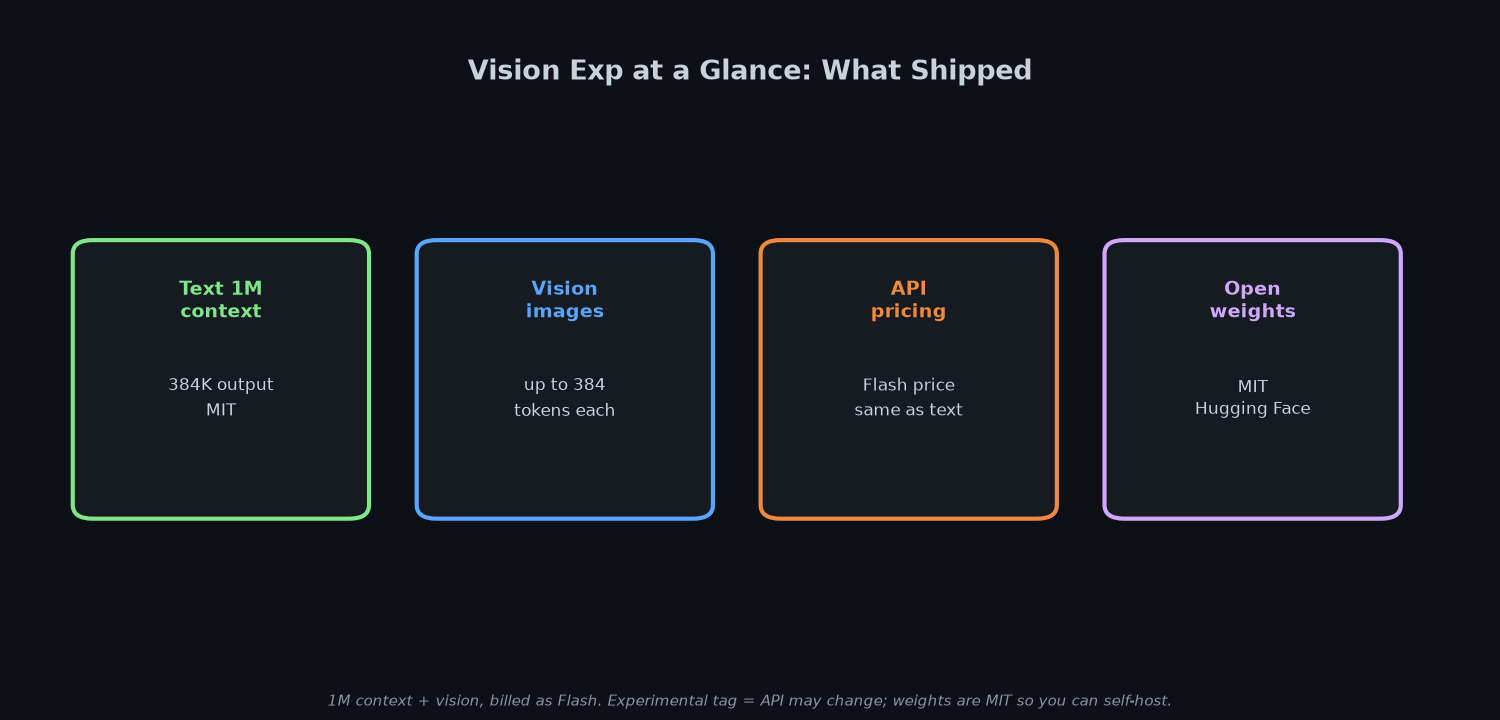
| Item | Detail (vendor-reported) |
|---|---|
| Model | DeepSeek-V4-Flash-Vision-Exp — first vision model in V4 family, builds on Flash architecture |
| HF | deepseek-ai/DeepSeek-V4-Flash-Vision-Exp — MIT, Transformers/vLLM/SGLang, 144k followers on org |
| API | model='deepseek-v4-flash-vision-exp' since Aug 21, Files API free (file_id reuse), chat/messages/responses |
| Context | 1M (same as V4 family), max output 384K |
| Vision | JPEG/PNG/GIF/WebP, up to 384 tokens per image, mixed text+image |
| Price | Billed at Flash rates (peak/off-peak from Aug 16) — check pricing page |
| Inference | encoding/ + inference/ minimal PyTorch, sglang/vLLM recipes on HF |
Text agents: no regression (actually a nudge up)
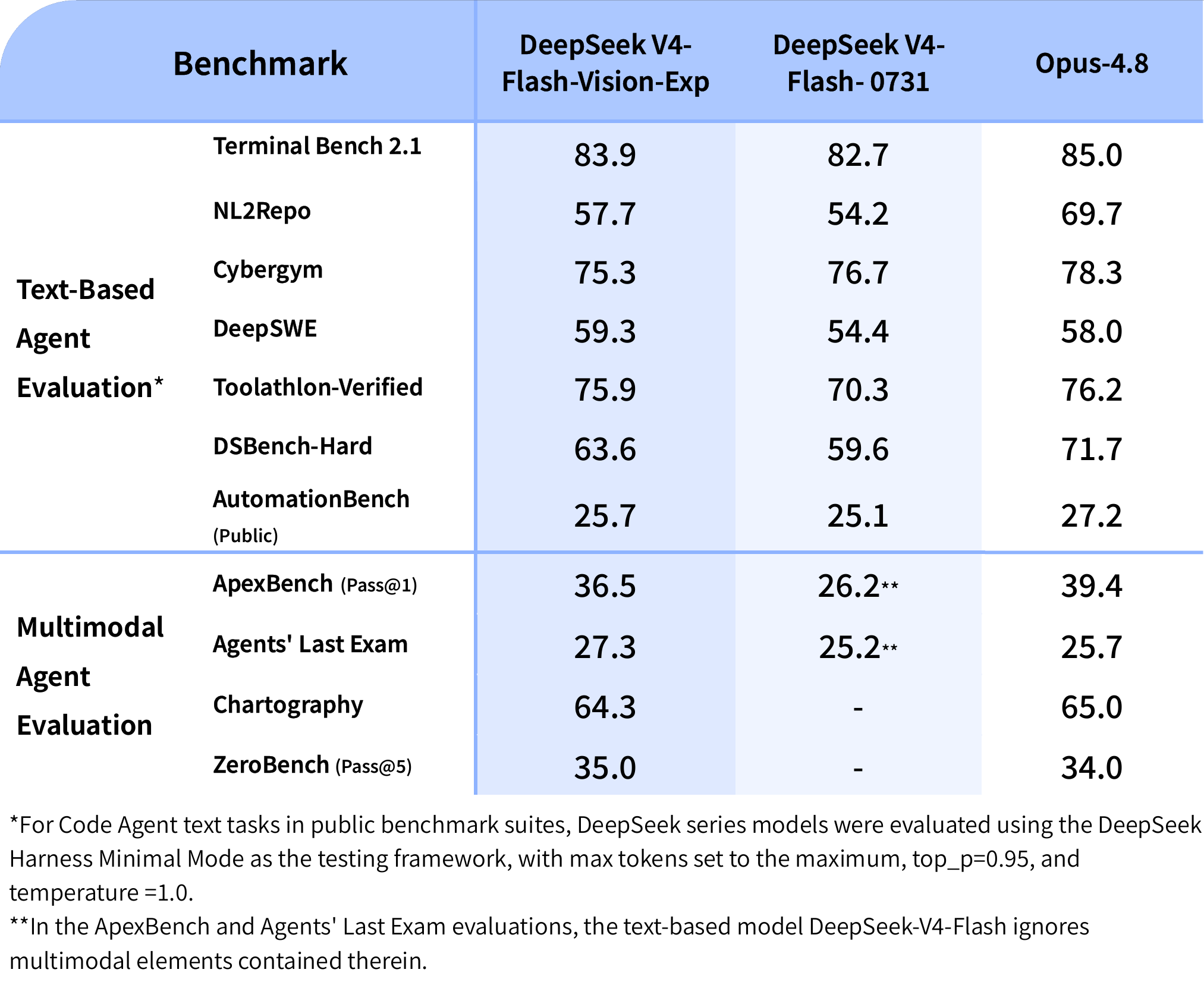
This was my first worry — does adding eyes make the text brain dumber? No. The changelog says "on par with Flash" and the table backs it: Vision Exp edges Flash 0731 on most text rows.
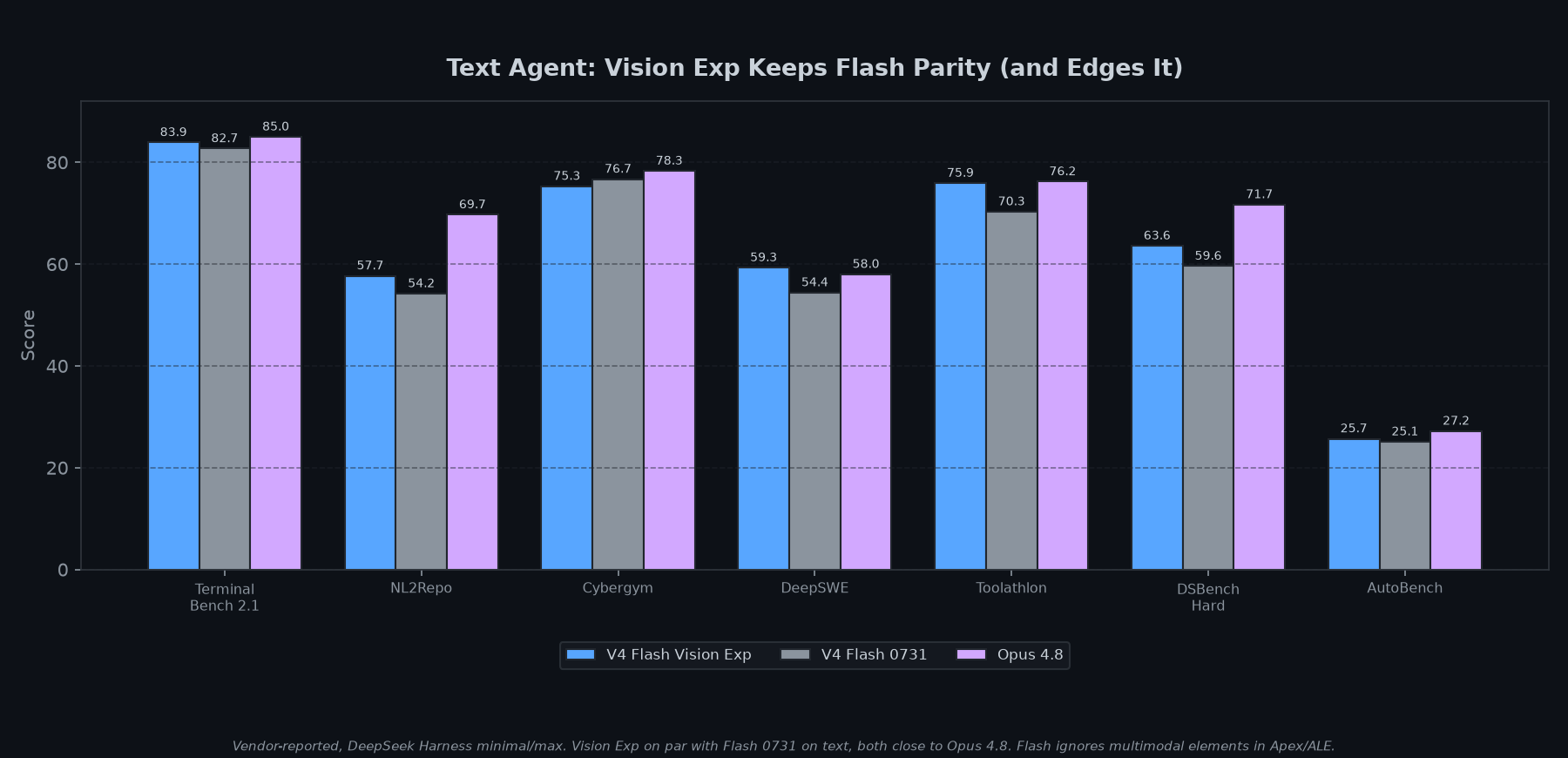
| Text Agent | Vision Exp | Flash 0731 | Opus 4.8 | Delta (Vision vs Flash) |
|---|---|---|---|---|
| Terminal Bench 2.1 | 83.9 | 82.7 | 85.0 | +1.2 |
| NL2Repo | 57.7 | 54.2 | 69.7 | +3.5 |
| Cybergym | 75.3 | 76.7 | 78.3 | -1.4 |
| DeepSWE | 59.3 | 54.4 | 58.0 | +4.9 |
| Toolathlon-Verified | 75.9 | 70.3 | 76.2 | +5.6 |
| DSBench-Hard | 63.6 | 59.6 | 71.7 | +4.0 |
The DeepSWE lift (54.4 → 59.3) now sits above Opus 4.8's 58.0 — vendor-reported, but it's the first time a vision Flash model beats Opus on a text-only agentic coding set. Caveat: still vendor harness, no independent leaderboard yet.
Multimodal agents: the real jump
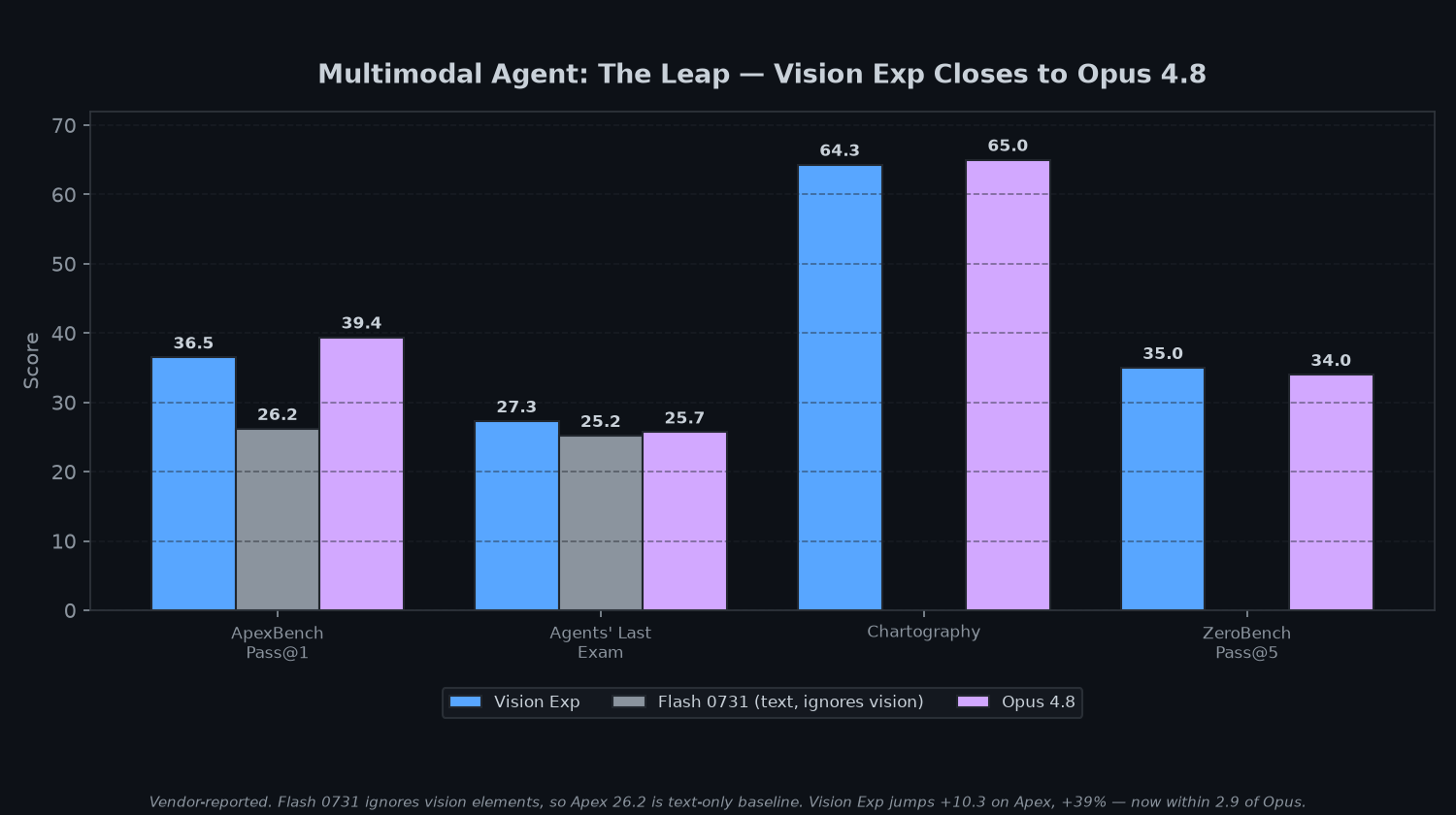
| Multimodal Agent | Vision Exp | Flash 0731* | Opus 4.8 |
|---|---|---|---|
| ApexBench Pass@1 | 36.5 | 26.2 | 39.4 |
| Agents' Last Exam | 27.3 | 25.2 | 25.7 |
| Chartography | 64.3 | — | 65.0 |
| ZeroBench Pass@5 | 35.0 | — | 34.0 |
*Flash tested ignoring multimodal elements (changelog footnote). So the gap is understated — Vision Exp is actually seeing the images.
How it fits the family
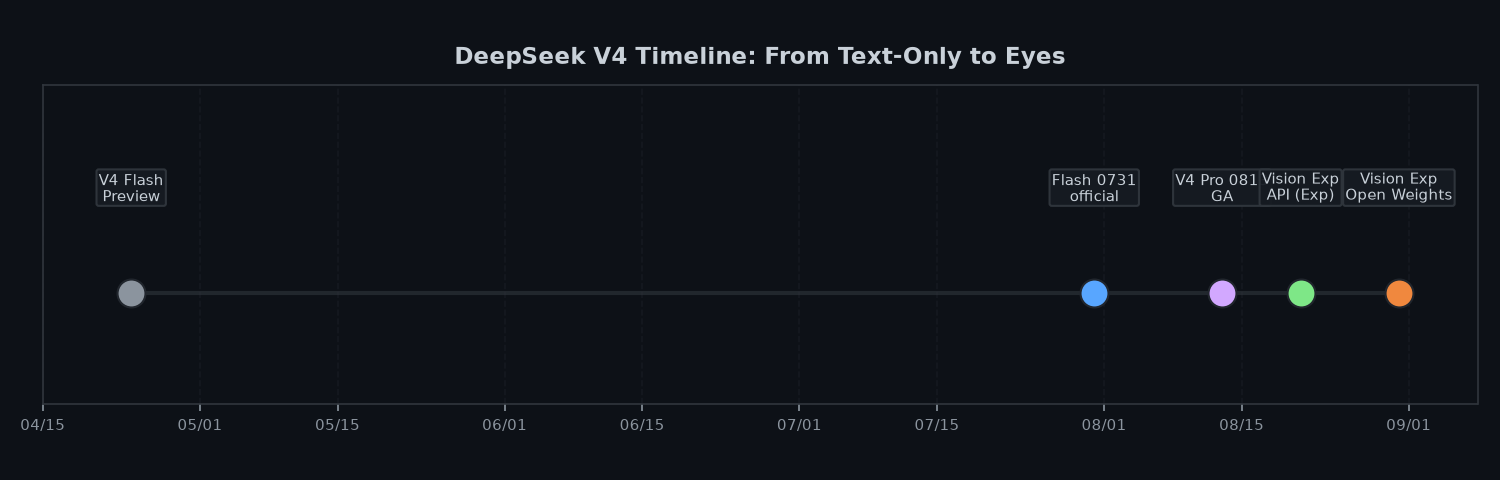
Vision Exp isn't a new scale — it's Flash 0731 with eyes and continued training. That explains why the repo layout mirrors Flash (same config.json / model.safetensors.index.json) and why Unsloth already lists a GGUF. If you self-host Flash today, Vision Exp is the drop-in vision swap at the same 284B/13B footprint (~158GB FP4/FP8 + vision encoder ~ a few GB).
API notes you will actually hit
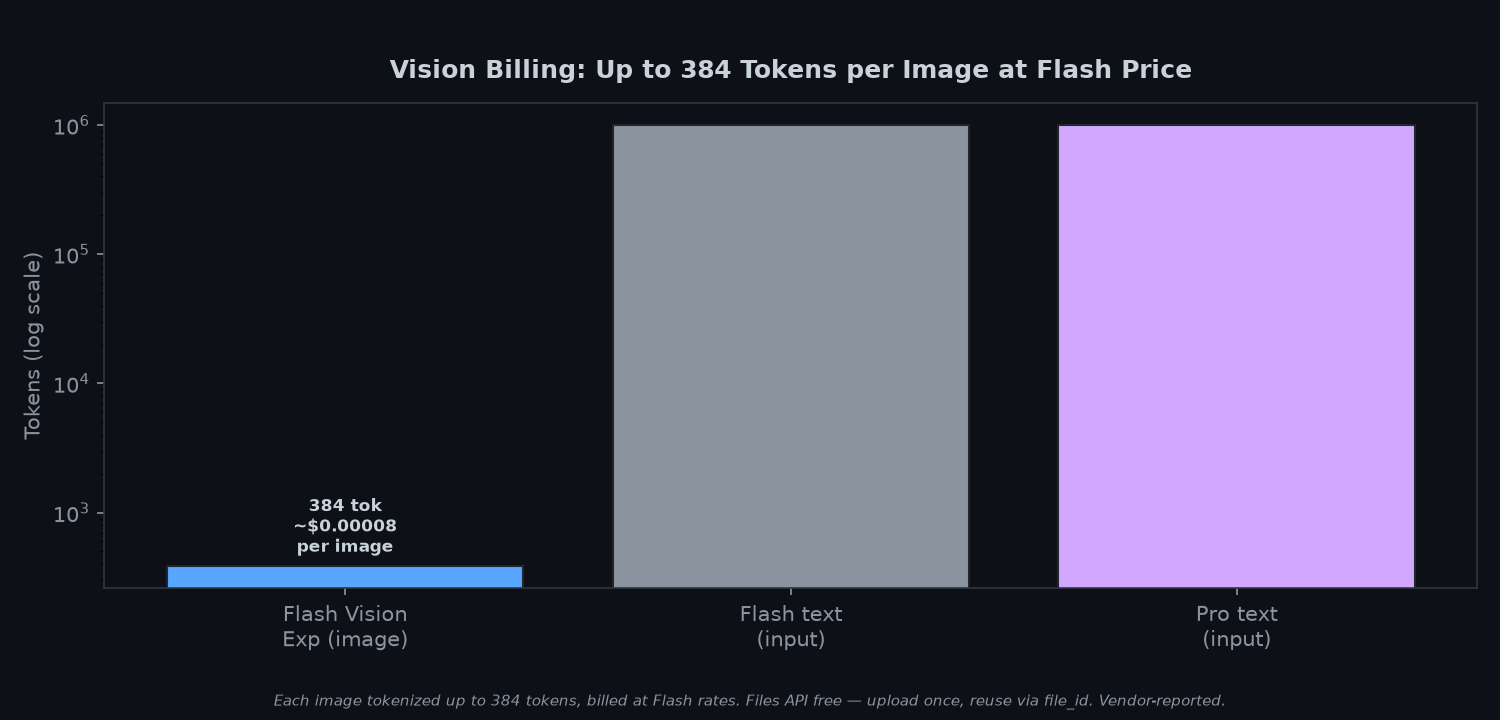
file_id and reuse. Vendor-reported.| Topic | What the docs say |
|---|---|
| Model string | model='deepseek-v4-flash-vision-exp' — still experimental, expect name stability but not guaranteed |
| Input | base64, URL, or Files API file_id; mixed text+image in one turn |
| Output | Same thinking effort levels as V4 (low/high/max), same 1M context |
| Billing | Vision tokens counted at V4-Flash cache-hit/miss/output rates (peak/off-peak from Aug 16) |
| Self-host | MIT repo — encoding/README.md + inference/README.md on HF, SGLang/vLLM recipes |
My take
This is the V4 I've been waiting for — not because vision is novel (Opus has had it), but because DeepSeek made the cheap Flash see. Text parity holds, vision jumps, and the price stays Flash. If your agent screenshots its own work (and it should — see my last audit post), Vision Exp is the first DeepSeek that can judge the render. Experimental means the API may wiggle, but the weights are MIT — you can pin a self-hosted copy today and not care.
What I'd watch: independent Harness numbers on Apex/Chartography (vendor tables are the optimistic place), and whether the 384-token cap per image hurts long-document QA. Also whether Deep Harness 0.1.1's vision prompt handling matches the HF encoding/ path — the repo splits them deliberately.
FAQ
Is Vision Exp just Flash 0731 with a vision encoder bolted on?
Essentially — same 284B/13B base, added vision modules + continued training per the model card. The text-agent lift (DeepSWE +4.9, Toolathlon +5.6) suggests the continued training helped text too, not just vision.
Does it beat Opus 4.8?
On these vendor tables: it beats Opus on DeepSWE (59.3 vs 58.0), Agents' Last Exam (27.3 vs 25.7), ZeroBench (35.0 vs 34.0), and trails narrowly on Apex (-2.9), Chartography (-0.7), Terminal Bench (-1.1). So "close to Opus on multimodal" is fair phrasing — not "beats Opus."
Should I self-host or use the API?
API is cheapest to try (Flash pricing, images ≤384 tokens). Self-host is MIT and 1M context friendly — same ~158GB + vision overhead as Flash, so you need a 256GB unified box (Studio Ultra) or 2× Spark with the community engine. For my Mac mini readers: this doesn't fit a mini — it's a Studio/Cloud model.
Sources: HF deepseek-ai/DeepSeek-V4-Flash-Vision-Exp model card (MIT, intro + benchmark table), DeepSeek API changelog 2026-08-21 (vision release + bench), news post news260821 (benchmark figure, Files API), Harness 0.1.1 notes. All numbers vendor-reported. Official figure: DeepSeek (Fig.2).
Related: 2026 Local AI Machines Ranked by Value · Qwen 35B-A3B on a Mac mini
Published Aug 31, 2026. Open weights fresh today — I'll update when independent evals land.
Comments
Post a Comment