Gemini 3.7 Flash: The Launch Rates and Their Expiry
MODELS & COSTS
Gemini 3.7 Flash: The Launch Rates and Their Expiry
The introductory Flash price lowers the cost of trying Google's reported coding gains. It also has an end date. An ongoing deployment needs a representative task test and a post-promotion budget; the missing Pro release is a separate availability question in this August snapshot.
In this article
- The August 13 release
- Google's benchmark comparison
- Introductory pricing and expiry
- Pro availability at the publication date
- Access and deployment conditions
- Is Gemini 3.7 Flash open source?
- How much does it cost?
- Is it actually better than 3.6 Flash?
- Where can I use it?
- When is Gemini 3.5 Pro coming?
- Linked source documents
Google reports DeepSWE v1.1 rising from 49.0 to 65.3 and AutomationBench from 17.0 to 30.4. Those are the concrete changes to examine. The half-price period has an expiry, so a deployment budget should include the scheduled rate after the promotion as well as a matching task test.
The August 13 release
Flash is Google's workhorse line — the fast, cheap model you ship agents and high-volume workloads on, as opposed to the Pro line that's supposed to be the frontier flagship. 3.7 Flash drops in to replace 3.6 Flash, and Google credits developer feedback and some under-the-hood improvements. The pitch is coding and agentic work: better debugging, better issue resolution, more first-pass-accurate code, and fewer retries. It's closed and API-only, like every Gemini — no open weights, unlike the DeepSeek and Qwen releases I usually write about.
Gemini 3.7 Flash is Google's "most intelligent workhorse model" for coding and agents (image: Google / Ars Technica)
| What | Gemini 3.7 Flash |
|---|---|
| Release | Aug 13, 2026 (3 weeks after 3.6 Flash) |
| Class | Workhorse (fast/cheap), closed, API-only |
| Price (intro) | $0.75 in / $3.75 out per 1M tokens (through 2026) |
| Price (list) | $1.50 in / $7.50 out (from Jan 1, 2027) |
| Focus | Coding + agentic workflows |
| Open weights | No |
Gemini 3.7 Flash at a glance, from Google's announcement
Google's benchmark comparison
Google's benchmark table shows a real step up from 3.6 Flash, and the gains are concentrated exactly where you'd want them for a workhorse: coding and automation.
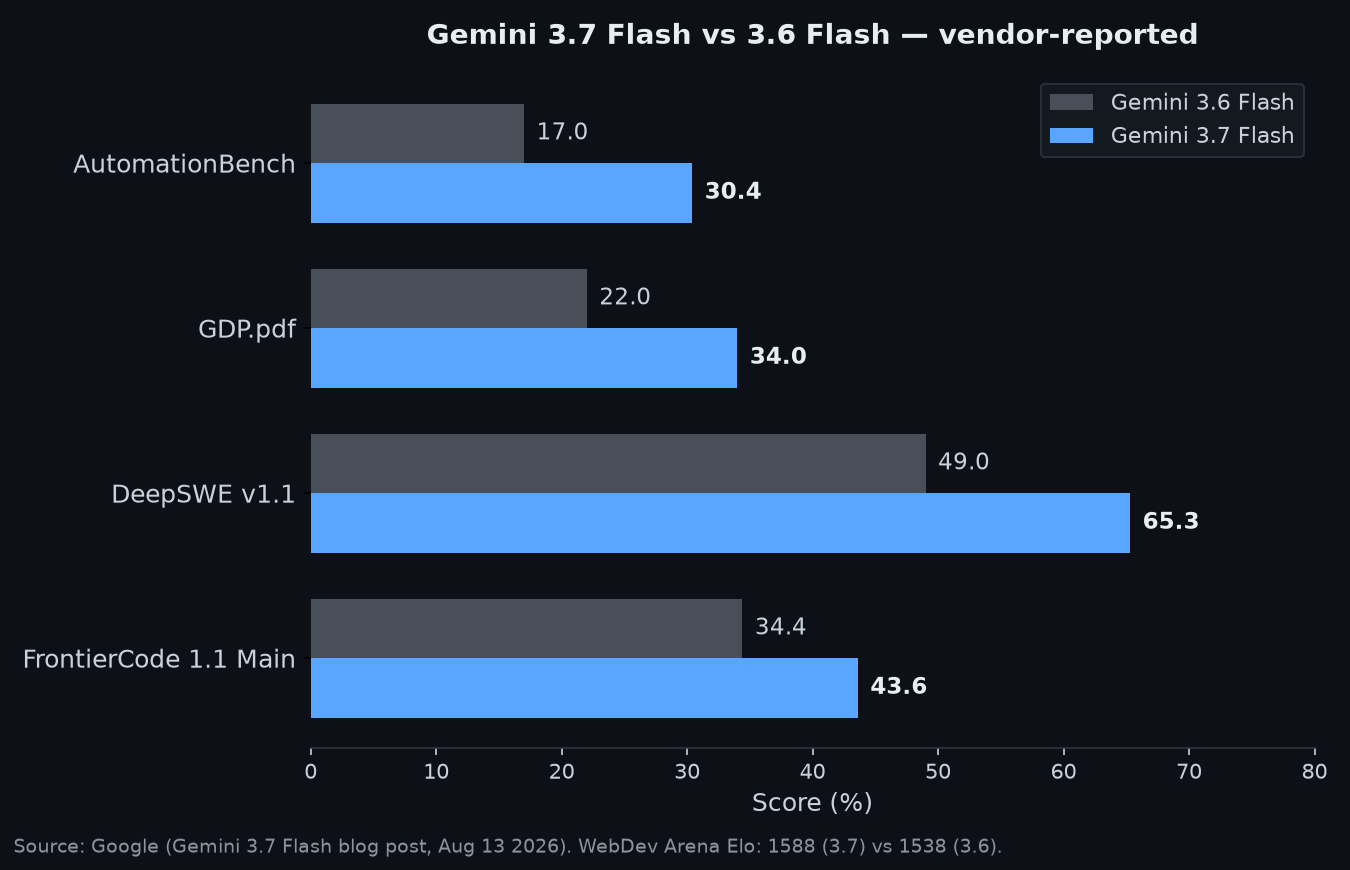
Gemini 3.7 Flash vs 3.6 Flash on four benchmarks. Chart by the author from Google's reported numbers; WebDev Arena Elo: 1588 vs 1538.
The headline is DeepSWE v1.1, a software-engineering benchmark, going from 49.0 to 65.3 — that's a big jump for a point release. AutomationBench, which tests real business-workflow execution, nearly doubles from 17.0 to 30.4. Document processing (GDP.pdf) climbs from 22.0 to 34.0, and production-code generation (FrontierCode 1.1 Main) goes from 34.4 to 43.6. WebDev Arena Elo ticks up from 1538 to 1588.
These are Google's own numbers, on a model that's hours old. There's no independent benchmark yet, and the previous few releases have taught me to wait for a third party before treating a vendor table as the final word. The direction's probably right — I'd wait on the size of the gains.
Introductory pricing and expiry
Through the end of the year, 3.7 Flash costs $0.75 per million input tokens and $3.75 per million output tokens. That's exactly half of 3.6 Flash's $1.50/$7.50. The fine print is the footnote: the introductory price expires December 31, and on January 1 it snaps back to $1.50/$7.50.
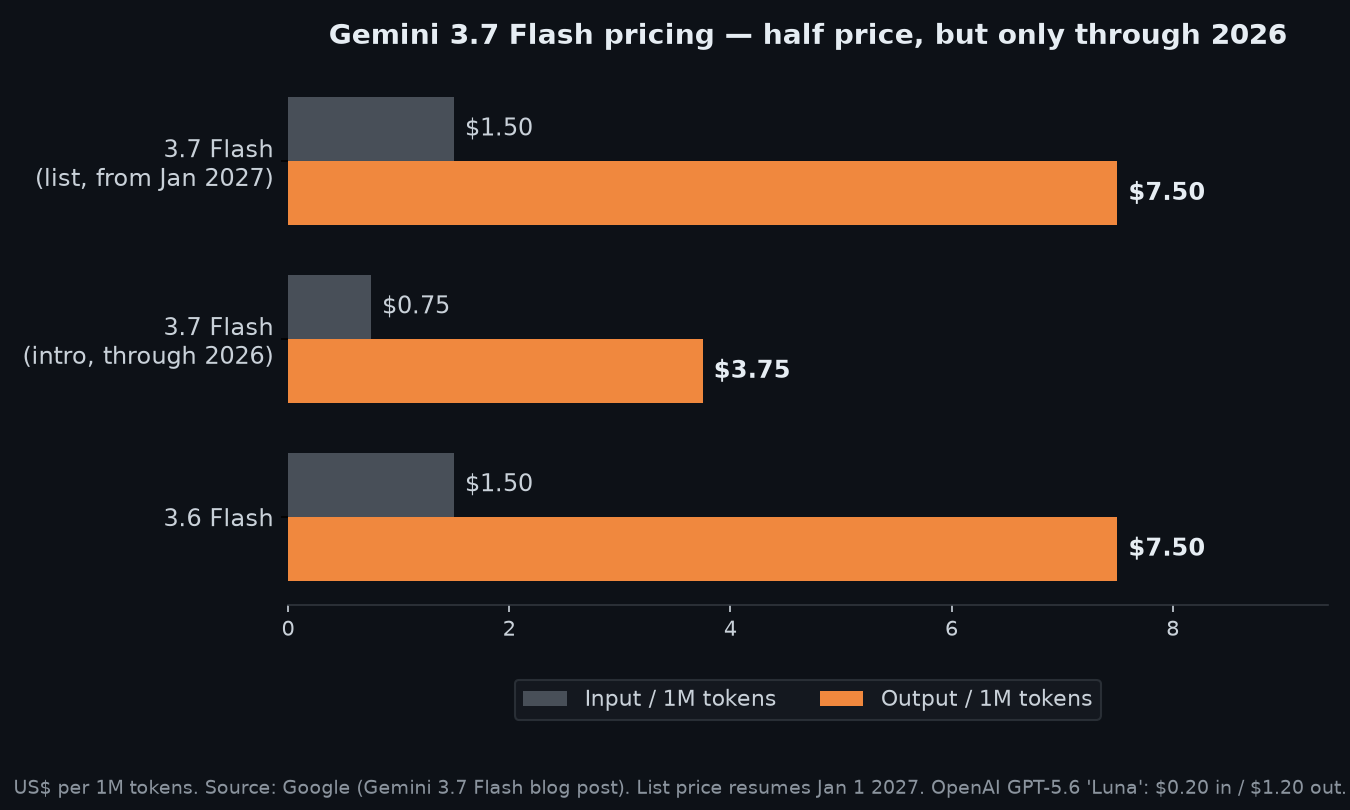
The half-price intro, and where it reverts to. Chart by the author from Google's pricing footnote.
Google is explicit that this is a promo. Ars Technica reads the cut as a move to counter cheaper rivals, and the price gap backs that up — OpenAI's flash-like GPT-5.6 "Luna" runs $0.20 in and $1.20 out, so even at half price Gemini is still the more expensive option by a wide margin. If you're building on 3.7 Flash, the real question isn't today's price; it's whether you can stomach the January 1 jump back to full freight.
Pro availability at the publication date
At I/O in May, Google said the flagship Gemini 3.5 Pro would launch in June. It's August 13 and there's still no 3.5 Pro. Instead we've gotten a run of Flash releases, each nudging the workhorse line closer to the frontier — Ars Technica calls it "multiple Flash models edging closer to 4.0." Their read is pointed: Google doesn't want 3.5 Pro compared against the newest OpenAI and Anthropic models while reports circulate that Gemini's coding has been trailing and AI talent is leaving.
I can't verify Google's motives, and I won't pretend to. The release pattern is public either way: the cheap line ships on a schedule, the flagship doesn't. For developers who've been waiting to see where Google's frontier actually lands, another Flash — however good — isn't the answer they were promised.
Access and deployment conditions
3.7 Flash is live in the Gemini API, AI Studio, Android Studio, and Gemini Enterprise. For individuals, it's a narrower story: the model only powers the Gemini Spark agent for Google AI Pro and Ultra subscribers. The regular Gemini chatbot is still running 3.6 Flash for now. So unless you're paying for Pro or Ultra, or building on the API, you won't touch 3.7 yet. It's a gradual rollout.
Is Gemini 3.7 Flash open source?
No. It's closed and API-only, like every Gemini model. Google hasn't released Gemini weights the way DeepSeek, Qwen, and MiniMax have with their recent models. This post covers it because it's a pricing-and-release story, not an open-weights one.
How much does it cost?
$0.75 per million input tokens and $3.75 per million output tokens through December 31, 2026. On January 1, 2027, it reverts to $1.50/$7.50 — the same as 3.6 Flash. The half-price deal is an introductory rate with a hard expiry.
Is it actually better than 3.6 Flash?
On Google's own benchmarks, yes — DeepSWE 65.3 vs 49.0, AutomationBench 30.4 vs 17.0, FrontierCode 43.6 vs 34.4, GDP.pdf 34.0 vs 22.0. But those are vendor-reported, on a model hours old, with no independent verification yet.
Where can I use it?
Gemini API, AI Studio, Android Studio, and Gemini Enterprise. For consumers, only via the Spark agent for AI Pro and Ultra subscribers. The regular Gemini chatbot is still on 3.6 Flash.
When is Gemini 3.5 Pro coming?
Unknown. Google promised it for June at I/O in May. As of the 3.7 Flash release on August 13, there's still no 3.5 Pro and no new date.
For a Flash user, the decision is whether the coding and automation gains reproduce on the same prompts at an acceptable cost. Pro's launch schedule is a separate availability question. Neither its delay nor Flash's promotional price establishes Google's motives; the published scores and dated rate card are the evidence available here.
Related on this blog: DeepSeek V4 Pro Goes Official — Still 30x Cheaper Than Its Rivals · 96% to 11%: GLM-5.3-Flash, Uncensored at the Weight Level
Sources: Google blog "Introducing Gemini 3.7 Flash" (Aug 13, 2026) · Ars Technica, "Google announces Gemini 3.7 Flash just three weeks after previous release" (Ryan Whitwam, Aug 13, 2026) · Reuters via WHBL (Aug 13, 2026). All benchmark numbers are vendor-reported unless attributed. No company mentioned here paid for coverage; this blog is independent.
Comments
Post a Comment