Grok Bot: AI Teammates With Computers of Their Own
Grok Bot: AI Teammates With Computers of Their Own
I opened X at 3am and my timeline had a new coworker. SpaceXAI dropped Grok Bot last night, and the pitch is unlike anything they've shipped before: not a chatbot, not a coding agent, but "AI teammates" that get a computer of their own. (Yes, SpaceXAI is the freshly rebranded xAI — stay with me.) They sign into your actual tools and keep working while you sleep. It's in beta today. I read the whole announcement twice before the coffee kicked in.
Here's the short version: Grok Bot is an AI agent product where each bot has its own computer in the cloud. You hand it real work the way you'd message a colleague — "handle the invoices in Gmail," "reproduce this bug and file it" — and it signs into the apps and tools you already use, finishes the job end to end, and only comes back to you when something needs your approval. No workflows to configure, no automations to build. Message it, hand off the work, done.
That's a bigger deal than it sounds, because the bots work across anything — including platforms with no clean API or MCP integration. They're not waiting on your laptop either: the bot's computer lives in SpaceXAI's cloud, so jobs keep running 24/7 even with your lid closed.
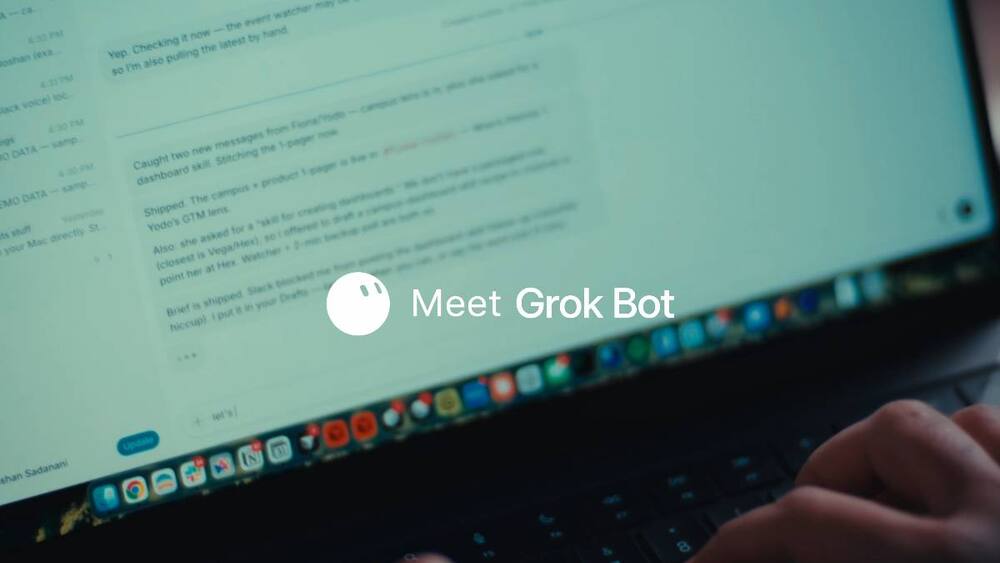
Grok Bot — AI teammates with a computer of their own (photo: Firstpost)
What makes it different
Five ideas stand out in the launch post, and each one is a small philosophy shift:
1. A computer of its own. Each bot gets its own computer in the cloud, where it can sign in and work across apps, tools, and websites — including places with no clean API or MCP. Jobs don't stall when you step away. Inside SpaceXAI, that already looks like real coordinated work: a sales bot updating the CRM with call transcript notes and drafting follow-ups, an ops bot onboarding new hires and processing invoices from Gmail, an engineering bot reproducing a bug in the product UI, filing the ticket, and handing the fix to a debugging bot.
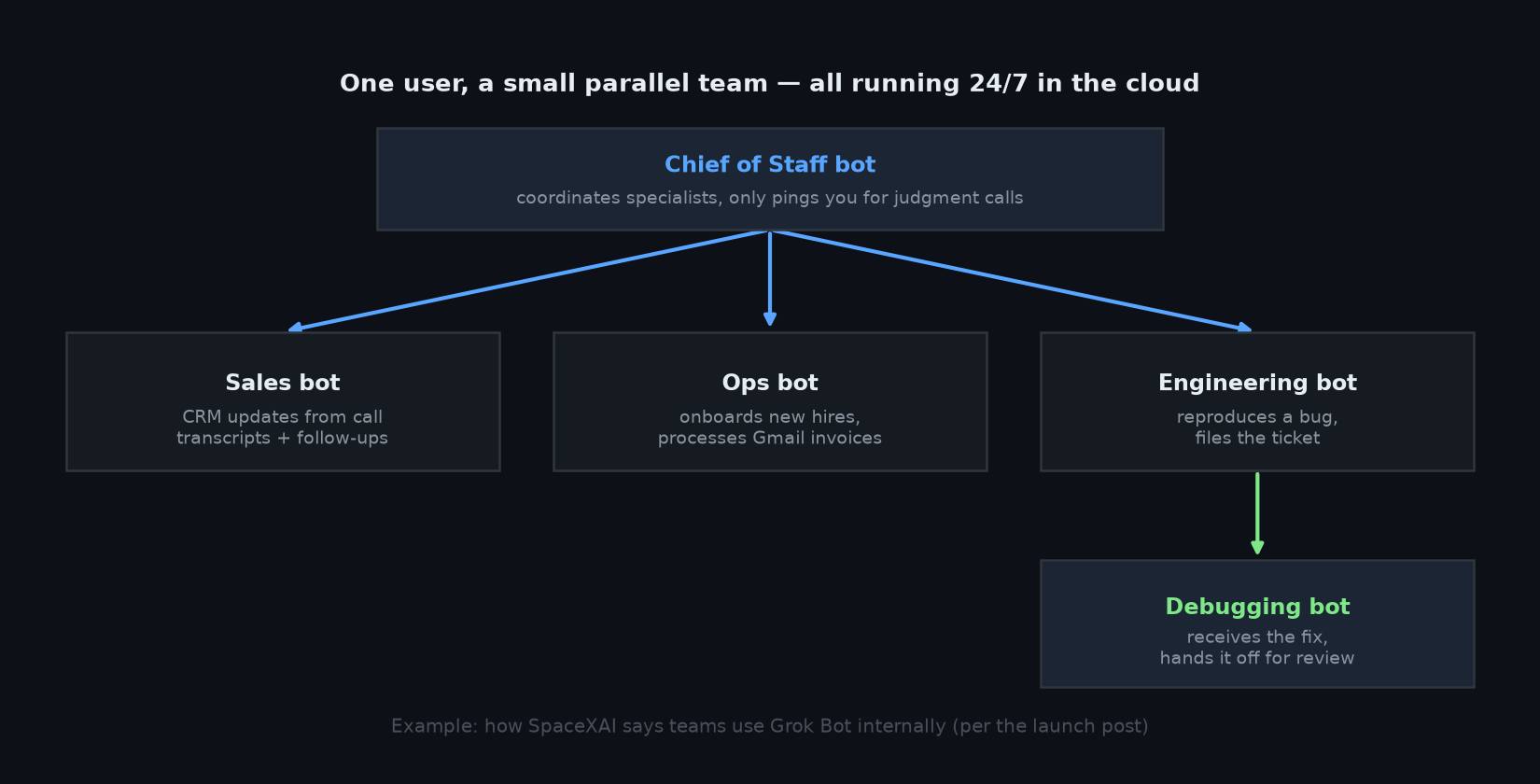
How SpaceXAI says teams run Grok Bot internally — one user, a parallel team (per the launch post)
2. Message it like a teammate. You start from your phone or desktop, the way you'd text someone on your team, and pick up the same thread later on either surface. Fiona from Community put it best: "There wasn't anything to learn. It was just like bringing on a coworker. No automations to set up, no product quirks."
3. Many bots at once. Inside SpaceXAI, people run multiple bots in parallel — a chief of staff bot on top, specialists underneath for inbox, expenses, recruiting, or ops. Bots can message each other, share context in threads, and coordinate in group chats, only pulling you in for judgment calls. Vincent from Growth: "It feels like I have eight arms like an octopus, with every arm in concert with the others."
4. Show a bot how it's done. The best way to teach a workflow is to let the bot follow along while you do a job. It watches the steps, saves them as a routine, takes your corrections, and runs it on its own next time. Bennett from Sales claims he's now "2-3x more efficient because it does it without me verifying and reviewing."
5. Trust grows over time. Bots keep context on how you like work done — your voice, your edge cases, when to ping you versus keep going. They follow up on threads you dropped and get more proactive the longer you work together.
Where this came from: the $60B Cursor deal
The most interesting part might be the corporate story behind it. Grok Bot was developed under the internal code name "Sand" by Cursor — the AI coding startup whose developer Anysphere is being acquired by SpaceX for $60 billion in stock, announced in June 2026, the largest startup acquisition on record. The closing is reportedly imminent, and Grok Bot is the first joint product out of the merger. It's also the first visible sign that the Cursor brand is being phased out in favor of "Grok" — existing Cursor tools keep their name for now, but new products ship as Grok.
That also explains the access model: the beta is unlocked by both companies' top-tier subscriptions — SpaceXAI's SuperGrok Heavy and Cursor's Ultra or Teams Premium. It's the product worlds of SpaceXAI and Cursor physically growing together.
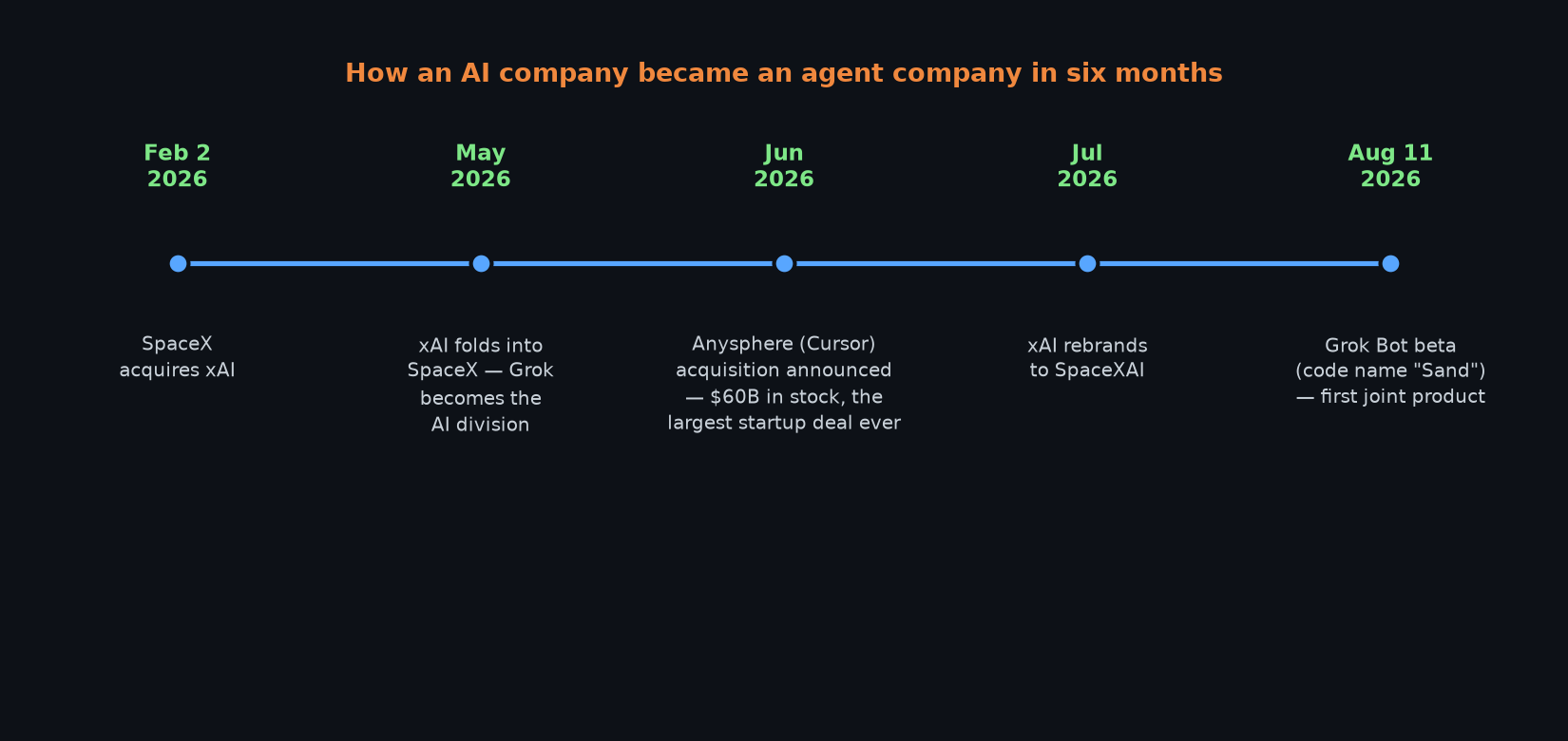
Six months from xAI acquisition to agent launch
The timeline is genuinely fast: SpaceX announced it was acquiring xAI on February 2, 2026. By May, xAI stopped existing as a separate company — Grok and X became SpaceX's AI division. The Anysphere deal followed in June, the rebrand to SpaceXAI in July, and now Grok Bot in August. From AI lab to agent company in six months.
Who can use it, and what it costs
Grok Bot is in beta starting today on desktop and iOS (Windows and Linux desktop versions are also available), for subscribers of:
| Plan | Price | Notes |
|---|---|---|
| SuperGrok Heavy | $300/mo | SpaceXAI's top consumer tier, full Grok 4.5 access |
| Cursor Ultra | $200/mo | Cursor's heavy-usage individual plan (20× usage) |
| Cursor Teams Premium | $120/user/mo | Team plan; $96/mo on annual billing |
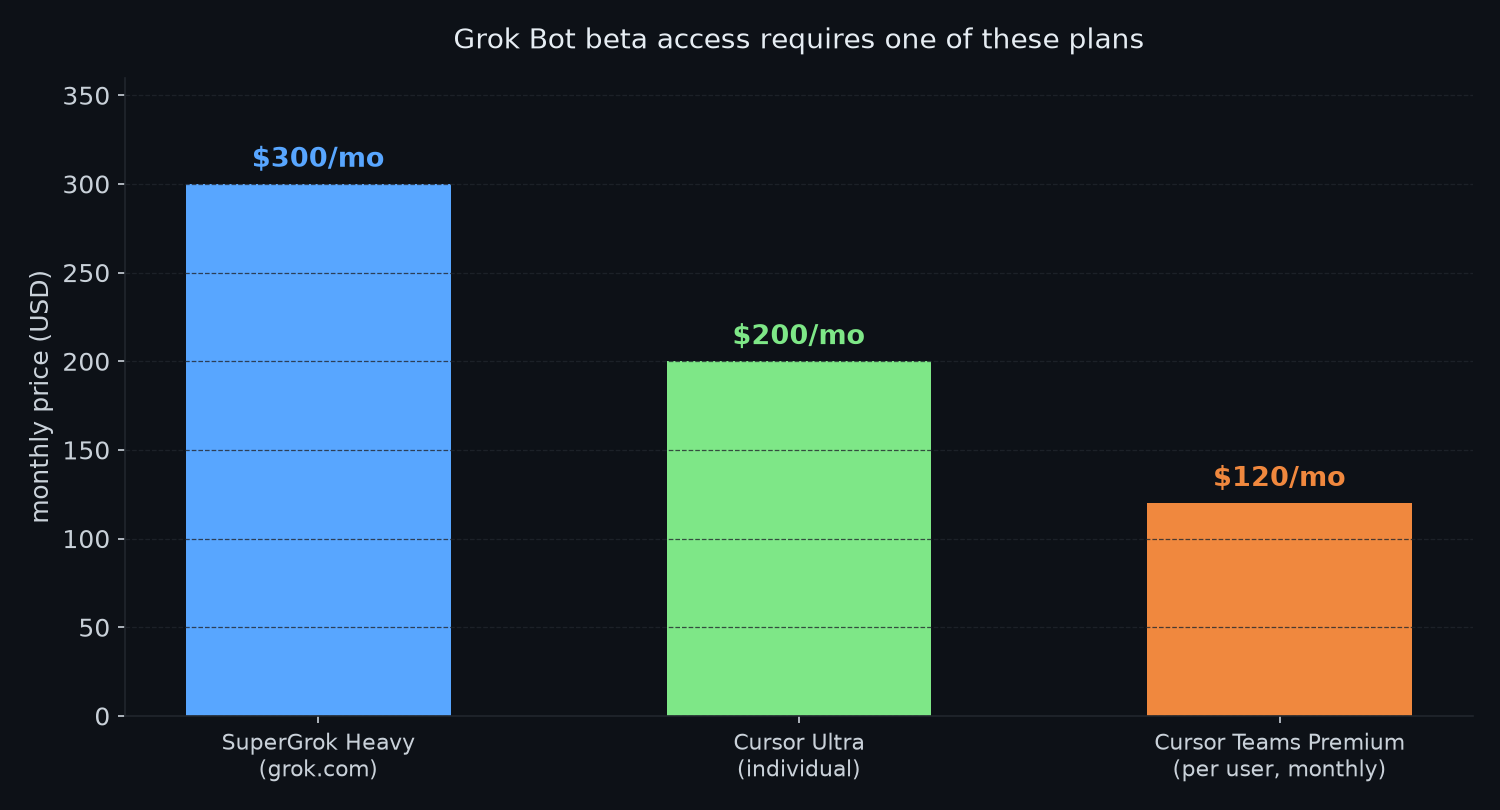
Beta access plans (prices per July 2026 pricing pages)
Enterprise customers join a waitlist. There's no free tier for this one — if you want to try an AI teammate, you're paying at least $96/user/month (Teams Premium on annual billing; $120 monthly). That's a real commitment for a beta.
The office-agent race is on
Grok Bot isn't arriving in an empty room. Anthropic's Claude Cowork has been doing the office-agent thing since January, and OpenAI keeps folding Codex deeper into ChatGPT — so the category isn't new. The framing is, though: Cowork and Codex feel like upgraded assistants; Grok Bot's whole pitch is that you're delegating to a teammate, one that can boss other bots around in a group chat. Whether that's marketing or a genuine architecture difference, only real workloads will tell — and yes, there's a bonus irony that SpaceX also sells Anthropic the compute to run on.
And for the open-source crowd watching this space, the contrast is sharp. The open agent OpenClaw (formerly Clawdbot/Moltbot) makes a similar hand-off-over-chat promise, but it runs as a self-hosted daemon on your own machine or VPS — MIT-licensed, memory stored as plain Markdown and YAML files in a ~/.openclaw directory, and model-agnostic, including local models via Ollama. Grok Bot is the opposite bet: a closed product, tied to Grok models and a paid subscription, with the bot's entire computer — and your credentials — living in SpaceXAI's cloud. Both bets get real-world test results this year.
My take
I'll be honest: the "message it like a colleague" flow is the most promising agent UX I've seen this year, and the multi-bot orchestration — a chief of staff coordinating specialists — is the most concrete version of that idea I've seen described in a launch post, not a rebrand of something that already existed. The internal examples (bot-to-bot bug handoffs, ops bots processing invoices) are the kind of concrete, end-to-end work that most agent demos only gesture at.
But everything here is the company's own word. The launch post is built on internal quotes from sales, ops, and growth people — with zero independent benchmarks or third-party reliability tests behind any of it. It's a beta gated behind $96–$300/month plans, which means the people stress-testing it right now are exactly the people most likely to make it look good. And the trust question is real: your credentials, your conversations, and your routines live on SpaceXAI's cloud machines, not in your home directory. For some teams that's the point — for others it's a dealbreaker before the first message is sent.
I'll come back with a follow-up once independent tests and real third-party usage reports land — especially on reliability, which is the metric that actually decides whether AI teammates are a productivity story or a demo story. For now, the most interesting agent launch of the year is also the one I can't fully test on my own hardware — so for the moment I'm stuck reading other people's results. I'll be back when I have my own.
Related on this blog: Astra: 10 Math Proofs, Then OpenAI Paused Its Own Model · Grok 4.6: Frontier Grade, Half the Price
Comments
Post a Comment