H3 Max: The Hosted Retrain and the Open Base
IMAGE, VIDEO & AUDIO
H3 Max: The Hosted Retrain and the Open Base
fal's H3 Max is a post-trained H3 service, not the same deployment as the downloadable base model. Its reported speed and arena placement make an API comparison worth considering. Local editing, released artifacts and hosting requirements need a separate check.
In this article
H3 Max uses the 33B H3 base, with post-training aimed at prompt adherence and visual quality. At the article's leaderboard snapshot, Artificial Analysis placed it first in image-to-video and third in text-to-video with audio. Its 768p limit and unreleased weights distinguish it from the base H3's local and editing workflows.
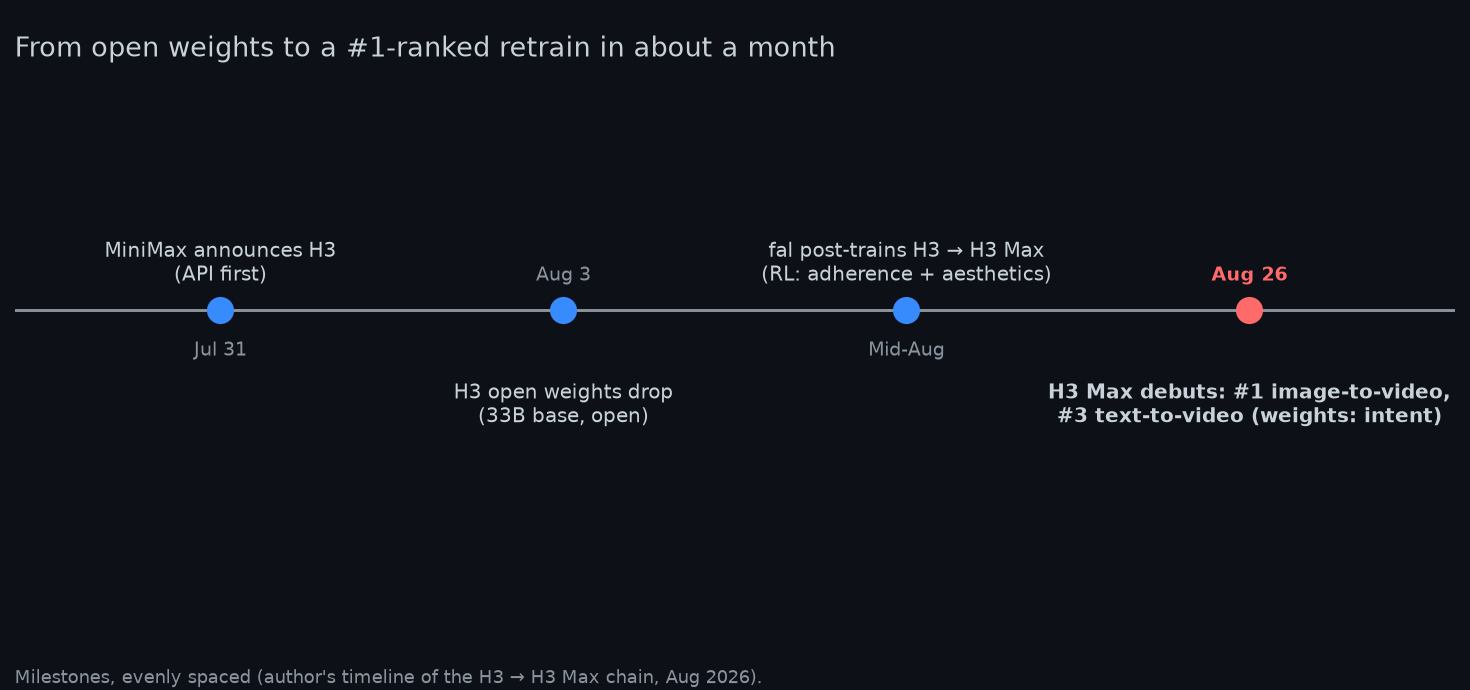
From open weights to a #1-ranked retrain in about a month (author's milestone timeline, Aug 2026).
The base model and fal's post-training
H3 Max is not a MiniMax model. It's fal's post-trained variant, built on top of the open-weights MiniMax H3 base. fal spent the post-training compute on two things it says moved the needle: stronger prompt adherence and better aesthetics, with a big slice of it going into verifiable reinforcement-learning tasks. Then it co-optimized the serving path so the thing actually delivers on the speed.
The output side stays close to the base: 5 to 15 second clips, 768p (native 480p and 768p, a step above 720p), 24fps, native stereo audio generated alongside the picture, 11 languages, and the usual six aspect ratios. Two modes are live right now — text-to-video and image-to-video. MiniMax's base H3 also does reference-conditioned generation from mixed images, clips, and audio; H3 Max doesn't carry that yet.
Output examples
Specs are one thing; the stills are another. These are actual generations, not renders — the cinematic frames are what make the "someone retrained open weights" framing finally land. Here's a poster and two frames pulled from the official H3 and H3 Max demos.

H3 Max hero poster from fal's product page — "the past is rewritten" (image: fal — H3 Max).

A frame from fal's H3 video demo: a rain-soaked duel, with native motion and a cinematic grade (image: fal — MiniMax H3 demo).

A relaxed street-café scene generated by MiniMax H3 — fine detail, natural light, filmic depth (image: MiniMax H3).
Latency claims and serving conditions
fal reports roughly three seconds for a five-second clip, about 35 times the throughput of the official H3 endpoint, and an average 15-fold speed advantage over services it describes as comparable in quality. It gives about 15 seconds for a 15-second generation. These are fal's service comparisons, not timings measured for this article.
But read the fine print before you imagine a magic box. H3 Max reaches 768p and stops — the 2K regenerate stage that MiniMax uses for its own service was never opened, so there's no 2K handoff. And the speed is partly the standard "co-designed inference stack" story: fal isn't just tuning weights, it's serving them on hardware and software built for this exact model. That's a real engineering advantage, not a qualification to pretend this runs fast on your 1080 Ti. The open base runs locally in ComfyUI; H3 Max the fast thing does not, yet.
The dated arena rankings
Here's the part that made me re-read the leaderboard. On Artificial Analysis's image-to-video ranking with audio, H3 Max sits at 1200 Elo, a hair ahead of ByteDance's Dreamina Seedance 2.0 720p (1189) and the base MiniMax H3 (1185). On text-to-video, it's #3 at 1235, inside a six-point window at the top — the top three are basically tied, and on any other day the order could shuffle.
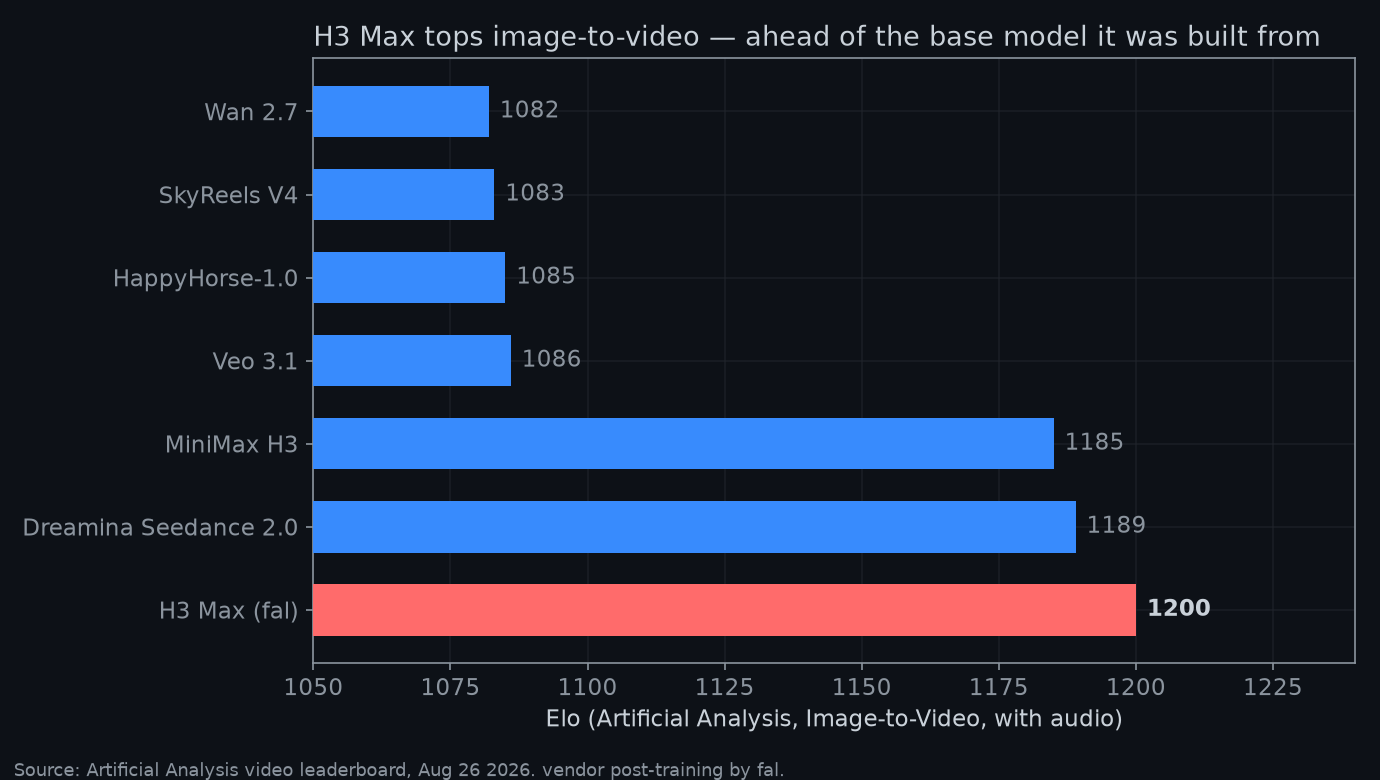
H3 Max edges out the base model it was built from on image-to-video (source: Artificial Analysis, Aug 26 2026).
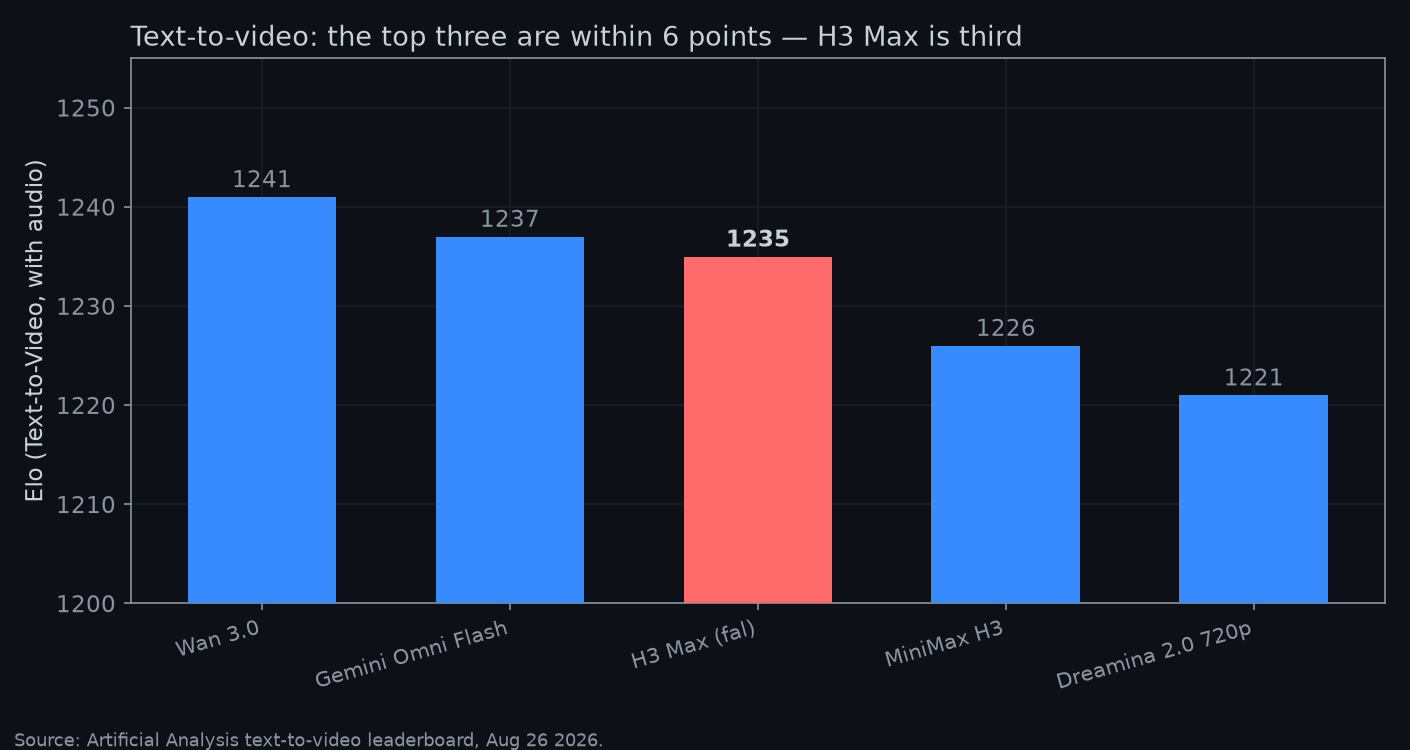
Text-to-video: the top three are within 6 points, with H3 Max third (source: Artificial Analysis, Aug 26 2026).
Price and launch conditions
On price it's refreshing, on two axes. The first is quality-for-money: at the top of the image-to-video board, H3 Max is both the strongest and among the cheapest — it sits in the corner of the price-performance chart that nobody else reaches.
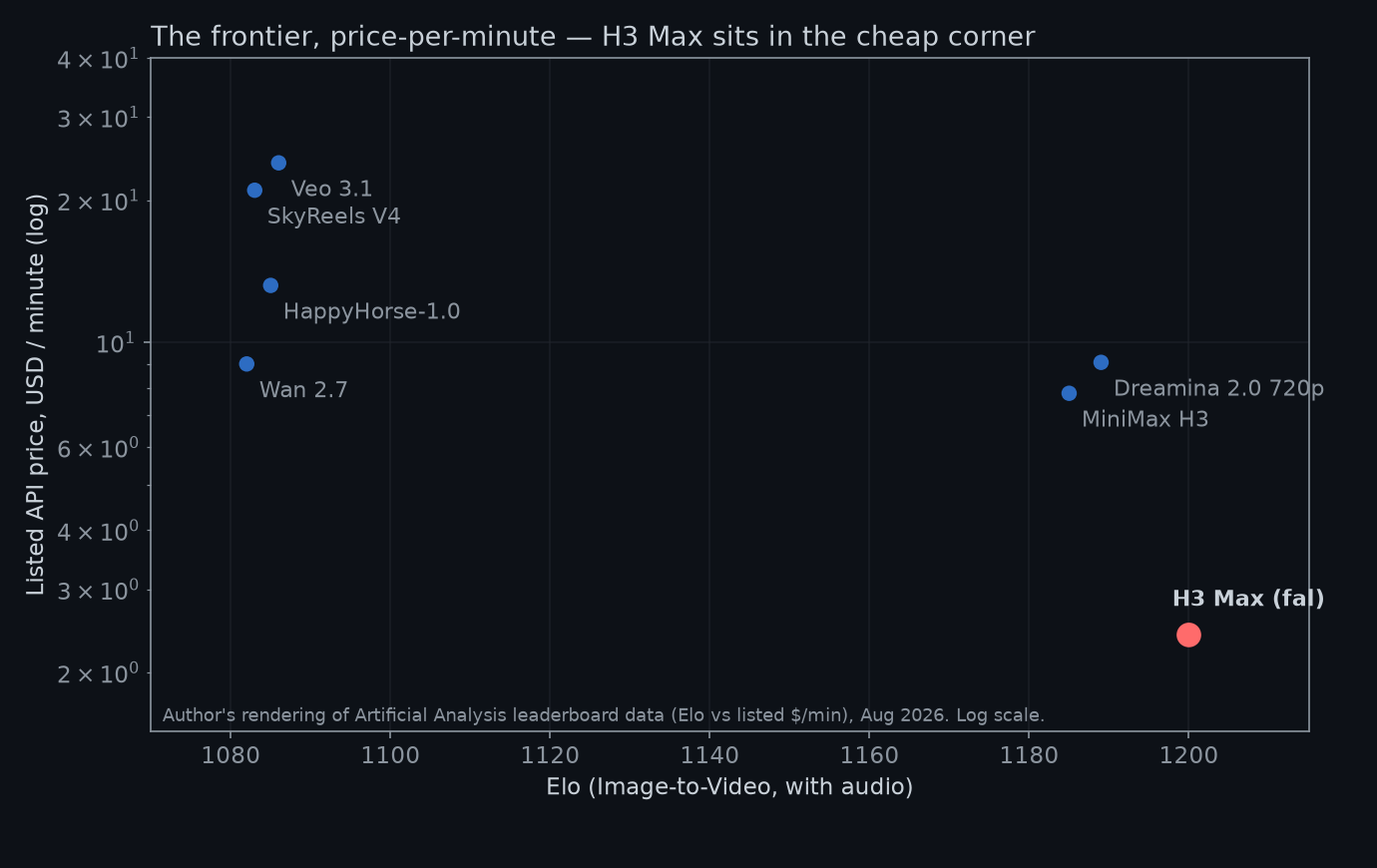
Quality vs listed price-per-minute: H3 Max sits alone in the cheap corner (author's rendering of Artificial Analysis data, log scale).
The second is the sticker price. fal lists H3 Max at $0.06/second at 768p ($3.60/minute), with a 50% launch discount for 14 days (about $0.03/second); Artificial Analysis's board quotes it even a touch lower. A 15-second clip runs about ninety cents at list — far under the $1.50 to $7.10 the closest rivals charge for the same fifteen seconds.
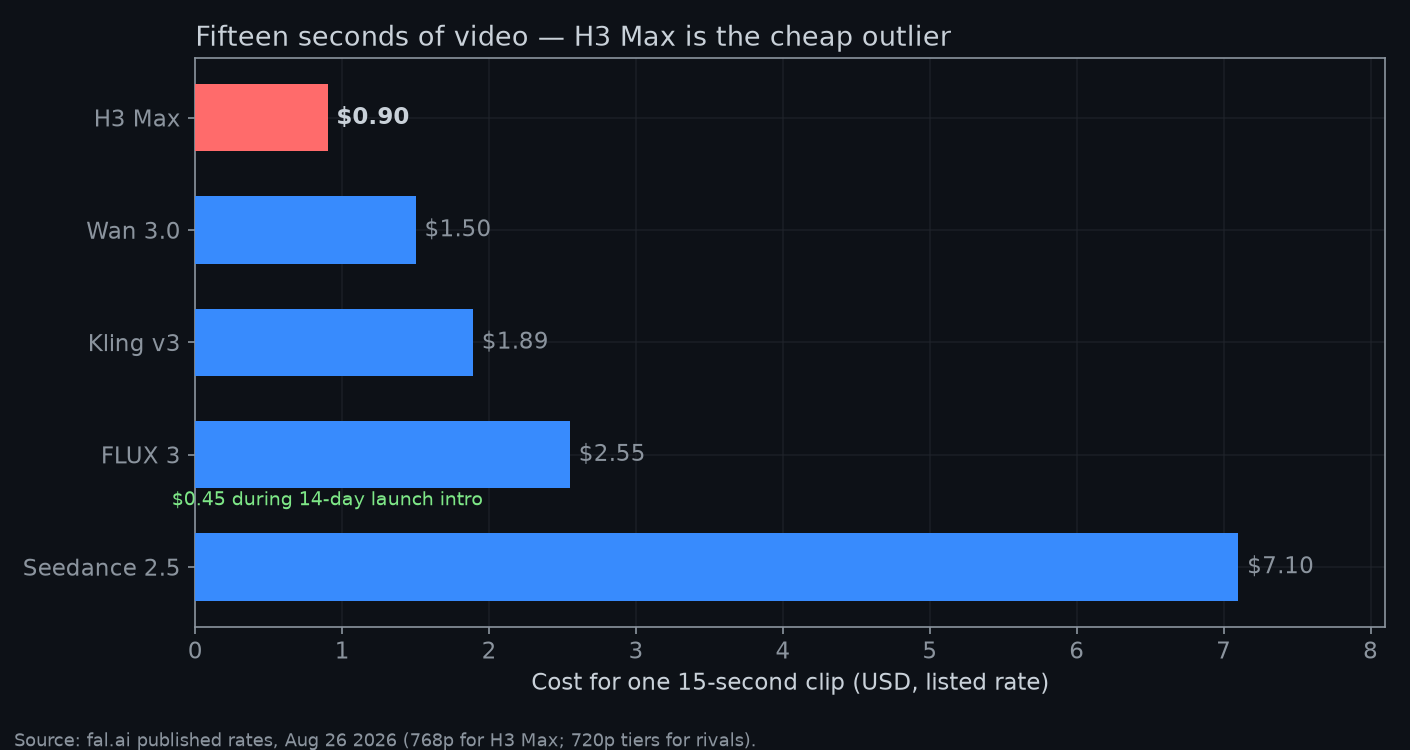
Fifteen seconds of video — H3 Max is the cheap outlier (listed rates, 768p for H3 Max, 720p tiers for rivals; fal.ai, Aug 26 2026).
Three caveats are worth carrying, and they're not small:
- The weights aren't out. fal has said it intends to release H3 Max weights — Artificial Analysis flagged that if it does, H3 Max would become the top open-weights model on both boards. As of today that's intent, not a download.
- The license chain is territorial. The base H3 is open but under MiniMax's Community License, which excludes Korea, the US, the EU, and the UK for commercial use without separate approval. H3 Max is derived from those weights, so that shadow extends to it.
- It's fal-served, not self-hosted. Everything fast about H3 Max lives behind fal's API for now. The moment the weights drop, the honest test — "can I actually run this without leasing GPUs" — starts.
Generation, editing and local use
The arena result supports a narrower conclusion than 'better H3': strong preference scores in the listed generation categories at 768p. Base H3 retains a separate editing workflow and the official service's 2K path. Compare the categories you will use, rather than combining those capabilities into one winner.
For an API workflow, H3 Max is worth a matched test of prompt adherence, failed generations, latency and price. For a local workflow, the open H3 base is the available starting point at this publication date. Hosted speed and arena preference scores cannot substitute for a released H3 Max artifact.
If the weights land, I'll rewrite this post the same week and actually put it on hardware.
Sources: fal — Introducing H3 Max · fal — H3 Max product page · Artificial Analysis — Image-to-Video leaderboard · Artificial Analysis — Text-to-Video leaderboard · MiniMax H3 model card. Related here: MiniMax H3 finally went open-weight and can my PC run it?.
Comments
Post a Comment