HeartMuLa: Suno Quality at $0? Not Quite
HeartMuLa: Suno Quality at $0? Not Quite
Every couple of weeks someone announces that open source has finally caught up with Suno. This time it's HeartMuLa: a 3-billion-parameter music model, Apache 2.0, runs on an 8GB graphics card. The team's GitHub says the internal 7B version "achieves comparable performance with Suno." I've been burned by that exact sentence too many times. So I did what I always do — checked what independent ears heard, and what happens when you run the thing yourself.
Verdict first: there is still no open-source Suno. Independent listening tests put HeartMuLa's released 3B at "generic pop in every case," and even the best-sounding open model of 2026 can't legally ship in a product. What HeartMuLa actually is matters more than the Suno comparison: the most practical Apache-licensed way to generate full songs on your own hardware. That's what this post is about.
What HeartMuLa actually is
HeartMuLa is a family of open music foundation models from a team that published a paper (arXiv 2601.10547) without disclosing an institutional affiliation. The interesting engineering is in the codec. Most music models tokenize audio with one encoder. HeartMuLa's HeartCodec fuses three — Whisper, WavLM, and a MuEncoder — into a single quantizer running at 12.5 Hz, the lowest frame rate of the eight models IT-JIM compared. On top sits a Llama-3.2-based language model, arranged hierarchically as global-plus-local, with preference optimization split along the same seam. The result generates full songs — vocals, instrumental, structure — from lyrics plus a handful of style tags.
HeartMuLa's logo (image: HeartMuLa project, Apache 2.0)
The release history is fast and recent. The first 3B checkpoint plus HeartCodec landed January 14, and the license switched to Apache 2.0 six days later, along with a community ComfyUI node. Then came an RL-trained build for tighter style control (January 23), the HeartBeats benchmark (February 3), and the "happy-new-year" build — the team's pick for lyrics control and music quality — on February 13. Online demos went up on Hugging Face Spaces and ModelScope on April 10. The model card sits at 258 likes and 21 Spaces as of this writing.

Six years of open-source music generation, from Jukebox to the 2026 wave — red dot is this post's subject. Chart by the author.
HeartMuLa isn't alone in that wave, which is the context that matters. Since January, the field has shipped ACE-Step 1.5 (MIT, the remixing toolkit), LeVo 2 (the audio-quality winner, non-commercial), DiffRhythm 2, Muse, and Khala. Every one of them came with the same headline — "Suno parity" — and the same problem: the claim never survives a listening session.
The claim vs. what actually ships
The HeartMuLa README's highlight section says, verbatim: "Our latest internal version of HeartMuLa-7B achieves comparable performance with Suno in terms of musicality, fidelity and controllability." Read that sentence twice. The 7B is internal — it has not been released, and every public checkpoint is the 3B. IT-JIM's independent review makes the same catch: "HeartMuLa's abstract claims significant gains at 7B parameters, but only 3B SKUs ship." The comparison everyone quotes is for a model you cannot download.
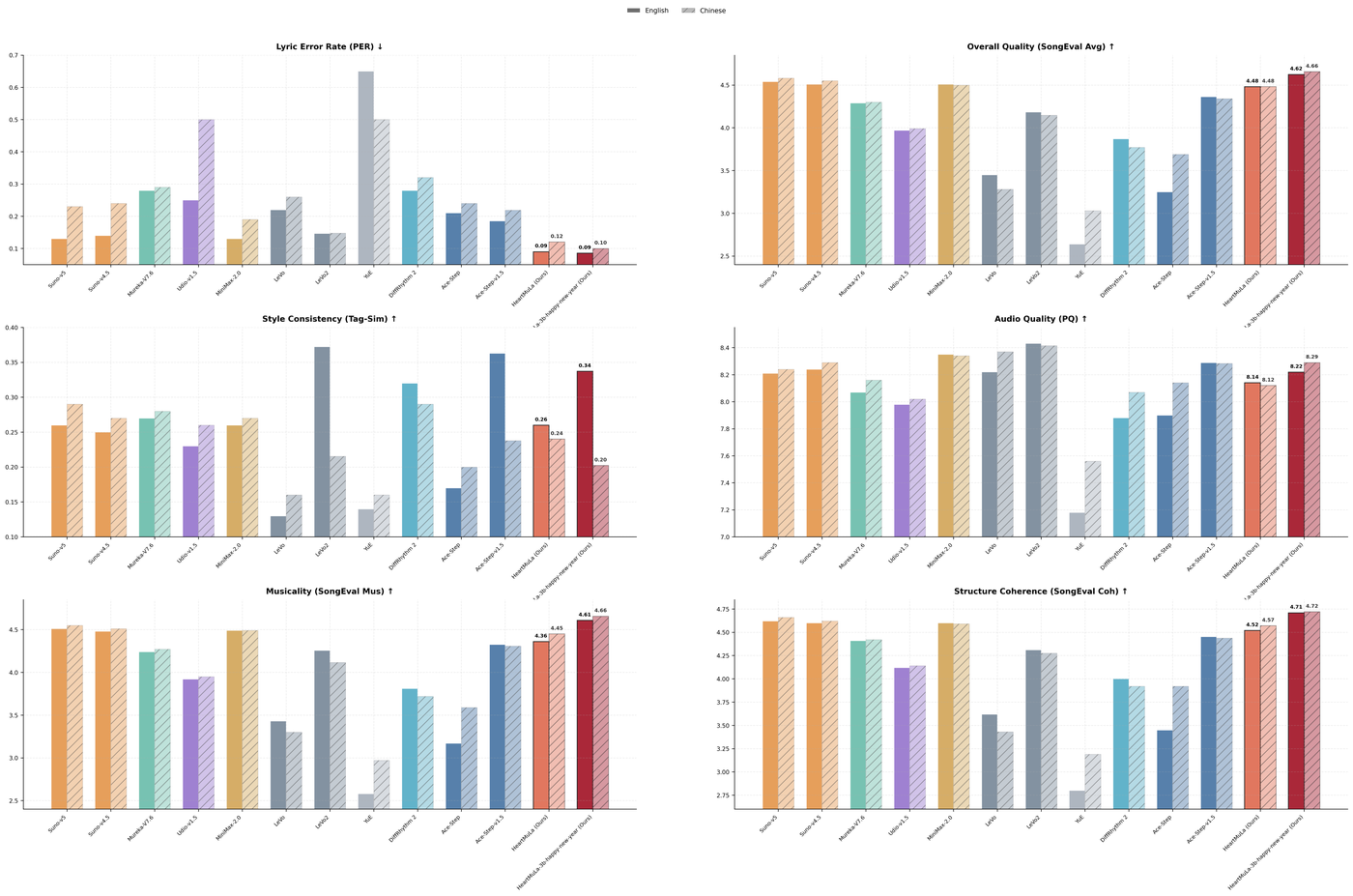
The vendor benchmark table: PER 0.09/0.12, SongEval averages around 4.6, audio quality (PQ) around 8.2 for HeartMuLa, compared against Suno-v5 and others (image: HeartMuLa; vendor-reported).
The numbers look strong — lyric error rate of 0.09 on English, overall quality around 4.6, perceptual audio quality around 8.2, sitting alongside Suno-v5. But the fine print is structural, not rhetorical. The lyric-error pipeline runs on HeartTranscriptor, which is HeartMuLa's own speech recognizer. The same ASR computes the WER table, the PER table against competitors, and the reward signal for one of its DPO sets. The subjective evaluation used 9 raters across 20 samples. None of that makes the numbers wrong; it makes them same-team measurements, which is exactly what IT-JIM's report says to watch for in this field's benchmark tables. Trust the listening notes instead.
Running it on modest hardware
This is where HeartMuLa genuinely stands out from the rest of the wave: it runs where most of the competition doesn't. The official minimum is 8GB of VRAM with lazy loading enabled. Models load on demand and unload after inference. The 3B peaks around 6.2GB. That's a genuinely modest ask; a single 11GB card clears it with room to spare. If you have two GPUs, you can split the language model and codec across them. On CPU it technically works, but a song will take on the order of an hour instead of minutes.
| Spec | HeartMuLa (3B) | Why it matters |
|---|---|---|
| License | Apache 2.0 | Commercial use and fine-tuning allowed |
| Minimum VRAM | 8GB (lazy load), ~6.2GB peak | Runs on mid-range cards, unlike most of the wave |
| Speed | RTF ≈ 1.0 — a 4-minute song takes ~4 minutes | Realtime-ish; Suno returns in tens of seconds |
| Output | MP3, 48kHz stereo | Ready to use, no post-processing |
| Input | Lyrics with [Verse]/[Chorus] tags + style tags | Full-song structure control |
HeartMuLa 3B as documented by the project and community (setup notes below)
Setup is the honest cost. The pinned dependencies conflict with current versions of the ecosystem, so you'll need to upgrade datasets and transformers first. Current transformers needs source patches, though. Re-initialize the RoPE caches after weights load from the meta device. Tell HeartCodec to ignore a codebook buffer shape mismatch — harmless, but fatal if unpatched. Once past those, generation itself is straightforward — write lyrics in bracketed sections, list tags like "piano,happy,wedding", and run. Community notes warn that bf16 on the codec degrades audio noticeably, and that tags sometimes get ignored outright in favor of the lyrics.
What independent ears actually heard
IT-JIM, an audio AI shop, ran the most useful independent comparison this field has: eight open-weight song generators, three style-and-lyric combinations each, careful listening. Their headline is the one worth repeating: "no, there is not an open-source Suno yet." The closest model gets within audible-but-real distance of Suno V5 on some prompts and trails on others. Their verdict on this post's subject is blunt — HeartMuLa "sounds the same across styles. We tried hard rock, jazz, and pop, and what came back was generic pop in every case — averaged, smoothed, AI-blurry." They frame it carefully: maybe a weights or inference quirk on their end. But the same result across three very different prompts pushed them toward something structural.
The full landscape makes the trade-off visible. I'm showing it because it explains every "Suno killer" headline you'll read this year.
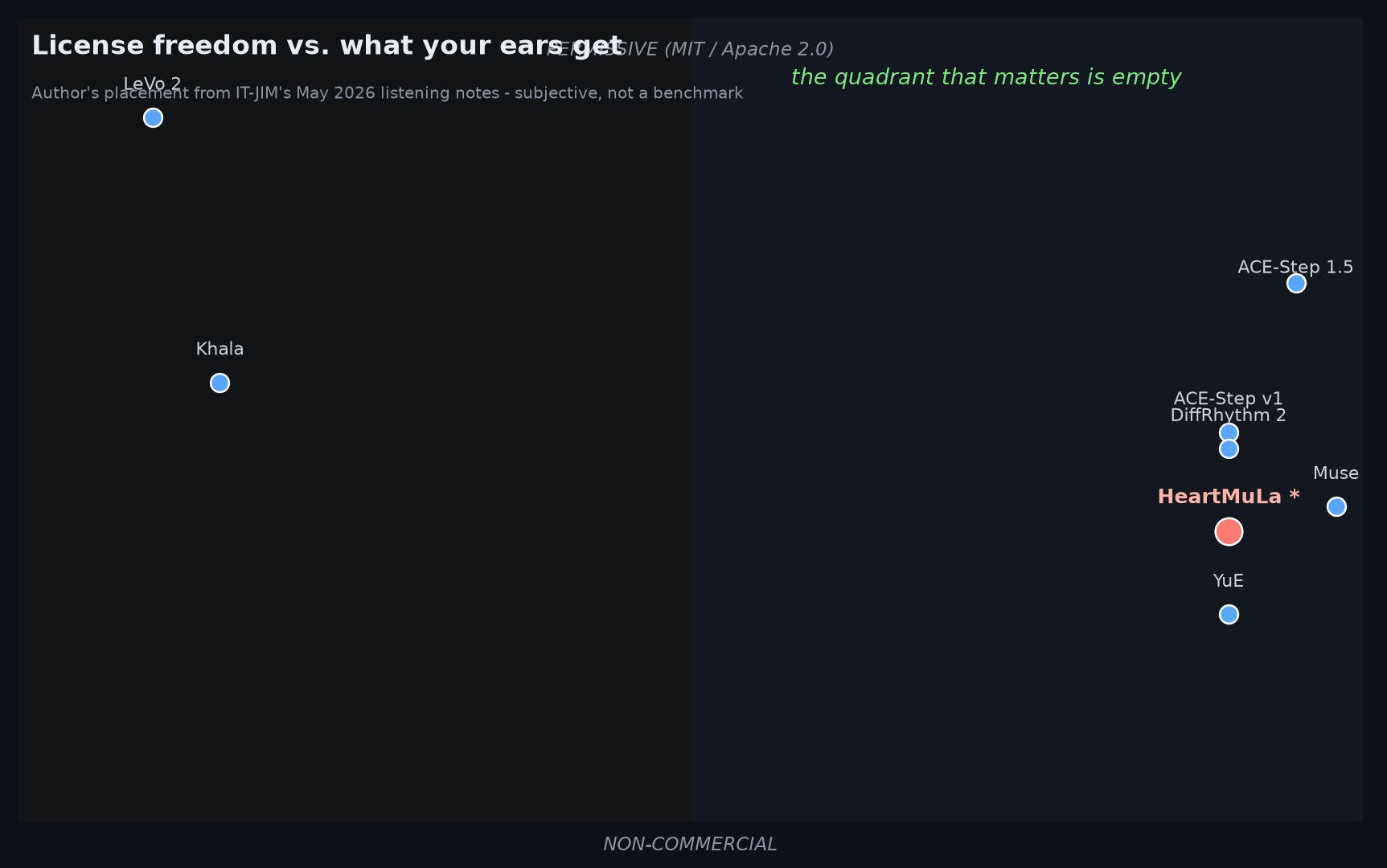
License freedom vs. what your ears get, for the 2026 slate. Author's placement from IT-JIM's listening notes — subjective, not a benchmark. Chart by the author.
LeVo 2 sits alone at the top of the audio column — and its Tencent license forbids commercial or production use. ACE-Step 1.5 is the permissive tooling winner, but IT-JIM heard a metallic shimmer on vocals and instrumentals alike. Khala is fascinating and unstable, under an active disclaimer from its own authors. Muse — the one permissive model with fully open training data — was trained on synthetic Suno output, and shows it. And in the top-right corner, permissive and great-sounding, there is nothing.
Even DiffRhythm 2, the most paper-honest model of the year, wrote its own thesis line: "Open-source still falls short of commercial systems overall." When the vendor says it about themselves, the marketing is officially over.
What it's actually for
Here's the pricing picture that reframes the whole comparison. Suno's free tier gives about ten songs a day with no commercial rights. Pro is $10 a month ($8 billed yearly) for roughly 500 songs with commercial use. Premier is $30 ($24 yearly) for about 2,000. HeartMuLa costs nothing per song, ever, and there's no account, no upload, and no ToS on your lyrics — but you pay in electricity and, at roughly realtime generation, in waiting.
| What you want | Suno Pro ($10/mo) | HeartMuLa local ($0/mo) |
|---|---|---|
| Best audio quality today | Yes — v5.5-class output, seconds per song | No — independent listening says generic pop |
| Unlimited volume | ~500 songs/mo on Pro | Yes, bounded only by GPU time |
| Offline / private / no account | No | Yes |
| Fine-tuning your own style | No | Yes — Apache 2.0 weights |
| Ship inside a product | Terms-of-service-limited | Yes, license-clean |
Where each option wins. Suno pricing via third-party summaries of suno.com/pricing (July 2026); HeartMuLa costs are hardware and time.
What do people actually use it for? Prototyping, mostly. Write a song, hear a full arrangement in minutes, decide whether the idea deserves a real production pass. Then pipelines — any tool that needs song generation without a per-song API fee or a vendor ToS. And the one the open community cares about most: a base model you can fine-tune on your own music. No closed platform offers that at any price. If you just need the best-sounding song right now, pay Suno; that answer hasn't changed all year.
My take
I keep a rule for claims like "Suno parity": the benchmark table is marketing until a neutral listener confirms it. HeartMuLa's table is impressive, its 7B claim is about a model you can't download, and the released 3B — by independent ears — isn't there yet. That's not a dismissal; it's the same arc every open model I've written about this year goes through, from swapping MiniMax H3's text encoder on an 11GB card to this. The gap closes in steps, not launches. HeartMuLa's real step is being Apache-licensed, structure-controlled, and runnable on a mid-range card — the thing Suno's terms of service will never give you. If the 7B ships, I'll rewrite this post the same week. Until then, "Suno quality at $0" stays a headline, not a verdict.
Can I run HeartMuLa on 8GB of VRAM?
Yes, with lazy loading — models load and unload on demand, peaking around 6.2GB for the 3B. Expect roughly realtime generation: a 4-minute song takes about 4 minutes on GPU. CPU-only technically works but is impractical.
Is it as good as Suno?
No, not the released model. Independent listening (IT-JIM, May 2026) heard generic pop across three very different style prompts. The team's Suno-comparable claim refers to an internal 7B that hasn't shipped.
Can I use the songs commercially?
Yes — code and weights are Apache 2.0, which covers commercial use and fine-tuning. That's HeartMuLa's biggest practical advantage over the non-commercial license of the best-sounding open model, LeVo 2.
What about the 7B model?
Unreleased. The README's highlight claims Suno-comparable performance; the paper's abstract claims significant 7B gains. But every public checkpoint is the 3B. When a 7B SKU actually ships, third-party ears will have something new to evaluate.
What about LeVo 2 or ACE-Step 1.5?
LeVo 2 sounds best by independent listening but forbids commercial use (Tencent custom license). ACE-Step 1.5 is MIT with the best remix/cover tooling but a metallic artifact. For shipping a product today, HeartMuLa's Apache license is the cleanest bet among the well-documented models.
Sources: HeartMuLa paper (arXiv 2601.10547) · heartlib GitHub · Hugging Face model card · IT-JIM "Best Open-Source AI Music Generator 2026" (May 21, 2026 — the independent listening notes quoted here) · Suno pricing page via third-party summaries (July 2026). All benchmark numbers are vendor-reported unless attributed. Setup details from community documentation and the project's own repo; not a fresh install by this author. This blog is independent — no company mentioned here paid for coverage.
Comments
Post a Comment