LTX-2.5: 10 Seconds of Video in 6.8 Seconds
LTX-2.5: 10 Seconds of Video in 6.8 Seconds
I stopped mid-changelog at "6.8 seconds." A 10-second AI video clip, image in, video out, at 720p — in less time than it takes me to microwave ramen. And the weights are just... out there. For anyone. So I spent the morning digging through what LTX actually shipped on August 11, and here's the thing: the numbers are real, but they're also weirder than the headline.
LTX — the open world model company that spun out of Lightricks (yes, the Facetune people) — dropped LTX-2.5 yesterday, the latest of its open-weights models that generates video and audio together. It landed on Hugging Face, inside ComfyUI on day one through a formal launch partnership, and behind the LTX API if you'd rather not touch a GPU at all.
That day-one ComfyUI integration is the part that actually matters, by the way. ComfyUI has quietly become the de facto prototyping environment for open generative media, and LTX's CEO Zeev Farbman was unusually honest about why they're there: "A whole lot of our customers are starting their journey with Comfy... it's basically our customer acquisition channel." Not philanthropy. Strategy.

LTX-2.5 — video, audio & world simulation (source: LTX / Hugging Face)
What's actually new under the hood
LTX says 2.5 rebuilds nearly every stage of the pipeline instead of bolting features onto 2.3. The four headline changes:
| Feature | What it does |
|---|---|
| Diffusion video decoder | Replaces the old VAE decoder — fewer artifacts in high-motion shots, and it reconstructs fine detail like text and faces while keeping LTX's high compression ratio |
| Native multishot | Generates a whole sequence as one output — character, scene, and voice stay consistent across cuts instead of stitching separately-generated shots |
| Gemma 4 language backbone | A custom 12B Gemma 4 text encoder plus a dedicated prompt enhancer for complex, multi-subject prompts |
| Physical-AI checkpoint | A pretrained checkpoint tuned for robotics and physical AI — a base to fine-tune on domain data that looks nothing like cinematic video |
The transformer itself is a 22B distilled DiT running a fixed 8-step schedule with CFG=1 — that's the whole speed trick. There's also a fully trainable "dev" transformer for people who want to fine-tune, plus ComfyUI-specific int8 and NVIDIA NVFP4 quantized variants, which matters for the 16GB-VRAM crowd. The full distilled pack runs about 66 GiB across five files, and you can download only the pieces your pipeline needs.
About that 6.8 seconds — read the fine print
That 6.8-second number doesn't survive contact with the fine print. LTX measured its own speed at 6.8 seconds for a 10-second, 720p image-to-video clip. That's faster than real time, which in this market is a genuinely absurd sentence. But here's the catch: the hardware. That figure was measured self-hosted on two NVIDIA GB200 superchips at steady state — a rig almost nobody has in their garage. Through LTX's own managed API, the same job took 23.7 seconds, and that's rendered at 1080p (the API has no 720p tier). Still fast. Not "faster than real time" fast.
Against competing APIs, LTX says its end-to-end measurements on the same task look like this — fair warning, these are LTX's own numbers, not independent benchmarks:
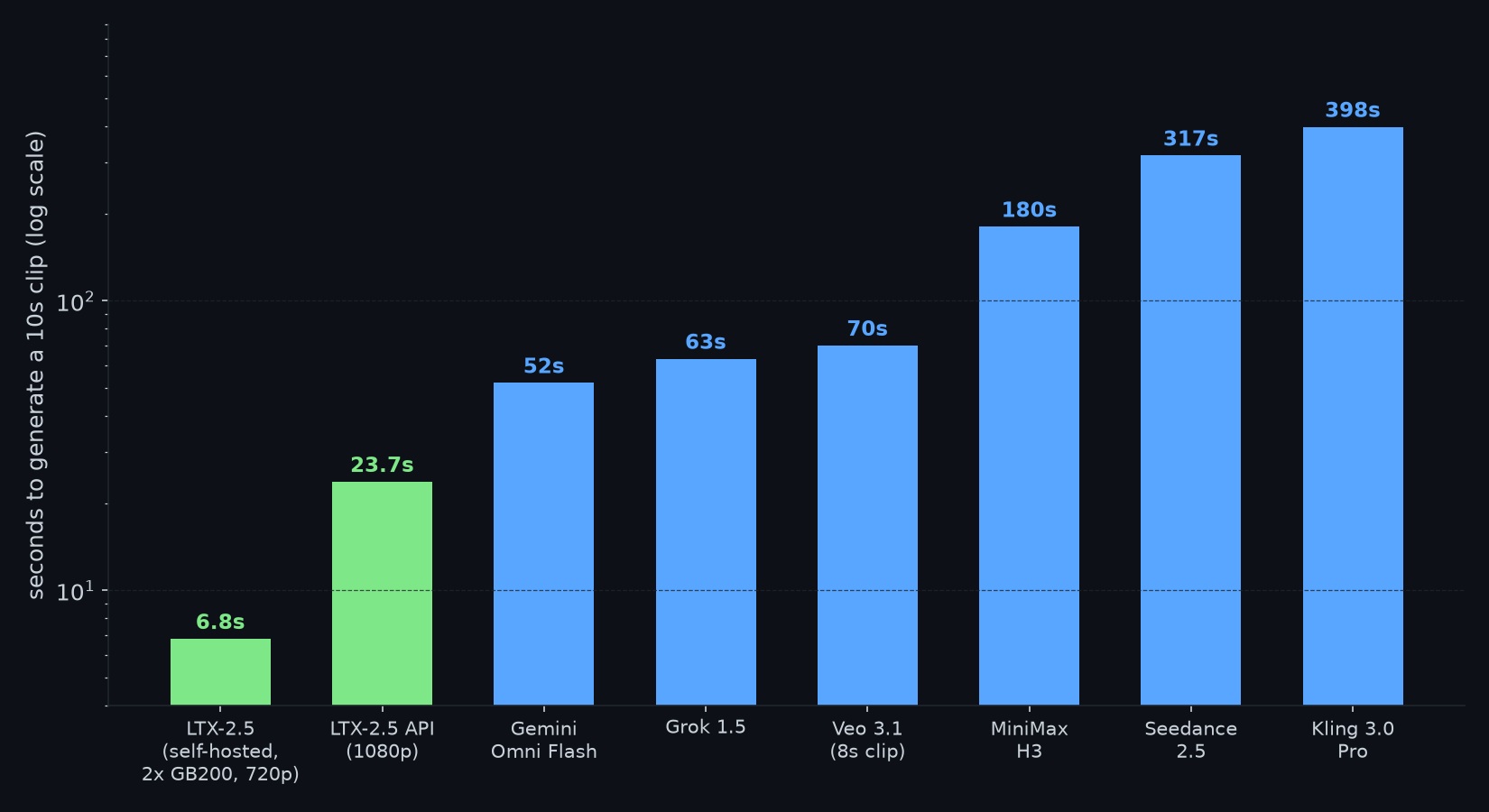
Time to generate a ~10s clip, per vendor (LTX-reported measurements, Aug 2026)
| Service | Time to generate a 10s clip | Notes |
|---|---|---|
| LTX-2.5 (self-hosted, 2× GB200) | 6.8s | 720p, steady state — not a typical rig |
| LTX-2.5 API | 23.7s | 1080p (API has no 720p tier) |
| Gemini Omni Flash | 52s | |
| Grok 1.5 | 63s | |
| Veo 3.1 | 70s | 8s clip, per LTX measurement |
| MiniMax H3 | 180s | |
| Seedance 2.5 | 317s | |
| Kling 3.0 Pro | 398s |
LTX also claims roughly one-eighth the cost and one-seventh the render time of comparable models. Same caveat applies: that's their math, on their workloads. Directionally interesting, not a settled ranking.
Quality: a 67% win rate in blind tests
On the "is it actually good" question, LTX shared blind side-by-side human preference results — evaluators voted on videos from the same prompt without knowing which model made which. LTX-2.5 landed at a 67% win rate, narrowly ahead of Seedance 2.5 at 65%.
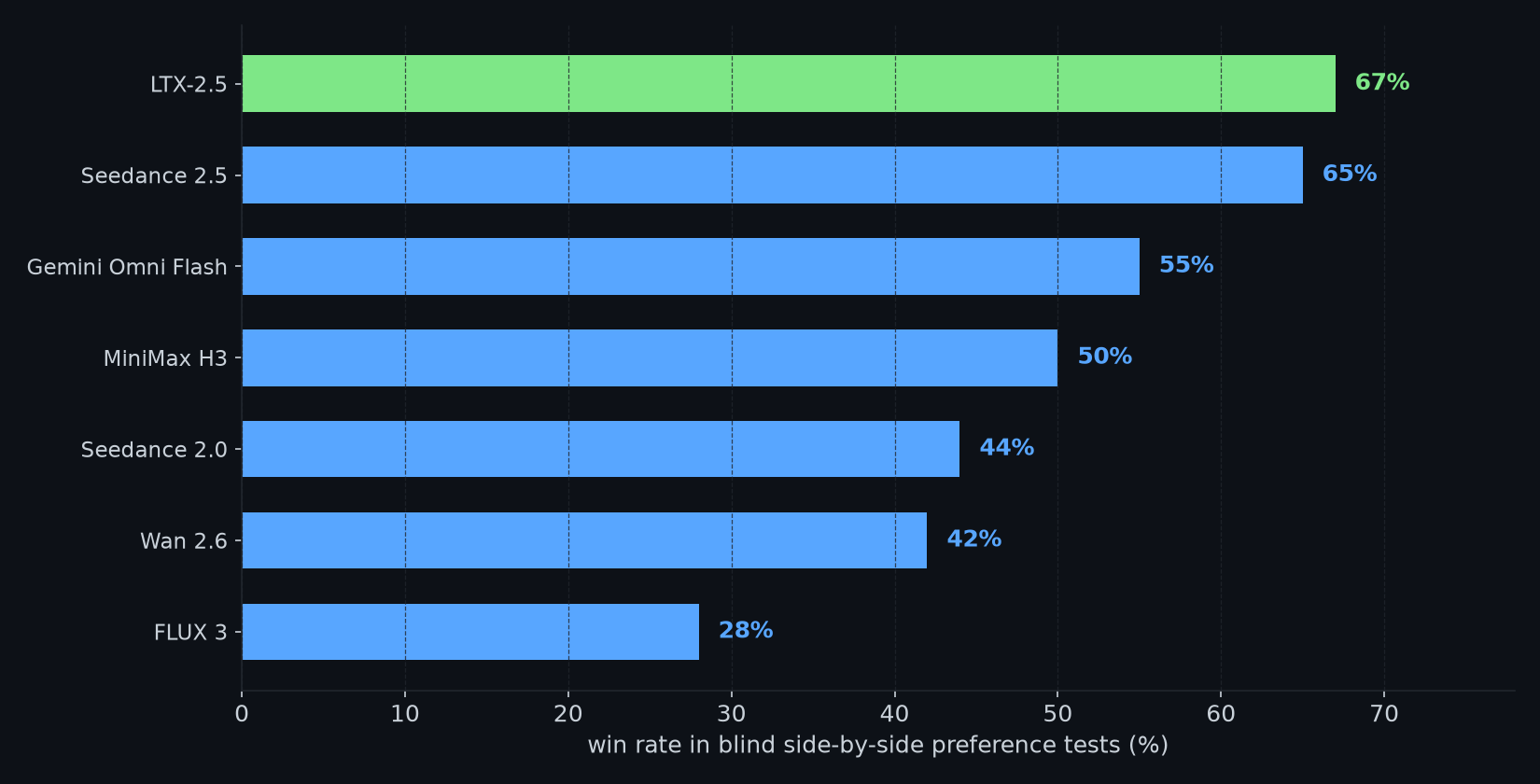
Blind human preference win rates (LTX-commissioned, preliminary — vendor-reported)
The company itself labels these preliminary and expects them to evolve as evaluation expands. I'd treat them as a directional signal, not gospel — and I'd especially not read too much into head-to-heads, because video models specialize wildly. Farbman put it well: "It's like comparing Michael Phelps with, I don't know, Michael Jordan. There are just different specialties here."
What you can actually run it on
This is the part that separates LTX from the API-only crowd. Minimum is 16GB VRAM, and LTX says it runs from data-center GPUs down to a Mac — the distilled 8-step model plus fp8 casting and CPU offload flags make that plausible. NVIDIA helped optimize it for RTX GPUs with reduced memory requirements, and there are pre-quantized NVFP4 (Blackwell) and ComfyUI int8 checkpoints so you don't have to do the quantization dance yourself.
It also deploys on-premises or at the edge, carries no mandatory branding on output, and can be fine-tuned on your own data. The dev transformer is fully trainable, and LTX ships LoRA + IC-LoRA training in the repo. Notably, most LoRAs trained for LTX-2.3 reportedly work on 2.5 without changes — with exceptions, so validate your adapters before production.
The license is the plot twist
Now the part I almost skimmed past, and the reason "open source" needs air quotes here. LTX-2.5 is open weights under the LTX-2.x Community License — not Apache 2.0, not MIT. If your company makes less than $10M in annual revenue, commercial use is free, including in production. Above that threshold, you need a paid Commercial Use Agreement — and the license is explicit that this is measured across your whole entity, including subsidiaries and affiliates under common control.
There are also restrictions worth knowing before you build a business on it: fine-tunes you create can only be transferred under this same license, a commercial entity receiving your fine-tune needs its own paid license, and you can't use it to train a competing model or in a product that directly competes with LTX's offerings (without a separate commercial license). Plus the standard safety terms — no deepfakes of people without consent, no disinformation, no military/weapons use.
That's the deal LTX is openly making: "We're definitely not doing this as philanthropy," Farbman said. Free under $10M ARR, license once you're successful. For indie creators and most small teams, it genuinely is free. For a funded startup, have your lawyer read the commercial-use terms — especially Section 2.1, where the $10M threshold and its fine print live — before you ship.
Where this fits in the open-video timeline
LTX's family history is a useful reality check on how fast this space moves. LTX-Video shipped open weights in November 2024 under Apache 2.0; a 13B version followed that May. LTX-2 got announced in October 2025 and fully open-sourced — weights plus training code — in January 2026. Then 2.3 brought a rebuilt VAE in March, and now, five months later, here's 2.5. The company says the LTX family has passed 33 million downloads — the most-used "open world" model line on the market, per LTX.
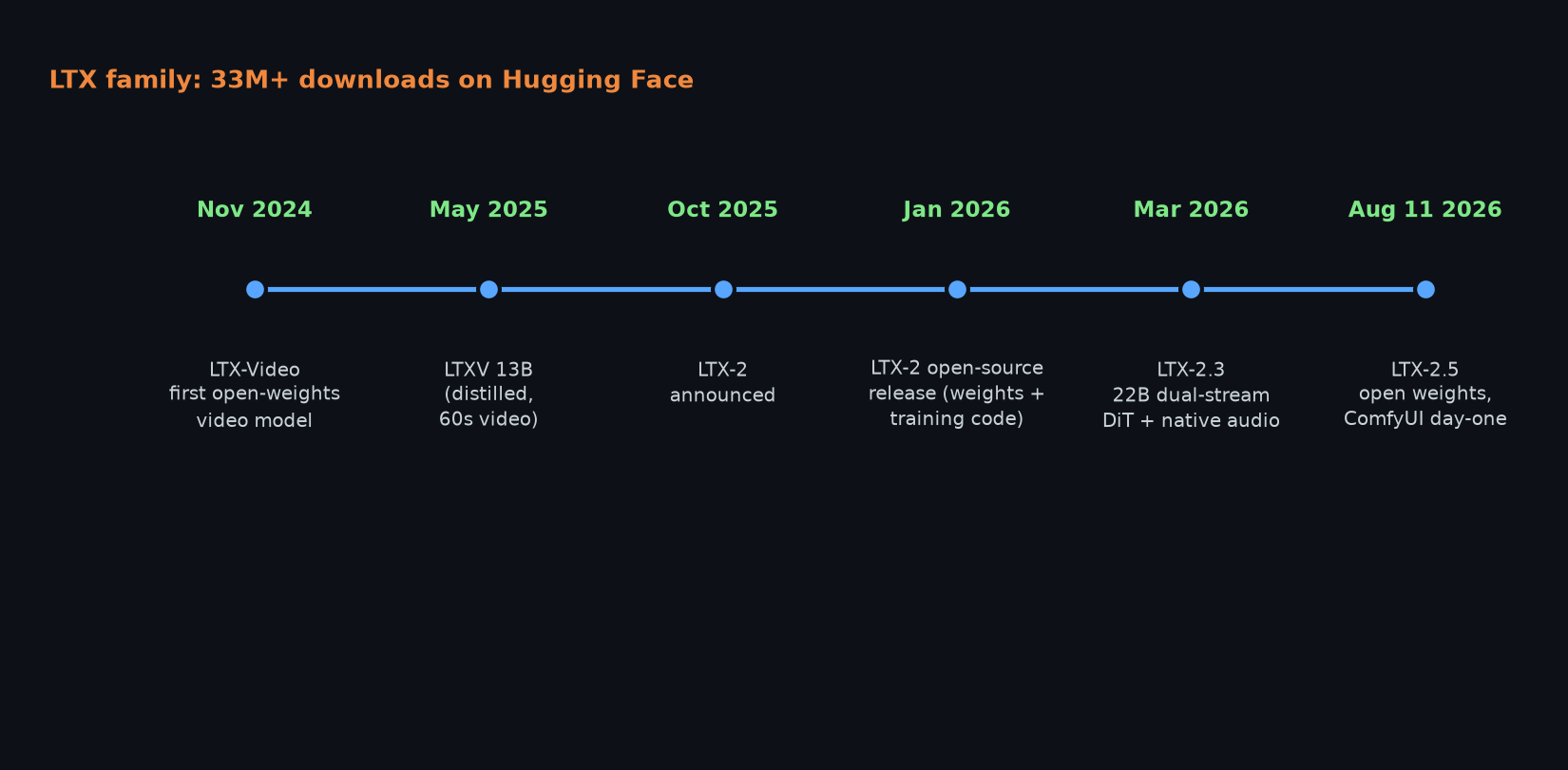
The LTX family: from LTX-Video (Nov 2024) to LTX-2.5 (Aug 2026)
Beyond video: world models and real-time
The "world model" framing isn't just marketing noise. Alongside ComfyUI, LTX named two other launch partners: Asteria, an AI film studio producing original film on LTX, and Reactor, a platform running LTX-2.5 on low-latency inference for interactive avatars, live worlds, and robotics workloads. The robotics angle is real — there's a dedicated physical-AI checkpoint, and Farbman cites hardware customers using diffusion models for computational photography, studios doing VFX and day-to-night conversion, animation studios using it for keyframe interpolation.
There's also Flipbook, an interactive Reddit-viral experience where an entire clickable world is generated live — click anywhere and LTX generates a brand-new interaction on the fly. Yan (ComfyUI's CEO) called it the kind of thing that "wouldn't exist without an open-weight model." That's the argument for open weights in one demo.
One last thing before you get excited: every number above is LTX's own — measured or commissioned, nothing independently verified yet. The 6.8s headline needs two GB200 chips, and the preference tests are preliminary by the company's own admission. If you're picking a production model, run your own prompts through LTX-2.5 and your shortlist on your own hardware before trusting any ranking. The weights also sit behind a Hugging Face agreement gate (share your contact info), and the day-one ComfyUI integration is a real strategic bet — ComfyUI is where LTX says its paying customers come from, so expect deep, maintained support there rather than a one-off custom node.
My take
I'll be honest: I typed "LTX-2.5" into my ComfyUI install this morning with low expectations and the speed numbers kept nagging at me — not because I distrust LTX, but because 6.8 seconds is the kind of number that makes you check whether the measurement is real. The architecture checks out (8-step distilled, tiny CFG, split weights so you only download what you use), the 16GB VRAM floor is genuinely accessible, and the license, while not Apache, is workable for most indie and small-team use cases.
Is it the best video model in the world? Nobody can say that from vendor numbers alone, and the field moves monthly. But it's the strongest open-weights audio+video package I've seen ship with day-one ComfyUI support, and at this speed, the bottleneck for most creators just moved from "waiting for the render" to "writing better prompts." That's a good problem to have.
I'll post an update once independent benchmarks and third-party comparisons land — and if I get my hands on a 2× GB200 rig in the meantime, I'll let you know if 6.8 seconds holds up.
Related on this blog: H3 Max: 5 Seconds of Video in Under 3 — and It's Not MiniMax's Model · I replaced MiniMax H3's 32B text encoder with a 4B one — on an 11GB card
Comments
Post a Comment