Meta just open-sourced its agent model: Muse Glimmer, a 30B that runs on your machine
Meta just open-sourced its agent model: Muse Glimmer, a 30B that runs on your machine
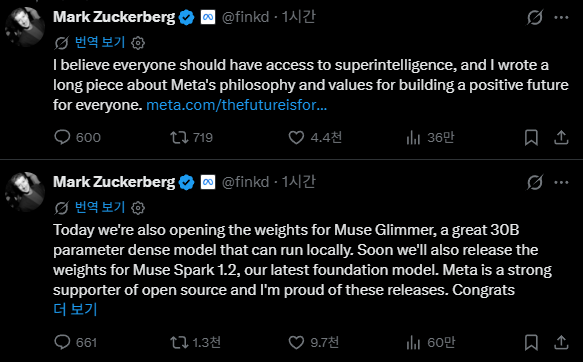
I opened X this morning and Zuckerberg was announcing open weights for a 30B "local agent" model with an Apache 2.0 license. Fine, another Llama-style release, I thought — and then I read the small print: it's a vision model, it was distilled from Muse Spark (Meta's cloud flagship), and Unsloth had already shipped day-zero GGUF quants. That combination — local, multimodal, agentic, permissive license — is new territory for Meta, so I dug into the numbers.
What Muse Glimmer actually is
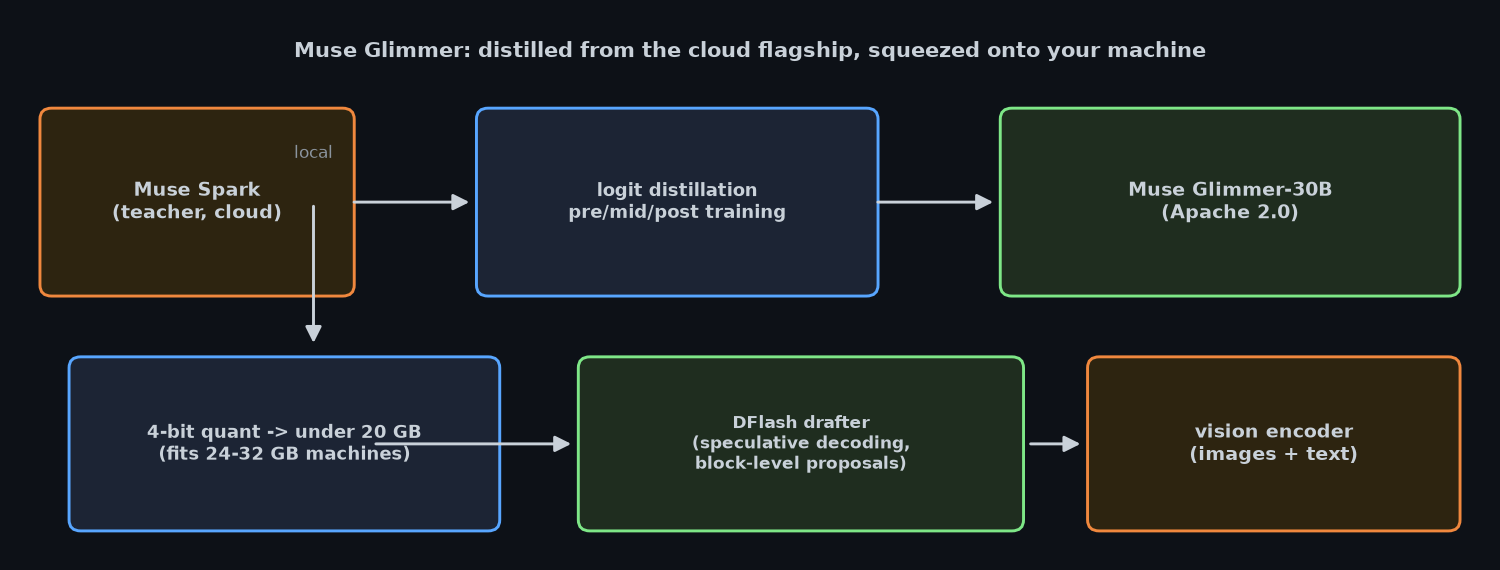
Muse Glimmer is a 30-billion-parameter dense model — the first open-weight release from Meta Superintelligence Labs, the lab Alexandr Wang and Nat Friedman have been running since mid-2025. Not a Llama successor: a distillate. Meta's research blog describes three training phases — logit distillation from Muse Spark's outputs, mid-training on long-context agent-heavy data, and post-training with on-policy distillation and RL. In plain English: Meta trained its cloud flagship, then squeezed the reasoning down into something that fits on your desk.
Specs that matter:
- Context: 131K default, up to 262K
- Reasoning: controllable effort — low / medium / high / xhigh
- Multimodal: dedicated perception encoder for interleaved images + text (screenshots, charts, documents)
- License: Apache 2.0 — no Llama-style usage restrictions
- Languages: 100+
- Built-in agent behaviors: tool-call error recovery (diagnose and retry, not halt), long-horizon planning, OpenClaw-compatible scaffolding
The numbers: how it does against the 30B class
Unsloth (which co-built the llama.cpp integration with Meta and Hugging Face) published measurements on day zero, comparing Glimmer at high reasoning effort against the two obvious rivals: Gemma4-31B and Qwen3.6-27B. The honest summary: Glimmer wins most of the agentic benchmarks, and loses a few of them clearly.
| Benchmark | Muse Glimmer-30B | Gemma4-31B | Qwen3.6-27B |
|---|---|---|---|
| MCP Atlas (tool orchestration) | 75.5 | 54.2 | 62.5 |
| DeepSearch QA (agentic retrieval) | 74.6 | 61.7 | 71.1 |
| SWE-Bench Pro (repo-scale coding) | 51.2 | 36.9 | 50.2 |
| SWE-Bench Verified | 76.0 | 66.6 | 77.2 |
| TerminalBench 2.1 | 51.7 | 43.4 | 60.7 |
| Gaia2 (general agent tasks) | 43.3 | 36.4 | 40.0 |
| OSWorld-Verified (computer use) | 65.9 | 58.5 | 75.6 |
| τ3-Banking (multi-turn agent) | 23.5 | 15.1 | 16.7 |
| AIME 2026 (math, Glimmer only) | 94.7 | — | — |
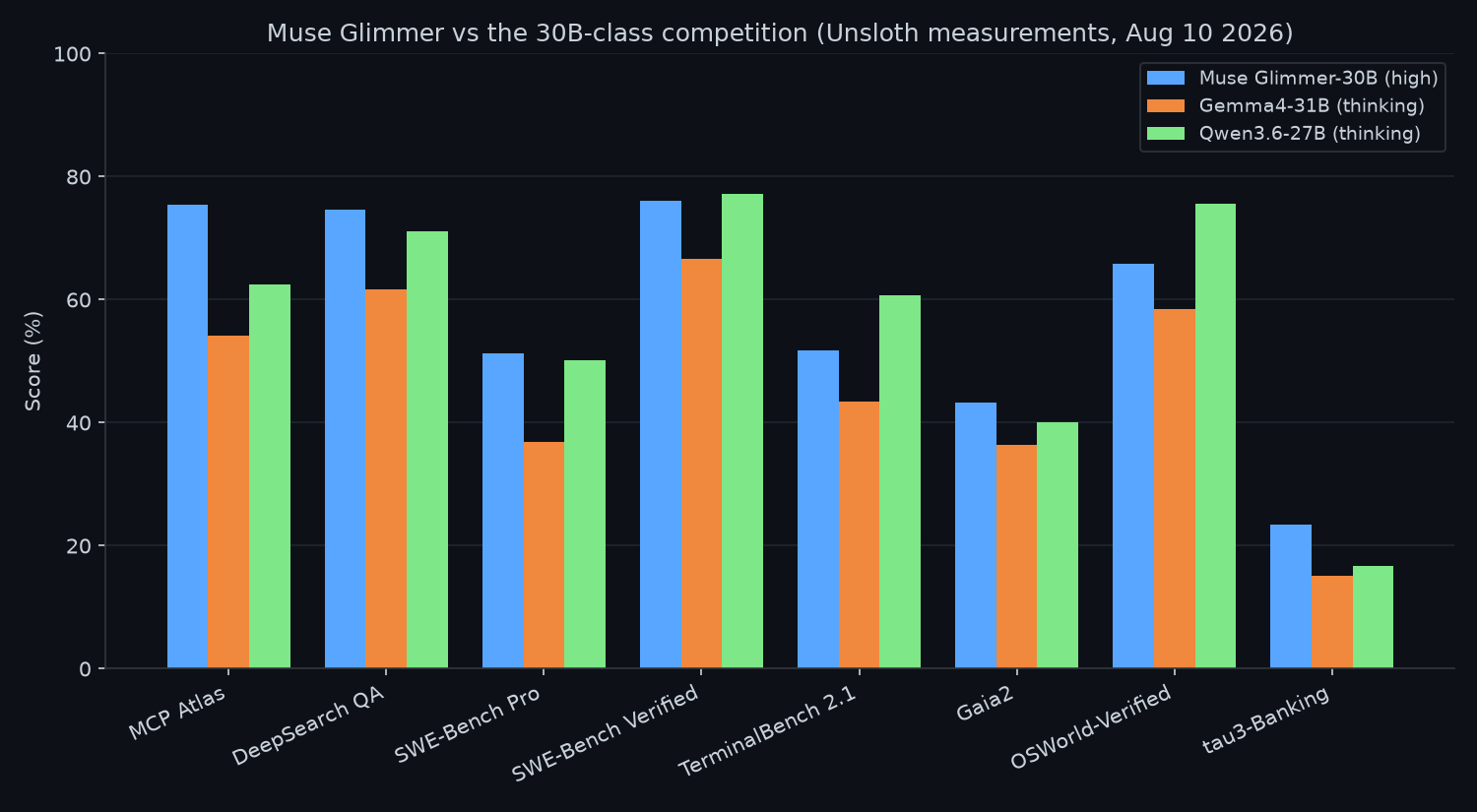
Read the pattern, not the individual cells: Glimmer's wins are concentrated exactly where Meta trained it — tool orchestration (MCP Atlas: +21 over Gemma, +13 over Qwen), agentic retrieval, and repo-scale coding. Its losses are just as informative: Qwen3.6-27B beats it on TerminalBench 2.1 (60.7 vs 51.7), OSWorld computer use (75.6 vs 65.9), and skills-heavy workflows. If your agents live in a terminal and a browser, Qwen's numbers look better on paper. If your agents live in MCP servers and API calls, Glimmer's edge is real.
The local story is the actual product
Meta's target envelope is explicit: 4-bit quantization brings the model under 20GB, leaving headroom for KV cache, the vision encoder, and a DFlash speculative-decoding drafter (a small companion network that proposes token blocks the main model verifies in parallel — meaningfully faster generation at identical quality). Meta says it validated the setup on M4-Max, M5-Max, and RTX 5090 machines, with "minimal to no degradation on agentic tasks" from quantization.
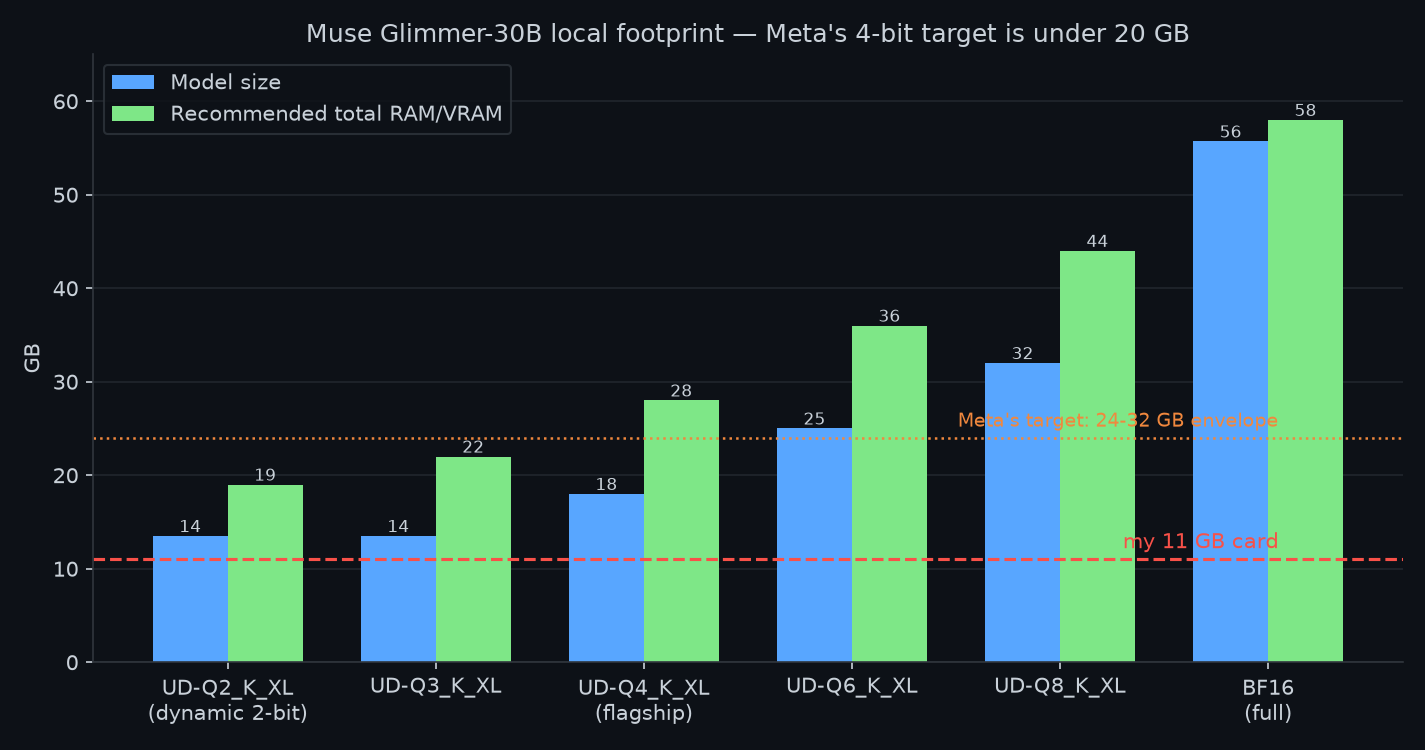
That chart has a personal sting: my 1080Ti has 11GB of VRAM, so the flagship Q4 (17-19GB) won't fit — the dynamic 2-bit quant (12-15GB) would only run with heavy CPU offload on my 48GB of RAM, at Maple-style speeds (~10-15 tokens/s). The realistic buyers here are 24-32GB cards, Macs with 32GB+ unified memory, and CPU-tower people like me who don't mind slow. Unsloth's quants are live (GGUF, MLX, NVFP4 for Blackwell), and Ollama/LM Studio/llama.cpp integrations land in the coming days.
Before you get excited: four honest caveats
1. It's day zero. The benchmark table above is one measurement run (Unsloth) plus Meta's own claims. Meta has a history of optimistic self-reported numbers — Llama 4's launch benchmarks were widely criticized. There are no independent third-party evaluations yet, no months of community testing, and the HN thread was basically one "good to see" comment when I looked. Treat every number as provisional.
2. The losses are real. Qwen3.6-27B beats Glimmer on terminal work and computer use. If your agent work is CLI-heavy, this release is not an automatic upgrade. The distillation-from-Spark approach gives Glimmer a specific profile — strong at MCP-style orchestration, weaker at free-form GUI/terminal autonomy.
3. "Runs locally" still means a real machine. The 17-19GB Q4 fits 24-32GB machines, not the 8-16GB laptops most people own. The 2-bit quant exists for smaller setups but nobody has independently verified what it does to quality yet. On my 11GB card, it's CPU inference or nothing.
4. The agent brain is not the whole agent. Glimmer's own blog post is honest about this: long-running session state, failure persistence, and tool scaffolding come from the harness (OpenClaw, etc.), not from the model. Buying the weights doesn't buy you an agent; it buys you a very good brain for one.
So what's actually interesting here
Three things, in my order of excitement. First: Apache 2.0 on a genuinely capable agentic model — no usage caps, no "acceptable use" gatekeeping, commercial use included. Meta keeps inching toward "the future is for everyone" rhetoric, and this license is the most concrete version of it yet. Second: the vision encoder. A local 30B that reads screenshots and charts alongside text closes the loop for local agents in a way that pure text models can't — this is exactly the multimodal gap I've been patching with auxiliary vision models. Third: the distillation recipe itself — MSL's first open release being a squeezed-down Muse Spark suggests where the next open releases are headed, and Muse Spark 1.2 weights are already teased as "coming soon."
I'm going to grab the Q2 dynamic quant when the llama.cpp integration lands and see how it handles agent tasks on CPU-only hardware — my Maple experiment proved 20B was workable, and Glimmer is a bigger, vision-capable target. If it holds up on a 48GB tower with no GPU acceleration, that's a genuinely interesting data point for the "local superintelligence" pitch. I'll report back.
Sources: Meta research blog (research.meta.ai, "Introducing Muse Glimmer"), Unsloth day-zero measurements and run guide, Zuckerberg's X/Threads announcement, Aug 10 2026. Model weights: huggingface.co/meta-models/Muse-Glimmer-30B.
Related on this blog: Meta's Muse Spark 1.2 Landed in OpenCode Go — and Most of the World Can't Touch It Yet · The Cheapest Model on Earth Just Announced a Price Hike. 8 Trillion Tokens a Day Will Do That.
Comments
Post a Comment