MiniMax Music 3: Five-Minute Songs, Open Weights, One $20M Catch
MiniMax Music 3: Five-Minute Songs, Open Weights, One $20M Catch
There's a model on Hugging Face right now with 46 likes and three demo Spaces that will sing you a complete five-minute song. MiniMax — the company whose H3 video model I've been poking at for weeks — just put the weights for MiniMax Music 3 up for download. On paper, it's strong: five-minute songs, real vocals, open weights, commercial use allowed. Then I opened the LICENSE file, and the word "open" started doing some heavy lifting.
Verdict first, because you're probably here to know whether this matters. MiniMax Music 3 is the most interesting music architecture anyone has released this year — an 8-billion-parameter "global" language model that handles song structure, wired to a 0.6-billion "local" model for the acoustic details, both feeding a flow-matching decoder instead of the usual token-to-audio dance. The weights are downloadable and you can use them commercially. But it is not open source. It ships under MiniMax's community license, which stops being free at $20 million in annual revenue and requires you to print their name on your product. And to run it at full precision you'll want a 24GB card.
What it actually is
Music 3 is a text-to-music model. You hand it lyrics and a description of the song you want, and it returns a 32 kHz, 16-bit stereo WAV. MiniMax has been serving a Music 3.0 model through its API since mid-July; what's new is that the weights now sit on Hugging Face for anyone to download, run, and dig into. That distinction matters — the API version and the open-weight version are two different ways to touch the same family of models.
MiniMax Music 3 (image: MiniMax)
What's genuinely different is the architecture. Most music models this year are one big transformer that turns tokens into audio. Music 3 splits the job in two. An 8B Global LLM — fine-tuned from Qwen3-8B — handles long-range musical structure: where the verse ends, when the chorus lands, how the key and tempo hold together across a whole song. A 0.6B Local LLM handles the frame-level detail — vocal articulation, instrumental texture, the small acoustic decisions. The two were jointly trained to model all eight layers of the model's residual-vector-quantized codebook.
| What | MiniMax Music 3 |
|---|---|
| License | MiniMax-Music3 Community License (not OSI) |
| Song length | Up to 5 minutes |
| Output | 32 kHz, 16-bit stereo WAV |
| Global LLM | 8B, fine-tuned from Qwen3-8B |
| Local LLM | 0.6B |
| Synthesis | Flow Matching (2.4B) → Flow-VAE Decoder (123M) |
| Tokenizer | 8-layer RVQ (training only) |
| VRAM | 24GB full · ~22GB offload · 8GB streaming |
Music 3 as documented in the model card
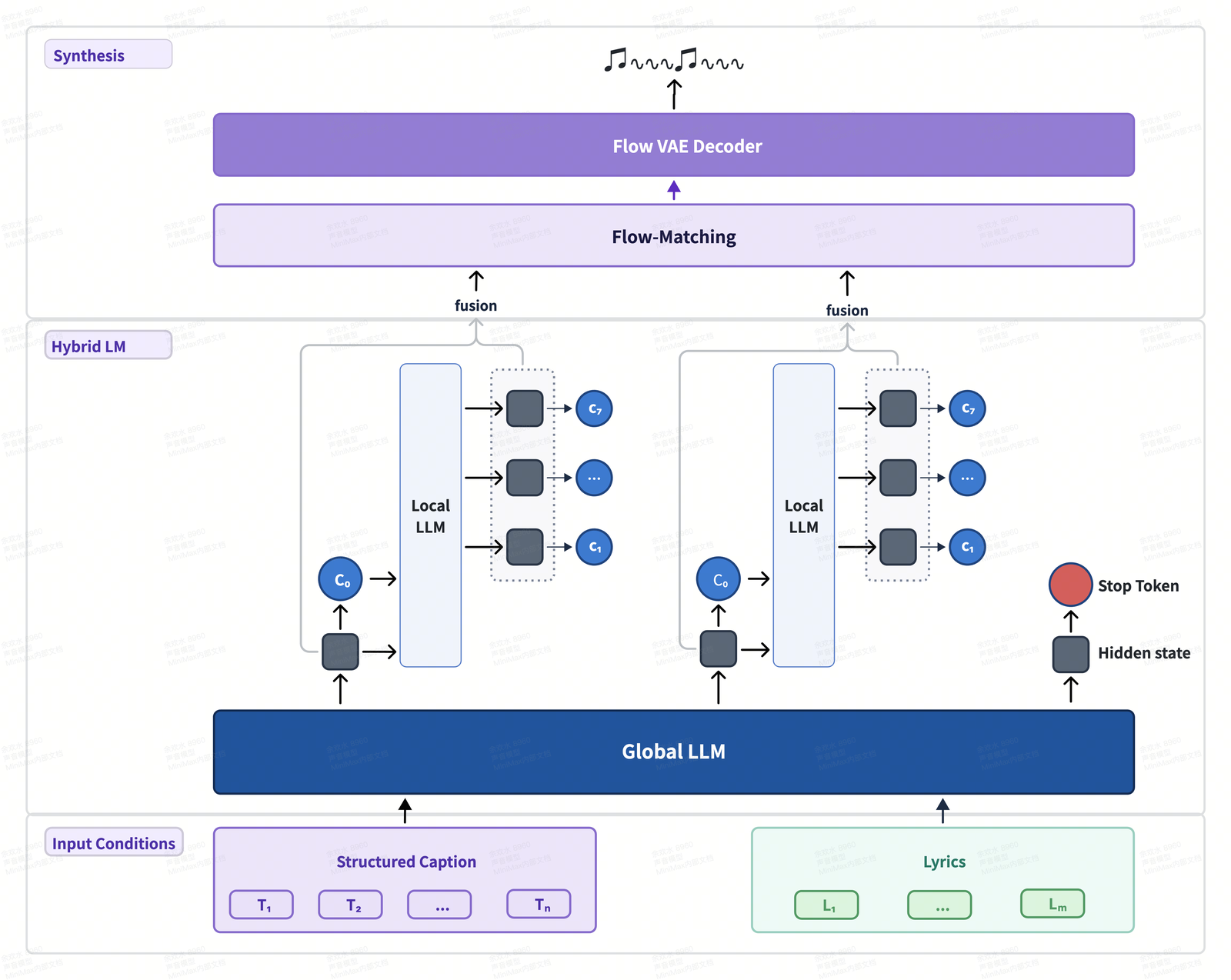
The Music 3 architecture — a hierarchical Global + Local LLM feeding a continuous synthesis path (image: MiniMax)
The part worth nerding out over
The thing I keep coming back to is how it goes from model to sound. A lot of music generators decode audio by walking back through discrete tokens — think of it as the model spelling out the waveform letter by letter. Music 3 skips that step. It takes the hidden states of the global and local LLMs, fuses them, and hands that continuous representation straight to a flow-matching module (2.4B params), which maps it into a compressed Flow-VAE latent. A 123M-parameter decoder turns that latent into audio. The pitch: because nothing gets rounded off into discrete tokens, you keep more of the expressive detail — the stuff that usually gets averaged away.
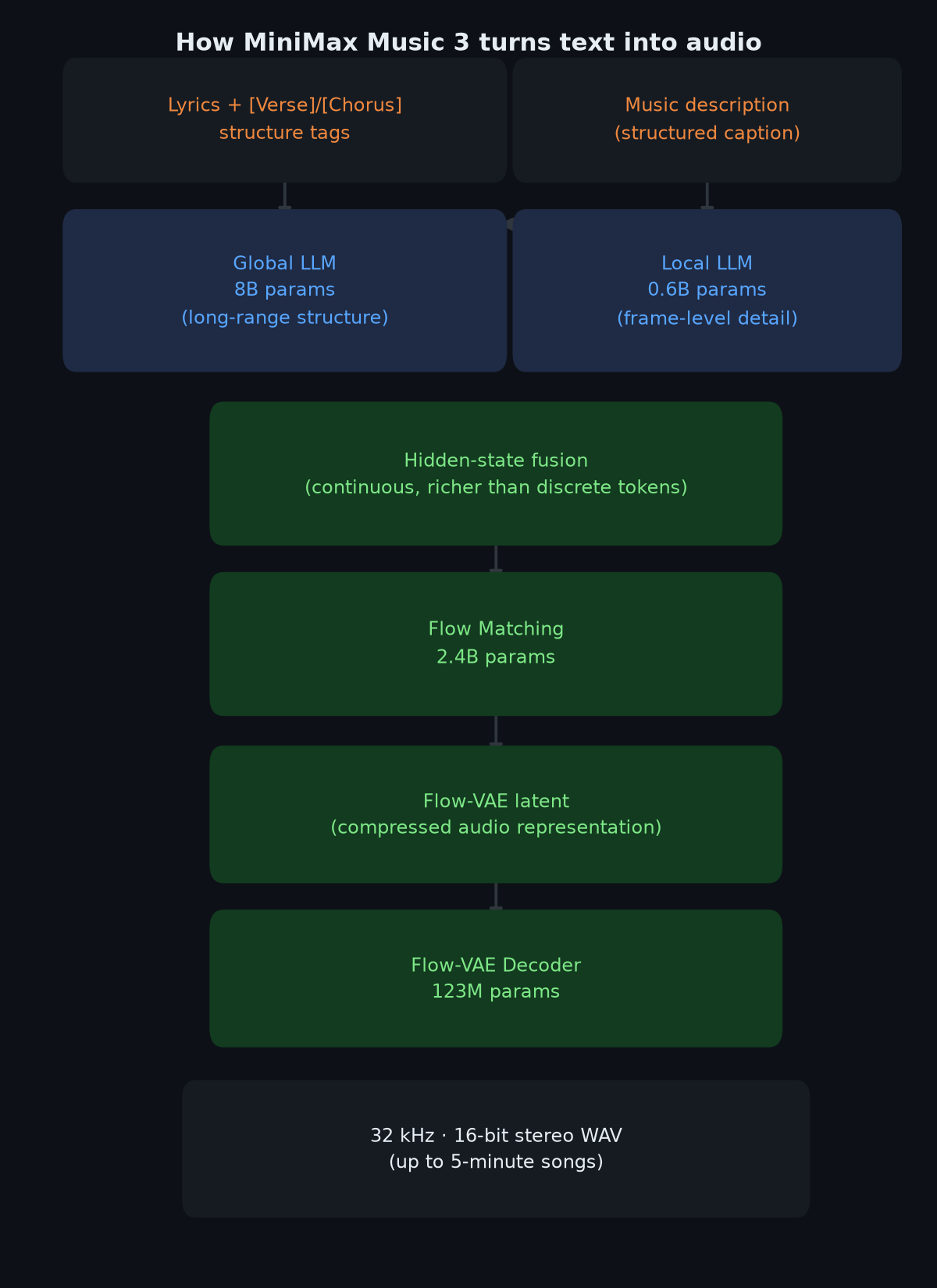
How Music 3 turns text into audio — hidden-state fusion instead of discrete-token decoding. Chart by the author, from the model card.
MiniMax's Flow-VAE is adapted from their speech models and retrained for music's dynamic range. That lineage shows in the model card's own priorities — vocal articulation, vocal identity, expressive vocals — which is what you'd expect when the audio decoder comes straight from a speech pipeline.
That pipeline is also why the control story is better than most. You write lyrics with section tags on their own lines — [Verse], [Chorus], [Bridge], [Intro], [Outro], [Instrumental], [Solo] — and pair them with a music description. There's a structured-caption format with three parts: global metadata (genre, BPM, key), vocal details, and arrangement. MiniMax even ships a "music-caption-rewriter" skill that expands a plain-English description into that full structured caption, so you don't have to hand-format everything.
The license: open weights, not open source
Now the part the "Open Source Factory" in me can't skip. The repo's big LICENSE button points to a MiniMax-Music3 Community License, and it is not an OSI open-source license. The good parts: you can use, copy, modify, merge, distribute, and sublicense the weights, and commercial use is fine. The catches are two lines you should read before you build anything on it.
The first is a labeling requirement: any commercial product using the model has to show "MiniMax-Music3" on its interface. The second is a revenue line — once you and your affiliates clear $20 million a year, you need MiniMax's written sign-off. That's a source-available license with a revenue ceiling, not open source. The parts underneath are genuinely open — it's fine-tuned from Qwen3-8B (Apache 2.0), with a DiT adapted from Stability's Stable Audio code (MIT) and a VAE from the descript-audio-codec (MIT). The wrapper MiniMax put around the whole package is the part with strings.
I'm not saying this is a bad deal. For a hobbyist, a band, or a small tool, this is about as permissive as it gets without being OSI. But if you've read this blog before, you know the difference matters: "open weights" and "open source" are not the same sentence, and a $20M revenue line is exactly the kind of fine print that shows up the moment something takes off.
What you need to run it
Here's the part that quietly disqualifies a lot of people, me included. At full precision the model wants just under 24GB of VRAM. With automatic CPU offloading you can get it to around 22GB, and if you stream the language model layer by layer it'll squeeze into 8GB — slowly. There's a second gate that gets less attention: everything loads in bf16, and bf16 needs an Ampere-or-newer card. My GTX 1080 Ti, the 11GB Pascal card I've done the math on before, fails both tests — not enough VRAM and no native bf16. The cheap answer, same as the H3 conversation, is a used 24GB card like an RTX 3090. If you're on an 8GB RTX 30/40-series card, it'll work with the layer-streaming trick, just not fast.
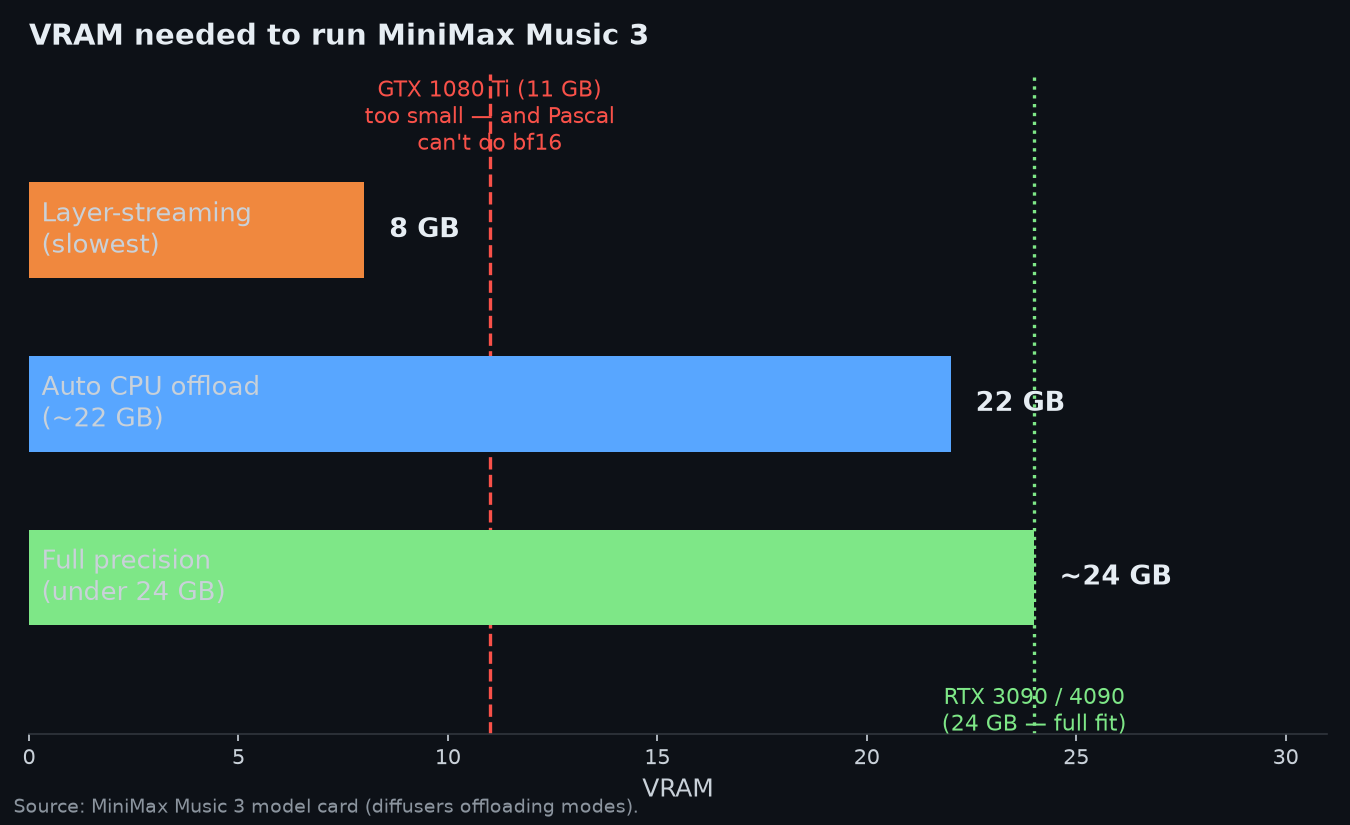
What it takes to run Music 3. An 11GB 1080 Ti falls short on VRAM — and Pascal can't do bf16. Chart by the author, from the model card.
What we don't know yet
Here's the honest part: MiniMax Music 3's open weights are days old, and I couldn't find an independent listening test of them. The quality claims floating around are either vendor material or reviews of the older Music 2.5 — which people did genuinely like, for realistic piano and clean instrument separation and vocals that stopped sounding like a vocoder. Whether the 3.0 architecture actually closes the gap with Suno is exactly the kind of question that needs neutral ears, and nobody has published that yet.
My HeartMuLa post ended the same way: the benchmark table is marketing until a neutral listener confirms it. Music 3 doesn't even ship a benchmark table — MiniMax describes the architecture and links a demo. So go listen to the demo, and take the "state-of-the-art" headlines with the usual grain of salt.
Is MiniMax Music 3 actually open source?
No. It ships under the MiniMax-Music3 Community License, which is not an OSI open-source license. You can download, modify, and use it commercially, but a commercial product must display "MiniMax-Music3" on its UI, and revenue above $20M a year requires written authorization from MiniMax.
Can I run it on 8GB of VRAM?
Yes, with layer-by-layer streaming — but slowly, and only on a card that does bf16, which means Ampere or newer (RTX 30 series and up). A GTX 1080 Ti won't work: it's Pascal, so no native bf16, and its 11GB is below the ~22GB offload tier anyway.
Can I use the songs commercially?
Yes. The license allows commercial use, with two conditions: show "MiniMax-Music3" on the product interface, and get written approval if your aggregate yearly revenue passes $20M.
How long can a song be?
Up to five minutes, with section tags ([Verse], [Chorus], [Bridge], and the rest) for structural control.
Is it better than Suno?
Unverified. No independent listening test of the 3.0 weights exists yet. The older MiniMax Music 2.5 was well-liked, but that's a different model. Until neutral ears weigh in, treat any "Suno killer" framing as marketing.
My take
This is the most watchable music release of the year — not because it's proven, but because of the architecture. The global-plus-local split, the continuous hidden-state synthesis, the structure tags: it's a genuinely different way to build a music model, and it's downloadable, which means the people who care can actually dig into it. The license is the "open-ish" kind that's become the norm this year — good enough for tinkerers and small products, not the thing you'd bet a company on without a lawyer. And the hardware story is the same one as my H3 post: the weights are free, the GPU is not. I'll post a follow-up when a neutral listening test lands. Until then, the demo is the only review that matters.
Sources: MiniMax Music 3 model card (Hugging Face) · MiniMax-Music3 Community License and Exhibit A (Acceptable Use Policy) · GitHub repo MiniMax-AI/MiniMax-Music3 · MiniMax Music 3 demo page. Related reading on this blog: MiniMax H3 went open-weight and HeartMuLa: Suno Quality at $0? Not Quite. No company mentioned here paid for coverage; this blog is independent.
Comments
Post a Comment