Qwen3.8-Flash-Next: 6B Active, Qwen4's Architecture Early
Qwen3.8-Flash-Next: 6B Active, Qwen4's Architecture Early
Qwen dropped open weights again, but this one isn't another point on the same curve. Qwen3.8-Flash-Next runs 6 billion active parameters out of a 125-billion-parameter model, ships a separate 51-billion-parameter n-gram embedding table you can offload to host RAM, and it's explicitly the preview architecture that the Qwen4 family will be built on. I stopped scrolling when I read that last part — a vendor shipping the next generation's architecture early, on purpose, so the community can hammer on it before Qwen4 lands.
Let me be direct about where I land: if you're running local AI on a budget, this is the most interesting model release in a while, and it's not because of a flashy benchmark headline. It's because the architecture was designed with the thing you actually hit — memory — as a first-class constraint.
What it actually is
| Item | Qwen3.8-Flash-Next |
|---|---|
| Type | Multimodal MoE (image / video / text) |
| Total / active params | 125B total, 6B active per token |
| N-gram embedding | +51B (separate, offloadable) |
| MTP | +4B |
| Context | 262,144 native, up to 1M with YaRN |
| License | Qwen Community License 1.0 |
| Architecture | GDN + QSA hybrid attention, Gated Residual, N-gram Embedding, Muon |
| Status | Open weights live on Hugging Face / ModelScope |
Qwen3.8-Flash-Next at a glance — vendor specs from the August 26, 2026 release.
The headline architecture change is the hybrid attention: a Gated Delta Network (GDN) that compresses history into a fixed-size state for three of every four layers, and a new Qwen Sparse Attention (QSA) on the fourth that picks important context at the micro-block level instead of per-token. That's the long-context play — agentic workloads eat context, and full attention gets brutally expensive as the window grows.
Why the n-gram embedding is the interesting part for local
This is the part I actually care about. Instead of pouring more capacity into the dense model, Qwen put 51 billion parameters into a separate n-gram embedding table that looks up local context. Two consequences for someone running models locally:
First, it scales capacity with very little extra compute per token — you're not paying full attention cost for those 51B parameters. Second — and this is the sneaky-good part — the table can be offloaded to host memory and overlapped with model computation through asynchronous prefetching. The n-gram lookups are mostly sparse, so they're a natural fit for system RAM while the dense 125B main model stays on the accelerator. A 4-bit quant of the whole thing is roughly 82GB (58GB main weights + 24GB n-gram), but the n-gram portion is exactly the part you can push to DDR while keeping the working set on VRAM.
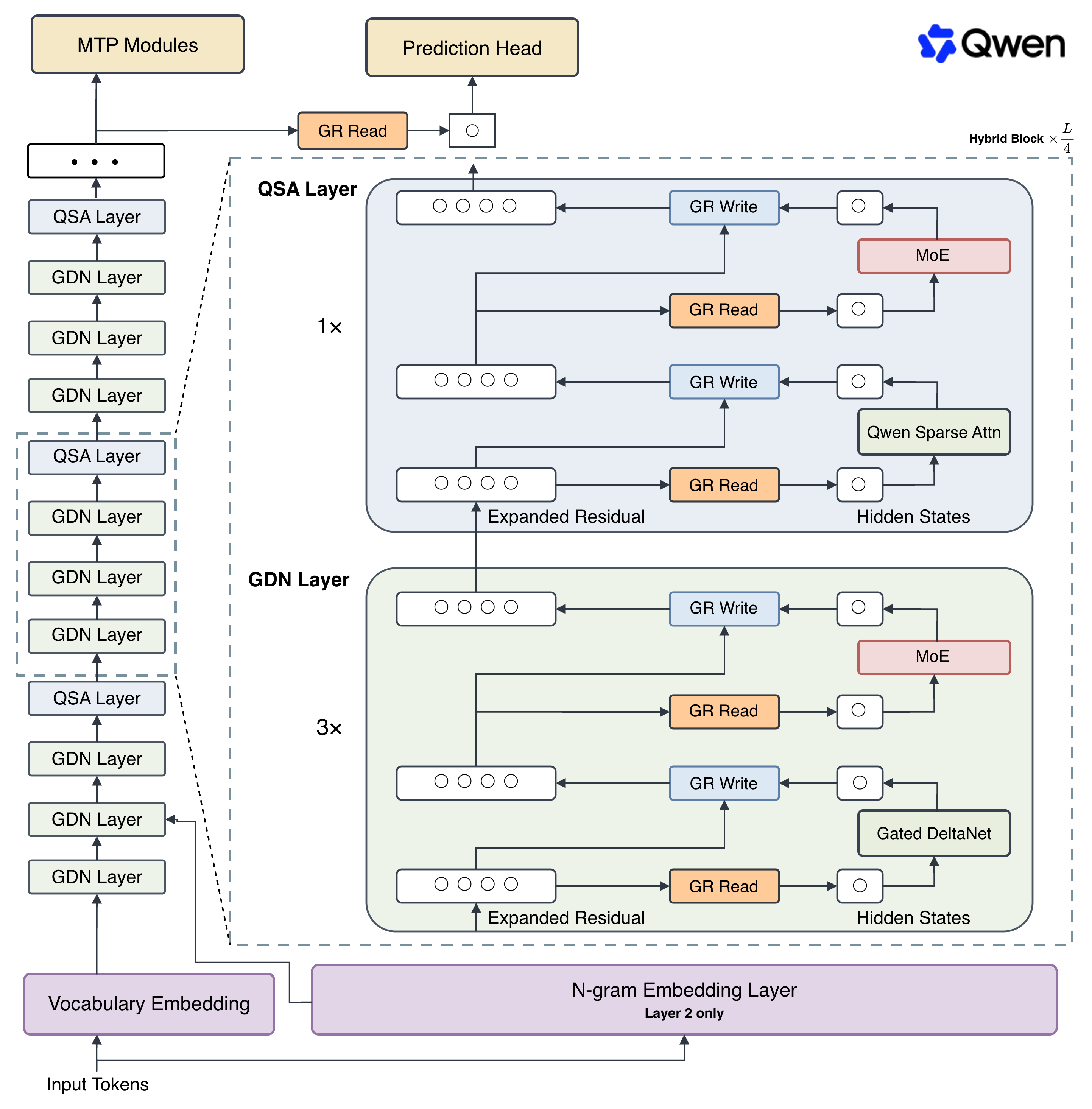
The Qwen3.8-Flash-Next architecture: hybrid GDN + QSA attention, gated residual branches, n-gram embedding lookup. (image: Qwen / Alibaba)
The community noticed immediately. Unsloth promised day-zero support and said it would upstream whatever llama.cpp changes are needed; 128GB Mac users started doing the math out loud; someone with 64GB of RAM asked if it could run. That's the tell that this isn't just another big model — it's a big model structured to actually fit practical local setups.
Benchmarks: it beats the field, vendor-reported
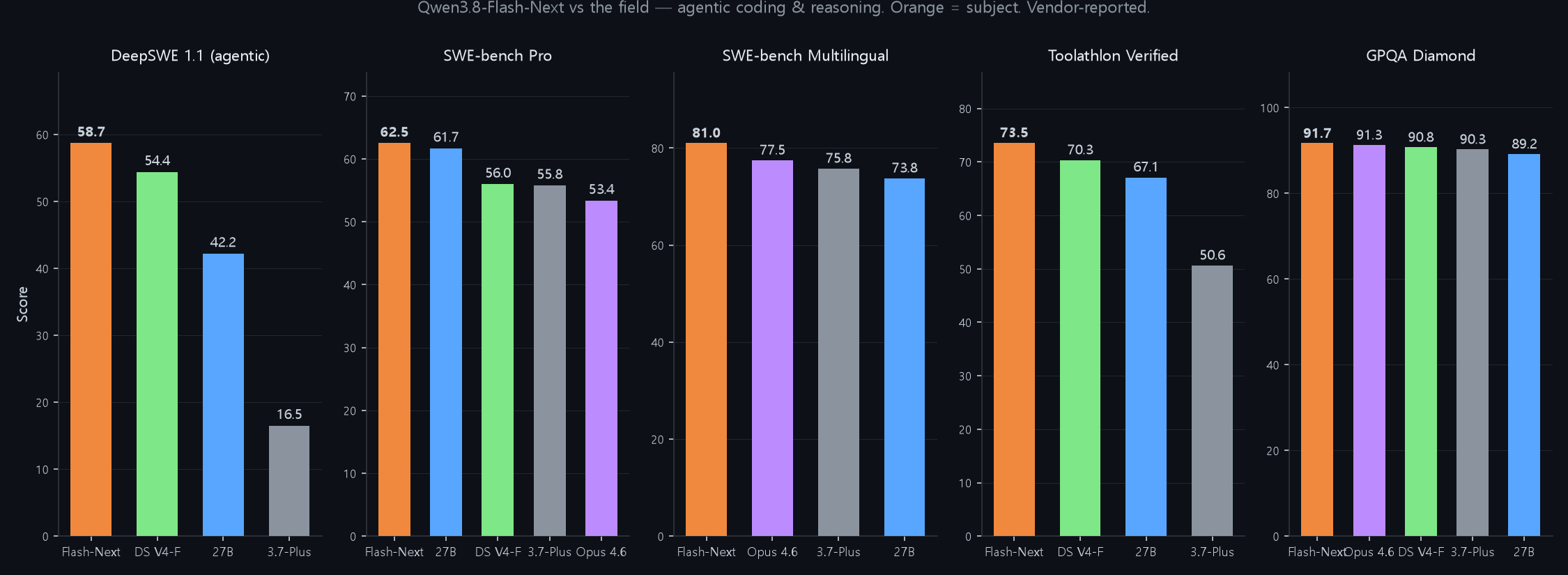
Agentic coding and reasoning — orange is the subject. Vendor-reported from the official model card. Chart by the author.
The numbers are strong. On agentic coding, Qwen3.8-Flash-Next scores 58.7 on DeepSWE 1.1 — versus 42.2 for the just-released Qwen3.8-27B and 54.4 for DeepSeek V4 Flash. SWE-bench Pro is 62.5, above the 56.0 DeepSeek manages. Toolathlon Verified 73.5, GPQA Diamond 91.7. It wins the majority of rows in the official table.
I need to be straight about what that is, though: it's one vendor's table, run on their harnesses (including a Claude Code harness and their own mini-SWE-agent), and "best in row" is their bold formatting. The DeepSWE figure comes with the note that it performs best on Qwen's own mini-SWE-agent harness. So directionally this is a serious agentic-coding model at a tiny active-parameter count, but I'll believe the exact margins once independent benchmarks land in the next week or two.
Training cost is the quieter story
Qwen says Flash-Next took about 1/9 the training cost of Qwen3.7-Plus. That's not a headline you see every day — it's the efficiency argument the whole architecture is building toward, and it's what makes the "this is Qwen4's base" framing credible. If the architecture trains for 9x less and matches or beats while also costing less to run, the next generation starts with a structural cost advantage baked in.
The license changed
Here's the thing people gloss over: this is not Apache 2.0 like Qwen3.8-27B. Qwen3.8-Flash-Next ships under the Qwen Community License 1.0. The terms are permissive for personal and most commercial use, but two gotchas matter: over 100M monthly active users or $20M monthly revenue and you must display the model name prominently; and if you operate a Model-as-a-Service or "AI Work Assistant" business (their term for AI coding/office productivity tools, e.g. Qoder), you need a separate license from Qwen. That's a real consideration if you're building a commercial coding agent or hosted API on top of it.
My take
This is the release I'd been waiting for someone to make: a frontier-ish agentic model whose memory profile is the design target, not an afterthought. The 6B-active / 125B-total split with an offloadable 51B n-gram table is exactly the kind of thing that makes a "big" model genuinely runnable where I sit — a modest GPU with the n-gram portion living in system RAM. Qwen calling this the Qwen4 architecture preview before dropping the weights is a smart, community-serving move, and the 1/9 training-cost claim, if it holds under scrutiny, points at where open-weight economics are going.
The honest caveats: it's all vendor numbers right now, DeepSWE's best result is on Qwen's own harness, and the license is a step back from Apache — not a dealbreaker for local hobbyists, but you must read it before building commercial things. I'll write a follow-up when independent benchmarks and real llama.cpp numbers land — the memory-offload behavior is the thing I actually want to see measured, not another vendor score. That's the post I've already promised myself.
Related on this blog: Qwen3.8-27B: 27B Dense, Vision Included, Apache-2.0 · Qwen3.8-Max is official — 2.4T parameters, and this time they're opening the weights
Sources: Qwen official blog (Aug 26 2026), Qwen3.8-Flash-Next Hugging Face model card + LICENSE, ModelScope pre-release page, NVIDIA developer forums (community thread), r/LocalLLaMA community reactions, Unsloth day-zero support announcement. All benchmark figures are vendor-reported from Qwen's official model card. The 82GB quant estimate (58GB main + 24GB n-gram, 4-bit) is a community estimate, not an official figure. API price $0.16/M input, $0.47/M output reflects Qwen3.8-Flash (the production version), announced alongside.
Comments
Post a Comment