Claude Fable 5.1: Same $10/$50, But Cache Reads Cost 75% Less
Claude Fable 5.1: Same $10/$50, But Cache Reads Cost 75% Less
September 1, 2026 · by OpenSource Factory · pricing and benchmarks verified against Anthropic's official announcement on the day of release
Anthropic dropped Fable 5.1 today, and the headline on the pricing page is doing a lot of heavy lifting: same $10/$50 per million tokens as Fable 5. Same price, so no story, right? Wrong. The fine print is the story — cache reads just went from $1.00 to $0.25 per million tokens, a 75% cut. For anyone running long agentic sessions — which is what this model class is for — cache reads are most of the bill. Anthropic's own math: typical workloads get ~25% cheaper, and highly agentic workloads up to ~45% cheaper.
Fable 5.1 and Mythos 5.1 — same model underneath, different safeguards. (image: Anthropic)

The launch video — Fable 5.1 on a sky-and-moon cover. (image: Anthropic / YouTube)
The quiet price cut
A coding agent doesn't send a fresh prompt every turn — it re-reads the whole context each time it calls a tool. That's cache reads, and in a long session they dominate the bill. Cutting that price by 75% is a bigger deal than cutting the headline rate, because it's the rate you actually hit most of the time. It's the same trick DeepSeek and the cheap providers have been winning with all year — except now it's Anthropic doing it on the flagship.
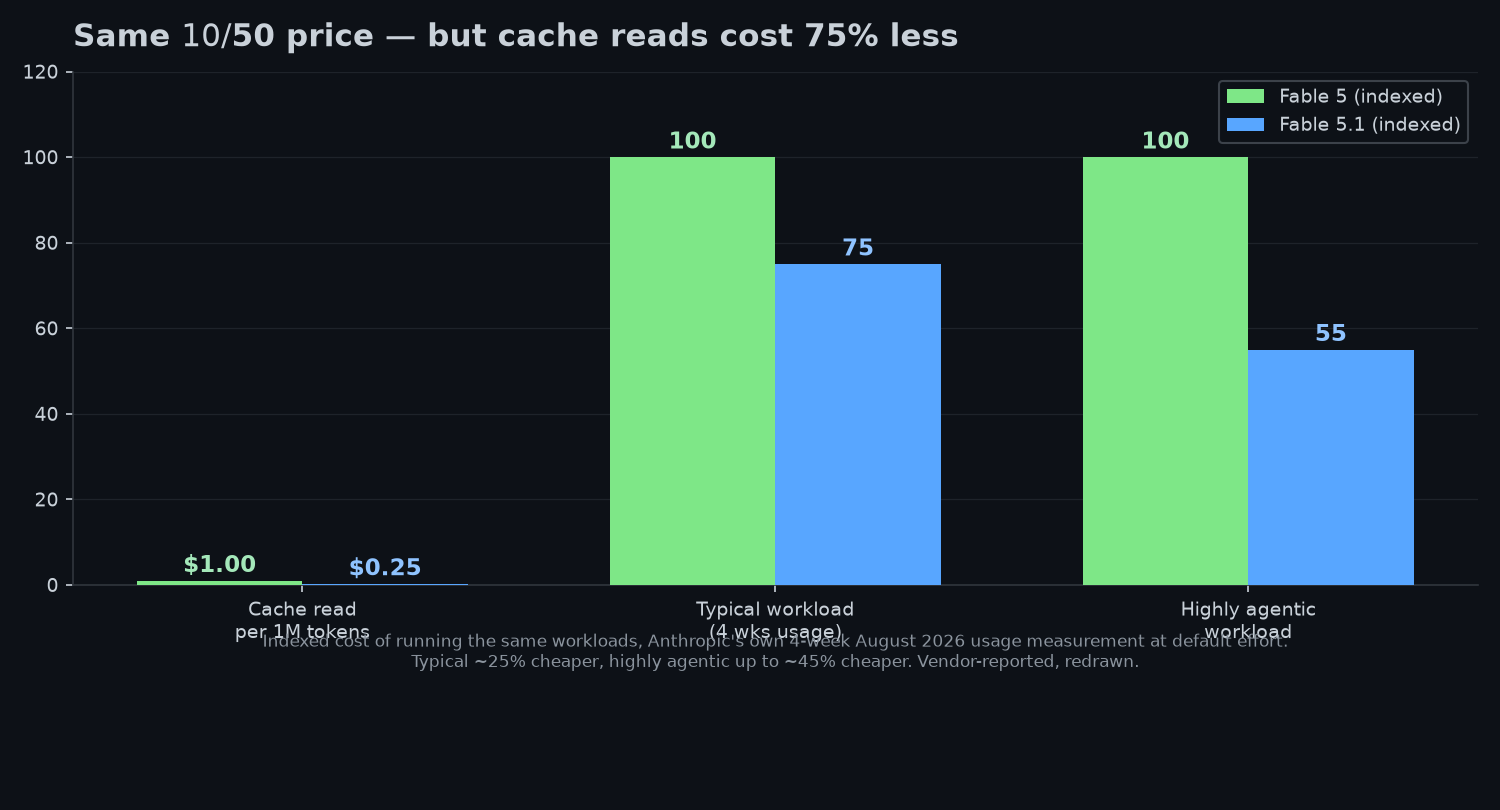
Same sticker price, much lower effective cost. Indexed cost from Anthropic's own 4-week August 2026 usage data. Vendor-reported, redrawn.
Where it actually got better
The benchmark table has two kinds of jumps. There are the "good, incremental" ones — CursorBench 73.4% vs Fable 5's 70.5%, OSWorld up ~5 points. And then there are the "wait, really?" ones. Terminal-Bench-Science more than doubled: 52.6% vs 24.7%. AutomationBench nearly doubled: 31.4% vs 17.1%. Those aren't polish improvements, they're a different capability class showing up in the eval.
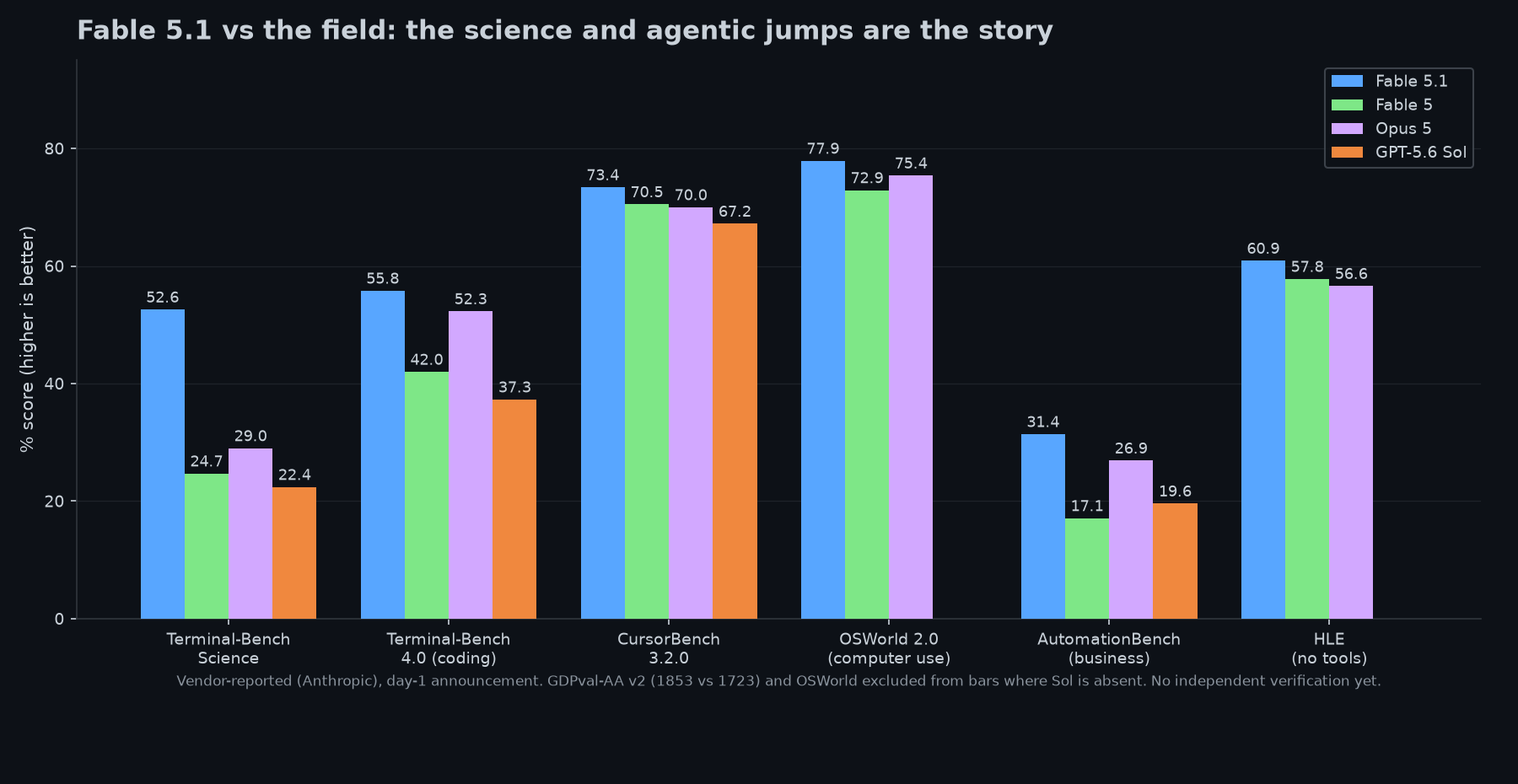
Fable 5.1 vs Fable 5, Opus 5, GPT-5.6 Sol. The science and business-workflow jumps (2x) are the real story; the coding gains are solid but incremental. Vendor-reported, day-1, no independent verification yet.
The real-world examples back it up in a way benchmarks rarely do. Millennium — an investment firm with some of the sharpest quant engineers around — says Fable 5.1 finally found the cause of a rare crash in their internal systems that no engineer and no other model had explained after years of trying. It disassembled an external vendor library, matched it against the core dump, and traced the crash to a bug in that library. That's the kind of story that moves money.
And the science stuff is genuinely wild: a neural network Fable 5.1 trained produced a new elevation map of a third of Venus at 2-3km resolution (the old map was 10-20km), using 30-year-old Magellan radar data. Anthropic released it under a Creative Commons license for the upcoming NASA and ESA missions.
Effort levels are now the cost lever
Fable 5.1 has adaptive thinking always on, with an effort dial (low / medium / high). The interesting part: at Low or Medium effort, it matches or beats Fable 5's results — at much lower cost. It defaults to High in Claude Code, Medium in Claude Cowork and on claude.ai. So the "downgrade" isn't a downgrade anymore; it's the same quality at a cheaper setting.
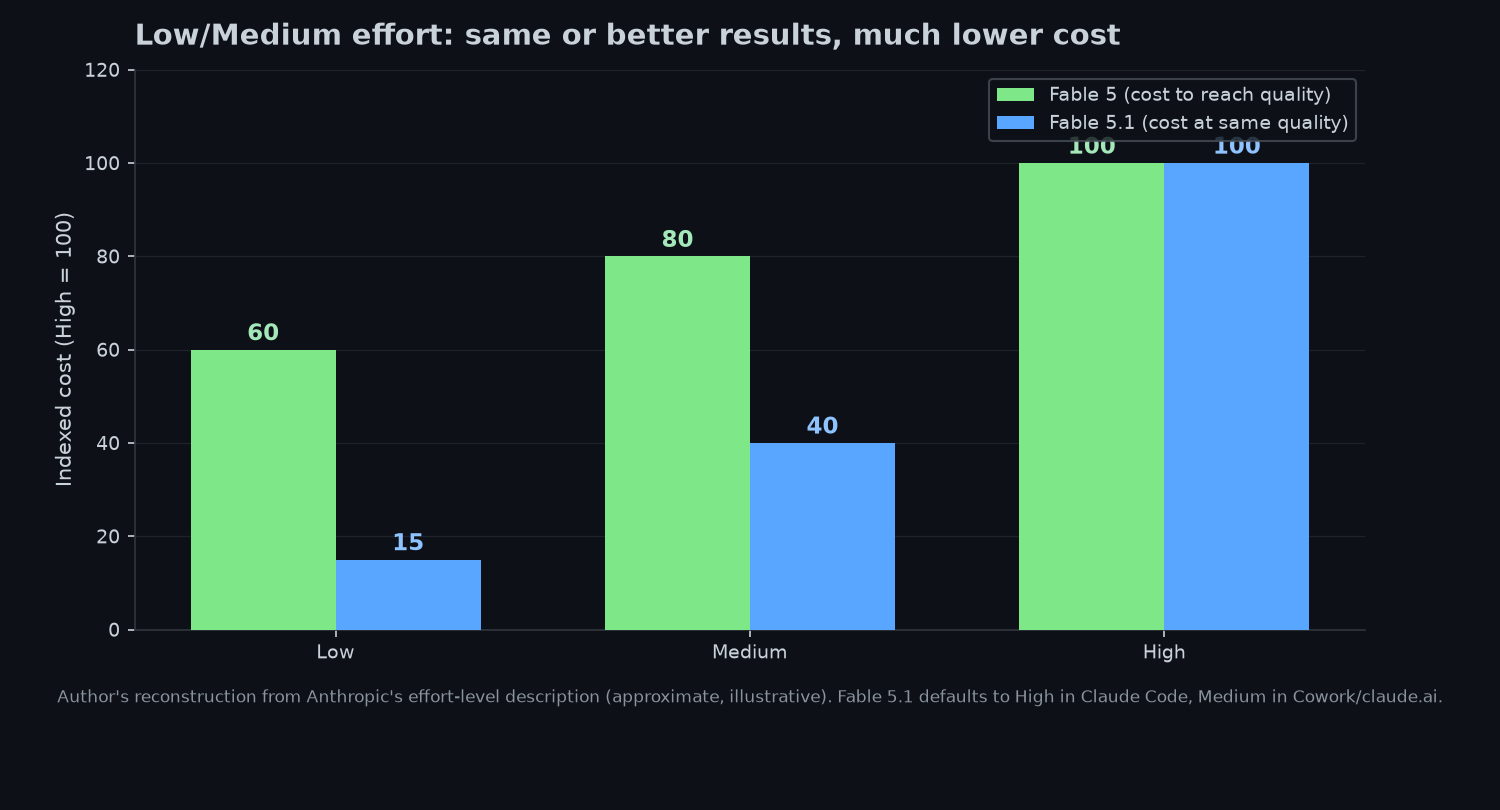
Author's reconstruction from Anthropic's effort-level description (approximate, illustrative). Low/Medium effort ≈ Fable 5 quality at a fraction of the cost.
Mythos 5.1, the safeguards, and the fine print
Fable 5.1 and Mythos 5.1 are the same model with different guardrails. Mythos — the version with stronger cyber and biology safeguards — is only available through trusted-access programs (cyberdefenders, life scientists, US orgs first). The safeguards themselves improved: 60% fewer false positives in cybersecurity, and the model can now find vulnerabilities but not build exploits. Biology access runs through a program built with the US government.
Two things worth knowing before you migrate. First, forced tool use is gone — setting tool_choice to a specific tool now returns a 400 error; you use strict tool use instead. Second, thinking blocks are bound to the model that made them — if you route a conversation from Fable 5.1 down to an older model, it can't read those blocks, and editing earlier turns invalidates them. Treat the conversation as append-only.
And there's a new Enterprise Frontier Safeguards system coming this fall: zero-data-retention-equivalent privacy by storing data in the customer's own cloud, not Anthropic's. Until then, eligible enterprise customers get Fable 5.1 with ZDR.
My take
The cache-read cut is the most interesting move Anthropic has made on price in a while, because it's aimed exactly at the workload pattern that makes frontier models expensive: long agentic sessions. Combined with effort levels that now trade cost instead of quality, Fable 5.1 is quietly the cheapest the Fable class has ever been to actually run — even though the sticker says $10/$50, same as before.
The 2x science and automation jumps are the part I'd love to see independently verified — day-1 vendor numbers on brand-new benchmarks deserve skepticism. If third-party evals hold up, this stops being "Claude got a bit better" and becomes "the frontier moved again." I'll follow up when independent benchmarks land. The video announcement is embedded at the top if you want Anthropic's own demo.
Sources: Anthropic announcement · Claude platform docs · OpenRouter pricing · benchmarks vendor-reported as of September 1, 2026. Price comparison context: my earlier post on $10 coding subscriptions.
Comments
Post a Comment