DeepSeek V4.1 Flash: a 507 tok/s Beta That Expires September 10
DeepSeek V4.1 Flash: a 507 tok/s Beta That Expires September 10
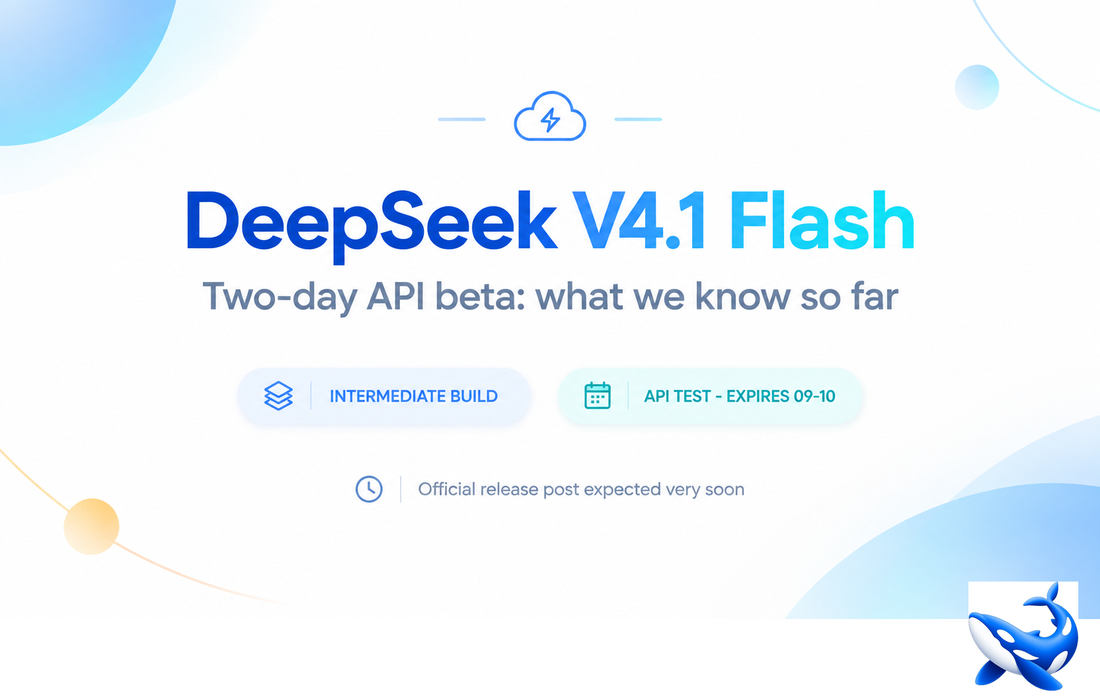
A model ID with an expiry date baked right into it — deepseek-v4.1-flash-expires-on-0910. I saw that string yesterday morning and laughed out loud, then immediately opened the API docs to check whether it was real. It is. DeepSeek dropped an intermediate V4.1 Flash build into the live API on September 8, gave it roughly two days to live, and attached a feedback form asking testers one remarkable question: can this thing replace V4 Pro?
So here is the short version up front. This is not a launch — no model card, no technical report, no changelog entry, no published specs at all. It is a two-day public test of a checkpoint DeepSeek itself calls an intermediate version, billed at exactly the same rates as V4 Flash, capped at 20 concurrent requests per account, and scheduled to vanish around September 10. The community numbers flying around are genuinely eye-catching — around 420 output tokens per second on average, peaks above 500 — but every single one of them is developer-measured under uncontrolled conditions. The interesting part is not any single speed number. It is the architecture claim sitting underneath them.
What actually happened on September 8
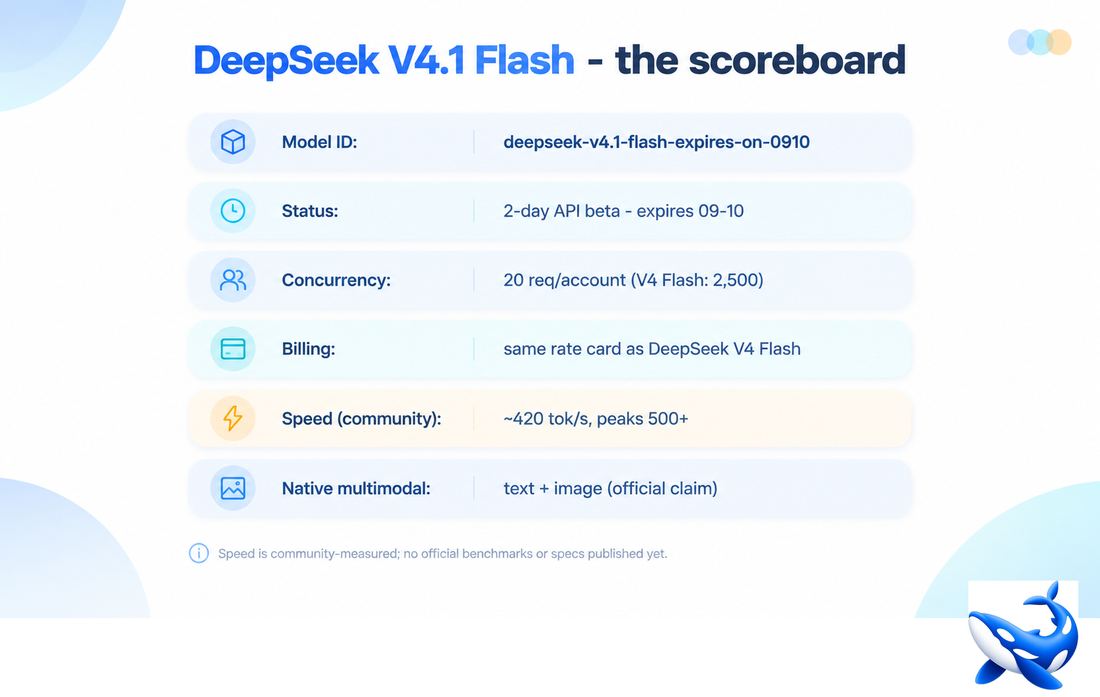
Around 15:00 Beijing time, DeepSeek's team told its official community groups that an intermediate version — described in Chinese as 中间版本, an in-between checkpoint — was opening for limited testing inside the real API environment ahead of a final build. Access could not be simpler: keep your base URL and key, set the model name to deepseek-v4.1-flash-expires-on-0910, and you are in. No waitlist, no new console, no separate endpoint.
| Item | The beta envelope |
|---|---|
| Model ID | deepseek-v4.1-flash-expires-on-0910 |
| Window | September 8 → around September 10 (about two days) |
| Access | Any DeepSeek API key, same base URL, model name swap only |
| Concurrency | 20 requests/account (production V4 Flash allows 2,500) |
| Billing | Same rate card as V4 Flash, no beta surcharge |
| Paperwork | None — no model card, no benchmarks, no tech report yet |
That 20-concurrency cap is doing a lot of quiet talking. It is barely one percent of what production Flash allows, which tells you exactly how DeepSeek sees this build: functional validation and evaluation, not a lane for production traffic. And tipsters expect the official release post very soon — the two-day fuse reads like DeepSeek does not intend to keep anyone waiting long.
Speed is the headline, and it is all community-measured
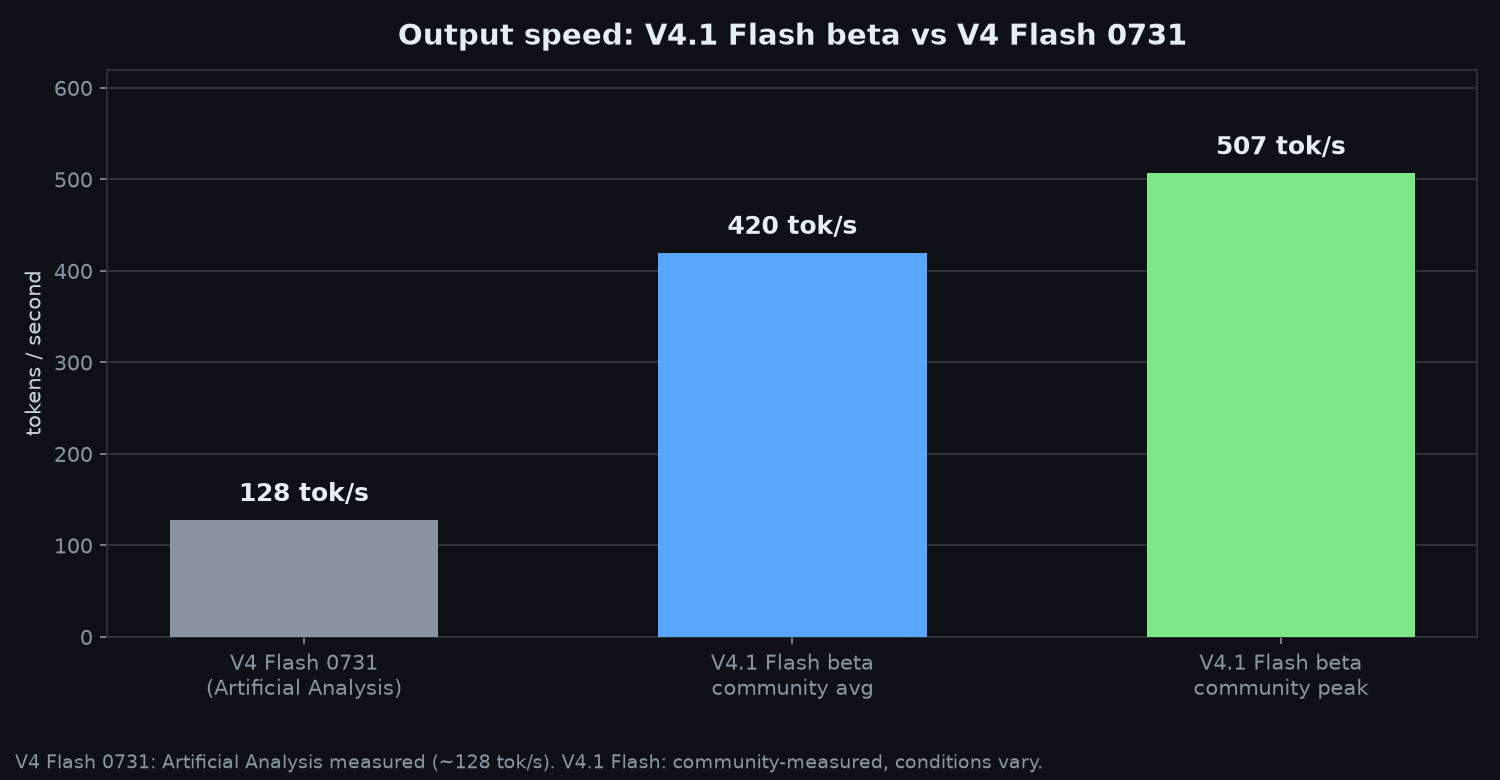
The number doing the rounds on day one is roughly 420 output tokens per second in long generations, with peaks reported above 500 — the highest shared run hit 507 tok/s, and one developer clocked 328 tok/s while having the model generate an SVG animation of a pelican riding a bicycle. One widely shared test pushed more than 71,000 tokens through in under three minutes. For scale, Artificial Analysis measures the public V4 Flash 0731 endpoint at roughly 128 tok/s, so the early reports point to a raw-throughput jump on the order of three times or more.
The back-to-back task comparisons against V4-Flash-Vision-Exp are where the gap looks widest: testers reported roughly 6x faster end-to-end on SVG code generation, about 5.2x on a 49k-token long-context retrieval, around 5x on a large SQL generation-and-optimization task, 4.6x on an algorithmic problem, and 3.9x on an async refactor. Same-task end-to-end numbers fold in thinking time, first-token latency, and generation speed all at once, and they come from individual testers rather than a controlled suite — so I read the consistent direction across all five as the signal, not any single multiplier. Nobody should wire production to a model ID that is scheduled to stop answering, but as a two-day evaluation window, this is a generous one.
The real story: a new architecture, not a tune-up
Here is the part that made me sit up. The previous refresh, Flash 0731, was explicitly a post-training update that kept the same architecture and scale as its preview — DeepSeek said so in the changelog. V4.1 Flash is described, in the company's own wording, as a brand-new model structure, and several outlets read that as a sign the model was re-pretrained rather than fine-tuned. That breaks the pattern, and it matters, because an architectural iteration can move capability ceilings in a way that post-training alone usually cannot.
Bundled with the restructure is the second claim: native multimodal support. This is a precise phrase with a precise contrast behind it. The Vision-Exp build from August 21 bolted a vision encoder onto the V4 Flash text base — DeepSeek's own materials described that pair as a text model plus an external vision path. V4.1 Flash is described as multimodal from the ground up, with text and image inputs handled by the base model itself. What testers have actually exercised so far is text-plus-images, and I would treat multimodal as confirmed only in that text-and-image sense until a model card lands. Some coverage mentions audio inputs processed in a unified manner too, but the modality spec has not been published, so audio stays in the unknown column for now rather than the confirmed one.
Same price tag, faster meter — the billing subtlety
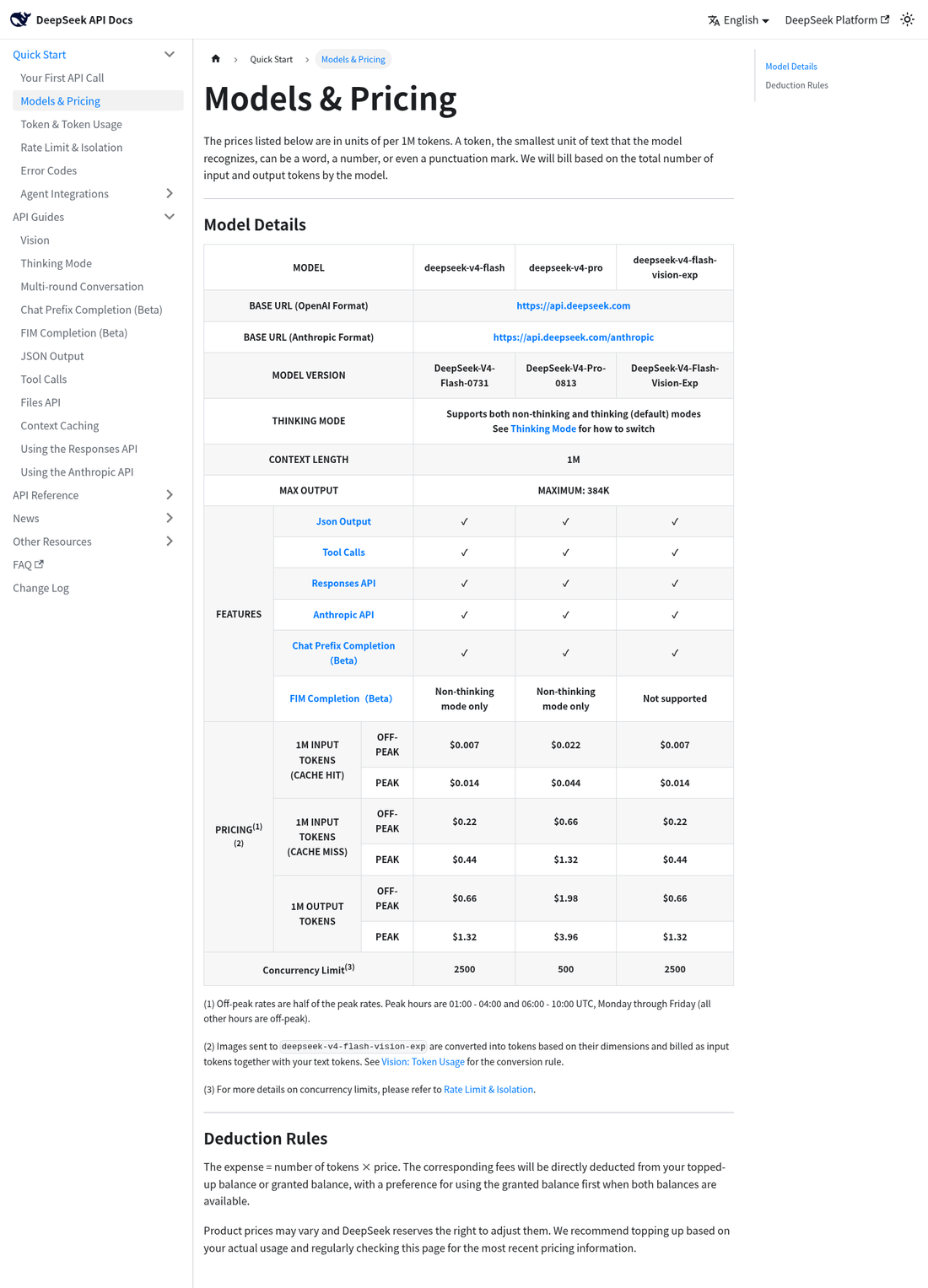
DeepSeek said the test bills at V4 Flash rates, and the Flash rate card since the August 16 repricing is peak/off-peak: $0.22 per million input tokens and $0.66 output off-peak, doubling at peak ($0.44/$1.32), with cache hits at $0.007/$0.014. Peak hours are 01:00–04:00 and 06:00–10:00 UTC on weekdays. Against Pro at $0.66/$1.98 off-peak, the Flash tier sits at a clean 3x discount on every line.
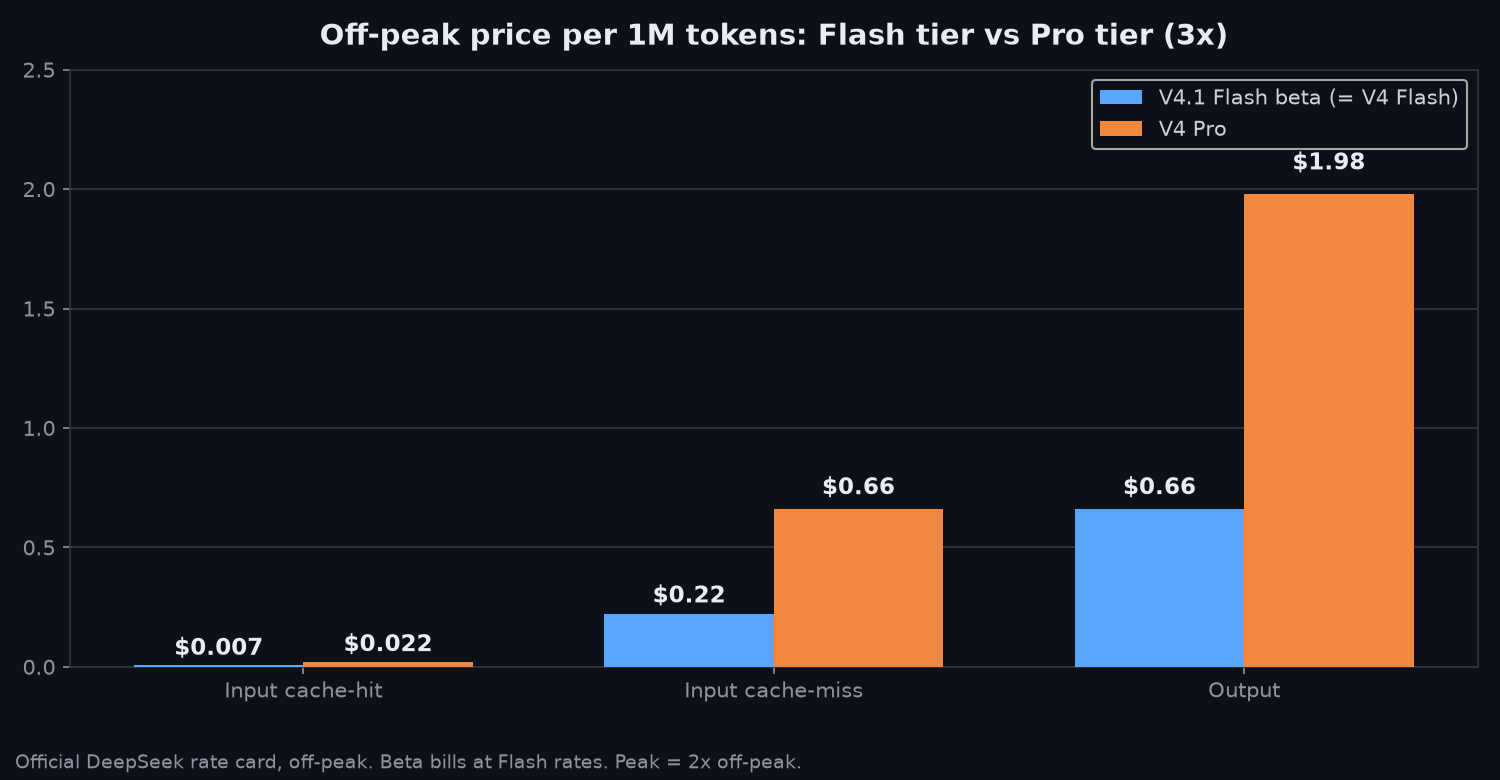
Now the subtlety several first-day testers noticed the expensive way: DeepSeek's “lower cost” claim is an efficiency claim, not a rate cut, because per-token prices did not move at all. A model generating tokens three times faster drains your balance three times faster per minute of wall-clock time — one five-minute session visibly cost more than the same five minutes on V4 Flash. Whether per-task cost actually falls depends on whether the model finishes the job with fewer tokens and fewer retries, which nobody can judge from two days of speed tests. Keep both ideas in your head at once: cheaper per token than Pro by 3x, but the meter spins faster.
The questionnaire question that gives the game away
The most strategic detail of the whole beta is hiding in the feedback form. Alongside questions about agent frameworks and real-world scenarios, DeepSeek asks testers directly whether this intermediate build can fully replace the online V4 Pro. That is a remarkable question to put in front of users, because Pro sits three price tiers above Flash — if a Flash-tier model genuinely approaches Pro-level capability at Flash-level prices, the migration math answers itself for a huge slice of users, and DeepSeek knows it.
Read together with the new-structure phrasing, the questionnaire hints that V4.1 Flash is the first visible step of something bigger than a point refresh — a Flash line repositioned to compress the gap to the flagship, the way DeepSeek has repeatedly used a cheaper, faster model to reset what a price tier buys.
That is my strategic read, not a confirmed fact — no benchmark exists yet that could confirm it. What would answer it is exactly what is missing: independent evals on the agentic and reasoning suites that separate the Flash tier from the Pro tier today. Until those land, the honest position is that a two-sentence survey question is suggestive, not evidentiary. But it is easily the most interesting thing DeepSeek said all week.
How this fits the last 40 days
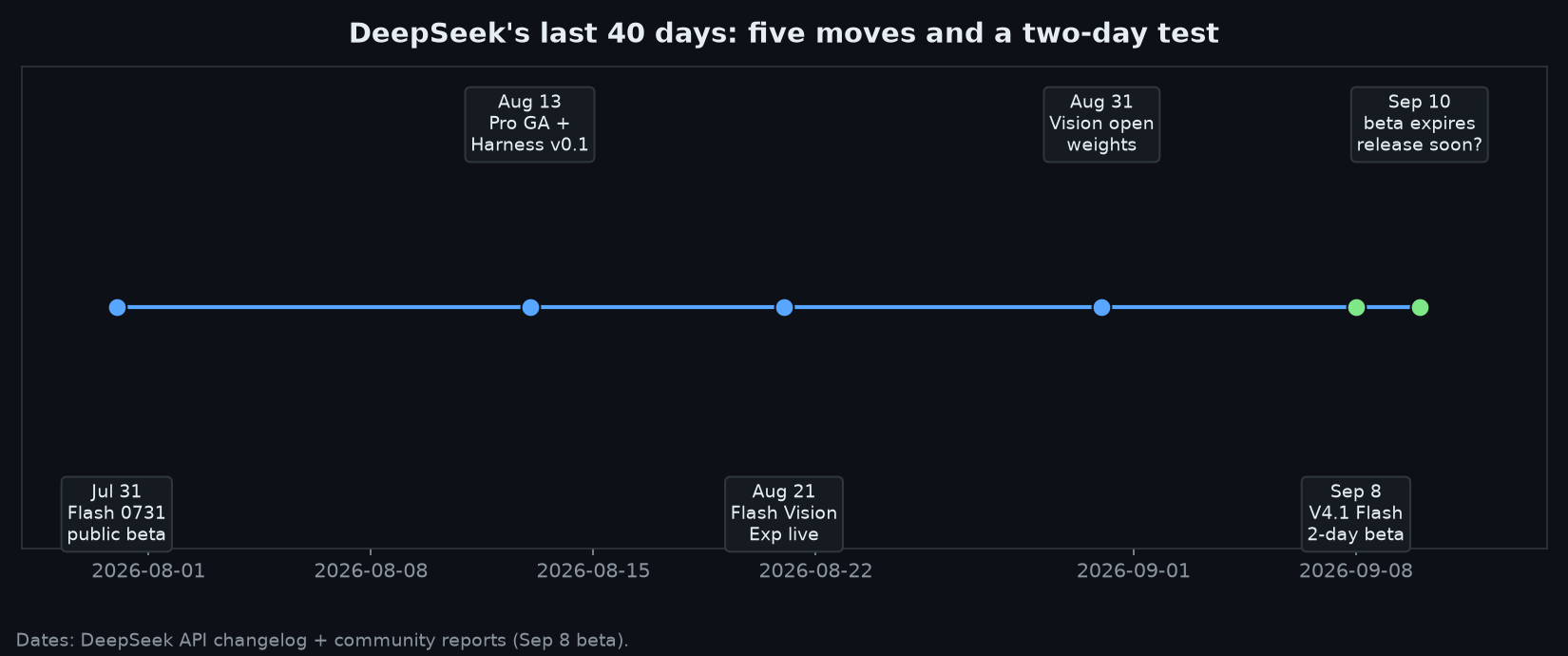
Zoom out and the cadence is striking: Flash 0731 public beta on July 31, Pro GA plus Harness v0.1 on August 13, Vision-Exp live on August 21, open weights on August 31 — four to five major moves in under 40 days. The V4.1 Flash beta looks like the opening salvo of a new cycle, not a one-off experiment.
My take
I like everything about how this beta is shaped: a real checkpoint in the real API instead of a teaser video, honest intermediate-version labeling instead of a fake version bump, and a feedback form that asks the question everyone is actually thinking. The speed reports are fun and directionally exciting, but speed was never Flash's problem — the question that decides whether this release matters is capability per dollar against Pro, and that answer needs independent benchmarks, a model card with real specs, and a launch rate card. My guess is the official release post lands within days of the September 10 expiry, and I will be running the agentic suites against it the moment it does — if the numbers hold anywhere near the hype, I will update this post the same week.
Sources: OrcaRouter, “DeepSeek V4.1 Flash Hits a Two-Day API Beta” (Sep 8, 2026, community measurements + beta details); DeepSeek API Docs changelog (Flash 0731 / Pro GA benchmark tables, vendor-reported); BigGo Finance beta coverage (Sep 8, 2026). All benchmark and speed figures are vendor-reported or community-measured as labeled — no independent verification exists yet for the V4.1 Flash build.
Comments
Post a Comment