Cloudflare Clef: Where the 13.5x Latency Claim Applies
AGENTS & WORKFLOWS
Cloudflare Clef: Where the 13.5x Latency Claim Applies
38.8 milliseconds caught my attention. The accuracy rows made me slow down.
A decision call that returns sooner can help an agent, but only the time spent on that call is saved. Cloudflare's Clef comparison reports 38.8ms against 524.1ms for Jev. The accuracy rows and the call's share of a full workflow decide how useful that difference is.
In this article
Clef arrived on October 1 with two sizes, open weights and a hosted API. The comparison below uses Cloudflare’s published tests and pricing, not a local Clef run. It asks where a faster decision call could help an application and where the accuracy or cost trade-off would matter more.

Typed decisions instead of generated prose
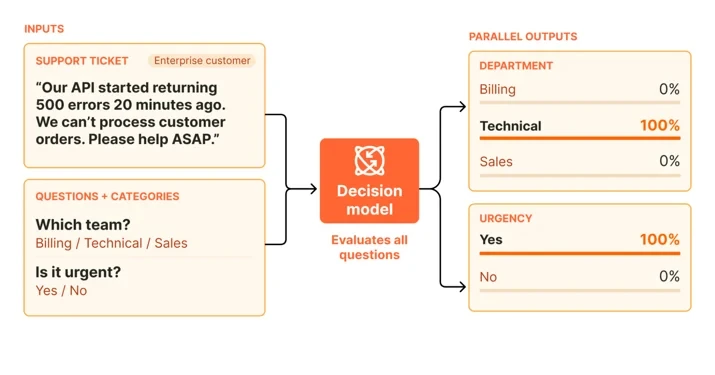
Think of a support inbox. Your software needs to decide which team receives a ticket and whether somebody should look at it immediately. You already know the available departments. A paragraph explaining the choice is optional; a dependable choice your program can use is the point.
The Clef model card describes a Qwen3.8-27B backbone with a head that scores the permitted options across typed questions. Clef-flash uses Qwen3.5-9B. Both return probabilities rather than freely generated prose. The surrounding program can use those scores to route a request, ask for more information, or send it for review.
That makes the output easier to integrate. It also puts more responsibility on whoever defines the questions. If the permitted choices leave out the right department, a neat response format cannot fix the design. I would include an escape route for cases the application cannot safely classify.
The measurements behind 13.5x
The published model card identifies the benchmark as Cloudflare's internal run of Decision Index 0.2.1. Its latency rows contain the comparison behind the headline. The larger Clef sits at 209.3ms median; the very small number belongs specifically to Clef-flash.
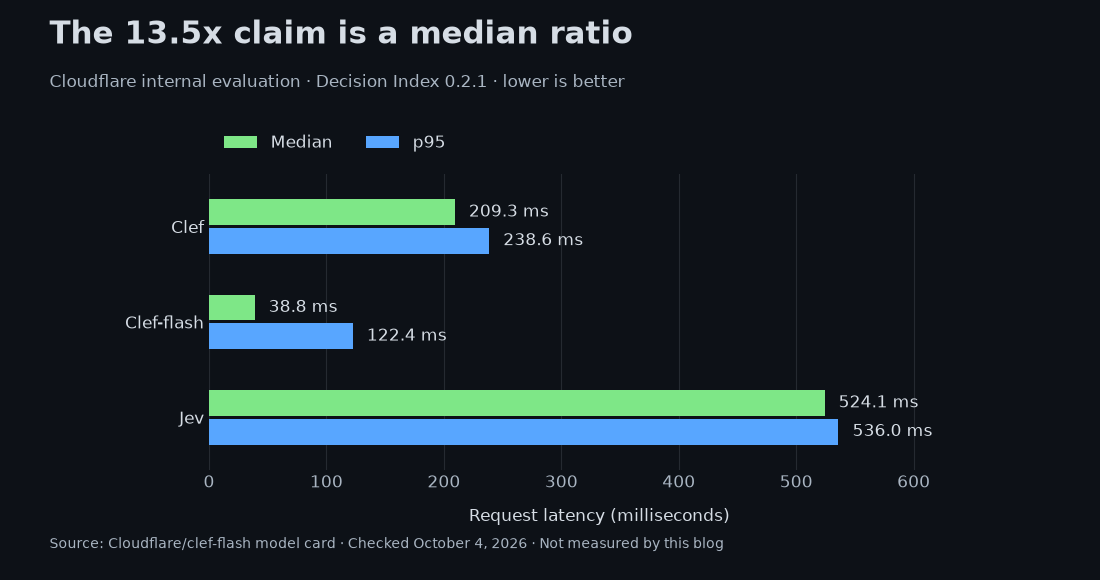
The distinction matters if your users notice the slower requests. A median describes the middle of the measured distribution. A p95 describes a point near its slower end. Calling the entire experience “13.5x faster” takes one comparison and stretches it beyond what the table establishes.
I would keep payload, questions, concurrency, and access route consistent in a comparison of my own. I would also time the request from the caller. A published request-latency ratio does not isolate GPU execution, and it does not establish the same ratio from every location or under every load.
Accuracy alongside latency
The answer changes with the task. Cloudflare's card gives Clef-flash 98.8 on BFCL case-exact accuracy, compared with Jev's 95.8. It also reports 35.6 versus 76.5 on RAGTruth hallucination-detection F1, and 65.6 versus 81.0 on When2Call MCQ accuracy. These are separate metrics from different tests; averaging them would hide the decision you actually need to make.
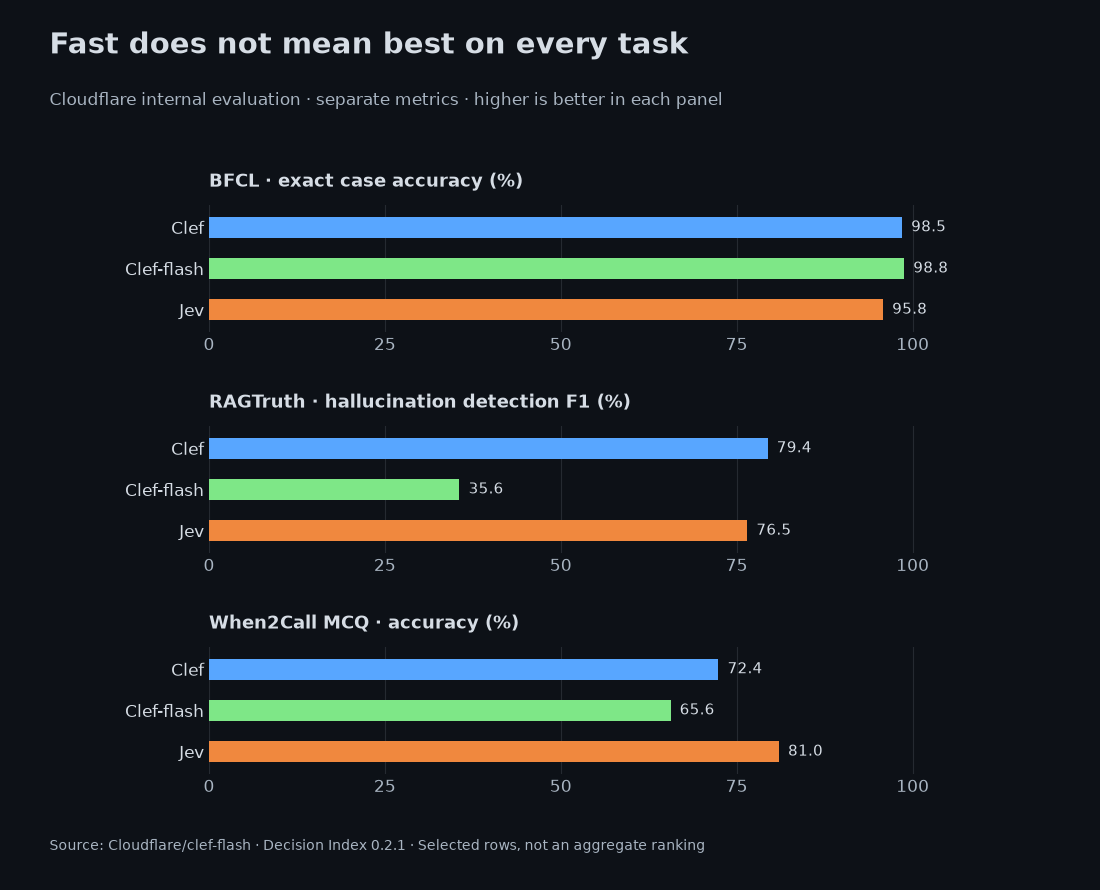
The larger Clef is useful context. Its RAGTruth score is 79.4, while its When2Call score is 72.4. Choosing the larger model changes the tradeoff, rather than eliminating it.
For a ticket router, I would build a small set of labeled tickets from the intended workflow. Include unclear requests, overlapping departments, and messages that should reach a human. Then examine the mistakes. A fast wrong destination can cost more time than a slower correct one, especially when somebody has to undo an automated action.
Hosted prices and open weights
The hosted input prices currently favor Jev. The same three models appear below, with each access route made explicit. These are listed token charges, not cost-per-correct-decision measurements.
| Model / listed route | Input per 1M tokens | Illustrative 10M input tokens |
|---|---|---|
| Clef / Workers AI | $0.24 | $2.40 |
| Clef-flash / Workers AI | $0.09 | $0.90 |
| Jev / Cloudflare third-party model | $0.042 | $0.42 |
Official list prices checked October 4, 2026: Clef, Clef-flash, and Jev. Jev lists free output; the Clef pages quote an input-token unit price. The example excludes platform, storage, other model calls, and taxes. OpenRouter independently lists the same Jev input price.
On these input rates, Clef-flash costs about 2.14 times as much as Jev, and Clef about 5.71 times. That is a different claim from the latency advantage. A comparison of full workflows would also have to count retries, review work, and the amount of input each route bills.
Both Clef releases carry Apache 2.0 licenses. The release files include the backbone, schema head, and inference code. That gives builders a path to inspect, adapt, and host the system. A local deployment still needs hardware and an operating budget; the published example was tested on an H200. I would price a complete serving setup before calling self-hosting cheaper.
The context comparison also deserves a careful reading. Cloudflare lists 65,536 tokens for both Clef variants. TypeSafe documents 64k for Jev's combined request, with a separate 32k limit for the state plus its longest question. “Twice Jev's context” compresses two different limits into one slogan. Check which limit your actual request hits.
For hosted use, Cloudflare's data policy says it will not train on or improve services with customer content without explicit consent. It also describes storage when you use storage services alongside Workers AI. I would check the full route—including application logs and gateways—before describing a deployment as having zero retention.
The effect on a complete workflow
Here is the arithmetic I wish accompanied more speed claims. Suppose everything around a single serial decision takes four seconds. Add the published Jev median and the total becomes 4.5241 seconds. Substitute the Clef-flash median and it becomes 4.0388 seconds.
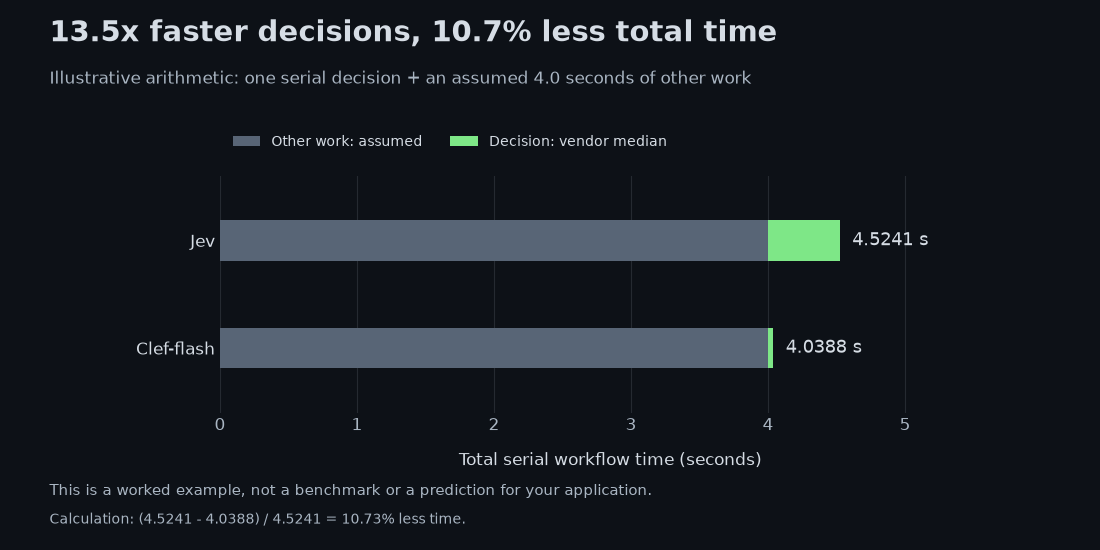
The improvement is about 10.7% of the original total time. The small fast step cannot remove the four seconds you left untouched. If decision calls dominate the critical path, the benefit could be larger. If they overlap with other work, adding their durations would be the wrong model.
Measure the step that makes a user wait before swapping models. If most of the time belongs to another tool or a generation call, reducing decision latency will have a smaller effect on the total. The worked example makes that limitation explicit.
Clef-flash is a candidate for a latency-sensitive routing task, provided it meets that task’s accuracy requirement. The larger Clef needs a reason tied to its reported gains to justify the extra latency and token cost. Open weights also make a local comparison possible, with hardware and maintenance costs included.
My earlier Jev workflow post looks at the kinds of jobs this layer can serve; the Laya comparison shows why speed and accuracy should stay in the same conversation. Clef is another reason to compare the complete workflow instead of choosing from a multiplier alone.
Comments
Post a Comment