Gemini 4 Argon: Better Results Within Which Limits?
MODELS & COSTS
Gemini 4 Argon: Better Results Within Which Limits?
Updated October 17, 2026: the third-party planets comparison image has been removed. That selected example and the comment tally are anecdotal evidence, not a reproducible model ranking. The linked reports and independently drawn charts remain.
A better answer is useful only while the account has enough allowance to keep working. Early Argon coverage contains both stronger results and complaints about limits. Those are separate pieces of evidence, so this article compares access, evaluations and selected user reports in turn.
In this article
One correction comes first. The October 13 rollout is for Google AI Pro and Ultra subscribers in the Gemini app. It is a global rollout, rather than a promise that every account already has access. Free users are not included in this Argon announcement. Google’s release notes and the consumer model-availability table agree on the eligible plans.
I researched the official results, independent evaluations and early public reports for this article. I have not run my own Argon benchmark. My read so far: the capability improvement is credible, while everyday value depends heavily on the task, the surrounding app and the quota.
October 13 access by plan
The important change is ordinary subscriber access. The earlier announcement concentrated on trusted testers; this release lets a much wider group try the model in their existing Gemini workflow. My original Argon launch breakdown covers that earlier phase.
| Route or feature | Status checked October 14, 2026 |
|---|---|
| Gemini app | Argon is rolling out globally to Google AI Pro and Ultra. |
| Free and AI Plus app plans | Argon is absent from these plans in the current consumer availability table. |
| Thinking controls | Low, Medium and High are available; the selected level affects the experience. |
| Developer API | Paid access has separate eligibility and metered pricing. An app subscription is not a blanket API entitlement. |
| API token window | Input, thinking and output share one 1,048,576-token window. A long response consumes that same budget. |
The developer docs introduce another product boundary: the API pricing page separately lists Argon as unavailable on its Free tier and Google AI Pro route. That does not erase the Pro access explicitly listed in the consumer app table. Check the product you mean before concluding that either page promises universal access.
The “one million output tokens” headline also needs the current specification beside it. Google’s API guide describes a shared input–thinking–output window, with long output limited by what remains after the input. It is not a guarantee of a million visible words, and it does not establish the consumer app’s practical upload limit.
The coding results by task
It wins some meaningful rows, including in coding. In Google’s launch comparison, Argon scores 77.9% on DeepSWE v1.1, ahead of GPT-6 Astra at 74.1% and Claude Opus 5.5 at 74.2%. That is a useful result for long software-engineering tasks.
The same table contains the counterargument. On FrontierSWE v2, Argon’s 55.0% trails Astra’s 65.5% and Opus’s 62.3%. On Terminal-Bench 4.0, it records 57.4%, against 58.2% and 66.4%. These are Google-reported results, with published evaluation methodology; they are not my measurements.
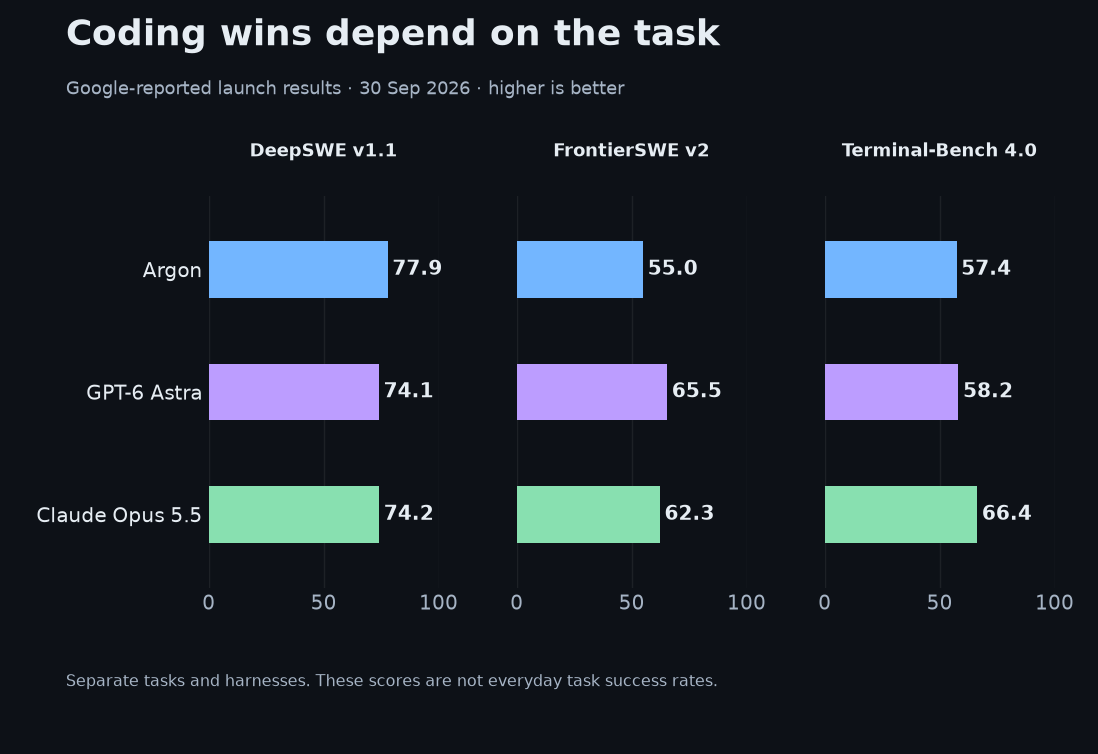
That spread matters more than counting highlighted cells. Debugging an existing repository, navigating a terminal and producing an attractive browser demo put pressure on different skills. A model can improve substantially while still leaving you with a reason to keep another tool around.
I would judge the output by the work it saves after review. If a generated change passes the real requirements but takes several repair cycles, the first response’s polish is a poor measure of productivity. For coding, review effort and regression checks belong beside completion time.
Two evaluators, different scales
Artificial Analysis lists Argon at the High reasoning setting with an Intelligence Index v4.3.2 score of 53, ranked 8th of 216 in its displayed summary. That supports “competitive,” while leaving plenty of room between Argon and a claim of universal leadership. Its throughput field was still N/A when checked, so I cannot turn “feels quick” into a measured tokens-per-second claim.
Vals AI paints a stronger picture of professional work: 68.90% ±0.97 on the Vals Index, ranked first of 48 on the current page. Its Finance Agent v2 result is 65.40%, first of 78. Yet its own detailed results include 4.83% on CUA-bench, ranked eighth of nine. Strong work-oriented performance does not automatically make the model a reliable operator in every graphical environment.
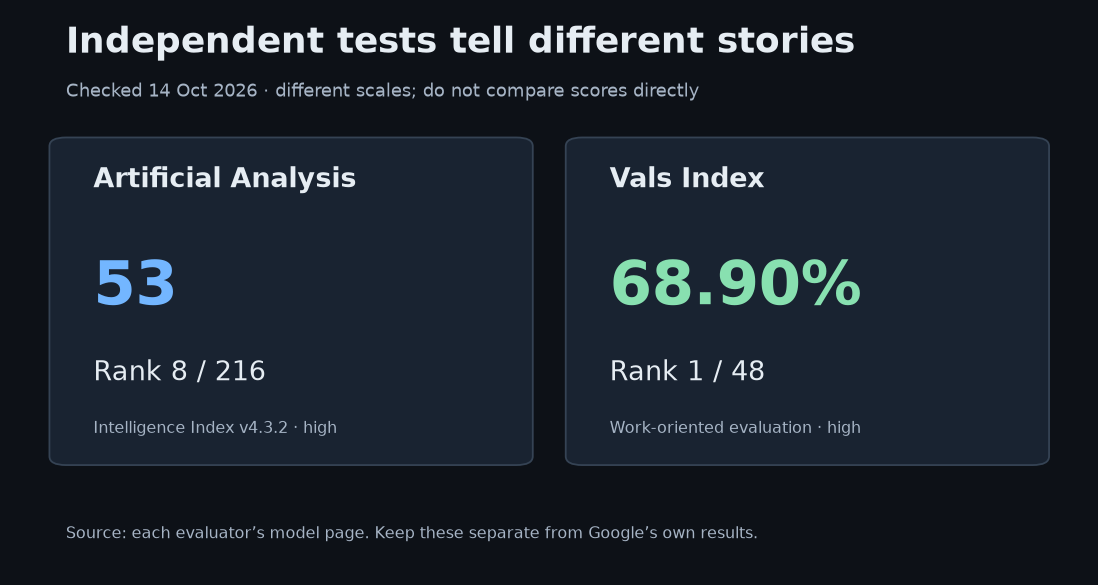
There is no contradiction to fix by choosing the nicer headline. The evaluations ask different questions. I find the split more useful than a single league table: it tells me to test the exact document, repository or workflow I care about.
The Vals run also specifies High reasoning and a 262,144-token output cap. The current API supports a larger shared window. That is an evaluation configuration, not proof that the model’s limit has suddenly shrunk. Likewise, a ranking can change when new models enter even if Argon’s score stays the same.
What the selected comments say
For a small, traceable look at the launch discussion, I manually coded 24 selected, task- or usage-specific comments in r/GeminiAI’s “Argon 4 Thoughts?” thread, read October 14 KST. I excluded generic cheers, jokes, speculation and repeated posts by the same participant. It is a convenience sample from one community, with overlapping categories; it cannot tell us what percentage of all users are satisfied.
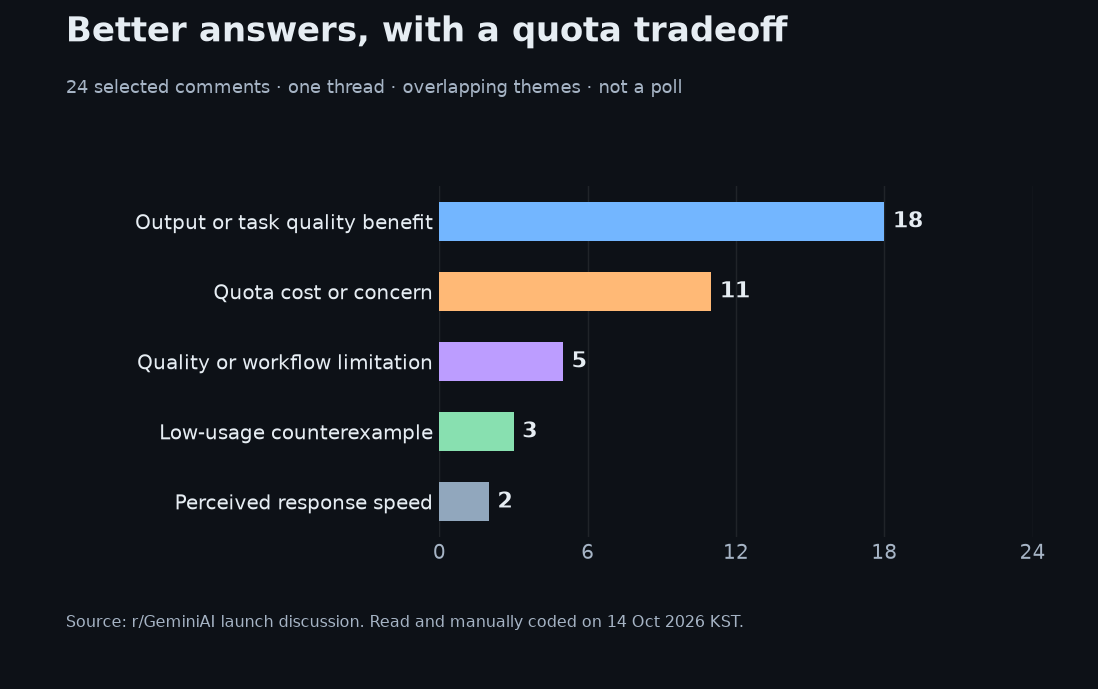
Favorable reports covered clearer reasoning, instruction retention, spreadsheet error spotting and 3D work. Counterexamples included a failed large-document task and continued preference for competing models on particular jobs. Some people liked the output and disliked its usage cost in the same comment.
“Surprisingly good tbh but need more limit tbh”
— a commenter in r/GeminiAI’s launch discussion
A separate r/AntigravityGoogle first-impressions post described an Ultra user being happy with the first hours and getting a better result than Astra on one task. The writer explicitly avoided calling it better overall. That is the right scope for a first-day success story.
My interpretation is that two experiences are getting mixed together: the model’s answer quality and the product’s ability to support an entire work session. A much better answer can be a real improvement even when the surrounding workflow still interrupts you. Both deserve a line in the verdict.

The limits of the speed comparison
There is at least one inspectable example. OhMyUnicorn’s same-prompt planet experiment reports Argon building a playable Three.js page in 5.5 minutes for $1.58, versus Opus 5.5’s 14.0 minutes and $2.54. The prompt and project notes were matched, but the agents differed: Gemini CLI versus Claude Code. Argon’s attempt to inspect its page failed; Opus inspected its result three times.
That is an interesting faster, cheaper run. It is also one run per model, with no blind quality judge. The additional inspection work affects what those times mean. I would use the public outputs to decide whether either result meets my brief before treating the stopwatch as a win.
Useful work within the allowance
This is the largest practical uncertainty. The same launch thread includes a Pro report of 52% of a reported five-hour allowance used by seven queries and another Pro report of 12% after three skills with spreadsheet ledgers. Other reports describe little or no visible consumption. Treat those numbers as account-specific observations, rather than an official “twenty prompts per five hours” policy.
Google’s model help says advanced models and higher thinking levels consume more usage. It also explains how to inspect which model answered, and that a paid chat can continue with Flash-Lite after the usage limit. A comparison made after that switch may be evaluating a different model. Capture the response details and remaining usage when testing.
The developer bill is easier to calculate. Standard API pricing is $2 per million input tokens and $10 per million output tokens through November 30, then $4 and $20 from December 1. Thinking tokens count as output. An illustrative request with 100,000 uncached input tokens and 50,000 total billed output tokens costs $0.70 now, $1.40 afterward, before any tool charges or taxes. That is arithmetic from Google’s dated price table, not a measured average task cost.
For my comparison sheet, I would record the completed result, repair effort, elapsed time and usage consumed. Start with the lowest reasoning setting that can meet the task. For the API, Google recommends Medium for most work and describes High as using more tokens with slower first-token latency. The consumer app has its own defaults, so do not assume every “Argon” report used the same setting.
The reported improvement gives existing Gemini subscribers a reason to retry a difficult task. It does not yet settle whether a new subscription is worthwhile. Coding results vary by test, and the early quota reports describe materially different experiences.
If you already have an eligible plan, bring back a task Gemini previously failed. Keep the original requirements, verify the result and watch the usage meter. That comparison will tell you more about your subscription’s value than a perfect-looking demo.
For a new subscription, check whether a normal work session fits within the plan’s allowance. A few strong answers followed by an exhausted quota would be a poor fit for sustained work, even if those answers looked better than the previous model’s.
Comments
Post a Comment