Bambu Lab H3C: What the $2,499 Combo Really Includes
Bambu Lab H3C: What the $2,499 Combo Really Includes
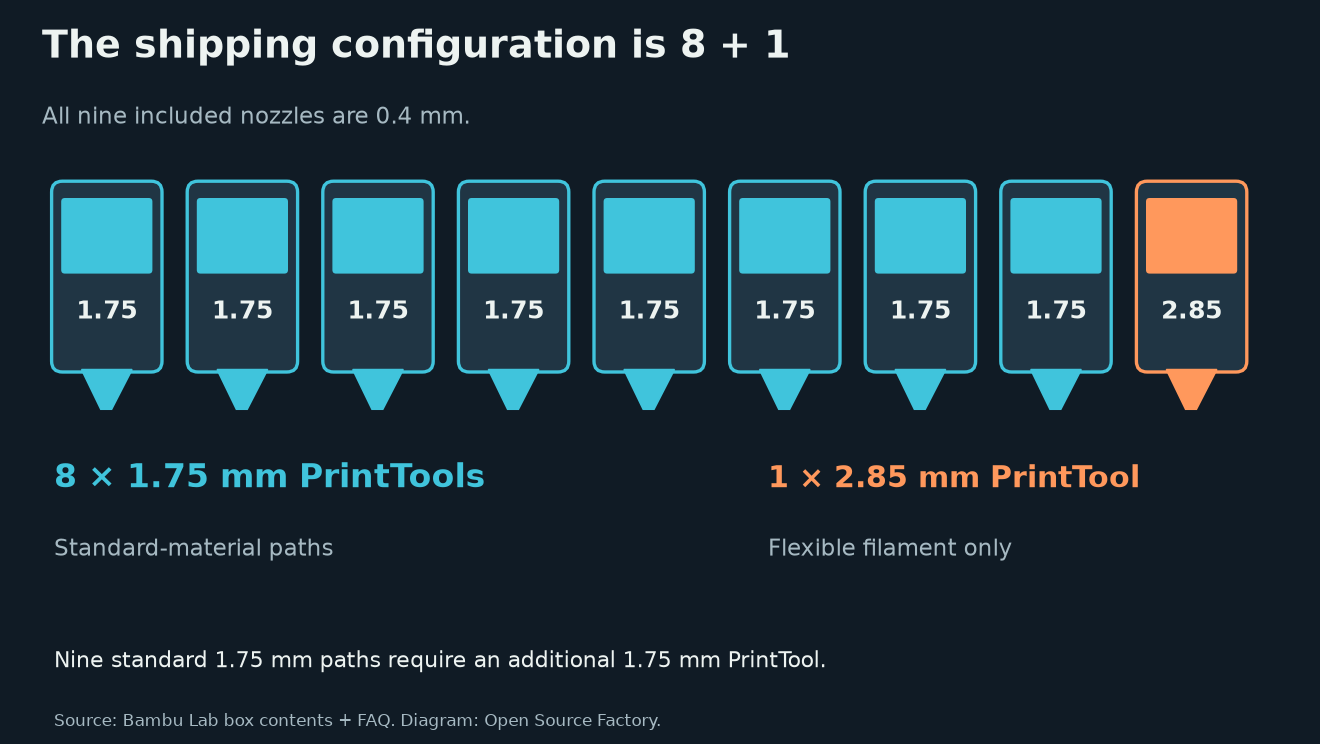
I went from the H3C’s nine-tool headline straight to its box-contents table. That table changes how I would plan a first print: the standard Combo contains eight tools for 1.75 mm filament and one for 2.85 mm flexible filament. It is a useful allocation, especially for rigid-and-soft parts. A job using nine ordinary PLA paths needs another compatible 1.75 mm PrintTool.
Bambu Lab launched the H3C on November 3, 2026. The Combo with AMS 3H is $2,499 in the US before tax; the official Korean launch announcement lists ₩3,999,000 including tax and shipping. This article follows our earlier P3C/H3C leak and certification report, now that there is an actual product configuration to examine. It is source-based analysis, with original calculations and diagrams; I have not run the printer or reproduced its demonstrations.
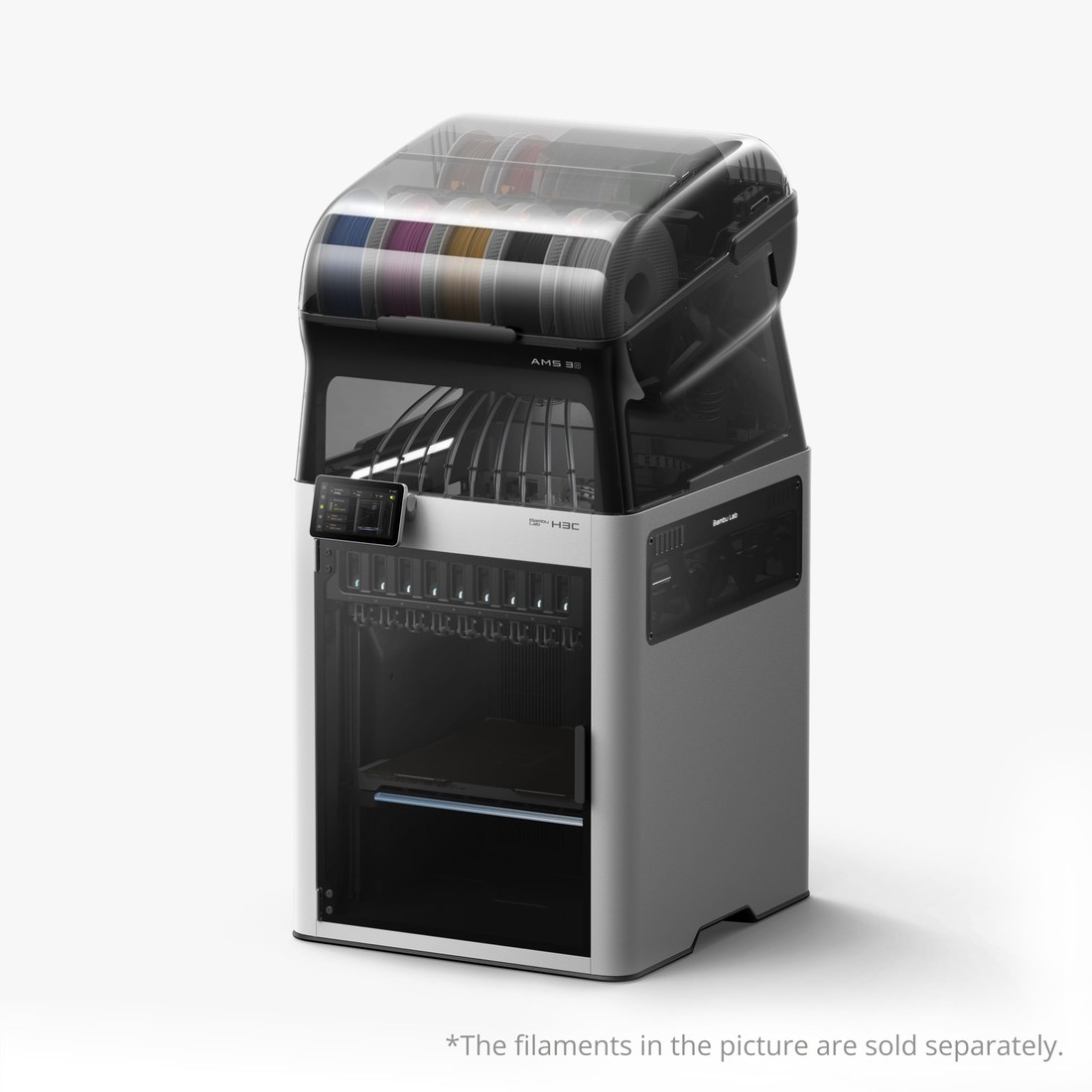
What does the launch price actually include?
The basic Combo already provides the printer, AMS 3H, a textured PEI plate and nine 0.4 mm PrintTools. The official FAQ says the FDM setup needs no extra accessories beyond filament. The additional purchases start when your project needs a different tool allocation, a smaller nozzle, or a crafting process.
| Announced package | US · before tax | Korea · tax + shipping included |
|---|---|---|
| H3C + AMS 3H | $2,499 | ₩3,999,000 |
| Above + PLA Palette and TPU filament bundle | $2,589 | ₩4,119,000 |
| Filament bundle + open Bambu Station | $2,799 | ₩4,448,000 |
| Filament bundle + enclosed Bambu Station + E1 purifier | $3,049 | ₩4,839,000 |
Prices are from Bambu Lab’s official launch announcement; the US product selector separately confirms the $2,499 Combo and $2,589 starter packs. The announcement also lists the enclosed-station package. Korean prices here are announced local prices, not dollar conversions or a claim that Korean checkout availability was verified.
The filament starter premium is $90 in the US and ₩120,000 in Korea. That adds consumables. The listed tool count remains eight standard-filament tools plus one flexible-filament tool, all with 0.4 mm nozzles. Buying a starter pack does not itself provide the extra standard PrintTool needed for nine independent 1.75 mm paths.
What does a six-second change mean on a long print?
Swaptek keeps each tool’s filament in its own path, with its own heater. The next nozzle can preheat while the current tool is printing. A tool change therefore avoids unloading one filament and feeding another through the same path. Bambu’s mechanism explanation describes why that matters when a model has hundreds of transitions.
The product page gives two different timing figures: 3.4 seconds for a tool change and as little as six seconds from printing one material to printing the next. I would use the latter when thinking about job time. Bambu ties that minimum to internal testing with PLA Basic and filament-saving purge mode; it varies with materials and slicer settings.
Here is a deliberately narrow calculation. At 1,000 transitions, six seconds per transition totals 6,000 seconds, or 100 minutes. At the advertised 0.038 g minimum purge per transition, the corresponding arithmetic is 38 g. These are separate illustrations of the launch claims, not measured results or a promise that both minima hold for every material pairing.
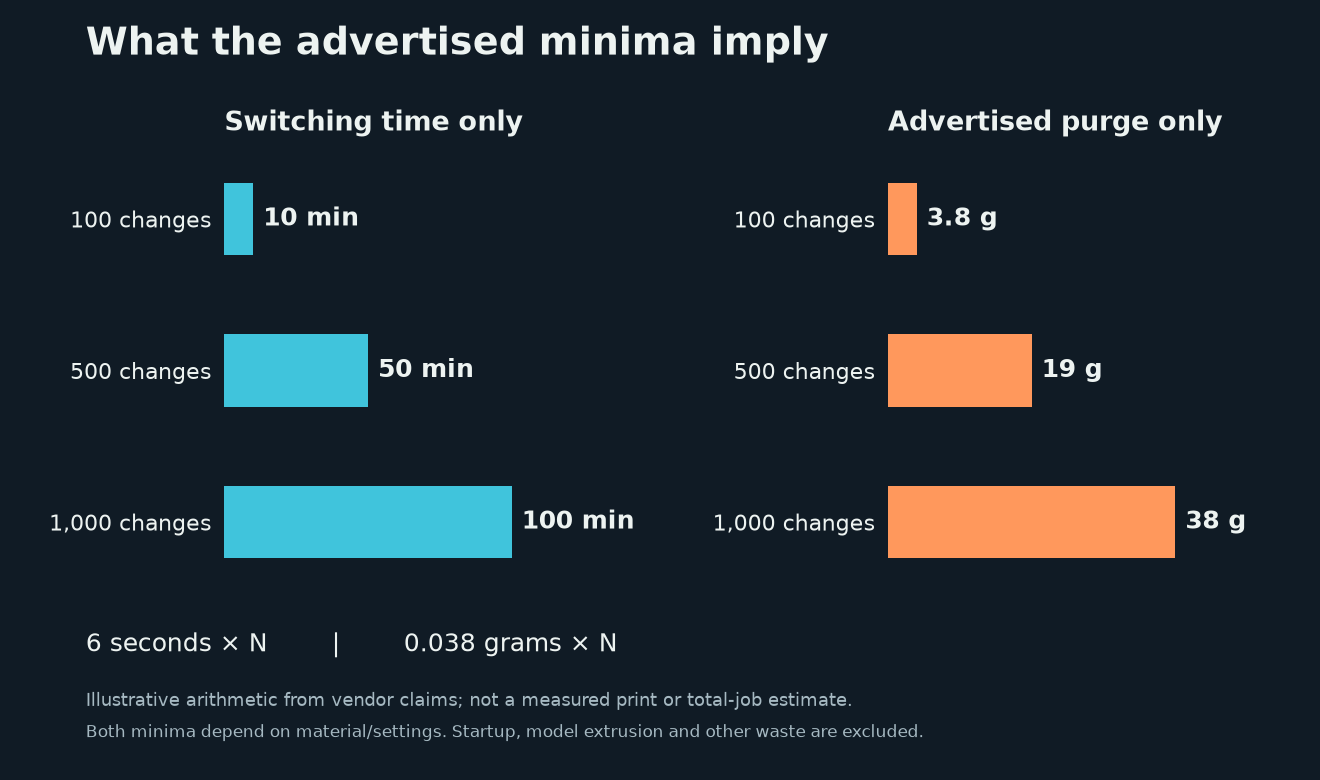
The useful sensitivity is even simpler: one extra second on each of 1,000 transitions adds 16 minutes 40 seconds. That is why I would inspect a project’s transition count before its maximum travel speed. A single-color bracket offers little opportunity to benefit from faster changes. A detailed multi-material model can spend a meaningful part of its schedule on them.
The minimum purge figure also leaves questions for testing. It does not establish the total waste of a complete model, prove that a prime tower is unnecessary, or measure long-run reliability. I would want a sliced project, the finished result and its collected waste before turning it into a savings claim.
Why the tool allocation matters beyond color
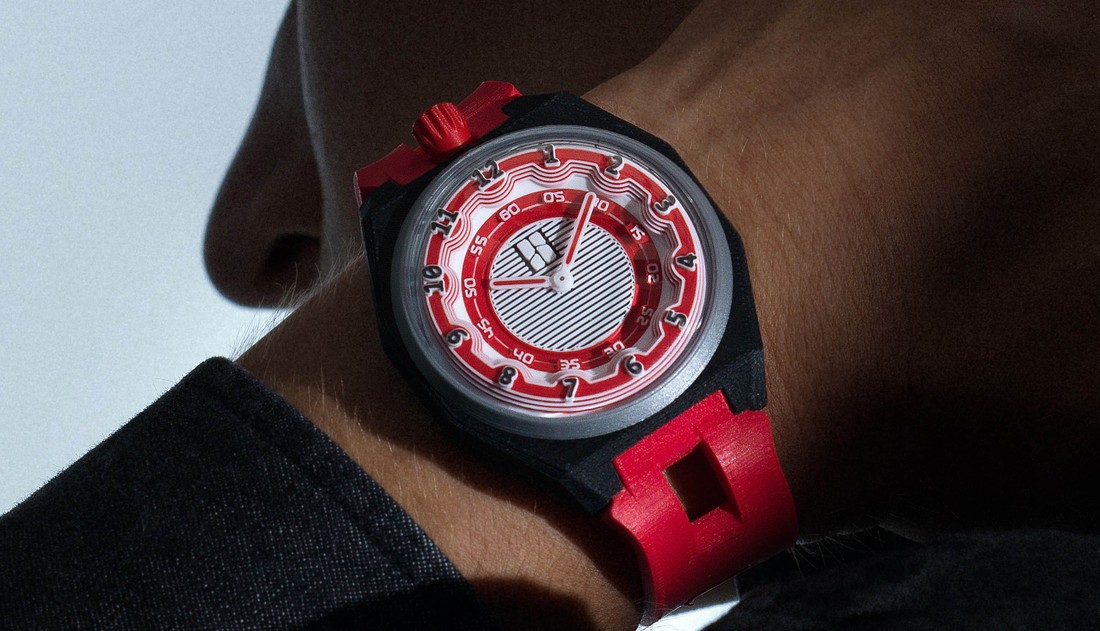
The H3C supports 0.2, 0.4, 0.6 and 0.8 mm nozzle diameters, with additional diameters sold separately. Bambu describes mixed-diameter planning in Studio that can give each nozzle a suitable layer height. Its watch demonstration uses fine detail, a rigid case and a soft band to explain the point. It is a more interesting design problem than simply adding another color.
The flexible-material side uses a dedicated 2.85 mm tool and a bypass feed. The FAQ restricts that tool to 2.85 mm flexible filaments; it is not a general-purpose ninth 1.75 mm PLA path. Its base, hotend and cutter differ from the 1.75 mm version. The factory places it in dryer slot 8, which makes sense for a material that needs moisture management.
FlexFeed is intended to make soft TPU, down to 75A, more practical. The detailed product page claims up to three times the volumetric flow of the previous-generation 1.75 mm setup under internal test conditions. That is an extrusion-flow comparison, not proof that a finished shoe or bag prints three times faster. The US store’s short feature list also displayed a conflicting “5×” figure during research; I have not used that larger number as a verified result.
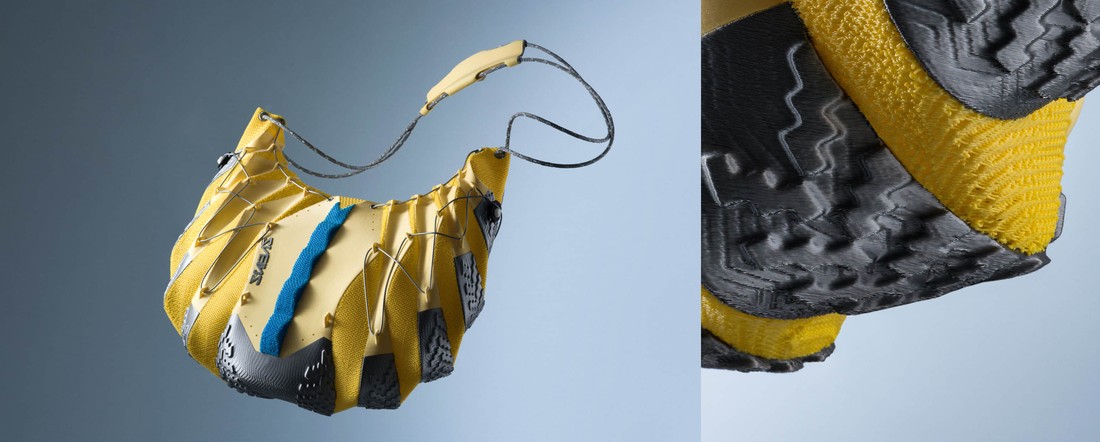
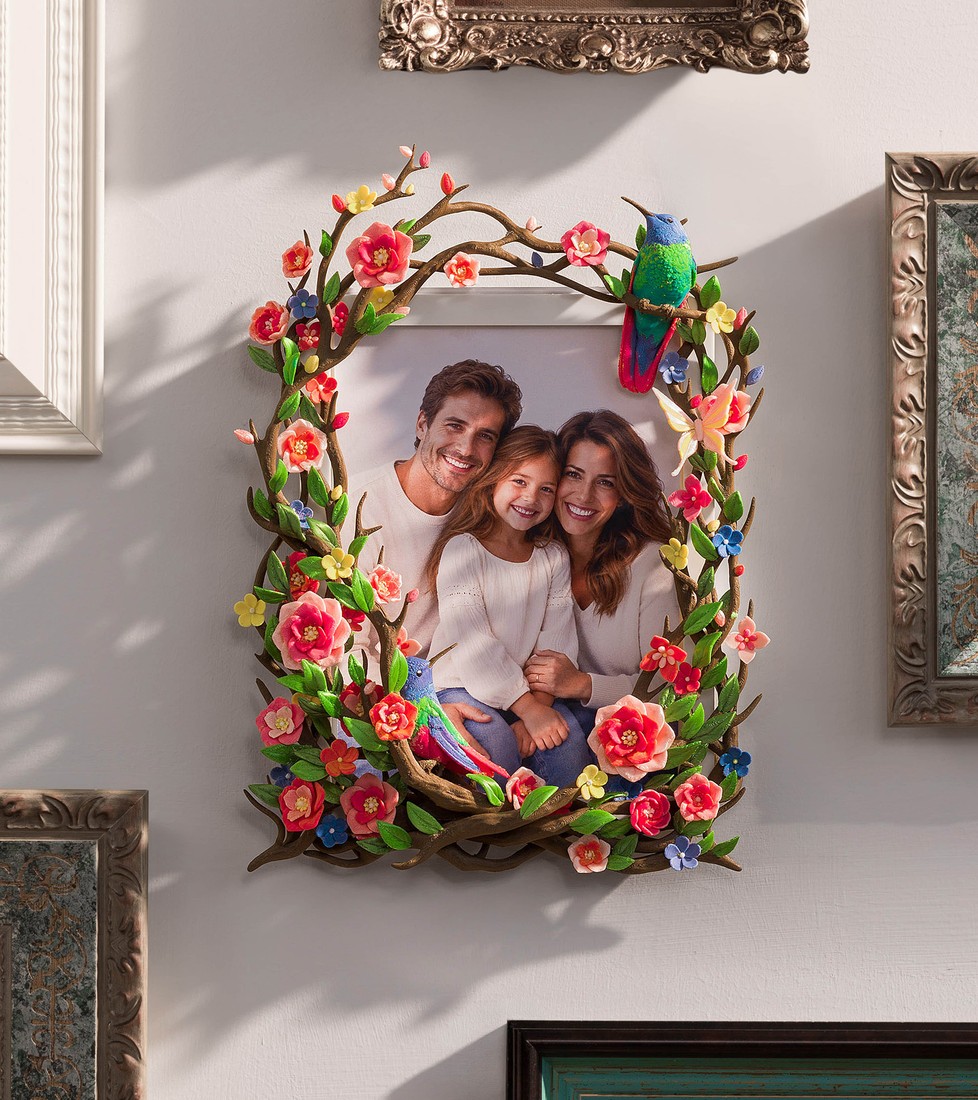
Color mixing follows a different route. Bambu’s maker-applications article describes layered deposition of five CMYKW base colors using PLA Palette. The shades come from calculated layers, rather than five molten filaments being physically blended inside one nozzle. Fast changes make that approach more plausible, but gamut, surface texture and repeatable color matching still need independent measurements.
Nine stored spools still need a drying plan
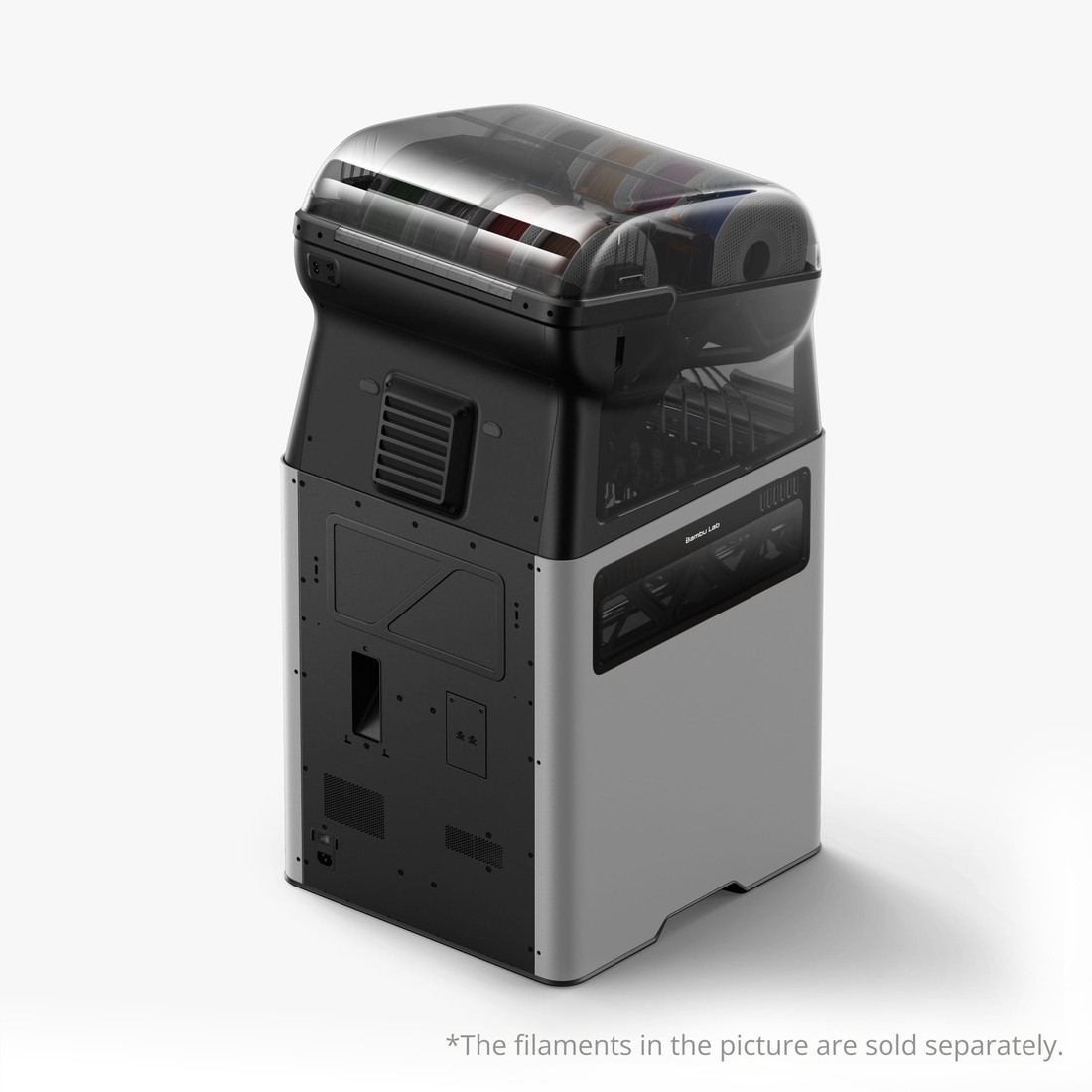
AMS 3H stores nine spools in an enclosed system, but heats two drying positions at once, up to 85°C. Bambu’s FAQ explains this as a compromise involving power, heat management and cost. For a project with several moisture-sensitive materials, I would plan which spools must be dry first and which need drying during the print. Enclosed storage does not mean every spool is actively drying.
Existing AMS expansion is useful, with a specific routing condition. The store FAQ says an optional Buffer connects up to four external AMS units through PrintTool No. 1, enabling up to 24 colors. Those external spools share one tool. They do not become 24 independently preloaded nozzles, so I would not apply the dedicated-tool switching illustration indiscriminately to every external color change.
The rest of the hardware is substantial. The specification gives a 330 × 320 × 325 mm build volume, 350°C nozzles, a 120°C bed and a 65°C actively heated chamber. Those describe the machine’s operating envelope; they do not establish that every combination of polymers will bond well or that every material profile will meet its best advertised speed.
| Hardware item | Official specification / practical distinction |
|---|---|
| Build volume | 330 × 320 × 325 mm |
| Nozzle / bed / heated chamber | 350°C / 120°C / 65°C maximum |
| Motion | 1,400 mm/s maximum head movement; 25,000 mm/s² acceleration |
| Specified hotend flow | 40 mm³/s; Bambu ABS at 280°C in the stated single-wall test |
| Included nozzle diameter | 0.4 mm; other supported diameters are separate purchases |
| Combo size and weight | 493 × 571 × 1,016 mm; 36.28 kg including AMS 3H |
| Recommended working clearance | 593 × 1,056 × 1,306 mm; height rises to 1,900 mm on Station L |
The maximum 1,400 mm/s movement figure is not a general extrusion speed. Flow, material, geometry and cooling still affect a real toolpath. The specification and installation FAQ also show why I would measure the room before buying: the 587 mm bare-printer height becomes 1,016 mm with AMS 3H, before lid-opening clearance.
Should an existing H2C owner upgrade for mixed nozzles?
I would read Bambu’s software-update schedule before making that decision. Mixed-orifice printing is also planned for H2D, H2C and X2D, with different dates depending on whether a filament track switch is installed. These are estimated release dates, not functions I have verified on those machines.
| Printer | Without filament track switch | With filament track switch |
|---|---|---|
| H2D | November 2026 | February 2027 |
| H2C | February 2027 | March 2027 |
| X2D | February 2027 | March 2027 |
Crafting deserves a similarly careful reading. CutTool, DrawTool and DebossTool are optional. The Swaptek explanation says tools can remain docked and switch automatically, but 3D printing and 2D operations currently use separate software environments and cannot yet be combined into one job. A camera is not mandatory for basic cutting and drawing; the store FAQ describes using Handy photos for alignment when BirdsEye is absent.
The optional Vision Encoder’s under-50-micron statement concerns motion accuracy after calibration, not a blanket dimensional tolerance for finished parts. BirdsEye-enhanced AI monitoring is planned for the first half of 2027; the product page distinguishes that future camera enhancement from monitoring that already works independently of it. I would value the shipping functions first.
My take
The H3C makes the strongest case when a design repeatedly combines different materials, fine detail and flexible sections. Its eight-plus-one shipping configuration gives that kind of project a clear starting point. A buyer mainly printing nine ordinary colors should put the extra compatible PrintTool on the shopping list; a buyer with several wet engineering spools should plan around two heated positions.
I would start with one representative project, allocate its materials and nozzle sizes, count the transitions, and check the installation space. That exercise tells me more than the largest speed number on the page. For an existing H2C owner who mainly wants mixed nozzle sizes, the announced software roadmap is also a reason to assess the current machine before spending on another one.
The launch is promising. Whether the tool paths stay reliable through a long, demanding job is the part I would want to see demonstrated next, along with finished-part quality, waste and maintenance.
Sources and scope: launch announcement, specification, FAQ, mechanism, maker applications, software roadmap, US store.
Official product and demonstration photographs: Bambu Lab. Calculations, diagrams, editorial analysis, conceptual animation and original score: Open Source Factory. No hands-on or independent performance test is claimed.