A Humanoid for $7,000: Physical AI Goes Open Source
A Humanoid for $7,000: Physical AI Goes Open Source
Three years ago a humanoid robot was an Atlas demo and a nine-figure budget. This summer, a Korean servo company showed one with 23 joints that runs off a Jetson module and weighs 35 kilograms. It's slated to ship as a fully open-source system for roughly $7,000. The robotics wave people have been predicting since ChatGPT arrived — it's here, and like every other AI wave, it came through the open-source door first.
The pattern is the same one LLMs went through. Open models and open hardware came first, while the closed frontier sucked up the money. And the entry point keeps dropping: you can train a robot policy on a laptop GPU today, and bolt it to a $300 arm.
The models learned to act
What changed is one model family: the vision-language-action model, VLA for short. An LLM reads words and writes words. A VLA reads camera images and language instructions, then writes actions — joint positions, grip forces, motion sequences.
Google's RT-2 proved the concept in 2022, from inside a lab. Physical Intelligence's pi-0 showed it could generalize in 2024, with closed weights. Then the open stack arrived, and the field accelerated.

Physical AI goes open — grey is the closed frontier, blue is open models, red is open hardware. Chart by the author.
NVIDIA's GR00T N1 set the pattern in March 2025: an open robot foundation model with a dual-system brain. A vision-language module (the slow thinker) interprets the scene. A diffusion transformer (the fast mover) turns that into real-time motor actions, trained end-to-end on real robot trajectories, human video, and synthetic data.
The open part matters because every humanoid maker now builds on it or competes with it. At GTC Taipei in May, NVIDIA said AGIBOT, LG Electronics, NEURA and Noble Machines are adopting GR00T N1.x models for industrial deployments. A next-gen preview, GR00T N2, is promised by year-end: a "world action model" that NVIDIA says succeeds at new tasks in new environments more than twice as often as leading VLAs on its own benchmarks. Vendor numbers, but the direction is unmistakable.
The open model stack
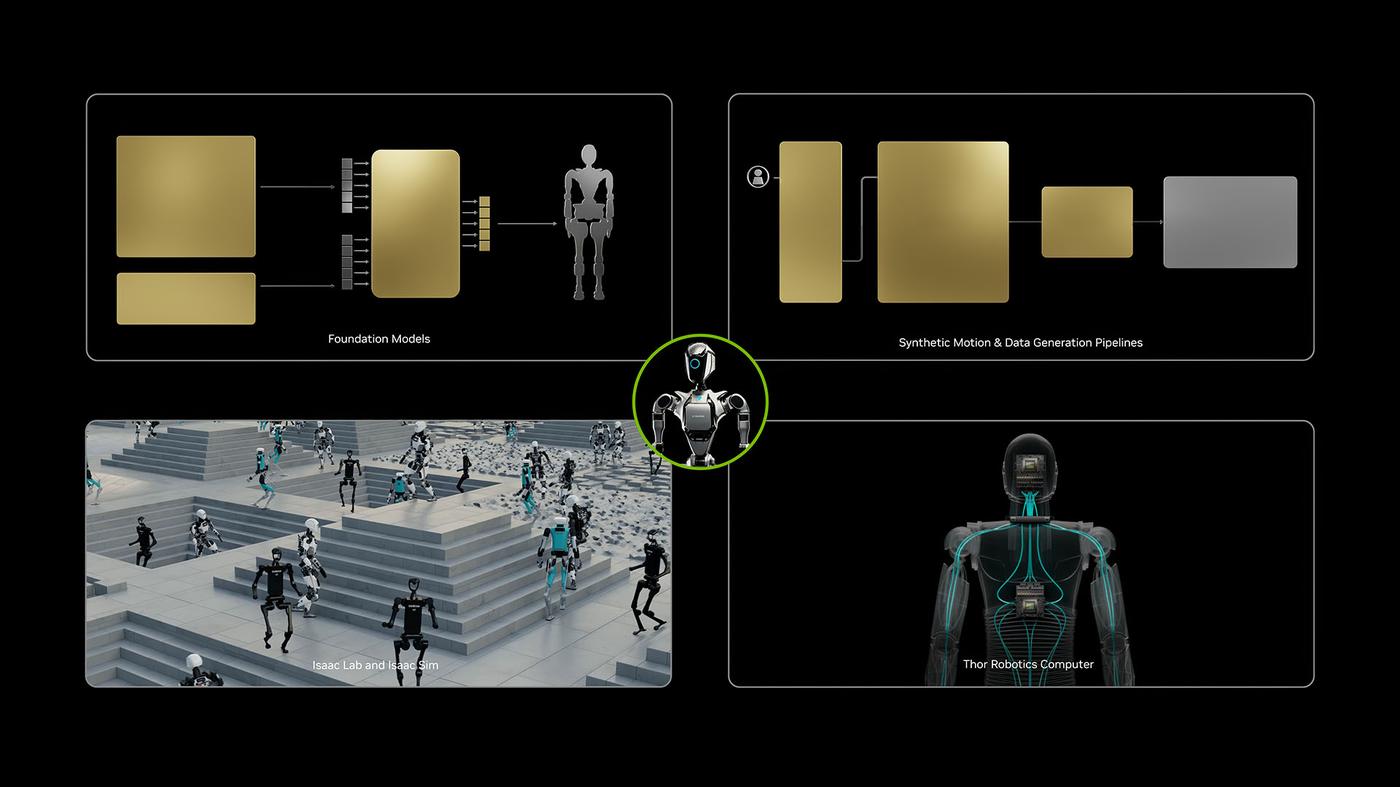
The NVIDIA Isaac GR00T platform: foundation models, synthetic data pipelines, Isaac Sim, and the Jetson Thor robot computer (image: NVIDIA).
Hugging Face did for robots what it keeps doing for everything else: it made the small version. SmolVLA is a 450-million-parameter VLA — a trimmed vision-language model paired with a flow-matching action expert — trained entirely on the open LeRobot community dataset. It runs on a single consumer GPU or a recent MacBook. The weights, code, and training recipes are all open.
Hugging Face claims it matches or beats far larger baselines such as pi-0 and ACT on real-world manipulation tasks. Discounted for vendor enthusiasm, a 450M model that fits on a laptop is still a category change. Stanford and Berkeley's OpenVLA-OFT added open RL fine-tuning on top of that family last October.
| Model | Who | What's open | Runs on |
|---|---|---|---|
| GR00T N1 / N1.7 | NVIDIA | Weights, framework (N1.7 early access) | Jetson Thor-class robots |
| GR00T N2 (preview) | NVIDIA | Not yet; due end of 2026 | — |
| SmolVLA (450M) | Hugging Face | Weights, code, recipes, dataset | Consumer GPU or MacBook |
| OpenVLA-OFT + GRPO | Stanford / Berkeley | Weights, RL recipe | Research clusters |
| pi-0.7 (5B) | Physical Intelligence | Paper; weights closed | Their stack |
The open model stack, August 2026. pi-0.7 included as the frontier reference point.
Physical Intelligence's pi-0.7 (April) is the other reference point: a 5-billion-parameter steerable model with what the company calls a step-change in generalization — compositional tasks, cross-embodiment transfer, following visual subgoals. The paper is public, the weights aren't. That split, open models versus frontier papers, is exactly how the LLM race looked in 2023, and it worked out well for the open side.
Open hardware arrived this spring
Until this year, the missing piece was the body. You could download a model but had nothing cheap to bolt it to. In May, NVIDIA closed that gap at GTC Taipei: the Isaac GR00T Reference Humanoid Robot, the first open humanoid reference design, built on the Jetson Thor robot computer with an open software stack. Unitree will manufacture it, available late 2026, and the reference workflow for Unitree's G1 lands on GitHub and Hugging Face soon.
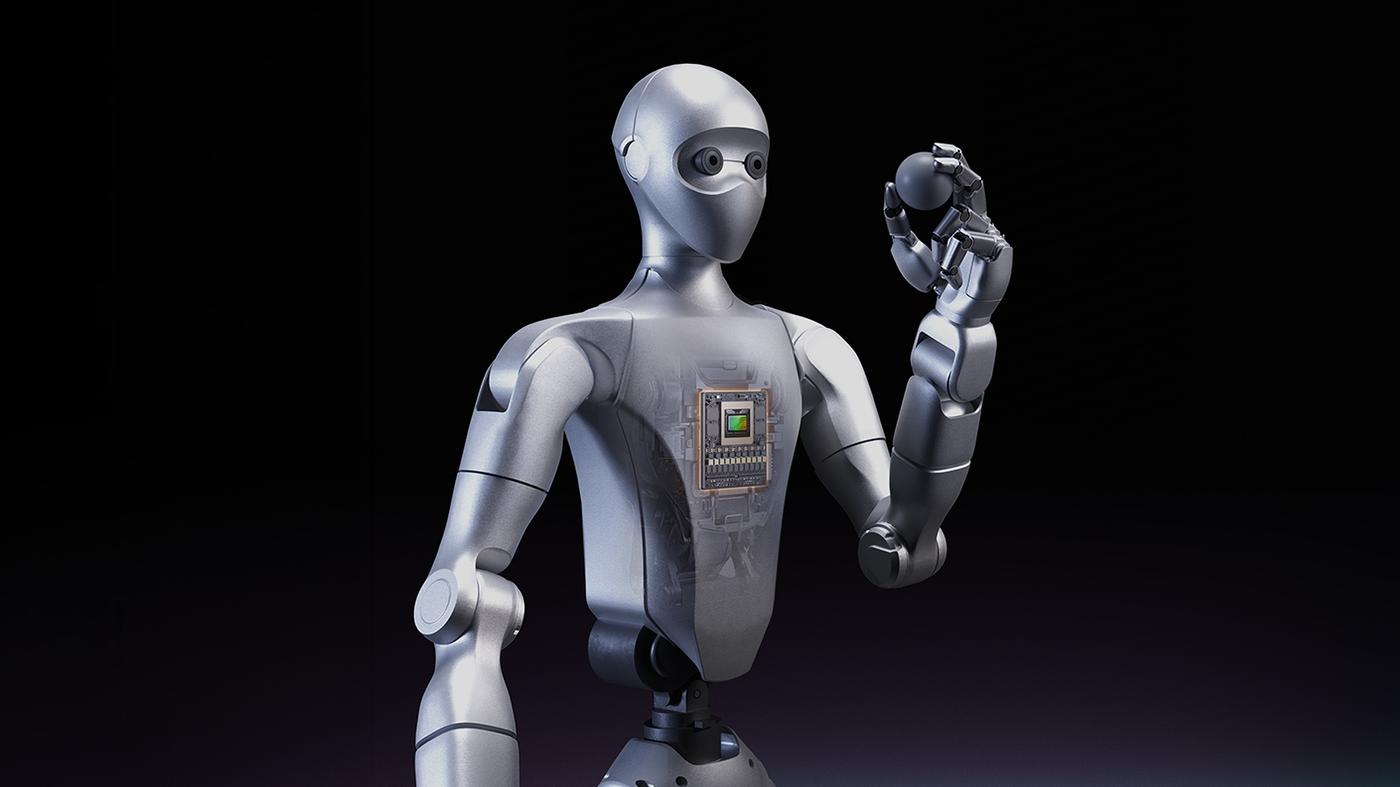
The Isaac GR00T reference humanoid, manufactured by Unitree (image: NVIDIA).
And Korea's ROBOTIS — the servo maker behind half the university robotics labs on earth — went further with AI Sapiens K1: a 23-DOF, 35 kg, 1.37-meter humanoid built on its new DYNAMIXEL-Q actuators. It carries an NVIDIA Jetson Orin NX 16GB, runs ROS 2 Jazzy, and ships with a containerized software stack. It's a product preview right now, priced around 10 million won — roughly $7,000 to $8,700 — and pitched explicitly as open-source hardware for physical AI research. In June it demonstrated natural-language-to-full-body-motion using NVIDIA's Kimodo motion model trained in Isaac Sim: you type a sentence, the robot moves.
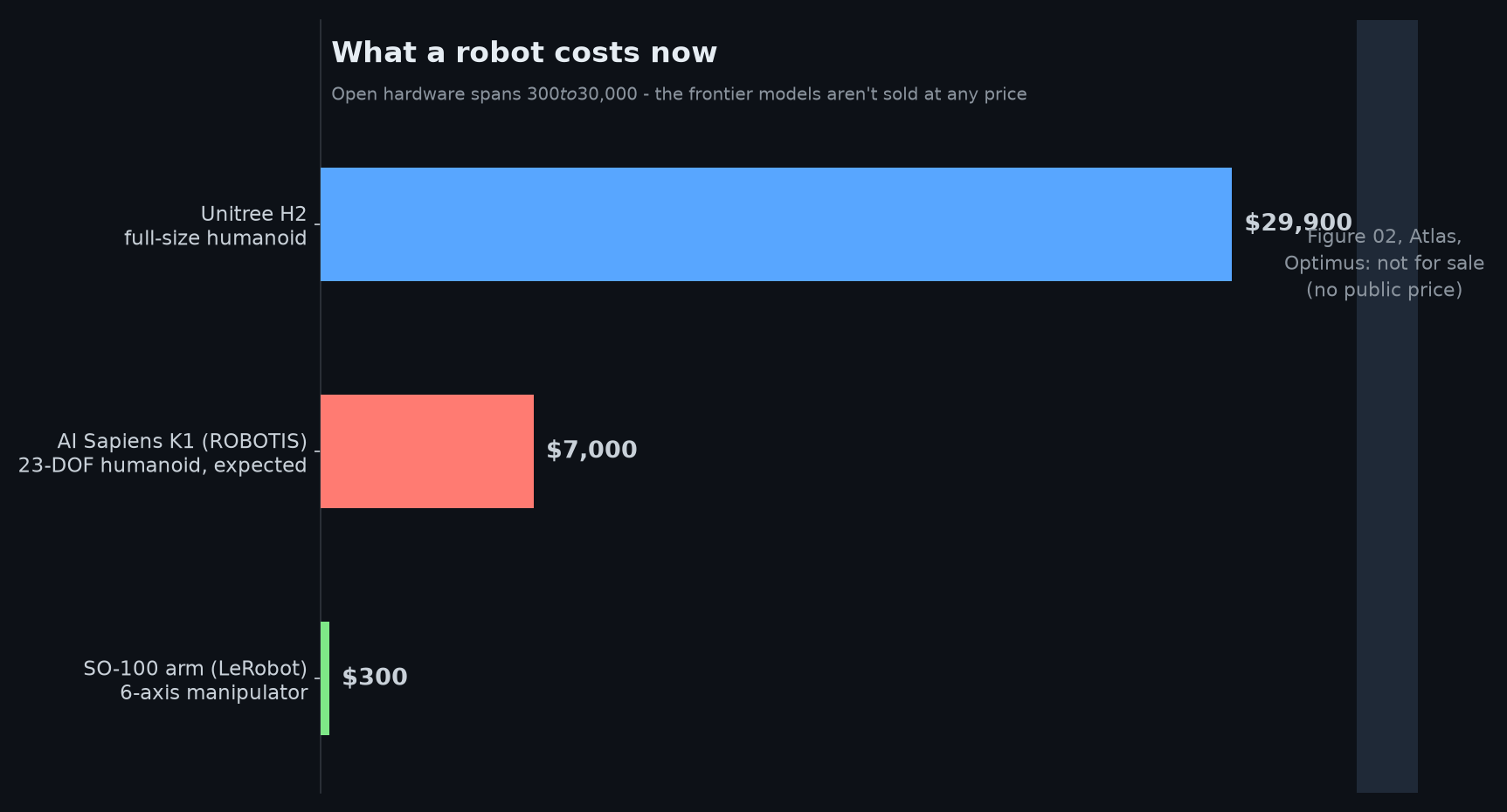
What a robot costs now — open hardware spans $300 to $30,000, while the frontier models aren't sold at any price. Chart by the author.
At the bottom of the ladder, the LeRobot community's SO-100 arm costs around $300 in parts and is the standard test bench for SmolVLA-class models. In the middle, AgiBot's X1 ships as fully open hardware and software for academic work. At the top, Unitree's H2 sells for $29,900 — a full-size humanoid with 31 degrees of freedom and 2070 TOPS of onboard compute. The entire ladder is new: none of it existed three years ago.
The money is noticing
The closed frontier and the open substrate are both growing, and fast. Unitree — the same company manufacturing NVIDIA's reference robot — filed for an IPO this year, reportedly targeting a valuation around $7 billion with gross margins near 60%. Figure's humanoid passed 1,250 operational hours on a BMW production line and is scaling to a second plant in Leipzig.
Japan Airlines is putting robots to work at Haneda Airport. Amazon is building a consumer physical AI platform called Fauna. Eighteen months ago, none of these existed.
Which side wins isn't the interesting question. The interesting question is what the open side unlocks. When GR00T-class models are downloadable and AI Sapiens-class bodies cost four figures, a university lab or a small company can iterate on whole-body control without a deal with anyone. That's the part of the LLM story that changed everything: fine-tuning stopped being a privilege and became a hobby. It's happening to robots right now.
What you can actually run
I'm the wrong person to oversell this, so I won't. SmolVLA genuinely runs on a machine like the one I'm typing on: 450M parameters, consumer GPU or MacBook, open weights and recipes, an afternoon to set up with LeRobot. Pair it with a SO-100 arm at $300 and you are doing real manipulation research for the price of a game console.
A full humanoid is a bigger commitment — AI Sapiens at roughly $7,000 to $8,700 is the cheapest open humanoid with a known price, and NVIDIA's reference design lands late this year. What you cannot do is download a Figure-class robot and press play; the frontier is still a frontier.
That gap is the real headline. The open stack has made the bottom of the field astonishingly accessible; the top of the field is still behind closed doors. Which is, word for word, where LLMs were in mid-2023.
My take
I wrote about a million AI satellites running NVIDIA silicon last week. NVIDIA — the same company behind that silicon — is now releasing the reference design for open humanoids, with Unitree manufacturing the hardware late 2026. Watch what that pattern means: NVIDIA's strategy in every AI wave is to sell the substrate and give away the recipe. The open-source humanoid wave is real regardless of who profits — a $7,000 body and a 450M model that runs on a laptop is a different world from the one where Atlas demos were the only physical AI anyone saw. I'll post a follow-up when the GR00T N2 weights drop or when the first AI Sapiens units ship with prices attached.
Can I run a robot model on my PC?
SmolVLA, yes — 450M parameters, consumer GPU or recent MacBook, open weights and training recipes via LeRobot. GR00T N1-class models are built for Jetson Thor-class robot computers, not desktops. The practical entry point is SmolVLA plus a $300 SO-100 arm.
How much does a humanoid actually cost?
The open options now range from roughly $7,000 to $8,700 (ROBOTIS AI Sapiens K1, expected price) up to $29,900 (Unitree H2). NVIDIA's reference humanoid arrives from Unitree late 2026 with no price yet. The famous frontier robots — Figure 02, Atlas, Optimus — have no public price at all.
Is AI Sapiens really open source?
ROBOTIS describes it as a fully open-source hardware system — designs, software, simulation assets, training workflows, and deployment guides — with a containerized ROS 2 Jazzy stack and documentation already public. It's a product preview, so treat specifics as subject to change; the company says so on the product page.
What's the difference between GR00T N1 and N2?
N1 is the open dual-system VLA (vision-language plus diffusion action head), available now. N2 is a next-generation "world action model" based on DreamZero research, previewed at GTC and promised by the end of 2026 — NVIDIA says it succeeds at new tasks in new environments more than twice as often as leading VLAs, vendor-reported.
What about Figure, Optimus, and Atlas?
They're not for sale, and their models are closed. Figure is deploying at BMW, Optimus is internal to Tesla, Atlas is a Boston Dynamics research program. The open stack is the route that's actually available to you, and it's advancing on its own schedule.
Sources: NVIDIA newsroom and developer pages (GTC Taipei reference humanoid, GR00T platform, N1.7/N2 announcements) · ROBOTIS DYNAMIXEL-Q / AI Sapiens K1 product pages and docs · GR00T N1 (arXiv 2503.14734) · SmolVLA (arXiv 2506.01844) and LeRobot · Physical Intelligence pi-0.7 blog (April 16, 2026) · Unitree IPO and Figure/BMW deployment via press coverage (KraneShares, June-July 2026). Performance and pricing claims are vendor-reported unless attributed. This blog is independent — no company mentioned here paid for coverage.
Comments
Post a Comment