Flourish 1: A $3,555 Home Robot You Teach by Phone
Flourish 1: A $3,555 Home Robot You Teach by Phone
A $3,555 home robot that learns chores from your phone got my attention. Flourish 1 promises to collect shoes, load dishes and tidy the small messes that eat an evening. The first run is just 50 units, with December 2026 deliveries planned. That makes this an interesting early product to investigate, with some unusually consequential fine print. Flourish’s September 29 announcement.
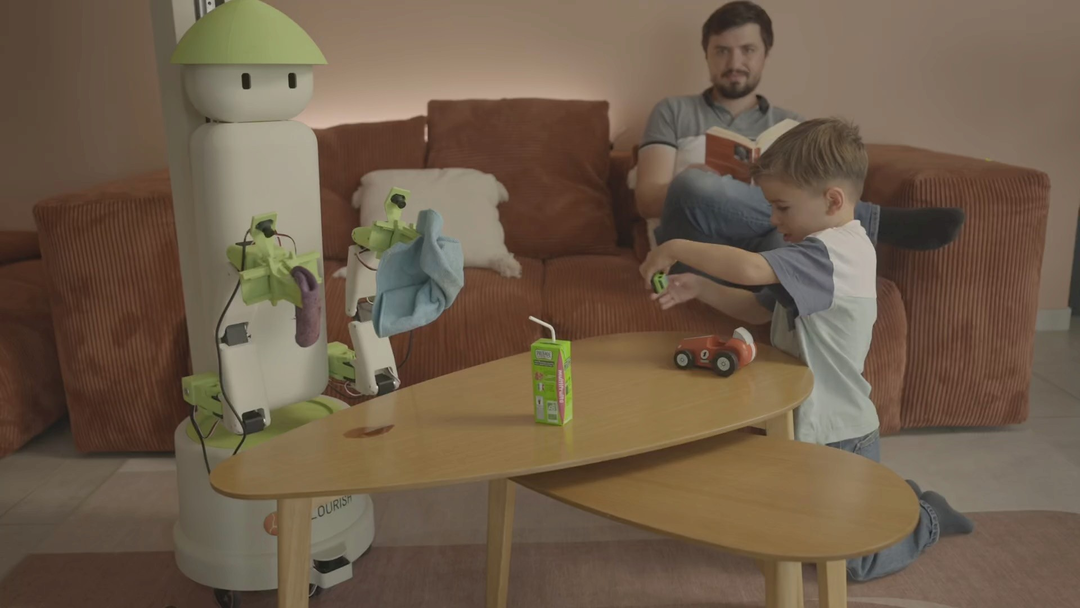
I went through the product page, sales terms and privacy policy for this post. The appeal is easy to understand: teach a robot your particular routine, then schedule it. The harder question is how much teaching, supervision and paid computing sit between that promise and a genuinely free evening.
What chores can Flourish 1 take on?
The launch release lists picking up shoes, clothes and toys, loading a dishwasher, wiping tables, watering plants, fetching objects and clearing a litter box. These are the manufacturer’s advertised tasks, not a checklist I have personally tested. A useful review would show how many repetitions succeed in an ordinary home. Advertised household tasks.
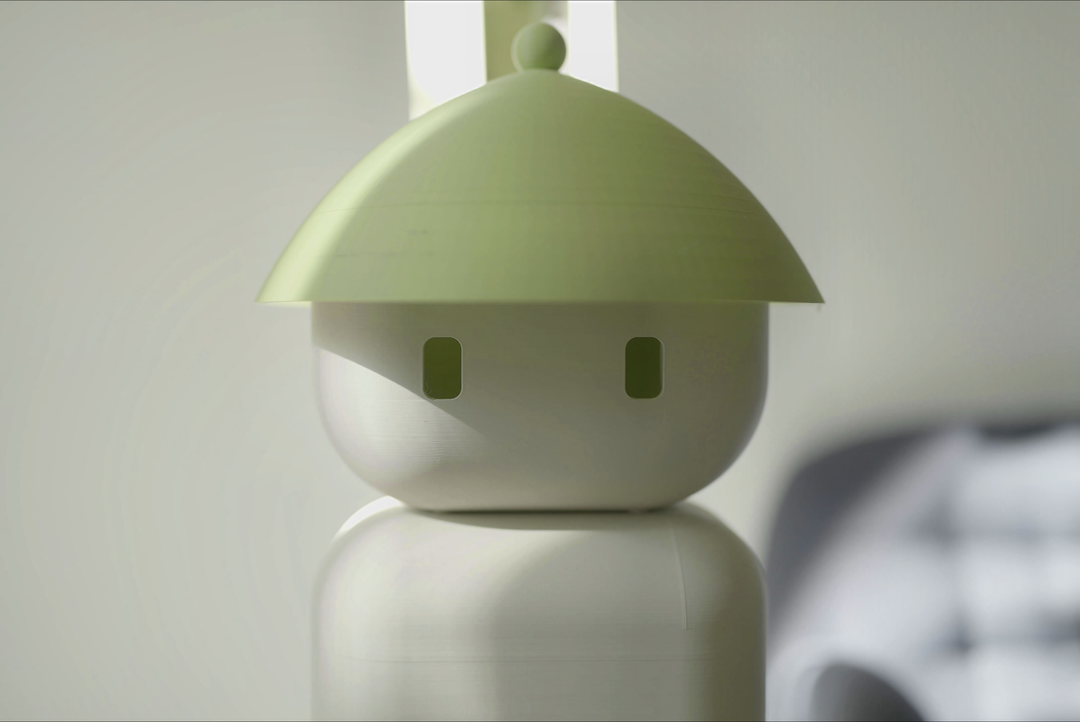
The product photos show a wheeled base, a rising central column and two arms with simple grippers. That design is interesting precisely because many household jobs happen on one floor, between a few familiar surfaces. A shoe does not need a spectacular robot; it needs a reliable trip to the right place.
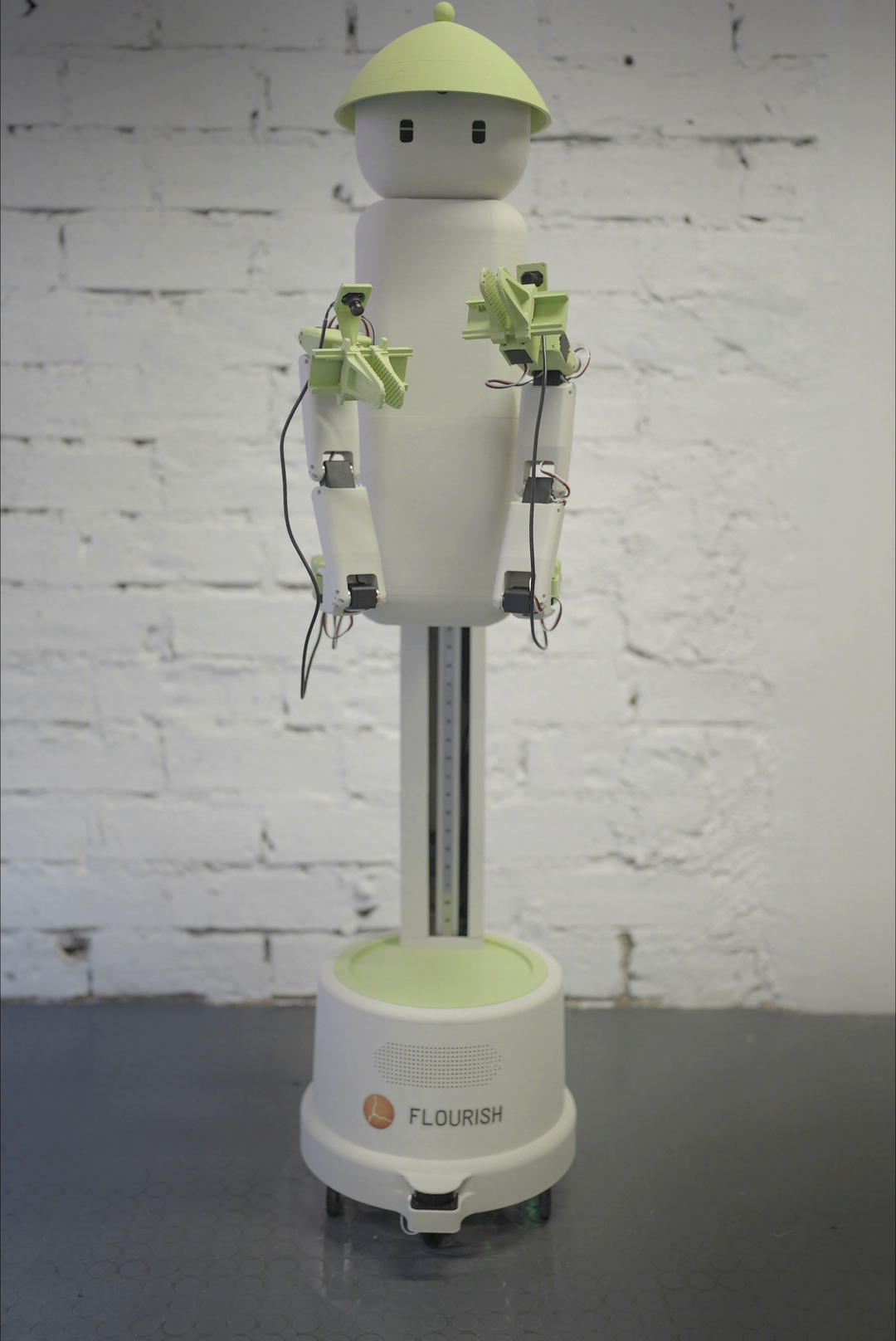
The advertised hardware is modest enough to put useful boundaries around the pitch. These are vendor specifications from the current product page. The metric equivalents below are rounded unit conversions, not additional measurements. Flourish 1 product specifications.
| Specification | Manufacturer lists | What I would check at home |
|---|---|---|
| Height | 3 ft 7 in · about 109 cm | Clearance under tables and around furniture |
| Robot weight | 44 lb · about 20 kg | Where the robot can move and be stored |
| Payload | 3.3 lb · about 1.5 kg | Each object in the routine, not an assumed per-arm allowance |
| Reach | Floor to 35 in · about 89 cm | The actual height of shelves and work surfaces |
| Runtime | 12 hours, vendor-reported | Duty cycle and charging conditions; no independent battery test here |
The sales terms exclude stairs, heavy or sharp objects and operating around water. That last restriction deserves clarification because the launch release includes watering plants. I would ask the company which handling conditions it permits. The terms also exclude childcare and care uses; the family imagery should be read as marketing context. Published operating limits.
Does “30-minute teaching” mean ready in 30 minutes?
The product page describes a more specific sequence: roughly five minutes arranging steps in the app, 30 minutes guiding the robot from a phone, then a notification about an hour later. The demonstration phase is the headline’s 30 minutes. The manufacturer’s teaching sequence.
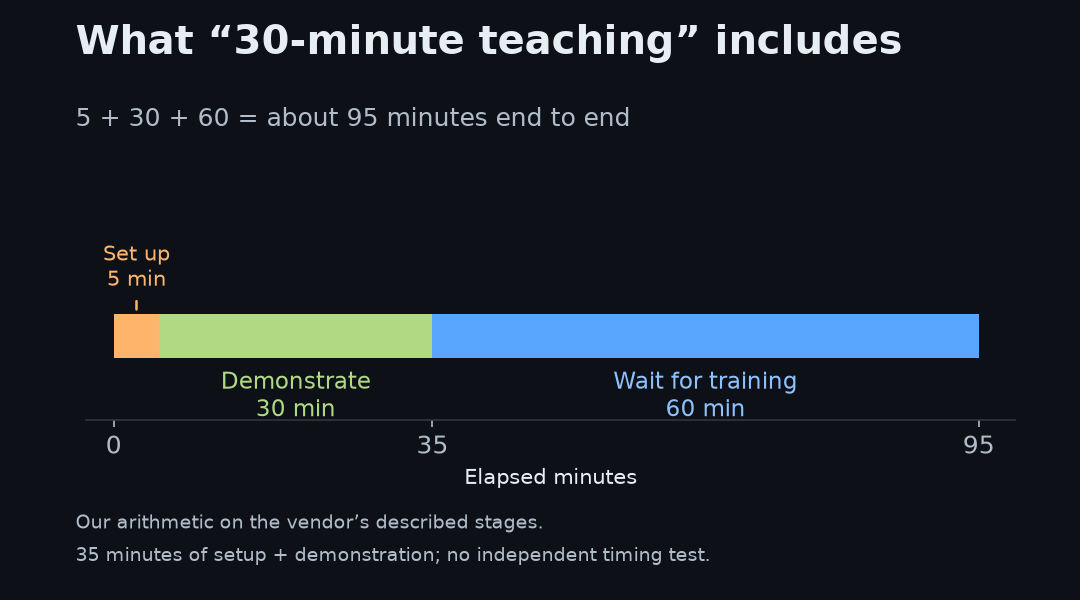
I like the idea of teaching the route to my shoe cabinet instead of hoping a universal robot understands it. But a saved routine must survive changes: a chair moved, a shoe turned sideways, a cupboard left closed. How often an owner must reteach a task matters as much as the first successful attempt.
The company’s page also mentions an 80% task success figure without a benchmark protocol there. I would not turn that into a probability of a whole evening going smoothly. We do not know the tested task mix, number of attempts or handling of partial failures.
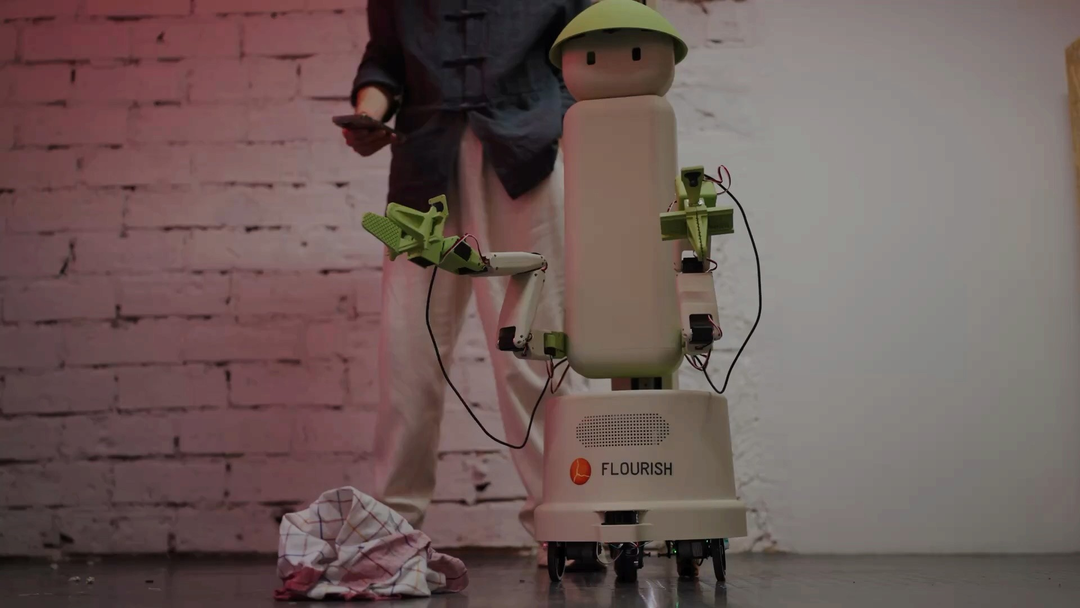
The follow-up I want is an uninterrupted routine in a customer’s home, with interventions counted. A failure the robot can recover from is different from one that sends the owner across the room. That distinction decides whether a scheduled chore saves attention or creates another device to manage.
What does the $3,555 price actually cover?
As checked on October 2, the product page shows a $3,555 price and a $1,555 reservation deposit, refundable before shipping. Advanced AI tasks require extra computing through an owner’s GPU or a company plan whose details are still pending. That leaves the ongoing cost open. Current price and compute notice.
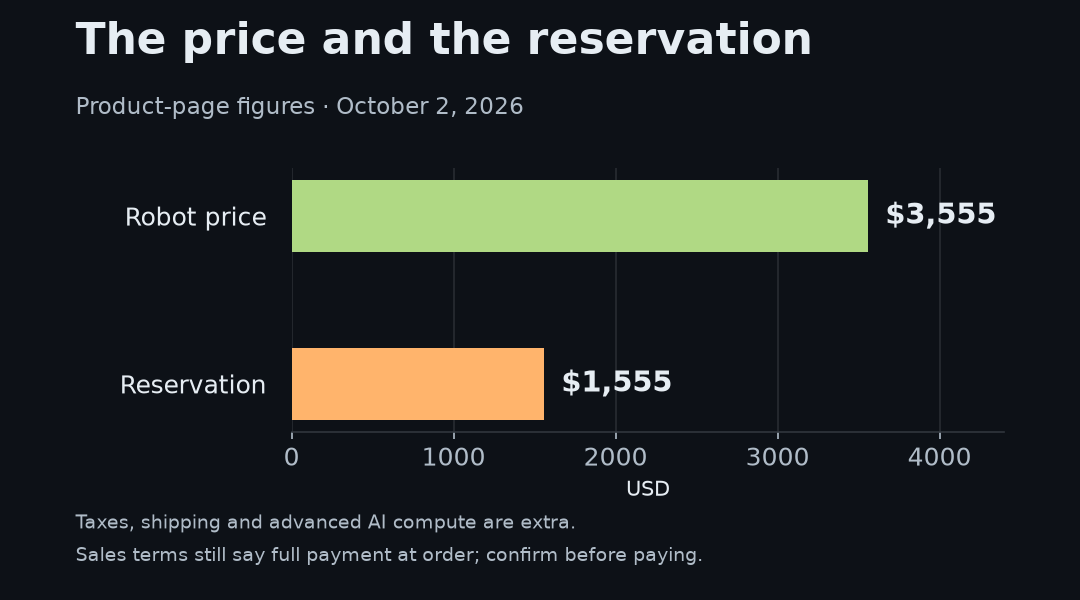
There is a document mismatch: the sales terms, dated September 8, still describe full payment at ordering. I did not complete a purchase or verify the final checkout amount. A buyer should get the charge, balance deadline and refund conditions confirmed in writing rather than assume the two pages have been reconciled. Sales terms, payment section.
Under the listed price and deposit, the difference is $2,000—our subtraction, not a verified invoice. Taxes, shipping, duties and advanced computing can raise the total. I cannot give a credible all-in price while those amounts remain unspecified.
The terms describe an experimental first run with no voluntary warranty or returns after delivery, while preserving any mandatory rights that apply. They allow cancellation before shipment and address shipping delays. December is an estimate, not a delivery guarantee. Those conditions put a lot of the first-generation uncertainty on the buyer. Delivery, returns and warranty sections.
For me, a published compute plan would be essential. Which tasks need it? What GPU is supported? What happens when a plan ends or the network drops? A low hardware price is more useful when the owner can also understand the cost and dependencies of their actual routine.
Will its camera footage stay inside the home?
The product page says the robot runs on-device. Its privacy policy says live camera and sensor data pass between the robot and company servers for operational decisions, and are not stored. These statements do not establish an entirely offline workflow. Live operational data policy.
Approved teaching recordings are sent to the company and may improve models beyond the owner’s robot, with identifying material obscured where used more broadly. The policy describes U.S. processing, deletion from backups within 14 days, and an inability to extract data already incorporated into a trained model. These are policy statements, not a privacy audit. Recording use, processing and deletion.
That would matter to me in a shared household. “Not stored” describes retention; it does not mean a video never leaves the room. Before placing one in a kitchen or living room, I would want a clear explanation of when a local GPU changes that data path and how recording consent works for everyone present.
My take
Flourish 1 is appealing because its goal is recognizable: move small objects, repeat familiar chores and return some attention to the owner. Phone-guided teaching could make a home robot useful without asking the owner to become a robotics engineer. The limited payload and reach also give the idea a concrete shape.
Based on today’s documents, I would wait for the payment pages to agree, the compute requirements to become clear and customer routines to be demonstrated over repeated runs. The product is interesting enough to follow closely. The current evidence is not enough for me to budget on it replacing household labor.
I’ll revisit it when shipped units show what owners can teach, how often they intervene and what the complete routine costs. That is when the $3,555 headline will have a much more useful meaning.
Comments
Post a Comment