MiniMax H3 finally went open-weight — real-world impressions
MiniMax H3 finally went open-weight
I rounded up the real-world impressions — the "wait, for real?" moments are not few
2026.08.05 · Open Source Factory
On the night of August 2, MiniMax H3's weights dropped on Hugging Face, fully open. The weight of the model ranked #1 in video editing per Artificial Analysis got dumped into a market where closed models had a monopoly. A full-modal model that makes video and sound in one pass — reportedly running on 12GB-VRAM-class hardware. Of course the community is in an uproar.
Three days in, real measured impressions are flooding Reddit (r/StableDiffusion) and the international community. I collected generation times per GPU, quality impressions, and — something you should know about no matter where you live — the license trap.
1. What even is H3 — specs at a glance
| Item | Details |
|---|---|
| Announcement / weights | 2026.07.31 announced → 2026.08.03 on Hugging Face |
| Architecture | 33.1B dense omni-transformer (13B is the AdaLN branch — skippable at inference) |
| Input | Text · image · video · audio unified (up to 9 reference images + 3 videos + 3 audio) |
| Output | Up to 15s · 24fps · 768p (local) / 2K (API) · native stereo audio |
| Text encoder | Qwen3VL-32B (51.5GB bf16 — the size culprit; the int4 version at 15.7GB solves it) |
| Minimum local setup | pruned int8 combo at 42.5GB (full bf16 is 123.6GB) |
| License | MiniMax H3 Community License — excludes EU, UK, US, and South Korea!! (see #6) |
The key point: video and audio are generated in the same pass. A character video with dialogue isn't "motion only, add voice later" — lip-sync, voice, and SFX all come out at once.
2. Real-world impressions — "Wan 2.2 feels like an antique"
Reactions poured into Reddit within a day of release. Highlights only:
The consensus: "frontier-grade video on local hardware, finally." On the flip side, speed still has a long way to go — a recurring complaint. The representative comparison: LTX 2.3 cranks out a 720p 5s clip on a 3060 in 3 minutes, while H3 takes close to 10 minutes even at 480p 5s.
3. Measured speeds per GPU — from 3060 to 5090
Real measurements gathered from Reddit and Discord. Resolutions and step counts vary, so this isn't a clean comparison — use it to get a feel for "would my GPU even be worth trying."
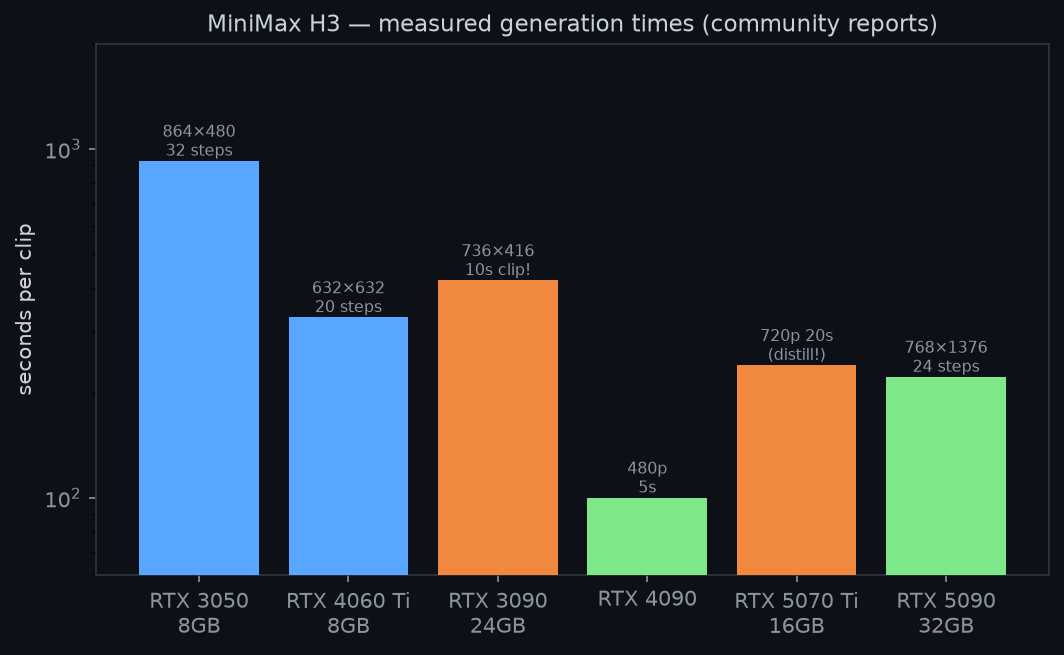
| GPU | Settings | 5s clip time | Verdict |
|---|---|---|---|
| RTX 3050 8GB | 864×480, 32 steps | 15 min 24 s | It runs, technically |
| RTX 4060 Ti 8GB | 632×632, 20 steps | 5 min 29 s | "Faster than expected" |
| RTX 3090 24GB | 736×416, 10s clip | Under 7 min | Bearable |
| RTX 4090 | 480p-ish, 5s | ~100 s | Actually usable |
| RTX 5070 Ti 16GB | 720p, 20s (distill) | 4 min (for 20s) | Distill + tweaks |
| RTX 5090 32GB | 768×1376 (1K), 24 steps | 222 s | Worked on first try |
Note: the community consensus puts the practical floor at 12GB VRAM + 32GB RAM + NVMe. One catch: on 3060-class cards there's a bug that page-locks nearly 30GB of system RAM, and the --disable-pinned-memory flag is reportedly mandatory.
⚡ I ran it too (GTX 1080Ti 11GB)
Honestly I expected the 1080Ti to be out of the question. But with the ComfyUI template (0.1MP, 16:9, 20 steps), a 5-second sniper scene took 14 minutes. Slow — but it produces a finished clip, sound included. Dropping steps to 10 cuts it to 7–8 minutes with no big quality difference. The fact that even old cards with under 8GB VRAM "run it" at all is what makes this model unusual.
4. Quality — praise and disappointments
👍 The good
· Prompt adherence: "one plain paragraph, done in one shot" is a repeated verdict. Handles compound instructions (this image's character + this video's camera move + this audio's voice) in a single pass
· Reference-conditional generation (ref2va): many reports say character consistency is solid even without LoRA. Swapping a character inside a video clip works out of the box
· Native audio: lip-sync, dialogue, and SFX in one pass. No comparison to the old workflow (video and sound separately)
· Editing / motion transfer: #1 in Artificial Analysis video editing. Grabbing motion from a reference video is especially strong
👎 The not-so-good
· Speed: still slower than LTX 2.3. Steps are fixed at 20, so a step-distilled LoRA would change the game (the community's big hope)
· Physics / anatomy errors: the surface quality is so high that "pretty but wrong" mistakes are more dangerous. Reported cases: a weirdly drawn heart diagram, a paper boat collapsing as it moves
· Local is capped at 768p: the marketing 2K is the API-only H3-Regenerate-2K pass. Local gets 768p as the base canvas
· The Qwen3VL-32B encoder: 51.5GB in bf16 — first time a text encoder has been this big. Grab the int4 version (15.7GB) instead
5. Price — not "cheap," "absurd"
Video generation bills per second. Here's the community price comparison under the same conditions.
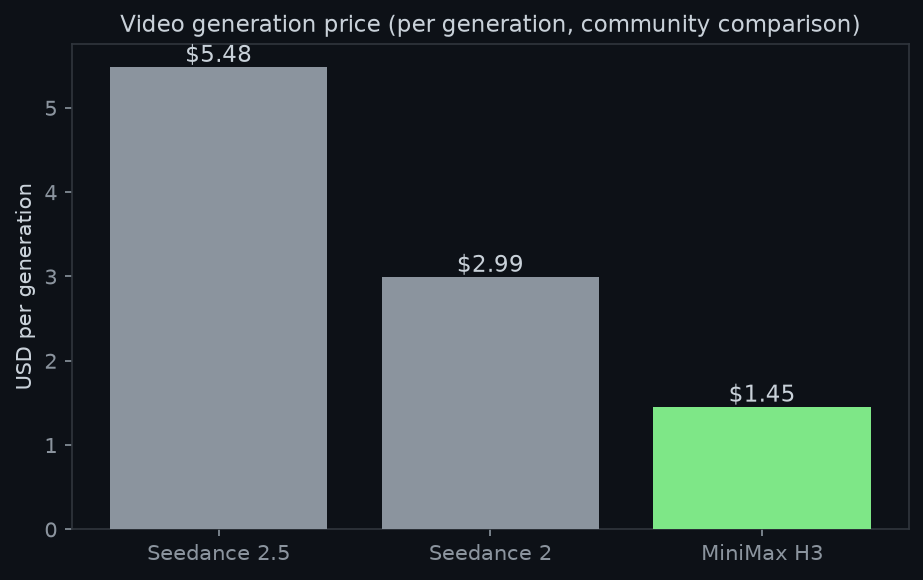
Source: community price comparison (Seedance 2.5 $5.48 / Seedance 2 $2.99 / MiniMax H3 $1.45, per generation). MiniMax officially claims per-second pricing at 2K is under 1/3 of mainstream models.
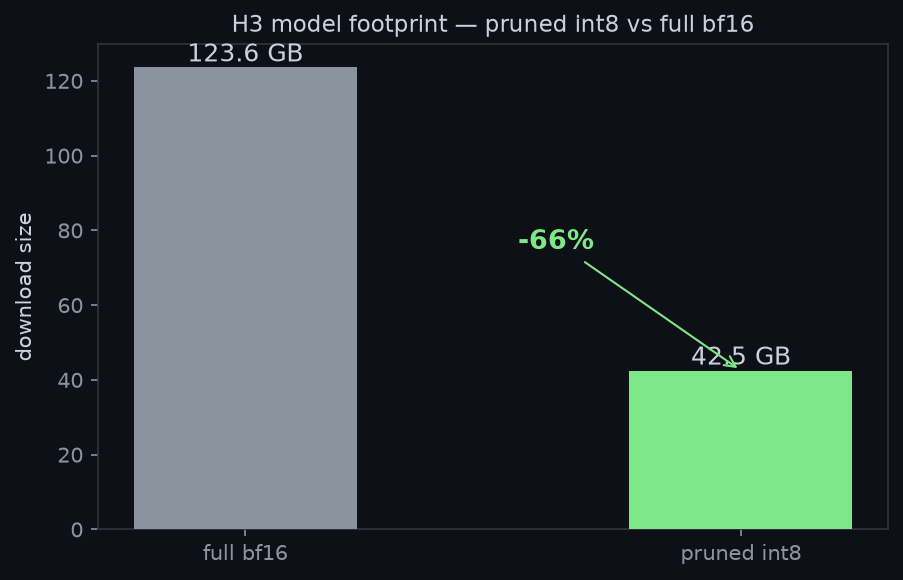
Same model, full bf16 123.6GB → pruned int8 combo 42.5GB. ComfyUI's pruning (turning ~40% of modulation weights into a lookup table) plus int8 quantization achieves a 66% memory cut.
6. ⚠️ License trap — read this before you build on it
🚫 This model is "officially" off-limits in the EU, UK, US — and South Korea
The MiniMax H3 Community License lists EU, UK, US, and South Korea as Excluded Territories. The gist: downloading the weights, local execution, modification, distribution, and even using the outputs are all outside the license grant in those regions.
So "it's open-weight, use it freely!" doesn't hold. For commercial use, even organizations under $20M annual revenue have an attribution obligation ("MiniMax H3" notice), and above that threshold you need separate approval. There's also a no-distillation clause.
The practical reality: there's no geo-block on Hugging Face, so downloads work. The international community's take is mostly "they can't really stop it," and MiniMax has opened a dedicated license-inquiry channel (QA docs). People are just running it for personal tests, but before any commercial project — contact MiniMax about the license first. This post is an information summary, not legal advice.
7. What to download for local runs
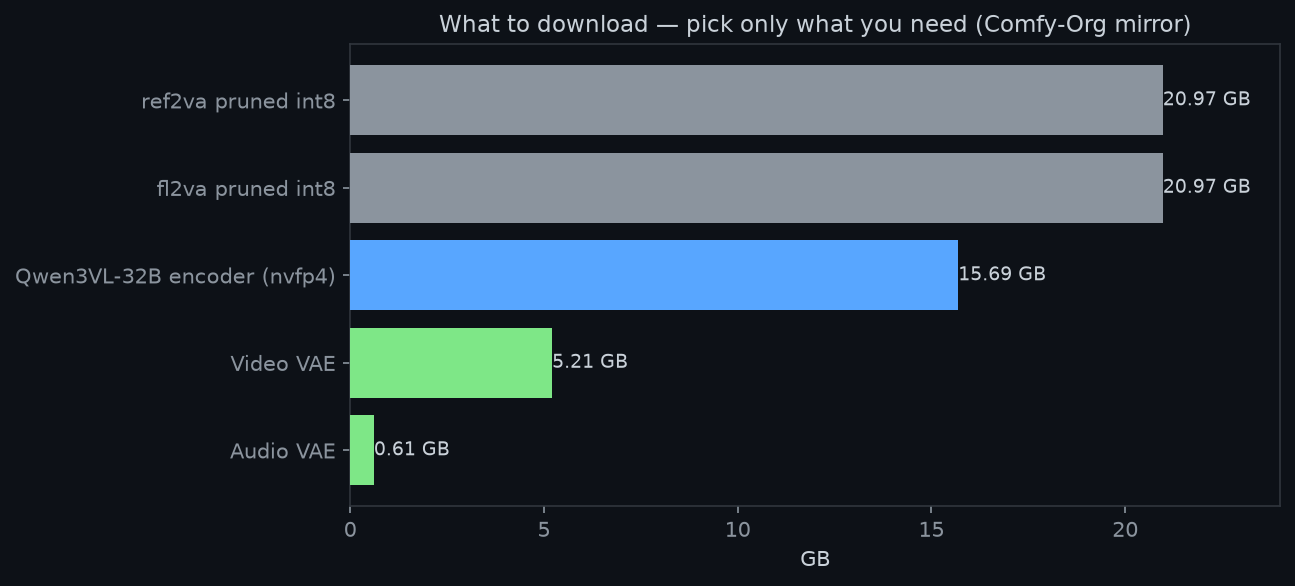
| File | Size | Purpose |
|---|---|---|
| fl2va pruned int8 | 20.97 GB | text→video / image→video |
| ref2va pruned int8 | 20.97 GB | reference-based video (both = 63.4GB) |
| Qwen3VL-32B nvfp4 encoder | 15.69 GB | shared across all workflows |
| Video VAE + Audio VAE | 5.21 + 0.61 GB | video & audio decoding |
Warning: the full original repo (MiniMaxAI/MiniMax-H3) is 498GB. Grab only what you need from the Comfy-Org mirror. Native support in ComfyUI 0.30.0+ (Kijai merged it into core rather than a separate wrapper — workflow templates included).
8. Bottom line
"A turning point for open-weight video models" is the most accurate phrase. Quality approaches the closed-tier leaders, reference control (character, voice, camera) is arguably stronger, and it runs on a 42.5GB download + 12GB-class GPU. The mood right now: people who waited 20 minutes per Wan 2.2 clip last week asking "this got released for free?"
Not a buy-in moment yet: fixed 20-step speed, the 768p cap, no step-distilled LoRA yet, and the license issue. If a distill LoRA lands and license inquiries get answered in 2–4 weeks, that's the real inflection point. Until then, tasting via API (straight to 2K, $0.14/s) is the smart move.
Note: this is a community-impressions roundup from three days after release. No verified long-term evaluation exists yet. Flux 3's announcement the same day also split the spotlight.
Related on this blog: H3 Max: 5 Seconds of Video in Under 3 — and It's Not MiniMax's Model · MiniMax H3 went open-weight, so I did the math on whether my PC can run it
Comments
Post a Comment