SpaceX wants a million AI satellites in orbit — and they'll all run on NVIDIA
and they'll all run on NVIDIA
Starmind, the AI1 design, and the part where the economics get spicy
2026.08.05 · Open Source Factory
August 4, SpaceX's first earnings call as a public company. And somewhere in there, Musk says something that made me read the transcript twice: "SpaceX will build exclusively on NVIDIA." Not for a new data center in Texas — for satellites. SpaceX made it official the same day: it's teaming up with NVIDIA on the Starmind AI1 satellite compute payload — Rubin GPUs and Vera CPUs on every satellite, "datacenter-class space compute," in SpaceX's words.
This isn't a render on a slide anymore. There's an FCC filing, a factory plan, and a public company's revenue behind it. Here's what's actually going on.
1. What Starmind actually is
Back on January 30, SpaceX filed an FCC application for up to one million orbital data center satellites at 500–2,000 km altitude. The filing projects that launching a million tonnes of satellites a year would generate 100 gigawatts of AI compute in orbit. Musk has said the same thing in a few venues now: "Within 2 to 3 years, the lowest cost way to generate AI compute will be in space."
In June, he revealed the first satellite's detailed design in a 30-minute video on X. The specs are... let me just put them in a table.
| AI1 satellite | Spec |
|---|---|
| Solar array | 70m panels, ~250 W/m² power density |
| Compute payload | avg 120 kW / max 150 kW — about one NVIDIA GB300 rack |
| Cooling | 110 m² deployable liquid-cooling radiator panels |
| Orbit | ~600 km LEO |
| Connectivity | 1 Tbps laser links between satellites + Starlink mesh |
| Ground latency claim | ~0.003 s |
| Compute silicon | NVIDIA Rubin GPU + Vera CPU (per the Aug 4 announcement) |
Musk notes the AI1 is structurally "much simpler than a Starlink satellite" — mostly solar cells, radiators, and a few laser links.
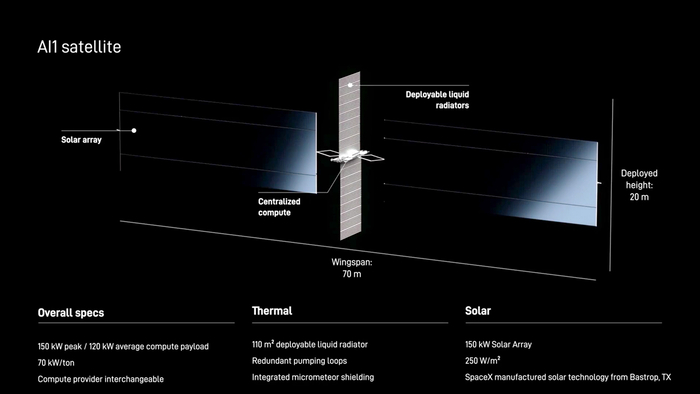
▲ The AI1 render Musk showed in June (source: SpaceX via X)
Behind the announcement there's real hardware: a Gigasat factory in Bastrop, Texas — 11 million square feet, targeting 1,000+ AI satellites a year by the end of 2027 — and Terafab, a chip fab co-developed with Tesla and xAI: 100 million square feet, a 2nm process, and plans for 100–200 billion AI chips a year. Eventually, one terawatt of compute. Phase 1 alone is about $55 billion, up to $119 billion total. I keep counting the zeroes on that press release.
2. How we got here — the timeline
This didn't start in August. The "GPU in orbit" story has been building for nine months, and NVIDIA has been in it the whole time.
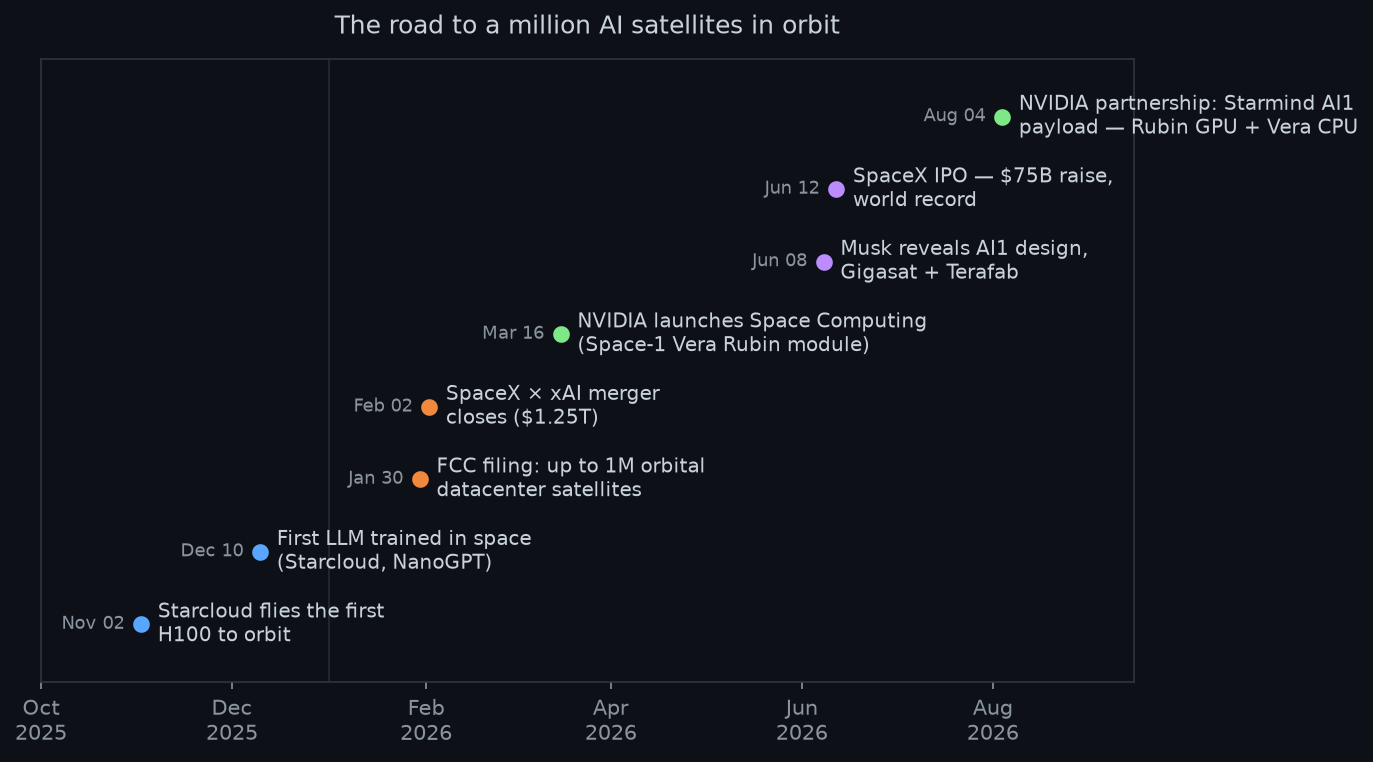
▲ Nine months from "one H100 in orbit" to "a million Rubin satellites"
NVIDIA-backed startup Starcloud flew the first H100 into orbit last November and trained the first LLM in space a month later. Then everything sped up: SpaceX merged with xAI in February — $1.25 trillion combined — NVIDIA rolled out its Space Computing platform at GTC in March, Musk showed off AI1 in June, and a month after that SpaceX pulled off the biggest IPO in history, raising up to $75 billion. Nine months from "one H100 in orbit" to "a million Rubin satellites."
3. Why space, though
The pitch is that ground datacenters are hitting walls that space simply doesn't have. The numbers behind this are worth sitting with.
Start with solar. In LEO you get 1,361 W/m² unfiltered, versus 150–300 W/m² effective on a good day on the ground — five to nine times more energy per panel, and in a dawn-dusk sun-synchronous orbit the capacity factor can hit 99% (terrestrial panels sit at 15–25%). Cooling is the fun one: you're radiating into a -270°C vacuum, so you use zero water, while terrestrial datacenters burn billions of gallons a year. And there's no interconnection queue in space — on Earth, getting one can take 7–12 years in key markets like Northern Virginia. No land, no permits, no water rights. The demand side is there too: hyperscalers are planning $400 billion of terrestrial datacenter spend in 2026 alone, and datacenters are tracking toward 8–10% of global electricity by 2030.
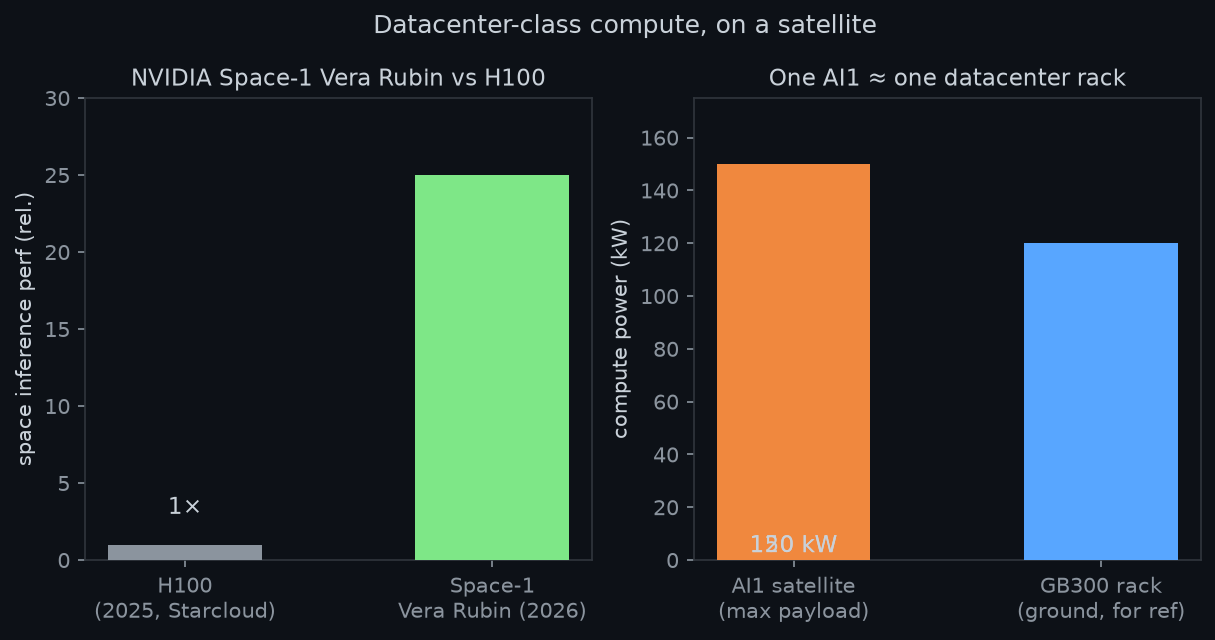
▲ Left: NVIDIA's Space-1 Vera Rubin module claims 25× the on-orbit inference performance of an H100. Right: one AI1 satellite draws about as much power as a GB300 rack.
And NVIDIA's timing is deliberate. Jensen Huang at GTC, March 2026: "Space computing, the final frontier, has arrived... transforming orbital data centers into instruments of discovery." NVIDIA calls the Space-1 Vera Rubin module its first module aimed at orbital datacenter compute, and the AI1 payload puts that same Rubin+Vera silicon at the center of the largest constellation ever filed.
4. The uncomfortable part — does the math work?
Here's where I have to pump the brakes a little, because this is genuinely contested.
The optimist's ledger: Starcloud claims energy costs near $0.005/kWh in orbit (8–16× cheaper than wholesale grid), and projects a 10-year, 40 MW orbital cluster at ~$8.2M vs $167M on the ground. Lonestar claims 97% lower operating costs. Solar is free, cooling is free, the sun doesn't have permitting issues.
The skeptic's calculator: Andrew McCalip (Varda Space Industries) built a public calculator and the base case says orbital compute costs about 3× more per watt than ground. His summary: "The physics doesn't immediately kill it, but the economics are savage." The European Space Policy Institute calls the $10M-per-flight Starship assumption "unrealistic in the near-term."
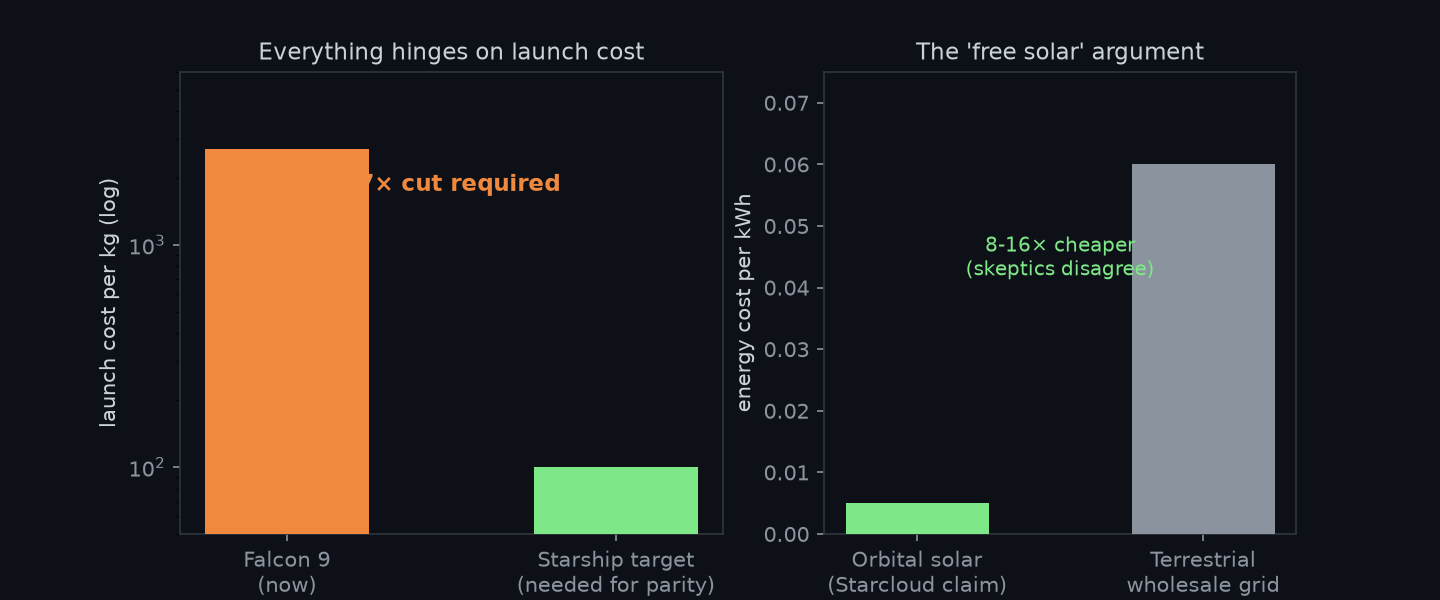
▲ Left: launch cost is the whole game — $2,700/kg on Falcon 9 today, versus the sub-$100/kg that Starship's economics would need. Right: the "free solar" claim that anchors the optimist case.
Everything collapses to one variable: launch cost per kilogram. My read of the numbers: if Starship actually gets below ~$100/kg, orbital DCs reach parity for specific workloads around 2028–2030; if it stays above ~$500/kg, ground wins for general-purpose compute through at least 2035. And SpaceX's own IPO filing was notably more conservative than Musk's tweets — it says the first deployments could start as early as 2028, and Musk himself told investors to take his "1 GW by end-2027, 1 TW eventually" timeline "with a grain of salt."
5. Everyone else is in this race too
SpaceX isn't alone, and that's the most interesting part. This is a real market forming, not a single stunt. Starcloud is already flying — H100 in orbit since November, with Blackwell and AWS Outposts hardware coming on Starcloud-2 in October. Kepler has ten optical relay satellites up with multi-GPU compute nodes, and Axiom is running two ISS-derived datacenter nodes. Google is quietly radiation-hardening its Trillium TPUs for Project Suncatcher (1.6 Tbps optical links — lab demo so far). Aetherflux, Robinhood co-founder Baiju Bhatt's $50M bet, is still pre-launch with a power-beaming demo planned for 2026. And Lonestar is eyeing lunar lava tubes after its LEO service.
My take
Two things stand out to me.
First, this announcement is as much about NVIDIA locking in the standard as it is about SpaceX building satellites. Rubin and Vera are now the default silicon of the largest orbital compute program ever filed, on top of Starcloud's H100 heritage, Kepler's on-orbit compute nodes, and the Space-1 module. If orbital compute happens at scale, NVIDIA's platform position in space mirrors its position on Earth. Google is the visible counter — radiation-hardened TPUs and those lab 1.6 Tbps optical links are not an accident.
Second, the honest timeline is longer than the headlines. FCC comment periods, radiation tolerance at scale, satellite lifespan limits, launch cost parity — there are a lot of "ifs" between one render and 100 GW. The thing I'll actually be watching: Starcloud-2 in October (Blackwell + AWS Outposts in orbit) and whether Starship's per-kg cost starts moving toward that $100 number. If those two things go well, 2028 suddenly looks plausible. If not, this stays a really cool rendering.
Space is genuinely the only place left where you can build a datacenter without asking anyone for power. I just wouldn't move my cloud bill up there yet.
📌 Sources & filters
Sources: SpaceX earnings call + X post (2026-08-04) · SpaceX FCC filing (2026-01-30) · NVIDIA Space Computing press release (2026-03-16) · SpaceX AI1 reveal (2026-06-08) · SpaceX IPO prospectus / record $75B IPO (2026-06-12) · Starcloud / Kepler / Axiom / Google Suncatcher / Aetherflux coverage via CNBC, WSJ, SpaceNews, Aviation Week, ETNews, TradingKey. Cost projections are exactly that — projections. The orbital-DC economics debate (McCalip calculator, ESPI analysis) is live and unresolved; treat vendor numbers as directional.
Related on this blog: Nvidia's reported $12.9B move on open weights · the $7,000 humanoid and the open physical-AI push
Open Source Factory · opensourcefactory1.blogspot.com · Written 2026-08-05
Comments
Post a Comment