DeepSeek's Early Price Notice: Before the Numbers Arrived
MODELS & COSTS
DeepSeek's Early Price Notice: Before the Numbers Arrived
DeepSeek's August 6 notice announced a significant increase without publishing the complete new rates. That left users a budget question, not an amount to calculate yet. This earlier account records the notice; the linked rate-card follow-up supplies the later peak and off-peak figures.
In this article
- The number that broke the camel
- How we got here (it was never going to stay this cheap)
- The boss basically told us this was coming
- The dry run: peak/off-peak pricing
- Even after the hike, it'll still be the cheapest thing on the market
- What I'm actually doing
- Read the later rate card
- Linked source documents
And then, on August 6, DeepSeek dropped this notice:
"We plan to implement a comprehensive price increase for DeepSeek API services in the near term, with a significant expected rise. Please adjust your usage accordingly. The specific plan will be subject to the official notice."
"Significant." Not "modest." Not "slight readjustment." Significant.
The notice left the new rates unspecified. The following figures explain the launch context, not the final price.
The number that broke the camel
OpenCode's reported token volume provides context for the service's scale. It does not disclose DeepSeek's unit costs or establish the motive behind the increase. The company's pricing notice is the evidence for the change itself.
Look at these numbers, from OpenCode's own disclosure:
- DeepSeek V4 Flash via OpenCode alone: 8 trillion tokens per day — 5T from free quotas, 3T from paid plans
- All 400+ models combined on OpenRouter: ~6.6 trillion tokens per day
OpenCode reported exceptionally high daily V4 Flash use. Separately, the cited OpenRouter weekly listing shows 7.22T tokens and Vercel about 5.3T. These are different platforms and reporting periods; they should not be combined into one measured global total.
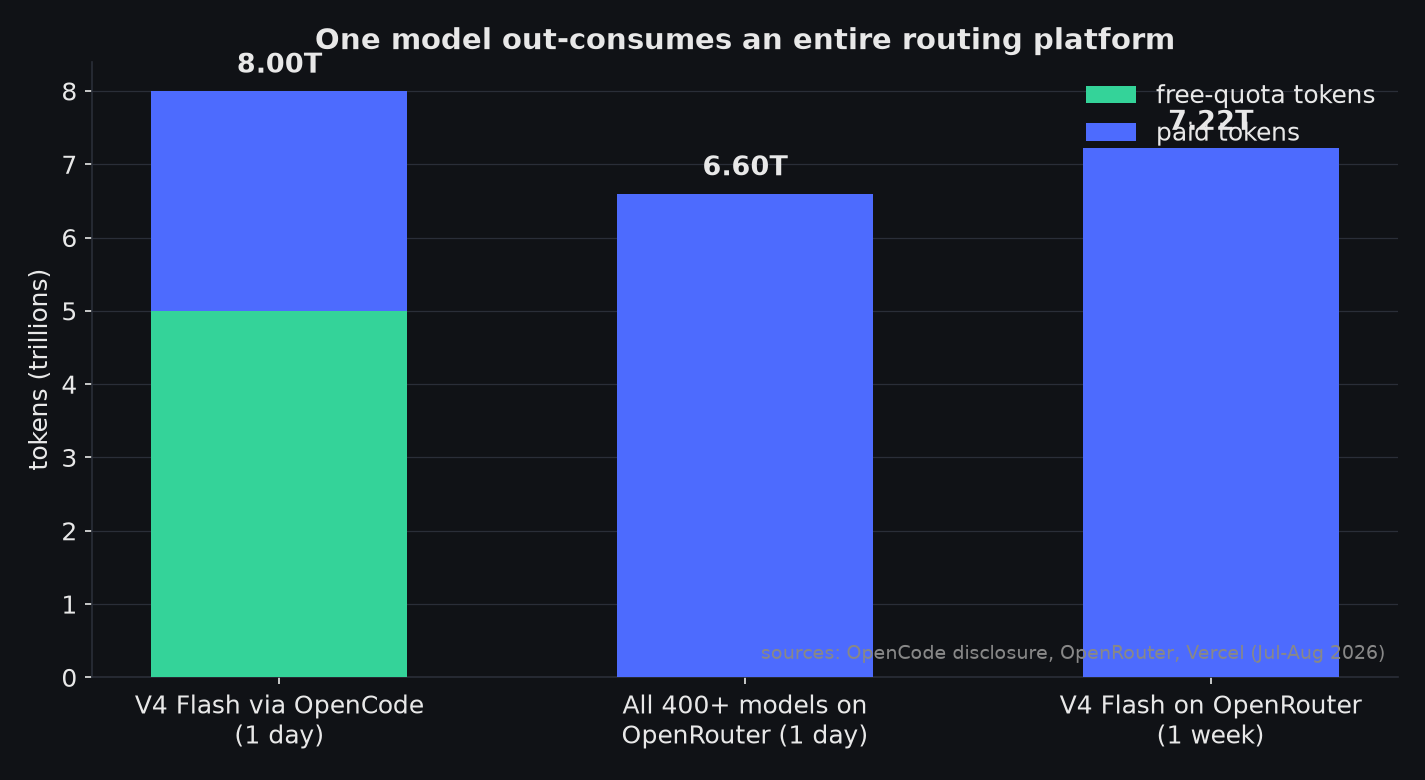
One model out-consumes an entire routing platform. Sources: OpenCode disclosure, OpenRouter, Vercel.
That's not a usage spike. That's a firehose pointed at one door.
How we got here (it was never going to stay this cheap)
| Date | Event |
|---|---|
| Apr 24 | V4 Flash + V4 Pro launch. Flash at $0.14/$0.28, Pro at $0.435/$0.87, both with 1M context |
| May 22 | DeepSeek makes a 75% launch discount permanent — the "AI price war" headlines peak |
| mid-July | Peak/off-peak pricing goes live: 2x price on weekday peaks (9-12, 14-18 Beijing time) |
| Jul 31 | V4-Flash-0731 official API beta — same architecture, retrained, notably better at coding/agent tasks |
| Aug 6 | "Comprehensive price increase... significant expected rise" — numbers TBD |
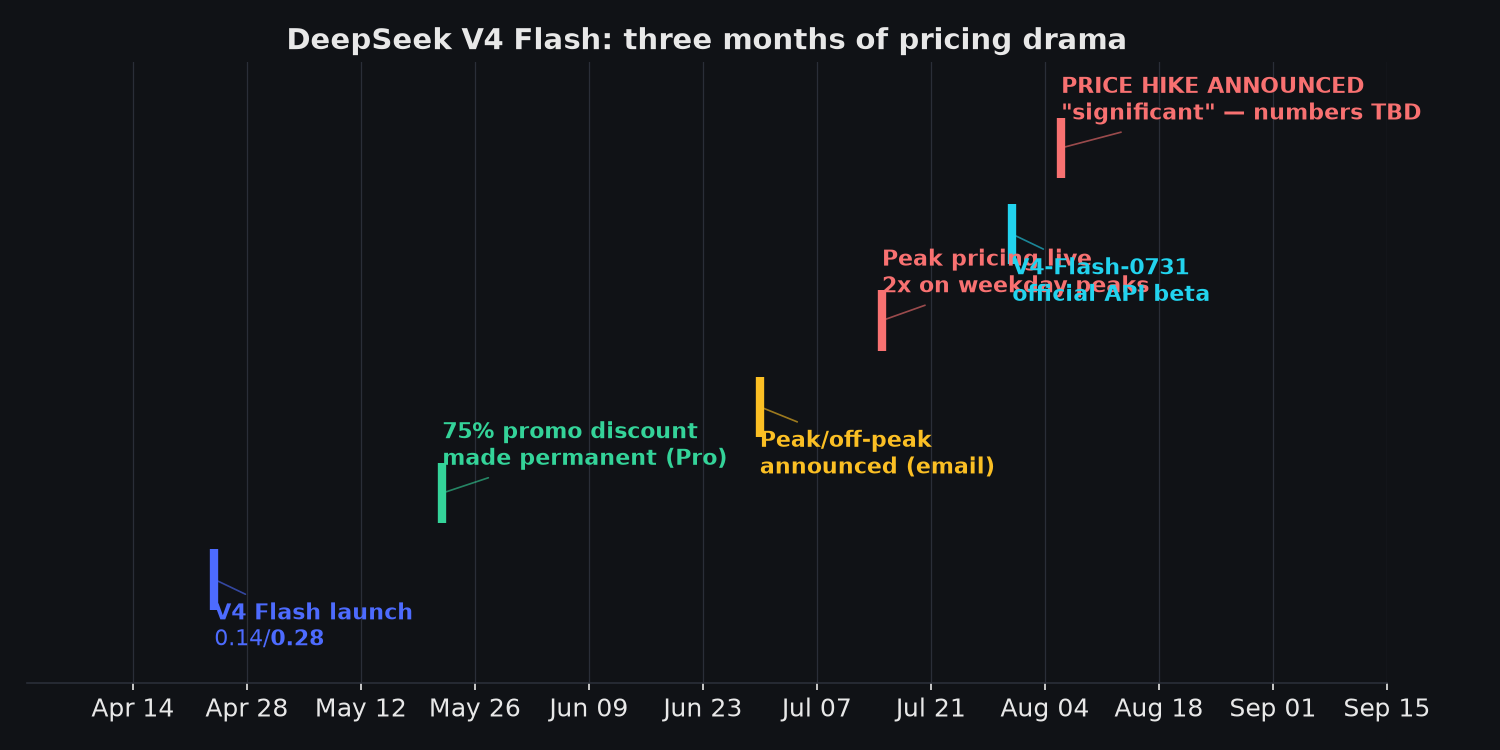
Three months of pricing drama, one chart.
The timeline records several changes in access and pricing. It does not provide the serving-cost data needed to establish when any rate stopped covering costs.
The boss basically told us this was coming
At an investor briefing in July, DeepSeek founder Liang Wenfeng laid out the pricing philosophy pretty plainly:
- API pricing is built around a "reasonable profit model" — hardware costs should be recovered within 10 months of purchase
- And the killer line: demand at current prices has "almost no elasticity" — "even if prices were raised by another 50%, token consumption would barely change"
Read that again. They pre-announced a 50% hike in July. The August 6 notice is just the formal version.
And the business context makes it make sense: ARR is already $400-500M, the V4 line has gross margin above 50%, and DeepSeek is raising a Series B of RMB 50 billion (~$7B) at a pre-money valuation of ~RMB 500B, with signing targeted for late August. When you're about to raise $7 billion, you don't go into the meeting with prices 100x below the competition.
The dry run: peak/off-peak pricing
The mid-July "time-of-day" pricing was the appetizer — a 2x surcharge on weekday peaks (9am-12pm, 2pm-6pm Beijing time). Goldman Sachs calculated the blended effect: about $0.35/M for V4 Pro and $0.12/M for Flash after weighting.
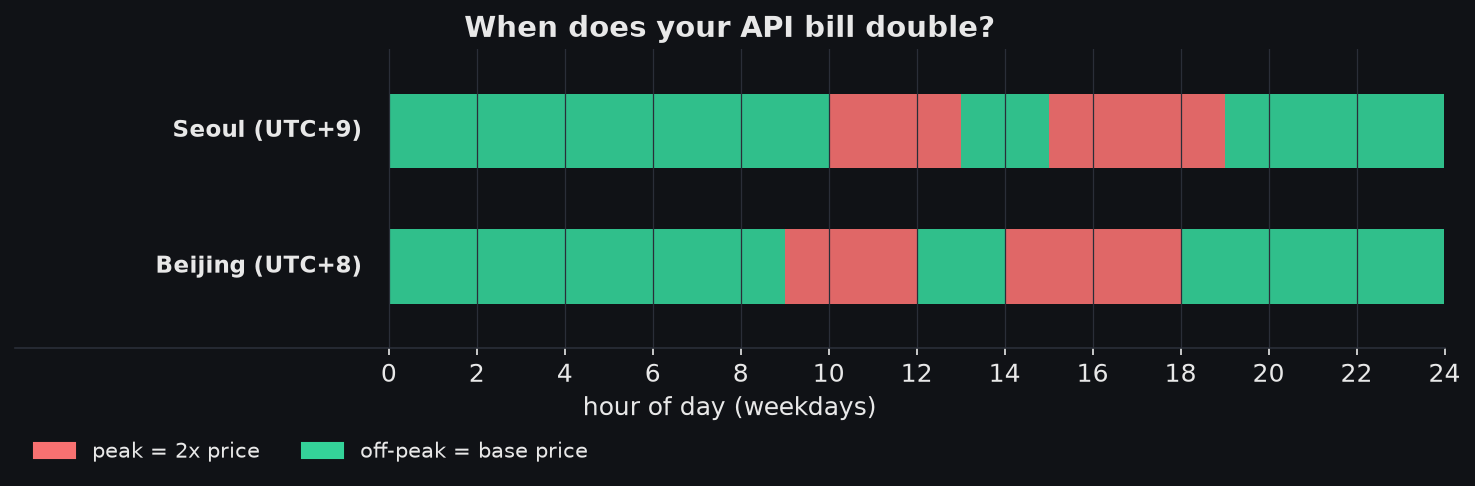
Weekday peaks, in Beijing and Seoul time.
For Korean users that means: 10am-1pm and 3pm-7pm KST = 2x. Shift batch work to night, and you're basically unaffected.
Even after the hike, it'll still be the cheapest thing on the market
Artificial Analysis's cost-per-evaluation measure includes the tokens used in its test. That is a more specific comparison than list token rates, but it still describes that evaluation rather than every user's workload:
- DeepSeek V4 Flash: $0.03 per test
- Kimi K3: $0.86
- GPT-5.6 Sol: $1.86
- Claude Fable 5: $3.15
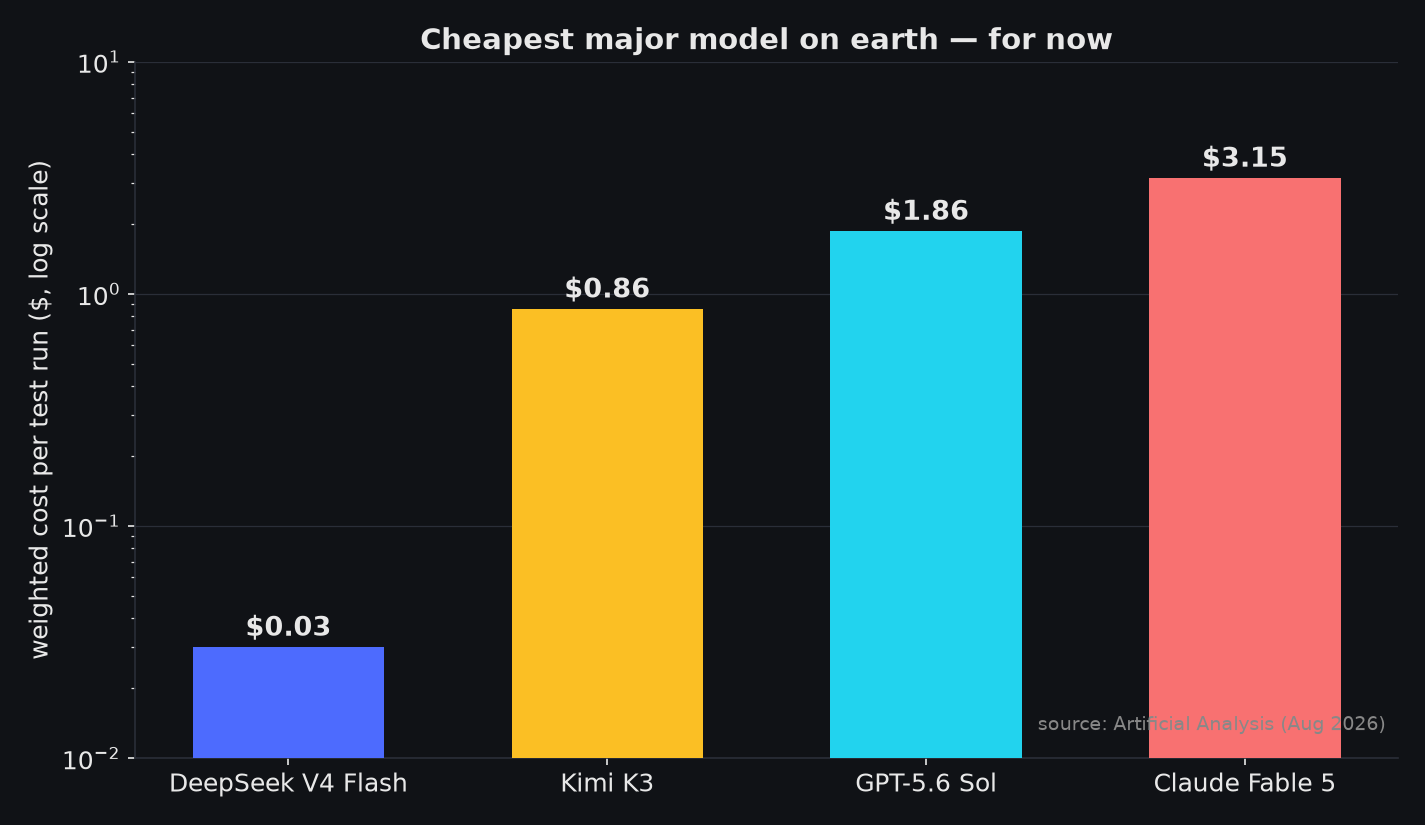
Weighted cost per test run, log scale. Source: Artificial Analysis (Aug 2026).
V4 Flash is 100x cheaper per test than Claude. A "significant" increase could mean doubling — and Flash would still be ~50x cheaper. Even a 3x hike keeps it the best deal in AI by a mile.
Before the rate card appeared, the table below illustrated hypothetical increases. These scenarios are retained as the original pre-announcement calculation, not as applicable prices. For the subsequently announced schedule, use the published rate-card analysis.
| Scenario | Input $/M | Output $/M | Cached $/M |
|---|---|---|---|
| Today (off-peak) | $0.14 | $0.28 | $0.0028 |
| +30% | ~$0.18 | ~$0.36 | ~$0.004 |
| +50% | ~$0.21 | ~$0.42 | ~$0.004 |
| 2x | $0.28 | $0.56 | ~$0.006 |
The earlier version also guessed a 30–60% base-rate increase. That forecast is superseded by the published rate card and is not a billing rule. Use the announced figures rather than this article’s original scenarios for a budget.
What I'm actually doing
- Moving batch work off peak hours. The 2x peak pricing already exists and it's cheap to just... schedule around it.
- Leaning hard into prompt caching. Cache-hit input is $0.0028 — 98% off. Long agent sessions that reuse context are already nearly free; that advantage survived the hike announcement, and I'd bet it survives the hike.
- Not panicking about alternatives. Even at double the price, Flash is the value king. The alternatives (GPT-5.6 Sol, Claude Fable 5) cost 60-100x more per test.
- Watching the free quota news. The 5T/day free tier on OpenCode is the part that actually matters for hobbyists like me. If the hike touches free quotas, that's the bigger story than any per-token price.
Read the later rate card
High usage and low launch prices can create pressure on a serving business, but the reports here do not quantify that relationship for DeepSeek. Avoid treating token volume alone as proof of profitability, loss or a particular required price.
The open question at the notice date was the new effective cost for each workload. That question now has a dated rate card to consult. A 'cheapest model' label cannot replace a calculation that includes input, output, cache and time-of-day billing.
Related on this blog: DeepSeek's Price Hike Gets Real: Up to 4.7x on Output · DeepSeek Added Vision to Flash. The Text Scores Went Up.
This records the August 6 notice. The later rate-card article linked above contains the announced peak and off-peak prices.
Comments
Post a Comment