URXR One vs Quest 3: I put the 93-gram glasses next to the 515-gram headset
next to the 515-gram headset
One of them destroys the other in specific places. Neither one is the loser.
2026.08.07 · Open Source Factory
Last week I wrote about URXR One going live on Kickstarter — 93-gram glasses doing 6DoF tracking with hand gestures. The comments turned into one recurring question: "why would anyone buy this when a Quest 3 is $300 cheaper?"
Fair question. $799 for a pair of glasses that needs a computer plugged into it, versus $499 for a headset that runs everything on its own. On paper that looks like an easy call. Then you put the two spec sheets side by side, and it gets genuinely interesting — because these two are not actually competing, but each one absolutely demolishes the other in specific places. I went through both spec sheets properly so you don't have to argue about it in the comments.
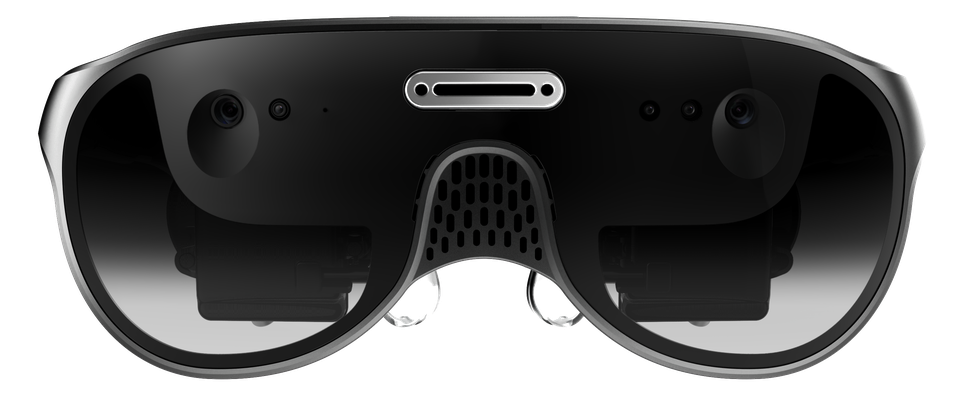
▲ The challenger: URXR One, 93 g, dual micro-OLED, on Kickstarter since Aug 4. (source: Unseen Reality)
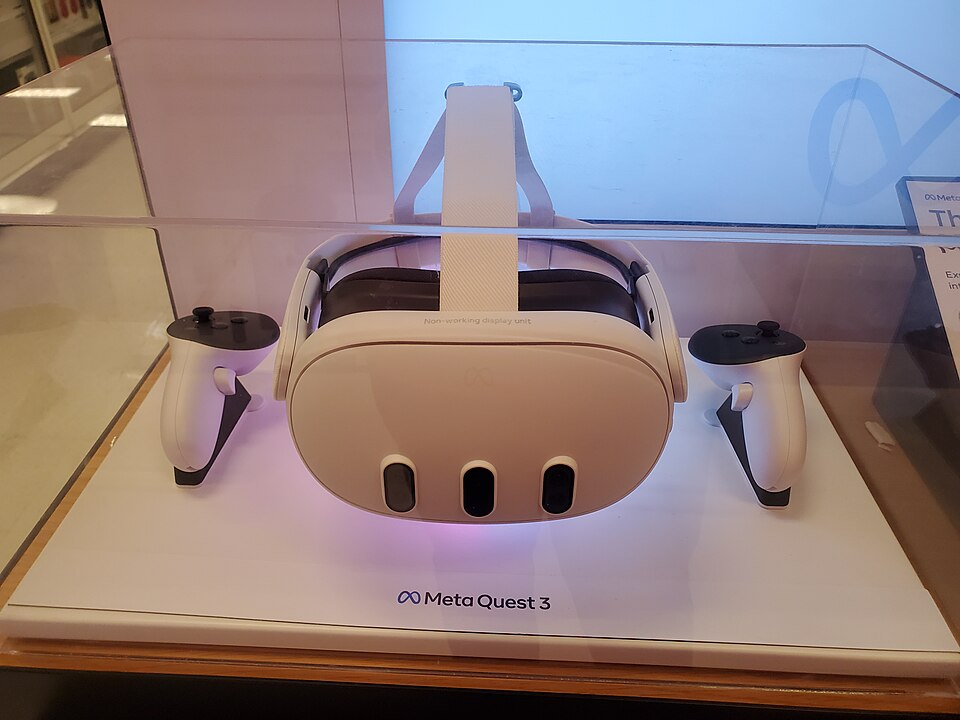
▲ The incumbent: Meta Quest 3, 515 g, on sale for almost three years. (photo: Wikipedia Commons, CC BY-SA)
1. The spec sheet, side by side
| URXR One (Kickstarter) | Meta Quest 3 | |
|---|---|---|
| Form factor | Glasses — 93 g | Headset — 515 g |
| Display | Dual 1.03" micro-OLED | Dual LCD |
| Resolution (per eye) | 2,448 × 2,064 | 2,064 × 2,208 |
| Sharpness | ~36 PPD (est.) | ~25 PPD |
| Field of view | 90° diag (~80° H) | ~110° H × 96° V |
| Refresh rate | 90 Hz | up to 120 Hz |
| Compute | None — your PC/phone renders | Snapdragon XR2 Gen 2, 8 GB — standalone |
| Tracking | 6DoF SLAM on-glasses, 1 kHz IMU | 6DoF inside-out, 4 cameras |
| Input | Hand gestures, buttons | Touch Plus controllers + hand tracking |
| Passthrough | Color VST, <10 ms claimed | Color MR (18 PPD) |
| Audio | None — use host/earbuds | Built-in speakers + mic |
| Battery | None — powered by host | Built-in (~2–3 h) |
| Connectivity | USB-C DisplayPort (wired) | Wi-Fi 6E, BT 5.2, USB-C |
| Price | $799 KS / $899 retail | $499 (128 GB) / $649 (512 GB) |
| Status | Kickstarter — ships Oct 2026 | On sale since Oct 2023, proven |
If you just read the numbers, the Quest 3 looks strictly better. That's the trap — the numbers don't tell you what each one is for. Let me go through the wins honestly, in both directions.
2. Where URXR One wins
📖 Text sharpness — the one spec that matters for work
36 PPD vs 25 PPD is not a small gap. That's the difference between "readable" and "actually comfortable to read all day." The whole point of these glasses is text — code, documents, spreadsheets, dashboards — and on that axis URXR One is meaningfully ahead of the Quest 3. It's also close to the Vision Pro's ~34 PPD (third-party estimate), at a fraction of the price and weight.
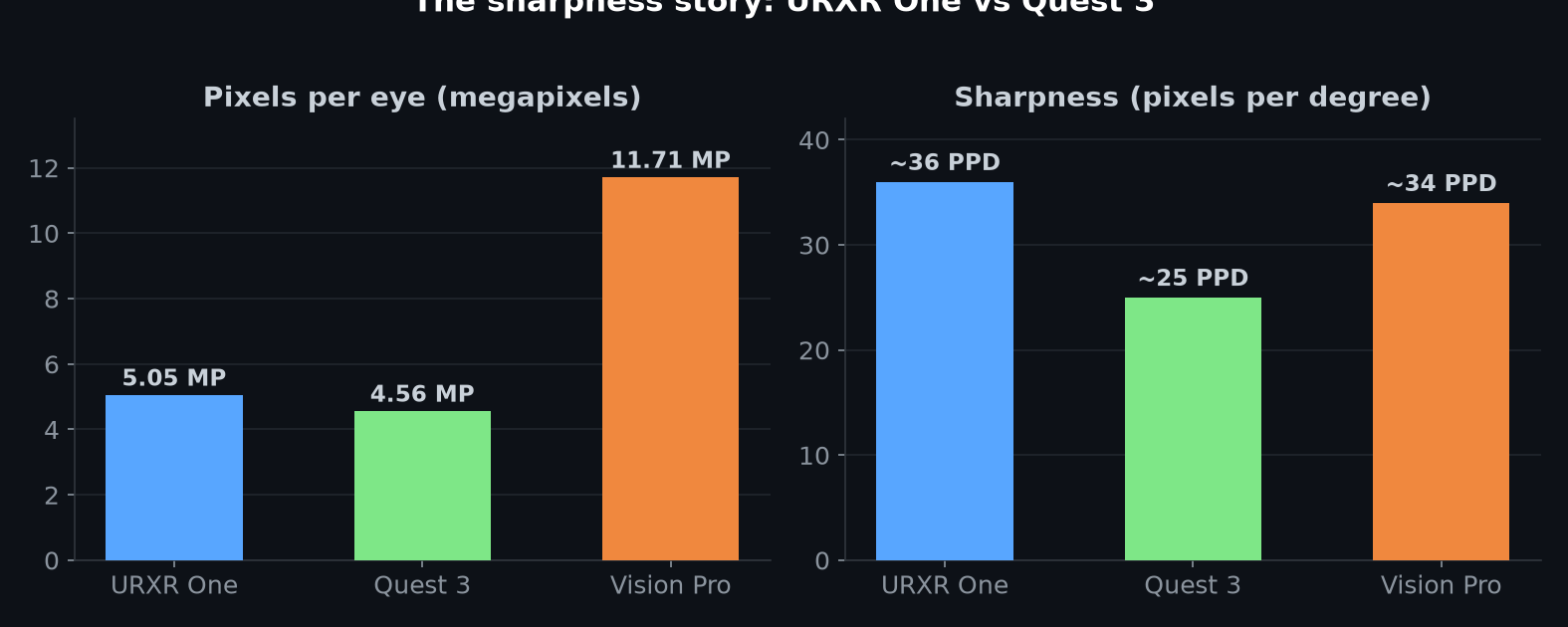
▲ Here's the honest version: URXR One is only ~11% more pixels than a Quest 3. The big PPD gap comes from packing those pixels into a narrower FOV — great for text, less great for immersion.
⚖️ The weight — it's not close
93 g vs 515 g. Five and a half times lighter. A Quest 3 is a brick strapped to your face for 30 minutes; the URXR One is lighter than most actual sunglasses and you can forget you're wearing it. For "wear it while working" that changes everything. And micro-OLED gives it proper black levels — LCD glow is one of the Quest 3's known weaknesses.
🔌 It's a display, not a computer — and that's the design
No battery, no fan, no app store. The glasses are a screen + a tracking chip; your laptop or phone is the brain. That's why it can be 93 grams, and it also means it never gets slower — performance upgrades when your host device upgrades.
3. Where Quest 3 wins
🌌 Immersion — FOV and refresh rate
110° horizontal vs 80°. That's the difference between "I'm looking at a big screen" and "I'm in the place." Plus 120 Hz vs 90 Hz for motion smoothness. The URXR One's narrow FOV is the honest tradeoff behind its sharpness — you can't have both at this size and price.
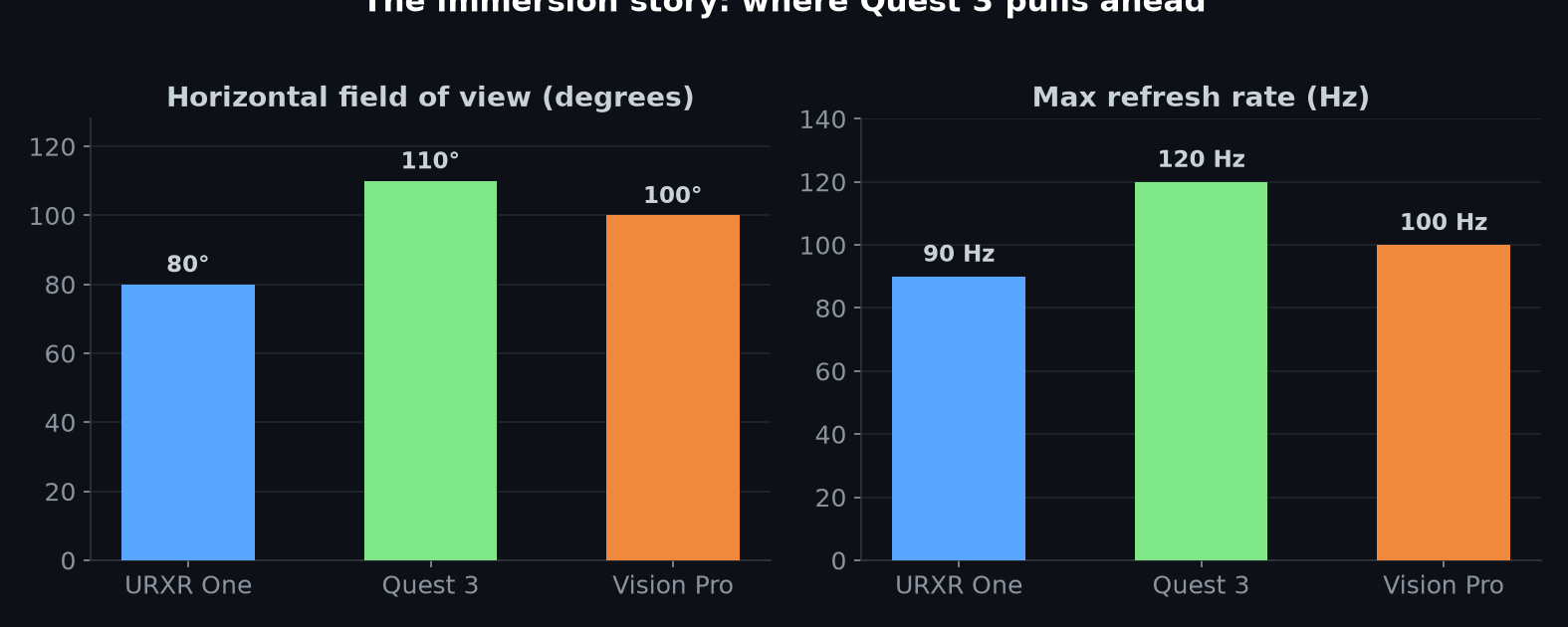
▲ The immersion gap is real and it's structural — a 93-gram glasses frame physically cannot do a 110° FOV today.
🎮 It's a complete computer that already exists
Quest 3 renders everything itself — games, MR apps, fitness, media — no host device required. It has a mature store with thousands of titles, three years of updates, built-in audio, and it's a shipped, proven product. The URXR One at launch is a crowdfunding bet with no SteamVR support, no built-in speakers, and first-gen software.
💰 The price — including the hidden costs
$499 vs $799 is already lopsided, and the glasses get worse on the details: phones need the optional $69 Power Hub, there's no audio hardware, and you need a compatible USB-C DisplayPort device on top of the purchase. The Quest 3 is the cheapest ticket into spatial computing that actually works today.
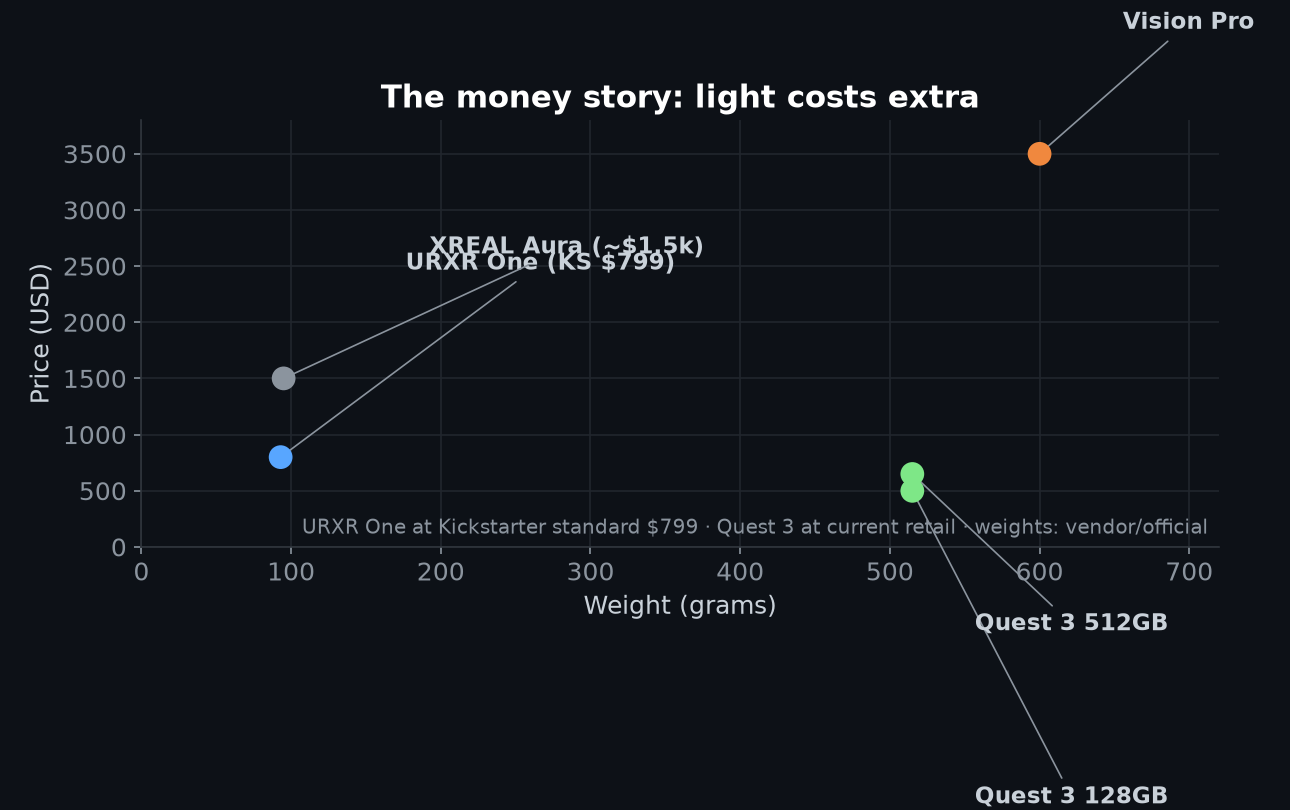
▲ The money story: grams cost money. The Quest 3 is the value pick; URXR One is mid-priced for its own (glasses) category — the XREAL Aura it competes with is ~$1,500. (XREAL price per Unseen Reality's comparison table)
4. So which one should you buy?
Depends entirely on the job. Three scenarios:
🎮 Games and full VR/MR: Quest 3, and it's not close. If budget is the constraint, the Quest 3S at $299 covers most of the same ground. The glasses aren't in this race.
💻 An all-day wearable monitor for work: URXR One is the only one of these two that's shaped for it. The Quest 3 is too heavy and its display is noticeably softer for text. This is the glasses' entire reason to exist.
🎬 Movies, lying down, casual: Honest split. Comfort and black levels go to the glasses; FOV and audio go to the headset. I'd rather watch a movie on the Quest 3 — but I'd rather fall asleep wearing the URXR One.
5. The honest math
Here's the thing nobody says in these arguments: the URXR One is not competing with the Quest 3 — it's competing with the XREALs and Vitures of the world, and against those it's genuinely aggressive (higher resolution, wider FOV, 6DoF standard, lower price than XREAL Aura). Comparing it to a $499 VR headset is like comparing a monitor to a console. A monitor loses every benchmark against a console — unless your job is reading spreadsheets.
And the reverse is true too: the Quest 3's advantages are exactly the ones that are hard to argue with — it exists, it works, it's cheap, and it does things the glasses literally cannot do. Anyone who tells you the glasses are "the future and the headset is dead" is selling something.
📌 The fine print, both sides
URXR One: Kickstarter campaign (funding total changes hourly — check the campaign page), ships October 2026, no shipping units exist yet. Specs are vendor-reported; PPD is an estimate. No SteamVR at launch, no built-in audio, phones need the $69 Power Hub, and hands-on reviewers noted hand tracking degrades in low light. Quest 3: released October 2023, well reviewed, but it's LCD (no true blacks), ~2–3 h battery, requires a Meta account, and the weight is what it is. Both are compromises — different ones.
My take
I keep going back and forth, and that's the answer. If someone asked me to pick one device for the next year, it's the Quest 3 — it's cheaper, proven, and does more. But if you actually work on a laptop all day and want a screen you can wear on the sofa, the Quest 3 won't replace that, and nothing else at this weight does 6DoF yet. The 93-gram direction is right; whether this first batch pulls it off is exactly what shipping-unit reviews will tell us.
So: don't back the URXR One as a Quest 3 replacement — that's a category error. Back it if the "wearable monitor" pitch is exactly what you've been waiting for, and you can eat the crowdfunding risk. Or wait for October, read the real reviews, and buy retail. I'll be watching either way — and if they ship a SteamVR path eventually, this comparison gets a lot more interesting.
📌 Sources & filters
Sources: Unseen Reality (unseen-reality.com official specs page, press release, URXR One vs Quest 3 comparison) · Kickstarter campaign (live since 2026-08-04, funding changes hourly) · Road to VR (campaign coverage 2026-08-05, 80°H×56°V FOV measurement note) · Meta / Wikipedia (Quest 3 specs: 2,064×2,208 per eye, 515 g, XR2 Gen 2, $499/$649) · Meta blog (25 PPD figure) · Quest 3 photo: Wikipedia Commons (Meta Quest 3 display unit, CC BY-SA). Specs are vendor-reported; PPD figures include estimates. No URXR One shipping units exist as of this writing — treat all glasses-side claims as pre-production.
Related on this blog: the Kickstarter launch these glasses come from · full-color 3D printing on Kickstarter the same week
Open Source Factory · opensourcefactory1.blogspot.com · Written 2026-08-07 · Published
Comments
Post a Comment