TDK's 150 nm Reflector: A Component, Not Finished Glasses
HARDWARE & DESIGN
TDK's 150 nm Reflector: A Component, Not Finished Glasses
TDK demonstrated a thin reflector inside an eyeglass lens. That may reduce one source of optical bulk, but the laser engine, tracking, battery and frame still need somewhere to go. The current monochrome prototype is a component result worth examining on those terms.
In this article
There is a physical prototype behind the announcement, but the current system is monochrome. Full color and mass production remain development goals. I have not worn or tested it; this is an analysis of the public technical material, with my own diagrams and a practical evaluation checklist. TDK’s October 2 announcement is the starting point.
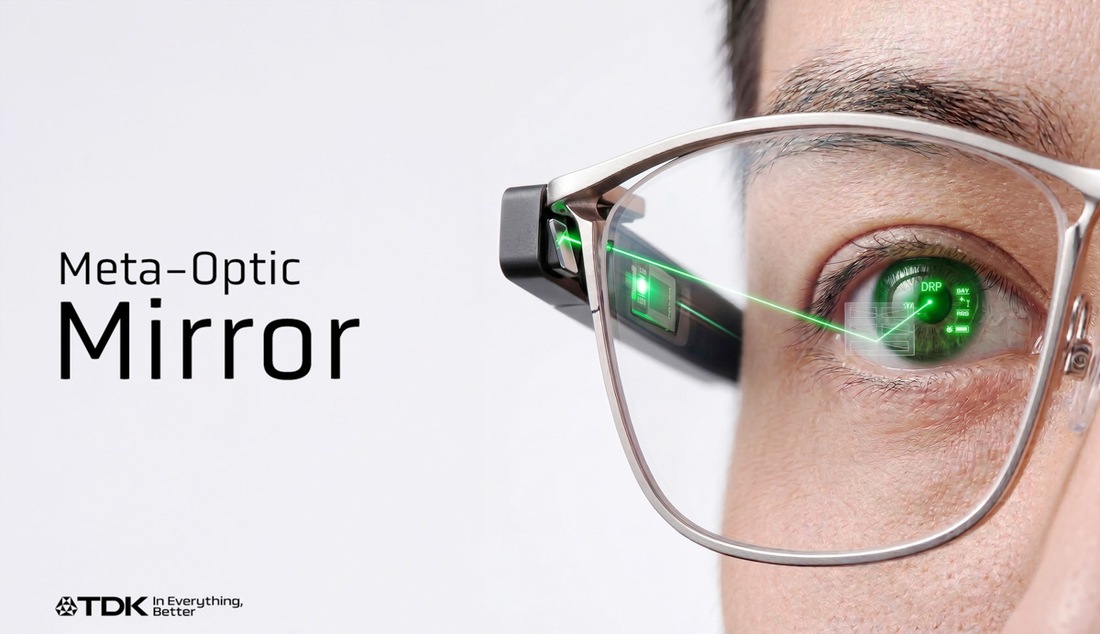
The demonstrated optical layer
TDK reports a direct retinal projection display that uses a flat, patterned reflector in place of the conspicuous curved mirror associated with earlier designs. Its “world first” claim is specifically about retinal projection using a meta-optic mirror. Retinal projection itself has a longer history.
The distinction matters because this is a component announcement. A successful optical element does not automatically tell us the complete glasses’ weight, runtime or comfort. Those are the specifications I would want before deciding whether this changes everyday computing.
The actual hardware is more useful evidence than the polished render. Notice the module on the side of the demonstration frame in the press photograph below. That assembly still has to live somewhere, even if the reflector no longer sticks out in front of the lens.
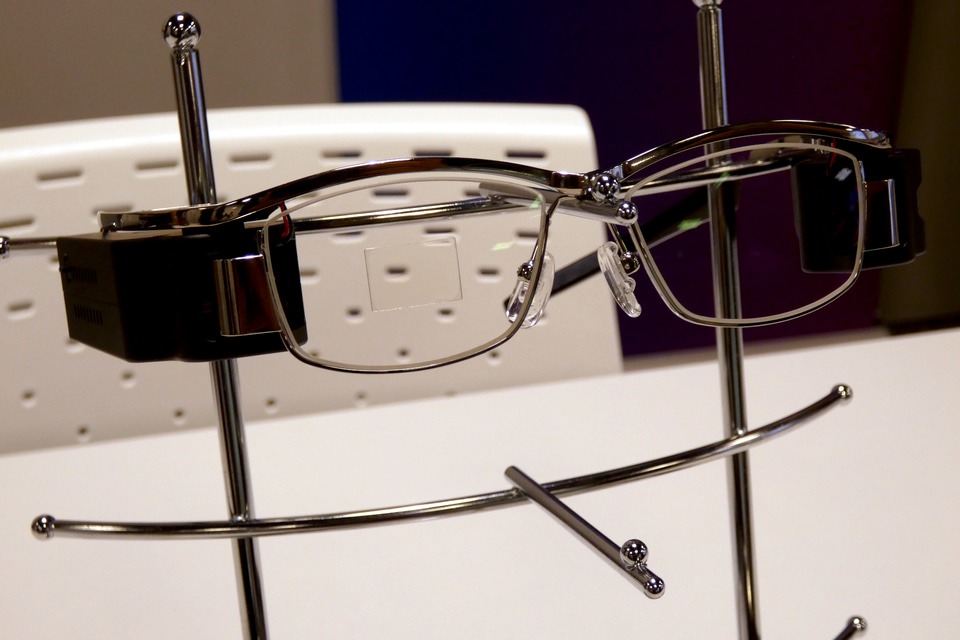
The CEATEC organizer lists the technology as the METI Minister’s Award winner. That is a separate confirmation of the award, not a substitute for a wear test. As of October 11, the October 13 CEATEC exhibition is still ahead of us.
Redirecting light with a flat reflector
A conventional curved reflector uses its changing surface orientation to redirect incoming light. TDK’s approach assigns that directional work to a pattern of nanoscale structures on a flat surface. Different positions can send incident light in the directions needed by the retinal projection system. The visible shape of the reflector can therefore become much simpler. TDK’s technical feature explains the mechanism.
In this architecture, the image is carried by laser light. The meta-optic mirror redirects it through the eye’s entrance toward the retina. Light from the outside world can pass through the optic at the same time. The lens is doing two jobs: providing a view of your surroundings and participating in the display’s light path.
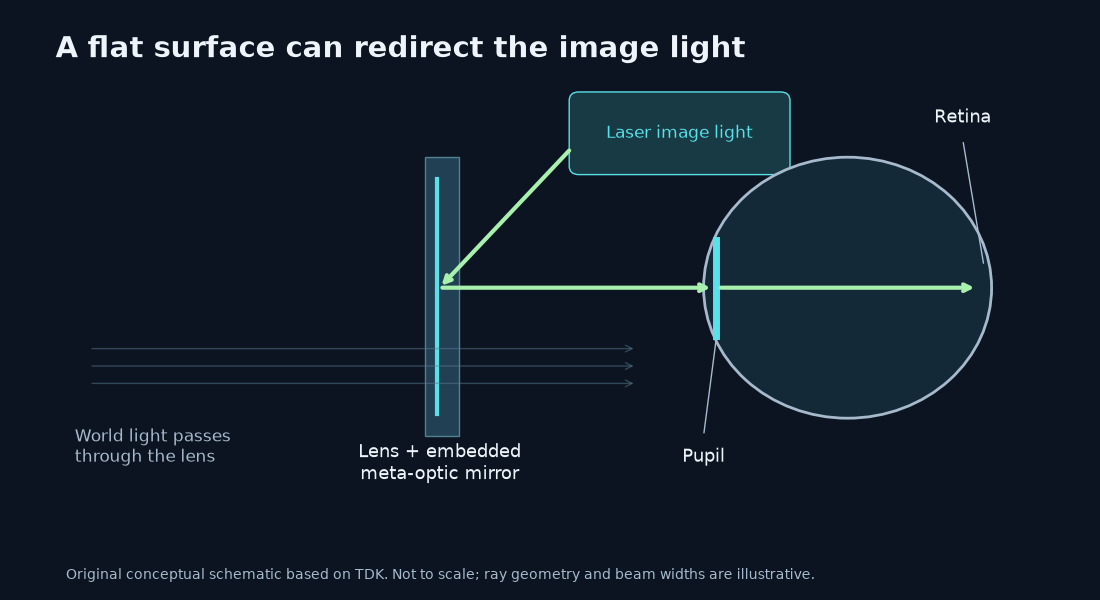
I find this more interesting than another promise to make a headset slightly lighter. It changes where the optical work happens. But removing a protruding reflector addresses one packaging problem; the source, control electronics and power supply still belong to the system. I would judge the finished arrangement as a whole.
Layer thickness and visible-light transmission
150 nm = 0.15 micrometres = 0.00015 mm. That is the stated mirror-layer thickness. It is not the thickness of the complete lens or the entire display module. To make the scale less abstract, a 1 mm reference is about 6,667 times thicker. That reference is a unit comparison, not a measurement of TDK’s lens.
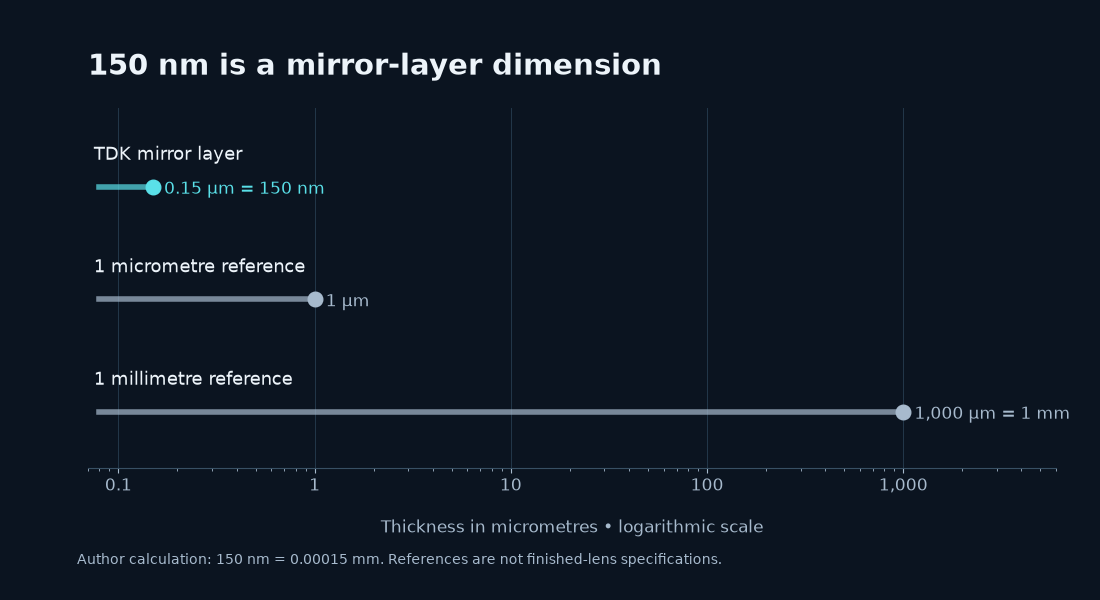
The other headline figure, approximately 80% visible-light transmittance, describes light passing through the optic. It does not tell us how bright a projected label appears on a sunny street. It also does not tell us how much electricity the complete glasses consume. I would keep those questions separate when reading any launch coverage.
TDK also discusses a laser-control component capable of supporting 4K. I would not turn that into a “4K full-color glasses” headline: a component’s capability does not establish the demonstrated system’s resolution, and the current meta-optic system is monochrome. The announcement keeps those statements separate.
Tracking a moving wearer
My first test would be deliberately boring: put up one short line of text, then let the wearer look around naturally. A crisp image at one carefully positioned point is useful evidence, but everyday glasses need to tolerate how people actually move. I would record when the image dims, clips or disappears as eye position changes.
Next, I would take the same text from an indoor room to a bright outdoor scene. A transmission figure alone cannot answer whether that text remains readable. The test should report the lighting conditions, display settings and power use together, so a brighter demonstration does not hide a runtime tradeoff.
| Question I would test | Evidence I would ask for |
|---|---|
| Does the image stay visible? | A continuous clip during normal eye and head movement, with fit conditions stated. |
| Can I read it outdoors? | The same content indoors and in measured daylight, with display settings disclosed. |
| Will it fit ordinary use? | Complete-frame weight, prescription compatibility, adjustment needs and runtime. |
| Is the complete system ready? | End-product optical testing and applicable eye-safety documentation. |
This is my proposed evaluation framework. I am not reporting that the prototype failed these tests. The cited announcement does not provide enough detail to score them. A transparent “not yet reported” is more useful here than a made-up readiness percentage.
TDK also describes reduced outward image leakage. That is an optical privacy claim: what someone facing the wearer can see of the display. It does not answer what a future camera or assistant records, where that data goes, or which permissions it has. Those questions belong to the finished device and its software.
Potential uses and product constraints
The immediate audience is glasses manufacturers. TDK’s June agreement with QD Laser covers joint RGB light-source and optical-engine development, prototype evaluation and technology transfer. It describes a route to supplying manufacturers, rather than a consumer order page.
That is why I would watch the integration story. A display manufacturer needs an optic it can reproduce consistently, fit into a frame and combine with the rest of the system. Semiconductor-like fabrication is an attractive direction, but manufacturing cost depends on more than the patterning method: yield, packaging and alignment still have to work commercially. This is my assessment of what the supplier route must prove.
For a wearer, even monochrome could be useful if the finished device handled short prompts comfortably. I would start with navigation cues or a few words of live information, rather than imagining a desktop permanently pasted over my vision. Those are possible uses, not demonstrated applications of this prototype.
The product question is different from the camera-versus-audio choice in Ray-Ban glasses or the glasses-versus-headset tradeoff in URXR One. TDK is working on the optical building block that might enable another kind of interface.
Prototype status
Availability
The cited releases describe prototype technology and supplier development. They do not announce a retail price or consumer launch date for a finished device.
Layer thickness versus lens thickness
No. The figure refers to the meta-optic mirror layer embedded in the lens. It excludes the rest of the lens and the electronics.
Color development
No. TDK reports monochrome operation. Full color and mass production are goals within the next few years, not completed milestones.
Device safety documentation
Direct retinal projection, by itself, does not establish the safety of a complete wearable. That requires documentation for the finished device, its operating limits and the intended conditions of use.
The reflector addresses one obstacle to a less conspicuous display: fitting the optics into an eyeglass lens. It says less about the bulk of the laser engine, tracking system, battery and frame. Those parts will determine what a finished pair is like to wear.
The next useful demonstration would show the view continuously while a wearer moves, with specifications for the complete system. Until then, evaluate this as an optical prototype rather than a pair of glasses ready to buy.
Comments
Post a Comment