GMKtec EVO-X5 Pro: What a 300B Fit Claim Requires
HARDWARE & DESIGN
GMKtec EVO-X5 Pro: What a 300B Fit Claim Requires
The EVO-X5 Pro's announced memory makes a large-model capacity calculation possible. It does not specify an interactive experience with a 300B model. Precision, the assignable memory pool, runtime support and measured throughput are needed before that fit claim becomes a buying recommendation.
In this article
The company announced a September 28 launch. At this article’s date, the price and independent inference results had not been published. Read the 300B claim as dependent on the model, precision and available runtime memory.
The announced launch configuration
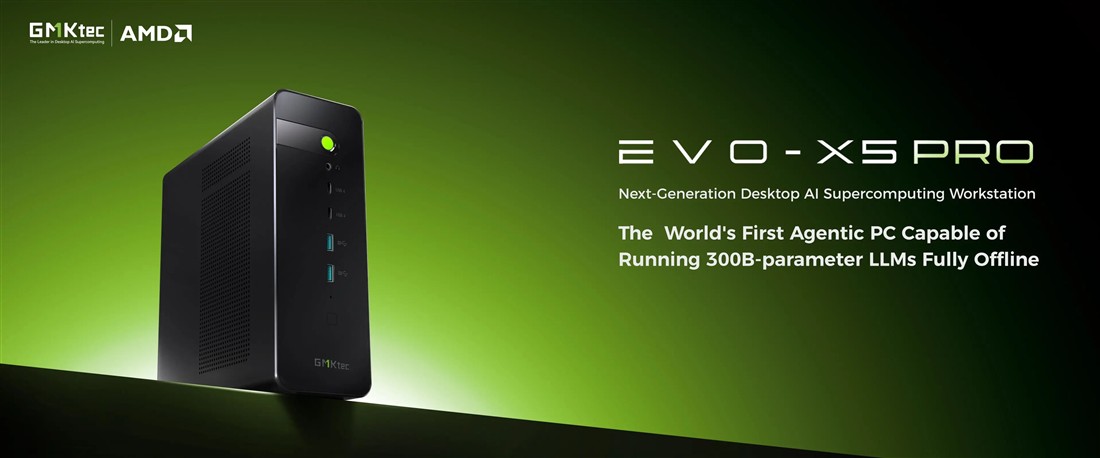
The EVO-X5 Pro is built around AMD's new Ryzen AI Max+ PRO 495. AMD lists 16 Zen 5 cores, 32 threads, a 5.2GHz maximum boost clock, and a 45–120W configurable TDP. GMKtec pairs it with Radeon 8065S graphics, 40 RDNA 3.5 compute units, and an XDNA 2 NPU rated at up to 55 TOPS.
The important number for local LLMs is not the NPU figure. It is memory. Large-model inference repeatedly moves weights through memory, so capacity decides whether a model loads and bandwidth heavily influences how fast tokens appear.
| Component | Official specification | Why it matters |
|---|---|---|
| Processor | Ryzen AI Max+ PRO 495 16 cores / 32 threads | Host work, preprocessing and general workstation performance |
| GPU | Radeon 8065S 40 RDNA 3.5 CUs | Main accelerator for local LLM inference |
| Unified memory | Up to 192GB LPDDR5X-8533 | Lets CPU and GPU share one unusually large pool |
| Configurable VRAM | Up to 160GB | Enough raw capacity for very large quantized weights |
| Memory bandwidth | Approximately 273GB/s | The more useful speed number for large LLMs |
| Storage | Up to 24TB | Large models and datasets consume storage quickly |
| Expansion | Four USB4 ports, rear USB4 V2, eGPU and clustering support | Fast storage, external acceleration and multi-node experiments |
| Estimated launch price | $4,999 midpoint $4,499–$5,499 range | Author estimate for a 192GB configuration; official price is not announced |
The conditions behind a 300B fit
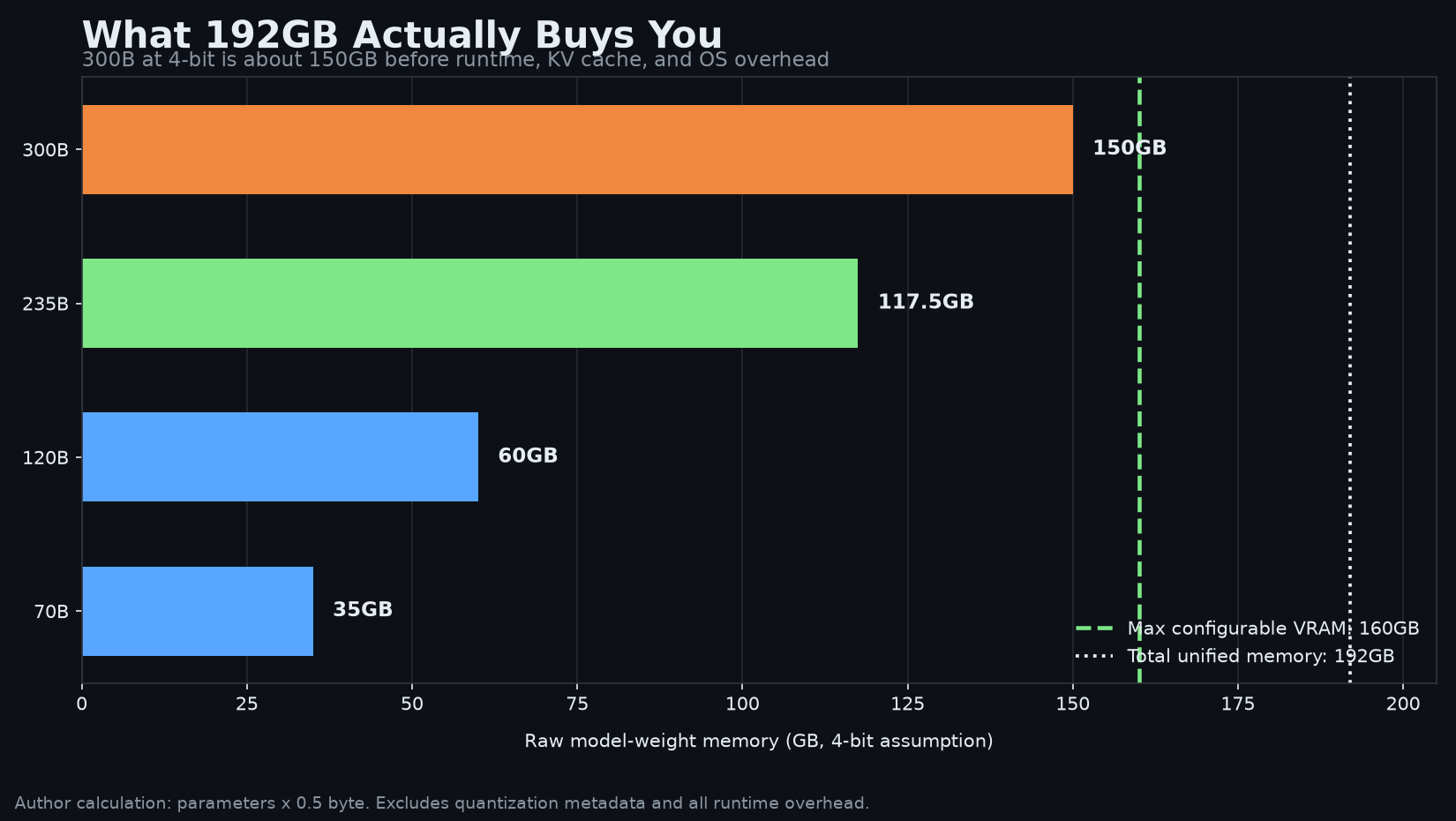
Yes, but only if we use the right meaning of “hold.” A 300B model at four bits needs roughly 150GB for the raw weights: 300 billion parameters multiplied by half a byte. That fits beneath the advertised 160GB graphics allocation with only about 10GB to spare.
That last sentence is the catch. Quantization metadata, runtime buffers, the KV cache, and the operating system all need memory too. Context length can move the KV-cache requirement substantially. GMKtec itself qualifies the claim with “the appropriate model, software, and configuration,” which is exactly the right caveat.
A sparse mixture-of-experts model changes the performance story because only part of the network is active for each token. It does not make the stored weights disappear, though. “300B supported” could describe a model that loads successfully while behaving very differently from a dense 300B model in speed and context capacity.
Capacity answers “will it load?” Bandwidth and software answer “will I enjoy using it?” Those are not the same question.
Capacity versus serving speed
GMKtec has not released a public 300B tokens-per-second result. Until that appears, the cleanest sanity check is memory bandwidth. If a dense model must stream roughly 150GB of four-bit weights for each generated token, dividing 273GB/s by 150GB gives a theoretical ceiling of about 1.8 tokens per second.
That is not a benchmark. Real throughput will be lower once overhead and implementation efficiency enter the picture. MoE routing, speculative decoding, prompt processing and caching can change the result. Still, the calculation explains why “fits in memory” should never be translated automatically into “fast.”
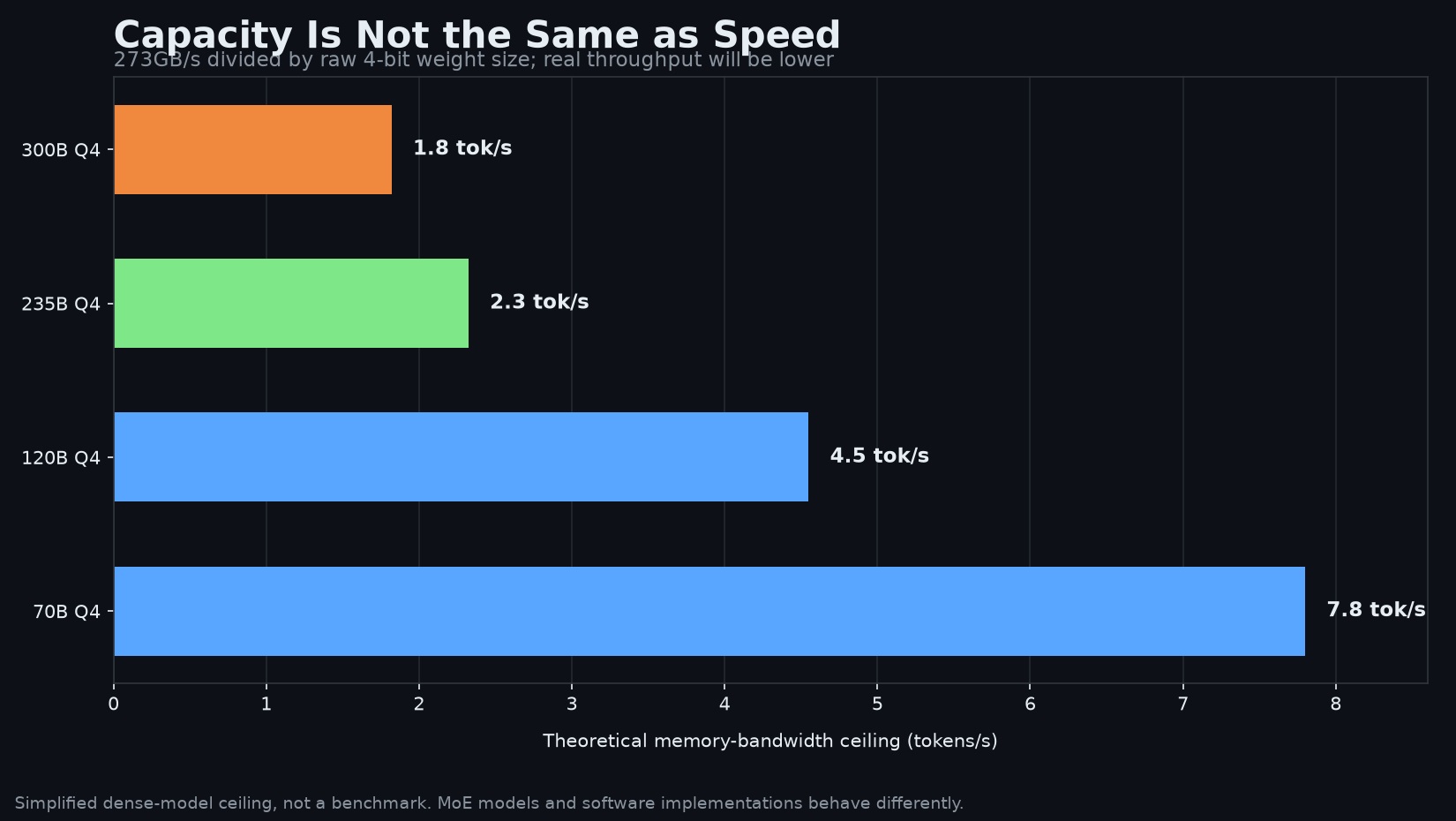
For 70B to 120B-class quantized models, this machine looks much more comfortable. There is more space for context and runtime overhead, while the same 273GB/s bandwidth is moving a smaller weight set. That is probably the more practical sweet spot for interactive local work.
Cooling, ports and the chassis
GMKtec is pitching this as a workstation and enterprise endpoint, not just an enthusiast box. The official specification includes vapor-chamber cooling, three fans, three performance modes, dTPM 2.0, AMD DASH remote management and validation for continuous 24/7 operation.
The machine also supports up to 24TB of storage and multiple USB4 connections. GMKtec says the rear USB4 V2 ports can be used for high-speed expansion and multi-system clustering. That sounds interesting, but the practical software path, scaling efficiency and cluster benchmarks still need to be shown.


Price and SKU information still needed
My estimate is $4,999 for the 192GB configuration. I would treat $4,499–$5,499 as the plausible launch range. GMKtec has not announced an official price; the pre-launch page currently asks visitors to subscribe rather than presenting an orderable configuration.
The estimate starts with GMKtec's own lineup. Its US store currently lists the EVO-X2 from $2,199.99 and the 128GB-class EVO-X3 from $3,799.99. Moving from X3 to a $4,999 X5 Pro would be a roughly 32% increase. That feels plausible for 50% more maximum memory, the newer PRO 495 platform, a larger chassis, upgraded connectivity and enterprise management.
The lower end, $4,499, assumes an aggressive launch discount. The $5,499 upper end leaves room for the expensive 192GB memory package and premium positioning without turning this into a completely different workstation category. If GMKtec introduces a lower-memory X5 Pro, its entry price could be below this range; my estimate is specifically for the headline 192GB version.
The launch price has to answer a harder question than “is 192GB impressive?” If it lands too close to multi-GPU workstations, buyers gain CUDA and a broader production software stack elsewhere. If GMKtec prices it aggressively, the shared-memory capacity could make it one of the simplest ways to explore models that will not fit on a single consumer GPU.
That tradeoff is familiar from my 2026 local AI machine value ranking. Capacity, bandwidth, software support and total system price all matter. A huge TOPS number by itself does not settle the buying decision. The much larger AMD Halo Station makes the same point at a different scale.
A 160GB GPU-addressable budget would permit experiments that do not fit into a 24GB or 32GB GPU. It would not reproduce the bandwidth or software behavior of those cards. Capacity, throughput and compatibility each need to be checked.
Before ordering from the 300B headline, obtain the exact 192GB SKU price and look for sustained power, noise, Linux/ROCm and inference measurements. Dense and MoE workloads may behave differently. The announcement supplies a capacity proposal, not a measured experience with the largest model.
Retail configurations and independent workload results are the missing pieces in this launch snapshot.
- GMKtec pre-launch announcement — launch date and qualified 300B claim.
- GMKtec IFA specification announcement — CPU, GPU, memory, bandwidth, storage and expansion.
- AMD Ryzen AI Max+ PRO 495 specification page.
- GMKtec EVO collection — current X2/X3 price context, checked September 16, 2026.
Published by Open Source Factory