Jev: 444x Cheaper on the Homepage, 32x in Real Runs
Jev: 444x Cheaper on the Homepage, 32x in Real Runs
I have scrolled past a hundred AI launches this year that promised better writing. The one everyone has actually been passing around this week cannot write at all. You hand it a situation and a list of allowed answers, and it hands you back a probability for each one. No prose. No parsing. No retries.
That is Jev, from TypeSafe AI — a company that left stealth on September 15 with $40M in seed funding led by DCVC, founded by Diogo Almeida, an ex-OpenAI researcher and one of the co-inventors of RLHF, the training technique that made ChatGPT feel like ChatGPT. Its homepage claims 193.6x faster and 444.6x cheaper than frontier LLMs, at $0.042 per million input tokens with output tokens free. The first week of independent numbers says the real gains are smaller — a median 5x faster and 32x cheaper — and that it is still one of the most interesting releases of the year. Here is everything I found, including the parts TypeSafe says about itself.
So what is a System One model, exactly?
TypeSafe borrowed the name from Daniel Kahneman's Thinking, Fast and Slow: System 1 is the fast, intuitive judgment; System 2 is slow, deliberate reasoning. Their argument is that the last four years of LLM progress went into System 2 — models that think, explain, write — while almost every decision inside real software is System 1. Which bucket should this ticket go to. Is this tool call risky. Did the agent just do something dumb.
A Jev call has exactly two parts. The state is the situation — a support message, a JSON blob, an agent trace, a game world. The questions are a short list of typed questions with their allowed answers. It evaluates all of them in one parallel pass and returns typed values with probabilities attached.
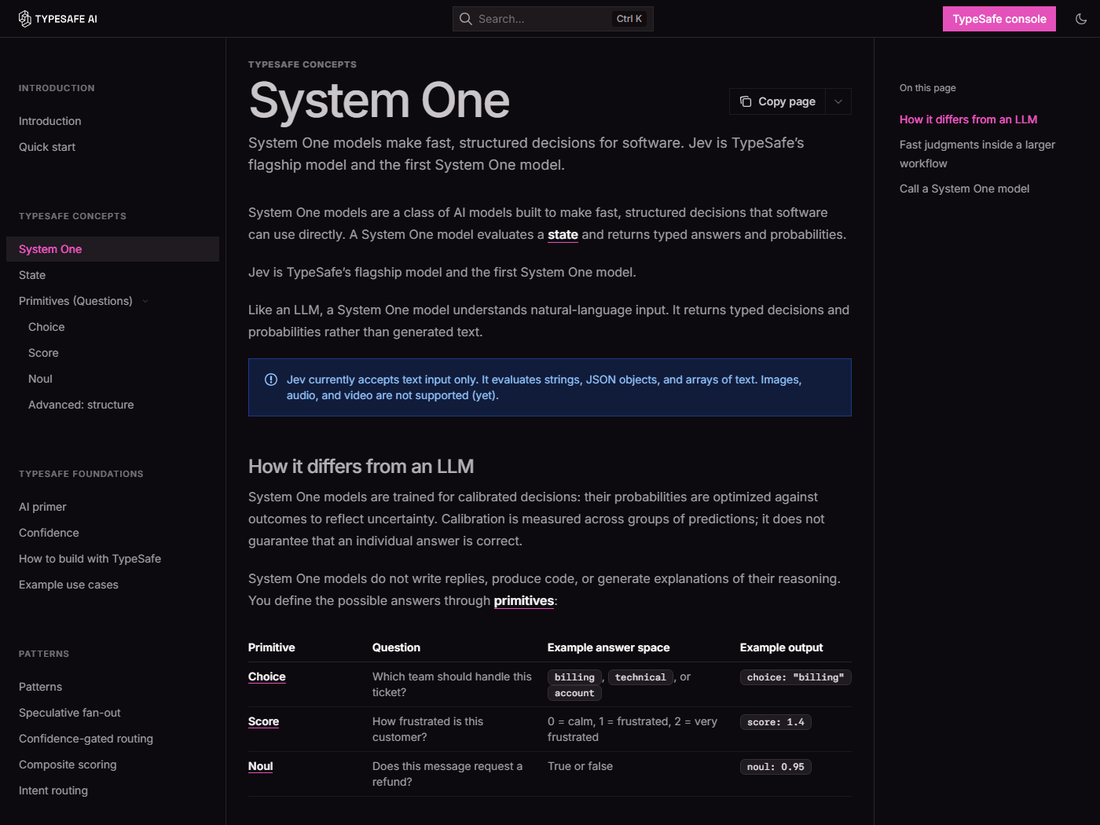
Noul is a real word they revived for yes/no — the response is a single probability, like noul: 0.95. Choice and Score also return a confidence value, and there is a subtle catch in the docs worth knowing before you build: the confidence you get is a statistic derived from the probability distribution, not a promise the answer is right. Calibration holds across groups of answers, not for any single one.
| Primitive | Question shape | What comes back |
|---|---|---|
| Choice | Which team should handle this? | choice: "billing" + probability per option |
| Score | How frustrated is this customer? | score: 1.4 + full distribution |
| Noul | Is this message urgent? | noul: 0.999 — one probability, no confidence field |
Two things follow from giving up text generation. The first is speed: there is no token-by-token loop, the answers come out together. The second is the guarantee I keep coming back to — because the possible outputs are defined in advance, the model cannot emit an invalid value. TypeSafe's number is a 0% structured-output error rate, versus 0.58% to 45.5% for various LLMs on their comparison, and a worst-of-class 17% tool-call error rate for GPT-5.6 Sol. Those are vendor-run tests, so treat them as direction, not gospel. But the structural claim is not really contestable: if the schema is the only door out, nothing else can walk through it.
The numbers on the homepage, and the numbers in the wild
The gap between the banner and the field is the most useful thing I read all week. After launch, OpenChamber pulled every number people posted about Jev on X in its first three days — 8,840 relevant posts — and split vendor claims from self-measured results. Here is the comparison.
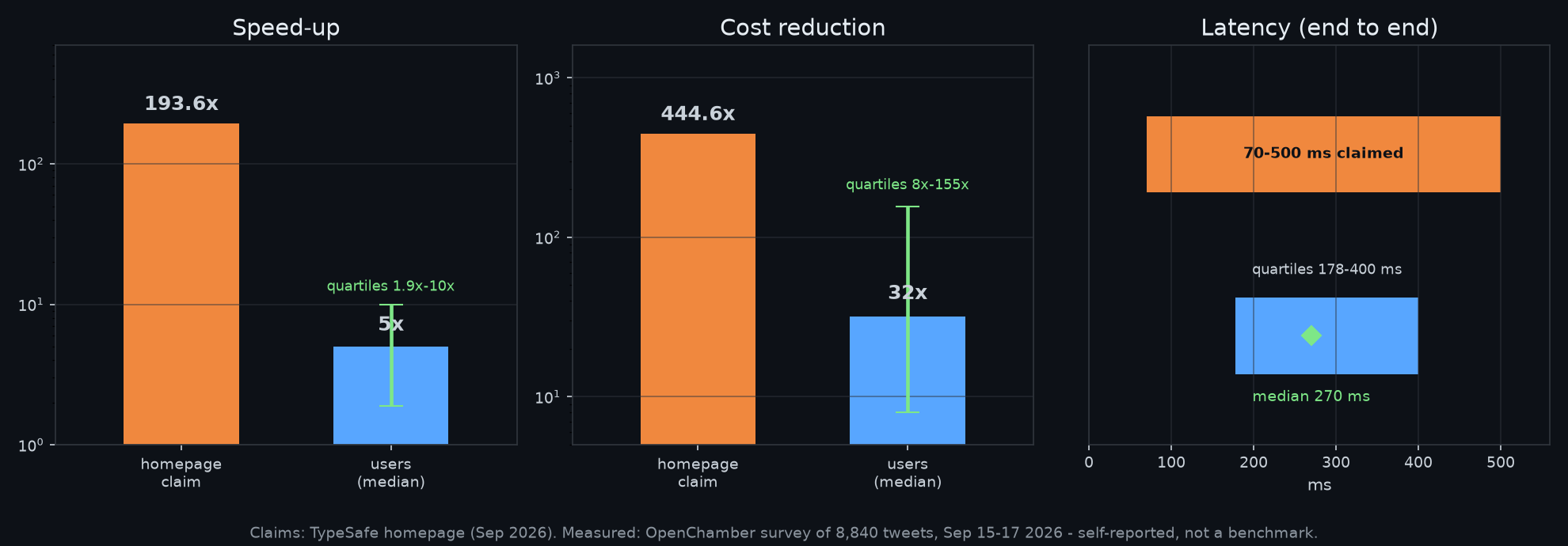
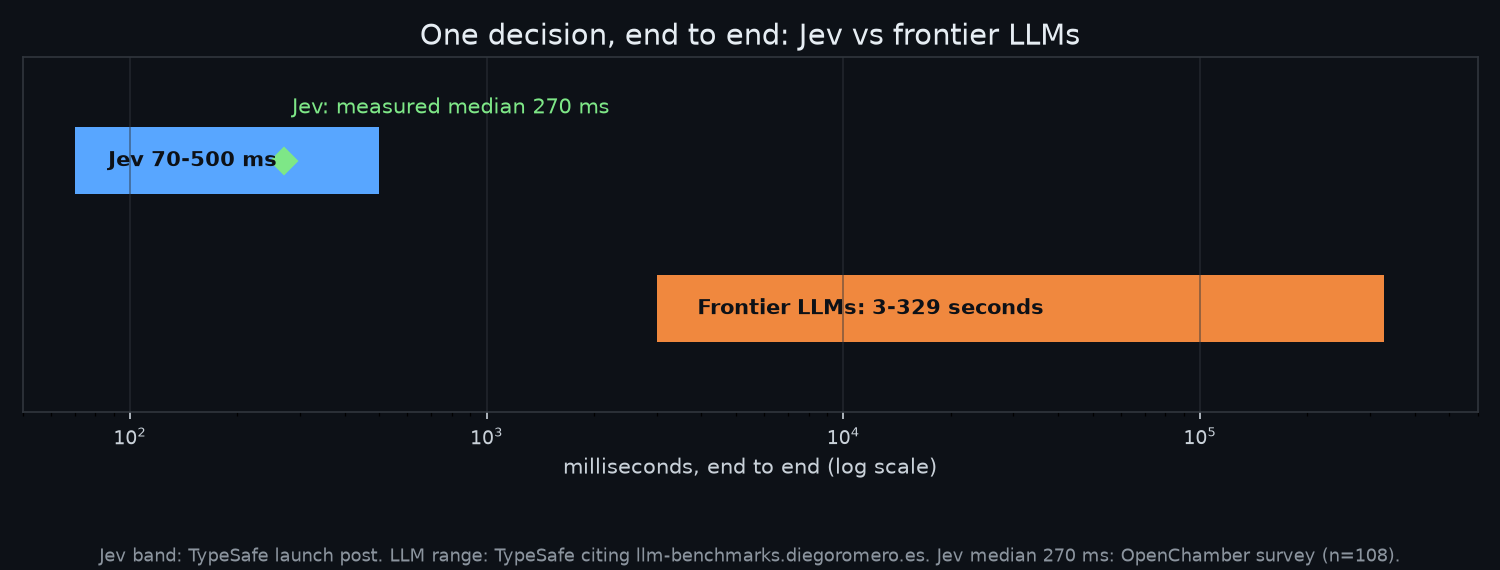
Median measured speed-up was 5x, not 193.6x. Median measured cost reduction was 32x, not 444.6x. Latency is the one number that checks out cleanly: users measured a median 270ms per call, inside TypeSafe's claimed 70-500ms band — though closer to the ceiling than the floor, and sub-100ms decisions are the exception, not the rule.
The gap is not dishonesty so much as baseline selection. Everyone compares against whatever is already in their pipeline, and the headline takes the most flattering pairing available: a heavy reasoning model on a task that needs one bit back. One commenter on the launch thread made the sharpest version of this point — if you just ask the LLM to answer "y" or "n", part of the advertised win disappears. Funnily enough, TypeSafe's own homepage carries the same gap: the worked example directly under the 444.6x headline shows numbers that work out to 75x faster and 171x cheaper. The footnote says "based on workflows for System One tasks," so the two need not match. It is still a useful preview of the distance between banner and field.

Reactions split the way you would expect. The Hacker News thread ran to 496 comments and 1,895 points. A skeptic's line: "all claims just sound like marketing terms... apples-to-oranges unless the LLM baseline is doing comparable work." Another, on benchmarks not being published with the launch: "I bet they would publish them if their score on those benchmarks were good." And an optimist, thinking about pipelines rather than parades: "it might be able to replace maybe 40-70% of LLM calls for a given pipeline... cutting the API costs on those calls by an order of magnitude." That last sentence is the actual product thesis, and it survives the multiplier deflation fine.
Where it wins: the decision layer
Strip the multipliers and you get a simple economic idea. Agent loops are full of tiny calls whose output is one bit — which model, which file, which tool, safe or not — and today you pay a frontier model to answer them in a paragraph you throw away. Jev prices the answer, not the paragraph.
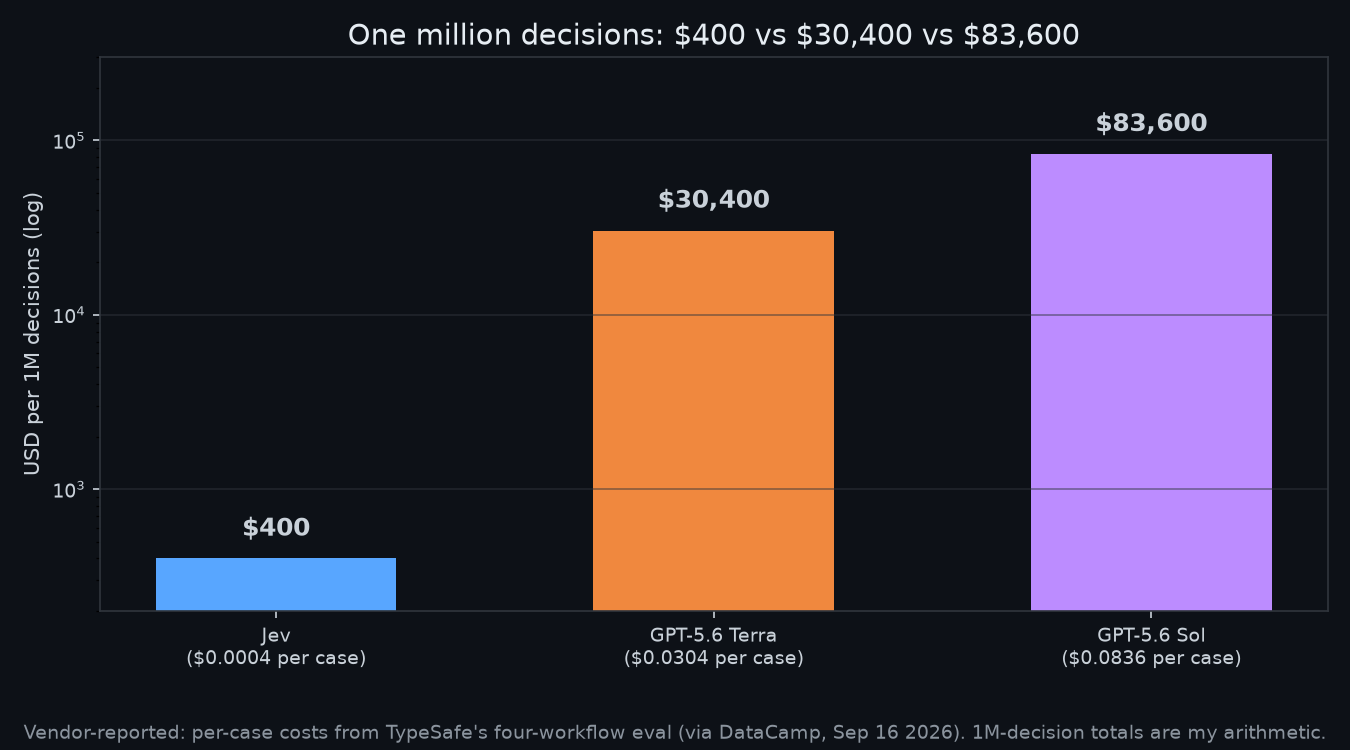
Concretely, per decision: roughly $0.0004 on Jev versus $0.0304 for GPT-5.6 Terra and $0.0836 for GPT-5.6 Sol in TypeSafe's workflow evaluations. Those are vendor numbers against consensus labels, not ground truth, so calibrate your expectations — but the order of magnitude matches what builders report independently, which is the part that matters.
The patterns people are shipping cluster tightly around that: routing (pick the model or path before spending a real call), guardrails (classify a tool call before it executes), evals (judge agent traces — Langfuse wrote up scoring their traces with Jev the day after launch), classification at volume, and an unexpected one: using it to compact agent context instead of waiting for a summarization pass. A Vercel engineer reported swapping a ChatGPT Luna classifier for Jev and getting results 5 to 18 times faster and more accurate; a CTO testing business-email classification found Gemini slightly more accurate but 10 to 20 times more expensive, and cared most that Jev "hands back a real probability".
LangChain shipped a provider integration with middleware that routes each request to a cheap or expensive model, and gates risky tool calls before they run — the same pattern coding CLIs like Claude Code and Cursor keep internally, now available to any agent. Distribution matters here: besides the TypeSafe API, Jev is on OpenRouter and Cloudflare's Workers AI, which quieted the loudest practical complaint in the launch thread — that teams could not adopt a new vendor without a proxy.
It is also worth noticing what this is a part of. The direction of travel is the same one behind DeepSeek V4.1 Flash shipping 70% cheaper and Gemini 3.8 Flash landing at $0.75 — intelligence is being unbundled into price tiers, and the interesting question stopped being "how smart is the model" and became "which slice of the work does this price belong to".
What people built in week one
Launch week produced an unusually honest artifact: a public list of builds with the cost each one actually racked up. The pattern is that whole runs cost less than a coffee's worth of tokens.
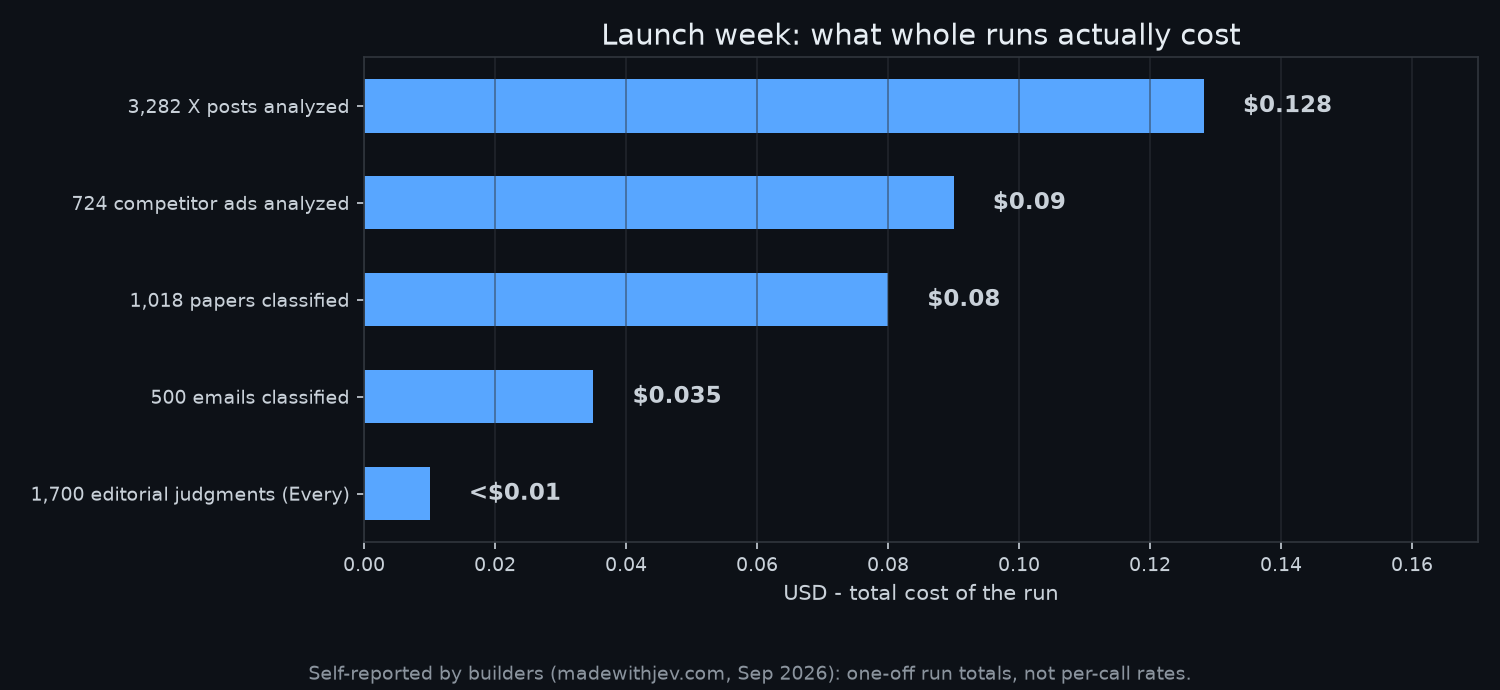
Some of my favorites. Browser Use ran a flight search through a browser agent in 7 seconds for $0.0039. Someone classified 1,018 AI research papers for $0.08 — the summarization step on DeepSeek V4 Flash cost $3.99, and the classification step on Jev cost $0.08, which led to the line I think will define a lot of 2027 architecture: "different models for different parts of the workflow, instead of using one model for everything." Every, the writer-owned publication, judged 1,709 pieces of its own writing for under a cent and called it a judge at "25x faster and 600x lower priced" than a Fable-class model. Someone else used it to compact a Claude session from nearly a million tokens to 86K in about a second.
And then there is the real-time stuff, which is where the latency story stops being a spec sheet. TypeSafe's own demo has Jev playing Doom at ten queries a second for about $7/hour of inference. At that cadence the comparison to a frontier model is not "slower" — it is "impossible".
The parts that don't make the headline
Start with what Jev cannot do. It cannot explain itself — you get a number, never a why, so debugging a wrong decision means inspecting your own question, not reading its reasoning. It cannot handle open-ended answers, plan a task, or look at an image; input is text only, up to 32k tokens of state plus your questions in a 64k budget. And the vendor's own jaggedness page is refreshingly blunt about its failure modes: it reads instructions literally, it cannot count or do arithmetic reliably, it treats dates as text, its accuracy falls as you stuff irrelevant detail into the state, and — this one deserves bold type in any architecture review — "state is data, and jev-1.13 does not treat it as hostile by default." Prompt injection inside the state can move the answer. They say they expect to improve on this; plan accordingly until they do.
Then the economics caveat: TypeSafe itself says it cannot prove the pricing is not subsidized. The long-term story ("prices should go down, not up") is a promise, not a contract. The waitlist is still gating access, rate limits are explicitly "adjusting dynamically" while GPU deals land, and the model is closed weights — though two open reimplementations on Qwen appeared within days, which tells you how reproducible the interface is even without the weights.
On the origin question, commentary has been mixed in a healthy way: Turing Post's framing is that TypeSafe assembled ideas that had sat in research for years — classification, calibration, selective prediction — gave them a clean systems use case and a new vocabulary, and launched at the exact moment developers got tired of paying generation prices for a yes/no. That is not a knock. Repackaging at the right layer is how primitives become standard.
One more check before you benchmark your savings: if you already swapped in a small, cheap model for those plumbing calls, Jev may not beat it on either axis — the cases where builders measured both lower cost and better accuracy were mostly against whatever small model they had settled for, not against a frontier system. Measure your own pipeline. The survey's bluntest line is the right advice: "It does not fit if you are not going to measure."
So is Jev worth building on today?
If your pipeline makes the same small closed-question decision thousands of times a day — route this, classify that, gate this action, score this trace — this is the first model priced for the job, and the confidence numbers give you a principled way to automate the easy majority and escalate the ambiguous rest. That is a genuinely new primitive, and it is why 23% of the launch-week tweets were from people who had run it themselves while access was still gated.
If your work is writing, planning, or anything that starts with "explain…", this is the wrong tool, and the docs say so themselves: use a generative model. The failure story for Jev adopters will not be that it is bad at decisions; it will be picking decisions that were never closed questions in the first place.
My take
The multiplier war between the homepage and the field data is a distraction, and TypeSafe's founder knows it — his line in TechCrunch was that "the main product of Frontier Labs is fear or hype. I would like our main product to be intelligence." The real thing to notice is that a decision layer quietly became a product category: typed questions in, calibrated probabilities out, at a price that makes per-row and per-tick decisions sane. The measured version of the savings — 5x faster, 32x cheaper, 270ms — is much smaller than the ads and still bigger than anything else in the category ships with by default.
I am keeping an eye on three things: whether an independent benchmark appears against ground truth instead of consensus labels, whether the pricing survives its own subsidy question, and whether the injection hole closes before this wave of agent tooling ships to production. I will post again when any of those lands.
Sources: TypeSafe AI — Introducing System One Models and Jev · typesafe.ai homepage · TypeSafe docs — Models · docs — Jev 1.13 jaggedness · TypeSafe workflow evals · OpenChamber — what 8,840 tweets measured · madewithjev.com · Hacker News launch thread · TechCrunch · DataCamp · Turing Post · BusinessWire (funding) · Langfuse · LangChain · Cloudflare Workers AI.
Community quotes are attributed by platform (Hacker News launch thread, X posts collected on madewithjev.com). Claims and measured figures are labeled at each chart; vendor numbers are marked vendor-reported. Independently verified: pricing ($0.042/M input, free output) against the docs and OpenRouter listing on September 18-19, 2026.
Comments
Post a Comment