Micron's 512GB DDR5 Stick: 12TB per Server, 60% Less Power
Micron's 512GB DDR5 Stick: 12TB per Server, 60% Less Power
Micron put 512 gigabytes of DRAM on a single memory stick yesterday, and it's the biggest server module anyone has demonstrated. Fill a 24-slot, dual-socket server with them and you get 12 terabytes of main memory. Then I got to the last line of the announcement — volume production in the second half of 2027 — and remembered what DRAM prices have been doing all year.
So what is this thing, exactly? A DDR5 RDIMM, the registered server kind, rated at up to 9,200 MT/s, built by stacking DRAM dies vertically and wiring them together with through-silicon vias. Micron says it demonstrated it on multiple server platforms, and that AMD and Intel are both validating it. There is no price, no SKU, and no date closer than "the second half of 2027". A real technical milestone, a not-yet-real product, and the worst possible moment in the memory market — that combination is the whole story.
What Micron actually announced
| What | Detail |
|---|---|
| Capacity | 512GB on one DDR5 RDIMM |
| Speed | up to 9,200 MT/s |
| Per server | up to 12TB in a single 24-slot dual-socket box |
| How | DRAM dies stacked vertically, connected by through-silicon vias (TSVs) |
| Power | 16.0W for one 512GB module vs 44.2W for four 128GB modules — "more than 60% less" |
| Performance | up to 1.4x vs 256GB DDR5 configs on Spark SVM analytics (Micron's own number) |
| Validation | AMD and Intel both actively validating, on next-generation server platforms |
| Availability | volume production, second half of 2027 |
Everything here is vendor-reported. There was no press event, no pricing, and no benchmark I can rerun — just a demonstration claim plus a footnote. (source: Micron press release, September 15, 2026)
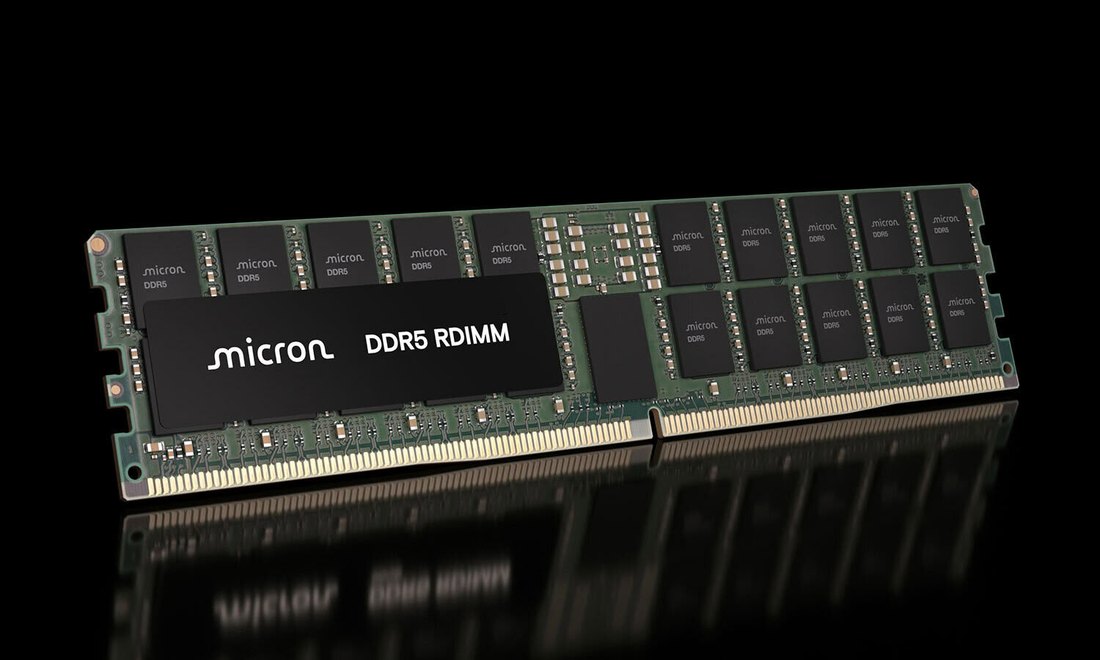
A Micron DDR5 RDIMM. The 512GB version is the same 288-pin idea, with far more silicon stacked inside each package. (image: Micron, via TechPowerUp)
The capacity doesn't come from a smaller process node as much as from packaging. Instead of one die per package, Micron stacks several dies and connects them with TSVs — the same approach it used on the 256GB RDIMM it sampled back in May. The interesting part isn't the stack itself; it's that the stack is claimed to hold speed, up to 9,200 MT/s, on real server platforms.
Fewer, bigger modules matter for boring reasons that add up. High speeds usually want one DIMM per channel, and slots are finite — twelve per socket on today's mainstream platforms — so capacity per socket is decided entirely by how much memory fits in a single module. Micron's own footnote is the pitch: 16.0W for a single 512GB module against 44.2W for the four 128GB modules it replaces. That's 63.8% less power for the same capacity, plus three fewer failure points and a slot-count problem that stops growing.
The number that matters is 24
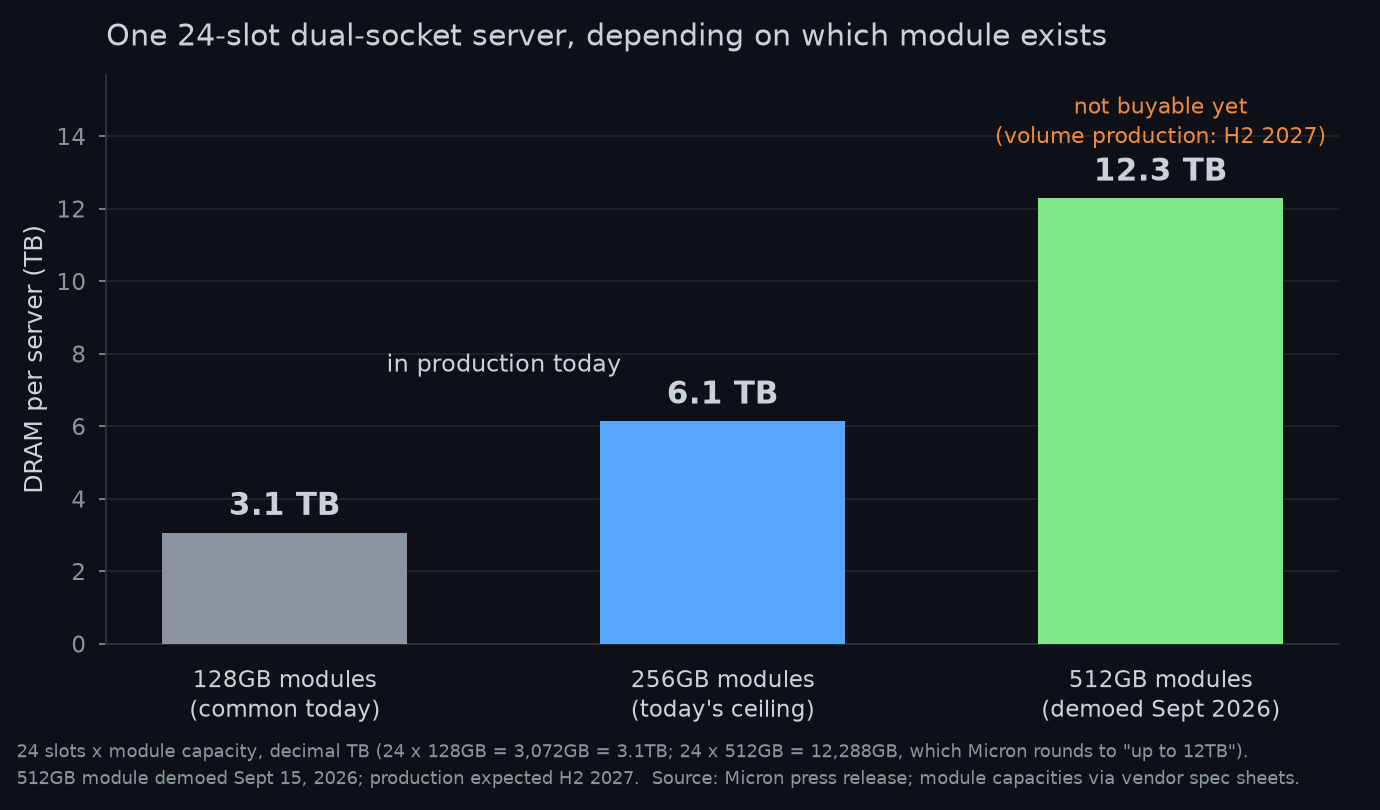
Same chassis, same 24 slots, three generations of modules. The 12.3TB bar is the one that isn't for sale yet. (chart: OpenSource Factory; source: Micron press release, module capacities from vendor spec sheets)
Same chassis, same 24 slots, wildly different totals: 3.1TB with the 128GB modules that are common today, 6.1TB if you max out the 256GB parts that just became available, and 12.3TB if the 512GB module ships as demoed. For anyone running an in-memory database or a fleet of agents with resident context, that's the difference between a working set that fits and one that pages to NVMe mid-query.
For scale: twelve terabytes is 24 maxed-out Mac Studio M5 Ultras, or roughly 4.7 times the 2.6TB of combined memory in the Halo Station prototype from this month's post. Micron's framing is the sane one — "keep larger datasets closer to the compute engines that need them," as its cloud-memory chief Raj Narasimhan put it.
Wait — didn't Samsung show a 512GB DDR5 module in 2021?
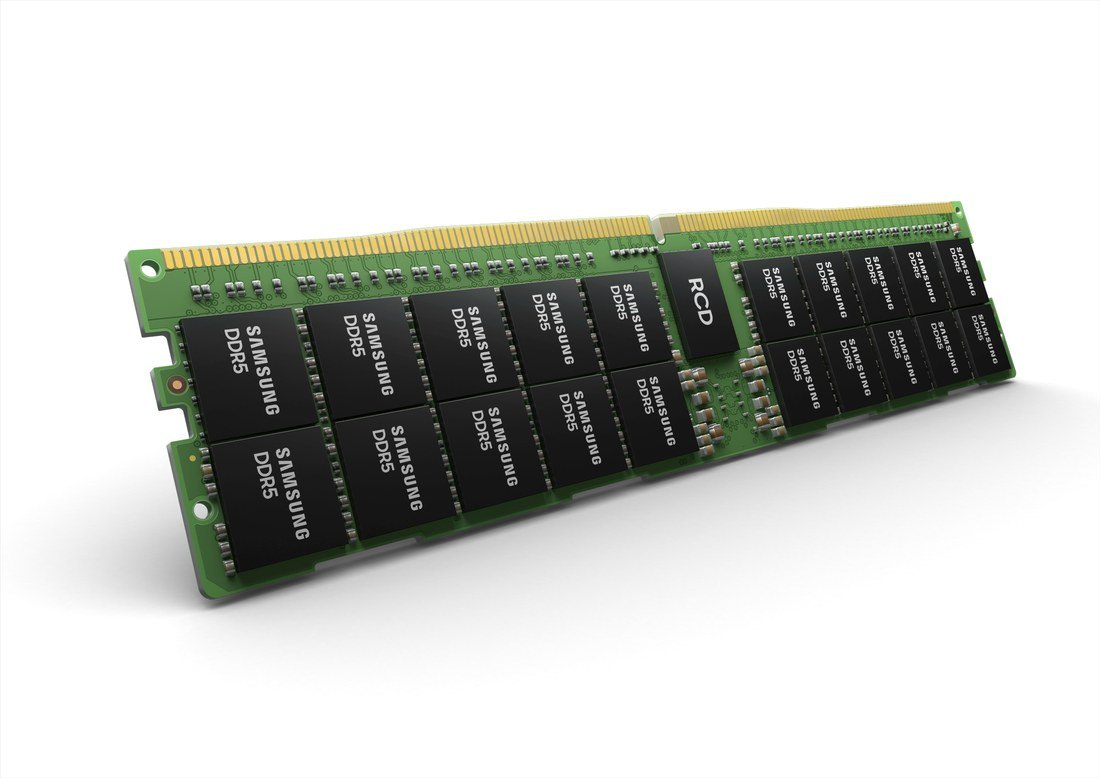
Samsung's 512GB DDR5 module imagery from March 2021: eight layers of 16Gb dies on TSV. It was a technology demo, and it stayed one. (image: Samsung)
Yes, and this is where "world's first" needs a careful reading. Samsung announced the industry's first 512GB DDR5 module in March 2021 — an HKMG part stacking eight layers of 16Gb dies on TSV, at up to 7,200 Mbps and roughly 13% less power. It stayed a demo. Through the years that followed, the biggest server module you could actually buy was 64GB, then 128GB, and only in December 2025 did SK hynix get a 256GB RDIMM through Intel's Xeon 6 certification — an industry first at that capacity. Micron sampled its own 256GB part in May 2026.
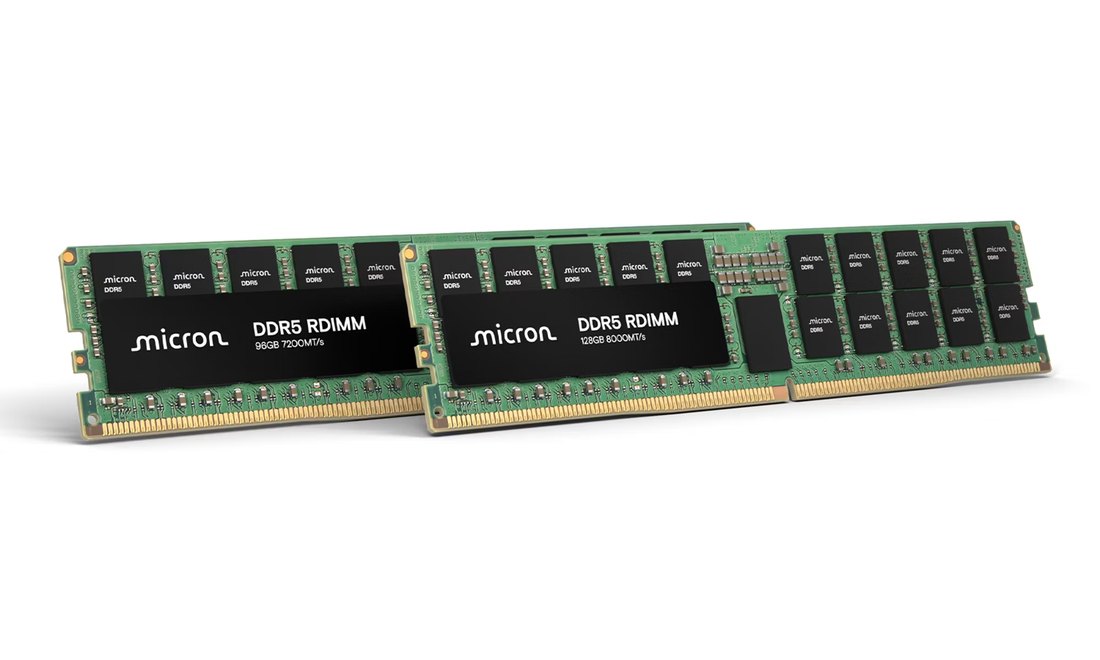
Micron's DDR5 RDIMM line today. The 512GB module is the same form factor, stacked much taller inside. (image: Micron)
So Micron's claim, precisely stated, is the first 512GB DDR5 module demonstrated on multiple server platforms. Not the first 512GB module ever announced. The five years between those two statements is the actual engineering story: capacity by stacking is one problem, and making that capacity behave at server speed, on real memory channels, with two CPU vendors signing off, is a different one. That's why it's news, and it's also why the shipping date is 2027.
Why the industry wants this: agentic AI runs on RDIMM servers
There's a line from TrendForce's July memory pricing survey that explains this whole product category better than any vendor slide:
"For server DRAM, general-purpose servers based on x86 CPUs and RDIMM memory configurations remain the primary memory platform for Agentic AI workloads, thanks to their strong multitasking capabilities."
— TrendForce, July 3, 2026
Read that twice, because it's the part the GPU headlines hide. Inference on accelerators gets the HBM boxes. The agent fleets — the thing that actually runs all day, juggling sessions, tool calls, and context — live on high-core-count x86 servers full of RDIMMs. Every agent session holds state; every database keeps an index and a cache; every Spark job wants its working set resident. Capacity is what lets one box serve many of them at once, and slots are the hard limit you can't buy your way out of after the fact.
One honest caveat on speed, because it's the number that gets over-read: this is CPU memory, and it's nowhere near HBM. Micron's 512GB stick at 9,200 MT/s works out to 73.6GB/s per channel, so a fully populated 24-channel server lands around 1.77TB/s of aggregate DRAM bandwidth if every channel actually runs at 9,200 — real, and actually above the 1.2TB/s of unified memory in a maxed-out Mac Studio, but a different sport entirely from the 8–16TB/s class HBM boxes play in.
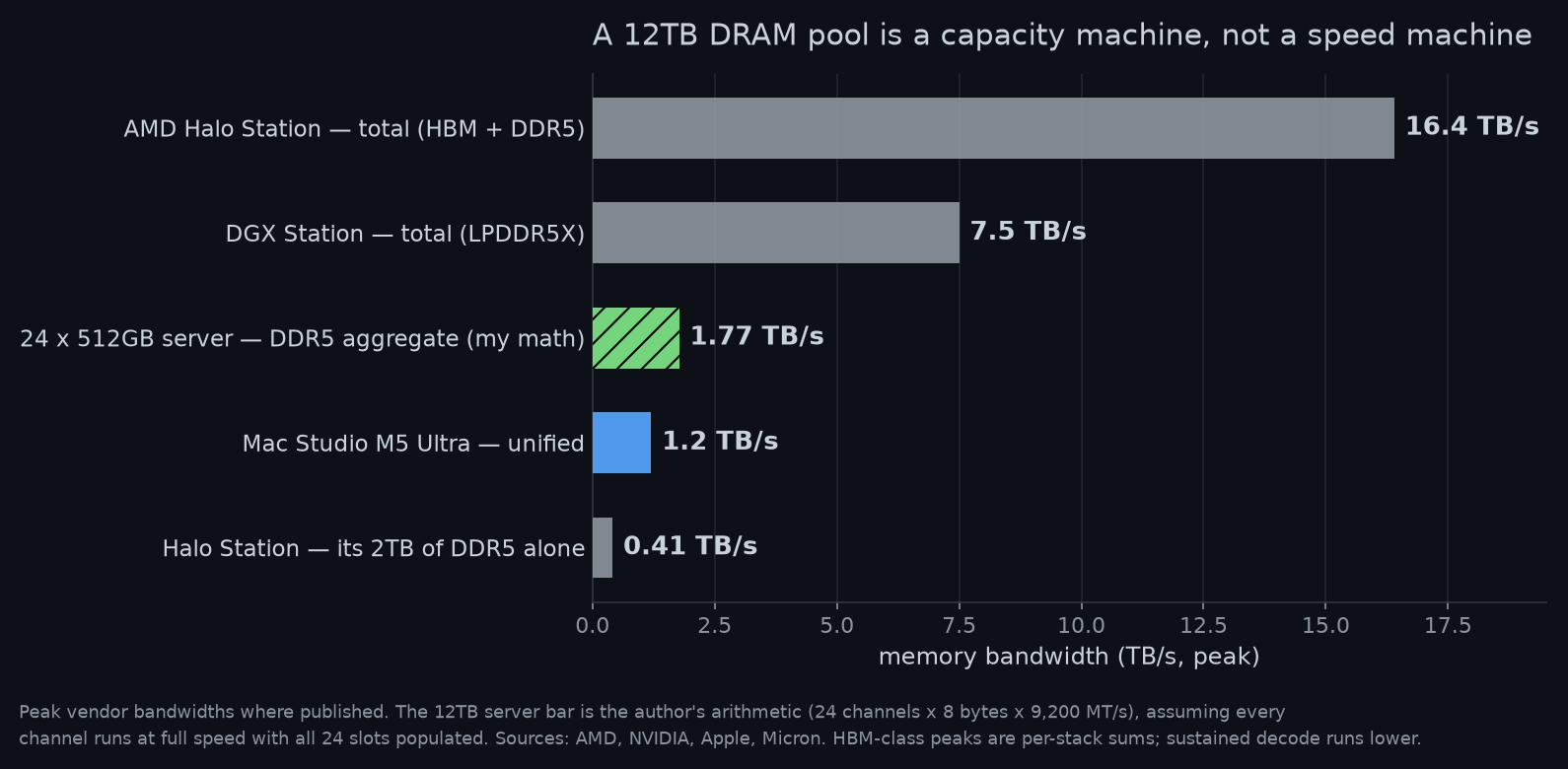
Capacity machine, not a speed machine: the 12TB server's DRAM bandwidth (my arithmetic) against the local-AI boxes I keep comparing on this blog. (chart: OpenSource Factory; vendor peaks where published)
Which is the same point Igor's Lab made when the module was announced: the decisive number isn't 9,200 on a spec sheet, it's what actually holds up with all 24 slots populated — and that isn't measured yet, because the platforms it targets don't ship either.
The awkward part: this landed in the most expensive DRAM market ever recorded
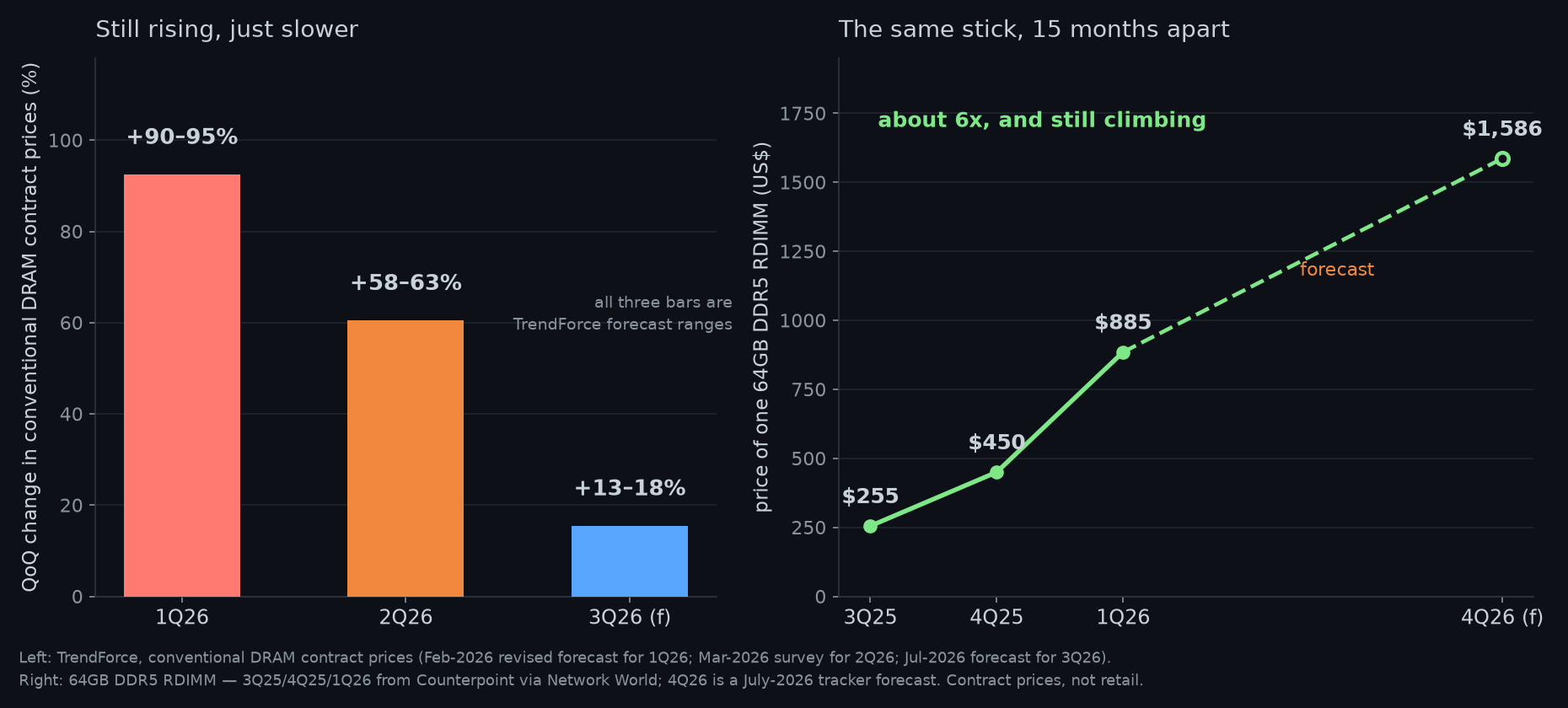
Left: quarterly contract price moves, all three straight from TrendForce. Right: one 64GB RDIMM's journey, $255 to a forecast $1,586. (chart: OpenSource Factory)
Here's where the milestone meets reality. Conventional DRAM contract prices rose 90–95% in the first quarter of 2026, another 58–63% in the second, and TrendForce expects 13–18% more on top this quarter — still rising, just rising slower, because buyers are hitting the limits of what they'll absorb. A 64GB DDR5 RDIMM that cost about $255 in the third quarter of 2025 was crossing $900 by early 2026, with forecasters putting it near $1,586 by the end of this year. That's under $4 per gigabyte turning into roughly $25 per gigabyte in fifteen months.
The cause is not a fab fire. It's HBM eating the wafers: memory suppliers keep reallocating capacity toward AI accelerators, and the three big makers spent 2026 selling conventional DRAM on allocation, with spot buyers paying steep premiums when they can find parts at all.
Now do the napkin math on the server from the top of this post. Twelve terabytes is 192 modules' worth of 64GB. At the contract prices that were already scandalous in early 2026, that's about $168,000 of DRAM; at the forecast prices for the end of 2026, closer to $305,000 — for the memory alone, before a single CPU. That's my arithmetic on published price data, not a quote: Micron has said nothing about what a 512GB module will cost, and large stacked modules won't price at simple per-gigabyte multiples of retail parts.
There's a less cynical read of the timing, and I think it's the right one. In a shortage, density is a form of rationing: one module does the work of four, which means fewer parts, less board space, and less power for the same terabytes — exactly what constrained buyers need. It's also a reminder that announcements like this are about 2027–2028 supply. Nothing about a module that ships in the second half of 2027 makes the stick you were going to buy this month any cheaper.
So can you put one in your PC?
No, and you shouldn't wait for it. This is a registered DIMM — it needs a server platform to talk to, and it won't fit or boot in a consumer desktop, which is true of every RDIMM ever made. Consumer DDR5 modules don't come near this capacity, and nothing in this announcement changes that. It also won't change what you pay for a 32GB desktop kit this winter; the price chart above settled that argument months ago.
My take
The demo is real, and so are its limits. The capacity claim is verifiable and impressive — 512GB in one module, 12TB in a box that doesn't grow. The power number comes straight from Micron's own footnote, which is the kind of specificity I like to see. What I'd hold loosely is everything measured by the vendor: the 1.4x analytics figure, and especially the 9,200 MT/s, which is a peak on platforms that don't ship yet and probably not what you'd see with every slot busy.
The dates are the part that keeps this from being a purchasing decision for anyone. The second half of 2027 is the earliest, and "aligned to customer needs" is the sentence memory makers use when they want room to move a schedule. If you're speccing servers this year, 256GB modules are the top of the real ladder; the 512GB part changes 2027 planning, not this year's.
What I'll keep watching is the collision at the center of this post: density is improving at exactly the moment supply is the binding constraint. If DRAM stays this expensive into 2027, the 512GB module's real legacy might not be the 12TB server — it might be letting the same terabyte count fit into fewer parts, at lower power, which is what the industry needs most right now. When the module reaches volume production, or Samsung and SK hynix answer with parts of their own, or the next quarterly price data lands, I'll rerun these numbers and update this post.
Sources & data: Micron press release — "Micron Advances Memory Innovation With the World's First Ultra-Dense Module for Next-Generation Servers" (September 15, 2026; includes the 16.0W vs 44.2W footnote) · TechPowerUp — republication of the release · Wccftech — coverage and Micron module imagery · Igor's Lab — production-status and fully-populated-channel caveats · Wccftech on Micron's May 2026 256GB RDIMM sampling · Samsung Newsroom — "Samsung Develops Industry's First HKMG-Based DDR5 Memory" (March 2021) · Chosun — SK hynix's 256GB RDIMM Intel Xeon 6 certification (December 18, 2025) · TrendForce memory pricing releases: 1Q26 revision (February 2, 2026), 2Q26 survey (March 31, 2026), 3Q26 forecast (July 3, 2026) · Counterpoint via Network World for the 64GB RDIMM price path; July 2026 industry tracker for the 4Q26 forecast. Related on this blog: M5 Ultra Mac Studio, AMD Halo Station, 2026 local AI machines ranked by value. The 24-slot totals, the bandwidth arithmetic, and the 12TB cost estimate are mine; all vendor performance, power, and pricing figures are vendor-reported or analyst-reported and labeled as such.
OpenSource Factory — AI hardware, model releases, and the pricing games in between. Micron, DDR5, RDIMM and related marks belong to their owners; product images via Micron and Samsung, used for identification. Not affiliated with Micron, Samsung, or SK hynix.
Comments
Post a Comment