Muse Voice Transcribe: Meta's First Superintelligence Product Is a Dictation Tool
Muse Voice Transcribe: Meta's First Superintelligence Product Is a Dictation Tool
September 1, 2026 · by OpenSource Factory · facts verified against Meta's official announcement and Artificial Analysis rankings on the day of writing
Meta Superintelligence Labs — the division Zuckerberg set up to chase AGI — just shipped its first product. It's not a reasoning engine. It's not a world model. It's a transcription tool. That sounds anticlimactic until you watch what it actually does: eight people talking over each other in a room, and it knows exactly who said what, live, in real time, in whatever language each of them is mixing in.
Muse Voice Transcribe is the first "real-time audio perception model" from Meta's superintelligence lab, and it's available today — through the Meta Model API, inside Meta AI for Mac (system-wide dictation), and in Muse Code. It does three things at once: streaming speech-to-text, speaker diarization for 20+ speakers, and endpointing (knowing when someone actually finished talking vs. just paused). And on the Artificial Analysis streaming speech-to-text leaderboard, it ranks first.
The benchmark lead, and how big it really is
Here's the headline number: 3.1% word error rate on Artificial Analysis's AA-WER streaming benchmark (English), ahead of Cartesia's Ink-2 (3.4%), ElevenLabs Scribe v2 Realtime (3.6%), GPT Live Transcribe (3.9%), and Gemini 3.5 Transcribe Live (4.0%). That's a real lead — and a small one. A 0.3-point edge over second place is a win today and a coin flip tomorrow in a market where OpenAI, Google, xAI, and Alibaba all shipped streaming models within weeks of each other this summer.
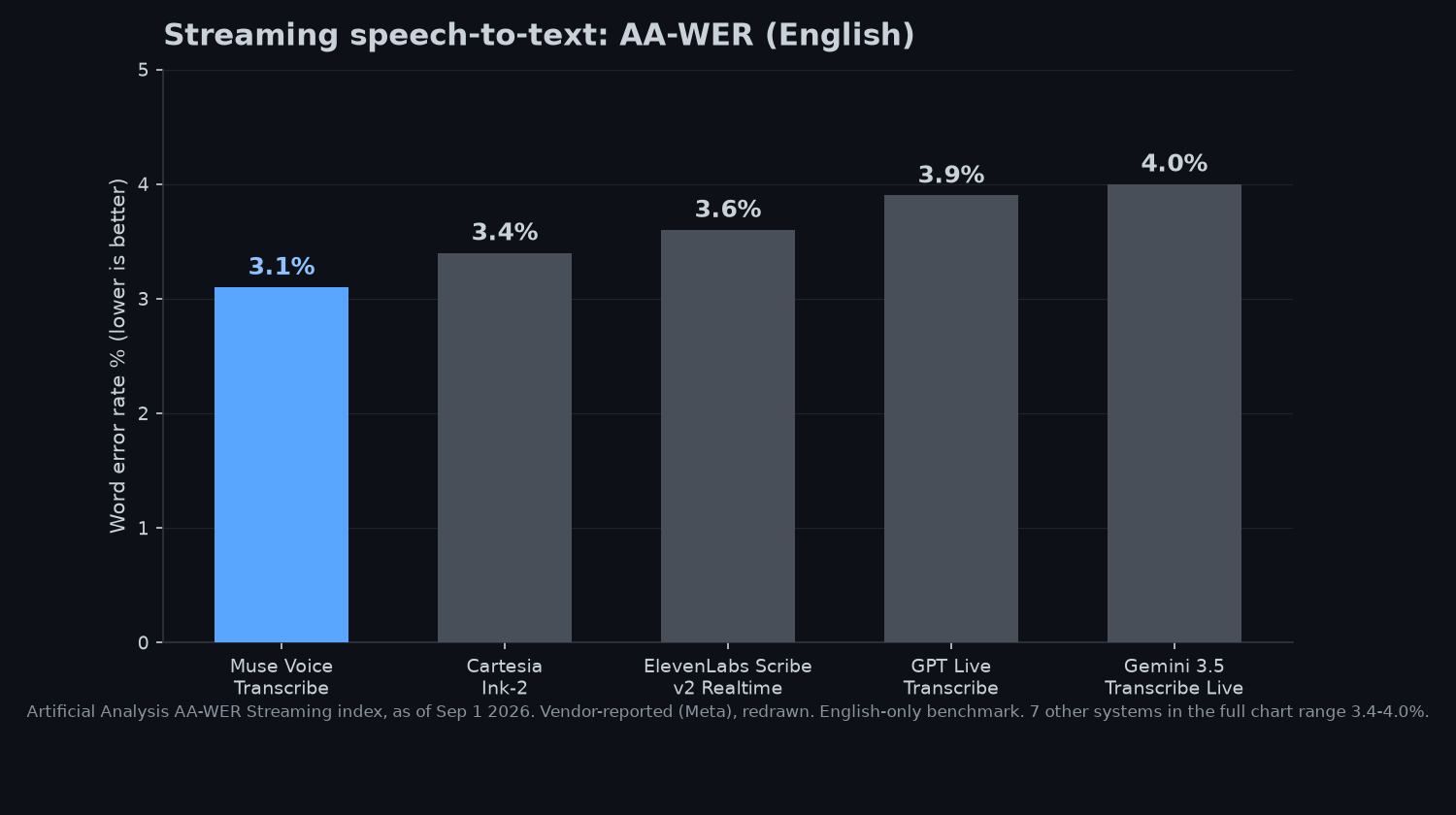
AA-WER Streaming (English), Sep 1 2026. Lower is better. Vendor-reported (Meta), redrawn. The gap to second place is 0.3 points — a lead, not a moat.
The bigger gap is in diarization — separating speakers. Muse sits at 17.5% diarization error rate across AMI-IHM, AMI-SDM, and VoxConverse, with the next-best systems at 21.1% and up. That's where the "eight people in a room" demo comes from, and it's the part that's genuinely hard.
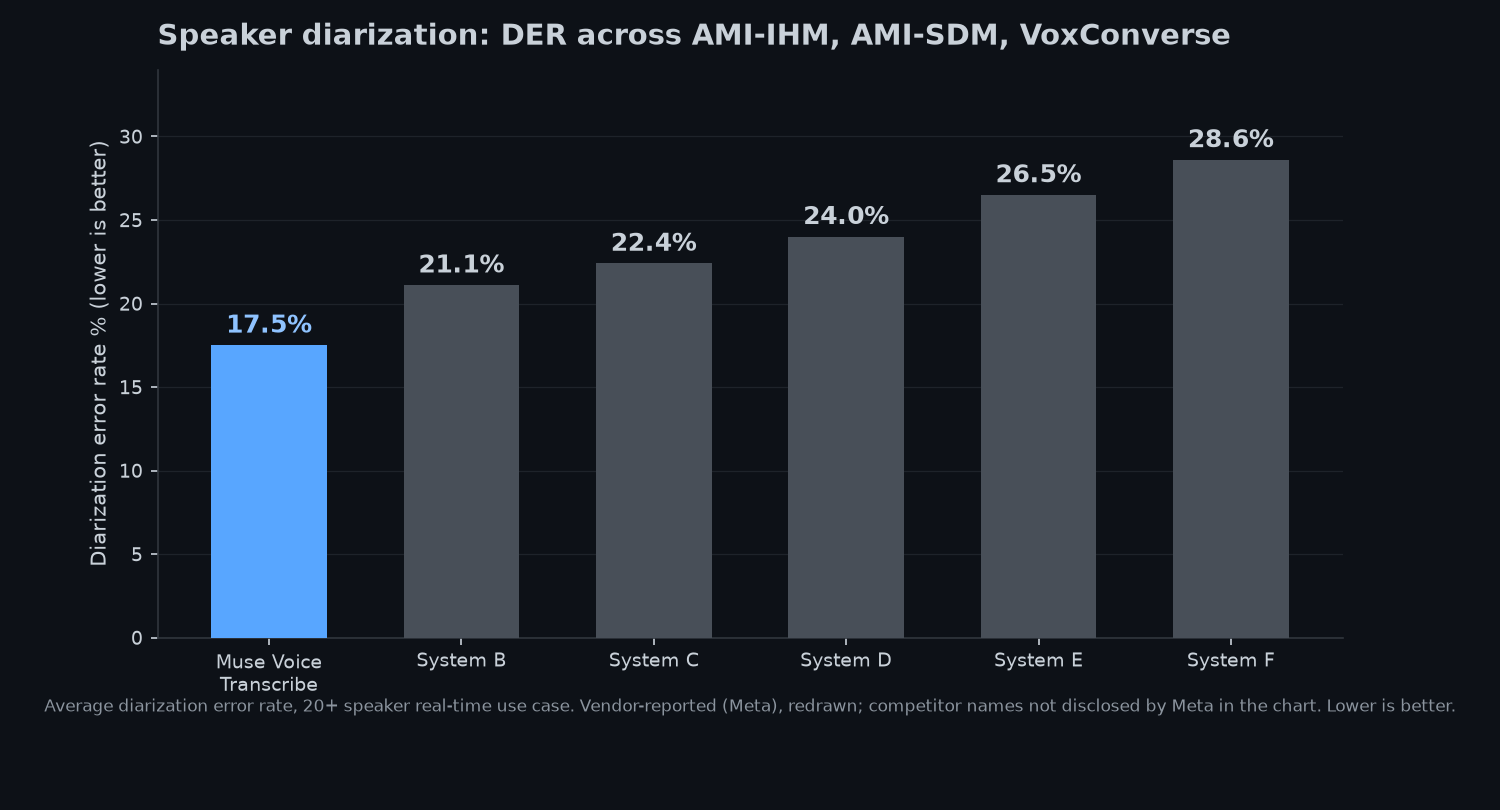
Average diarization error rate across AMI-IHM, AMI-SDM, VoxConverse. Lower is better. Vendor-reported (Meta), redrawn; competitor names not disclosed.
How it decides when to listen — the part I actually find clever
Most streaming ASR burns through audio on a fixed timer. Muse doesn't. It's an autoregressive model from the Muse Spark family that ingests audio in 80ms chunks, and at every chunk it makes a choice: transcribe what it has, or listen to the next chunk. Easy words get transcribed almost instantly; hard words get more audio context before the model commits. Meta calls this "adaptive delay," and it's trained with reinforcement learning where a word-error reward and a delay reward are multiplied together.
The payoff is a speed-accuracy curve that sits below the old Pareto frontier — roughly 3.0% error at 0.16 seconds to final transcription, where Soniox, Cartesia, and ElevenLabs previously defined the tradeoff. That's the kind of thing that doesn't show up in a static benchmark but changes how a voice assistant feels.
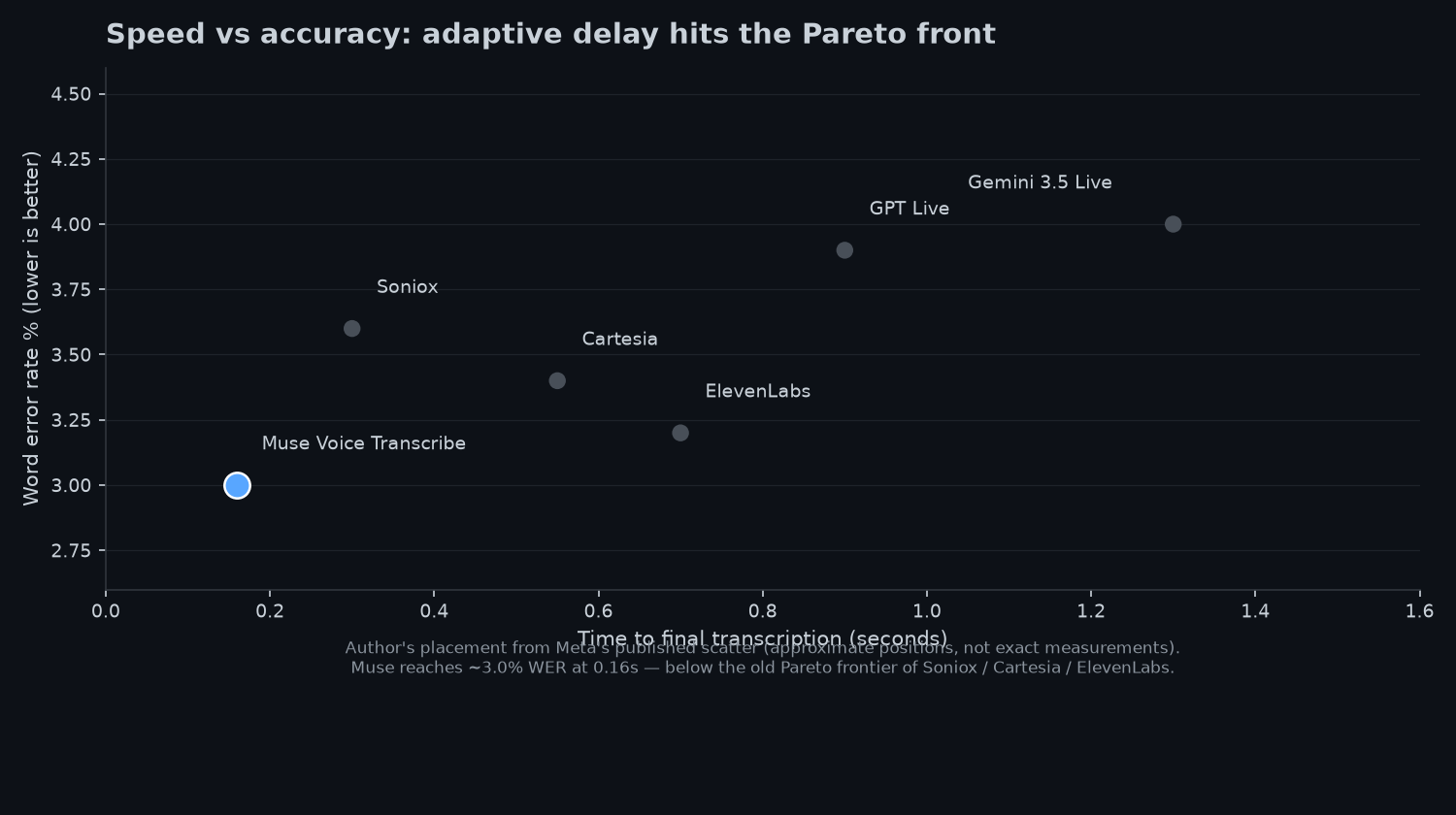
Speed vs accuracy: adaptive delay lands below the old Pareto frontier. Author's placement from Meta's published scatter (approximate positions, not exact measurements).
What it's actually like to use
Meta AI for Mac now does system-wide dictation: hold the Fn key, talk into any app, and it types. That's the mundane superpower — your whole Mac becomes voice-input. In Muse Code, the same model handles voice interaction while an agent is mid-task. And the API costs $3 per 1,000 audio-minutes — $0.18 an hour — which is aggressive for a leaderboard-topping model.
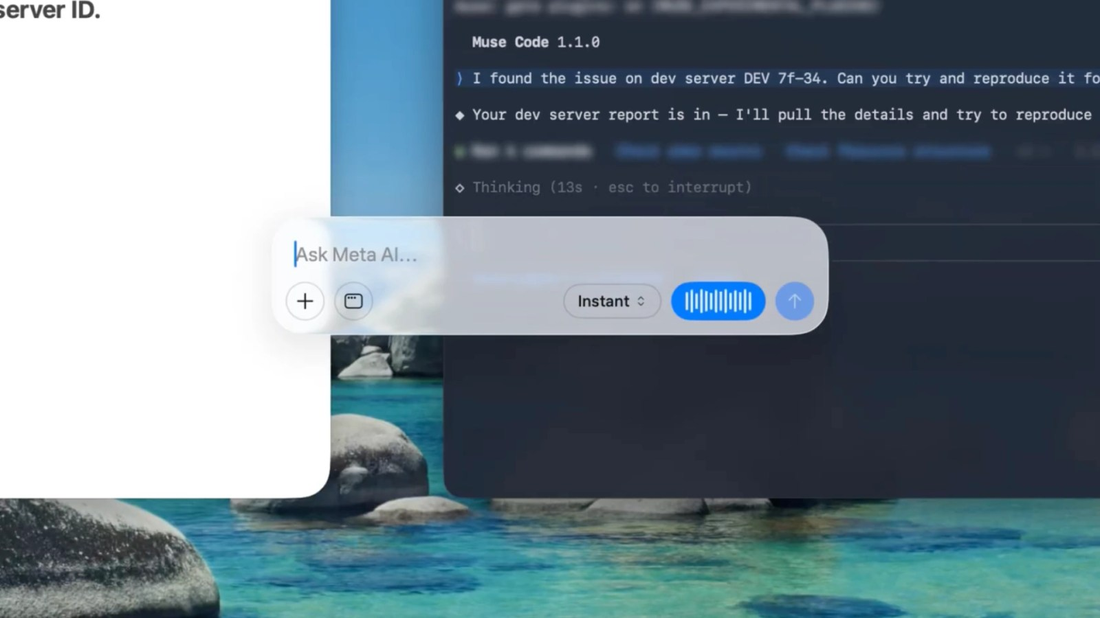
Meta AI on Mac with voice input active — the same Muse Voice Transcribe model powering dictation across apps. (screenshot: 9to5Mac)
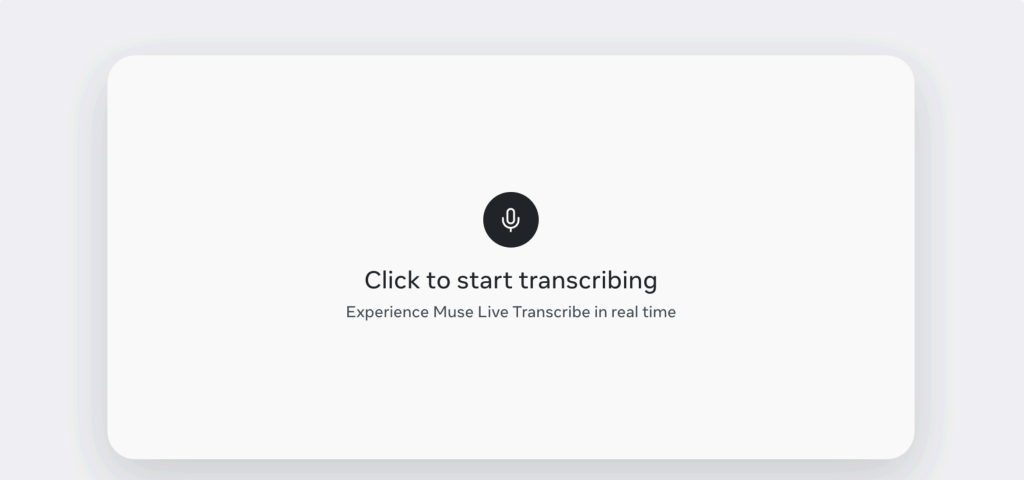
The live transcribe demo — click, talk, and it's already on screen. (image: The New Stack)
The catch: these weights stay closed
Here's where I got disappointed. Meta open-sourced Muse Glimmer (the 30B agent model) and put Muse Spark 1.2 into OpenCode Go's free tier. Muse Voice Transcribe is neither. It's API-only, no open weights announced, and the demo page runs on Meta's servers. For a model this good at a task this foundational — real-time speech understanding is basically the "ears" for the AI glasses Zuckerberg keeps talking about — closing the weights is a statement. The open-weights speech stack (Whisper-family, FunASR) still has no real-time diarization answer at this quality, and the gap will widen while this stays proprietary.
The other caveat: the benchmark is English-only. AA-WER Streaming measures English; the multilingual claims (70+ trained, 25 validated) are impressive but unverified by third parties at launch. And "first on Artificial Analysis as of September 1" is a snapshot — this market moves weekly.
My take
There's something quietly funny about a superintelligence lab's debut being a dictation tool. But it's the right first product. Every serious Meta AI ambition — glasses, personal agents, the whole "AI for everyone" pitch — starts with ears that work in a noisy room, across languages, without a pause button. Shipping that first, at $0.18 an hour, is the boring foundation move that everything else builds on.
I'm going to keep an eye on two things: whether the weights ever drop (the Glimmer precedent makes it not impossible), and whether anyone matches the 17.5% diarization number with an open model. Either one is a follow-up post. The transcription race just got a lot more interesting.
Sources: Meta research blog · 9to5Mac · The New Stack · benchmark rankings as of September 1, 2026, vendor-reported. Pricing verified against the Meta announcement.
Comments
Post a Comment