OpenAI DevDay 2026: 20+ Launches, One Bet on Agents
OpenAI DevDay 2026: 20+ Launches, One Bet on Agents
I went through OpenAI’s DevDay 2026 recap expecting a list of model upgrades. The bigger bet is clear: agents that keep working between prompts, with developer tools and shared spaces inside ChatGPT. OpenAI says the September 29 event brought more than 20 launches across Dots, GPT-6.1 Sol, Codex, plugins, and workspaces.
Not every item is open to everyone. Some are live; others depend on plan or market, or remain in preview or on the way. Here’s what matters, and who can use it.

A self-rendered concept image for the shared-workspace theme; not an OpenAI product screenshot.
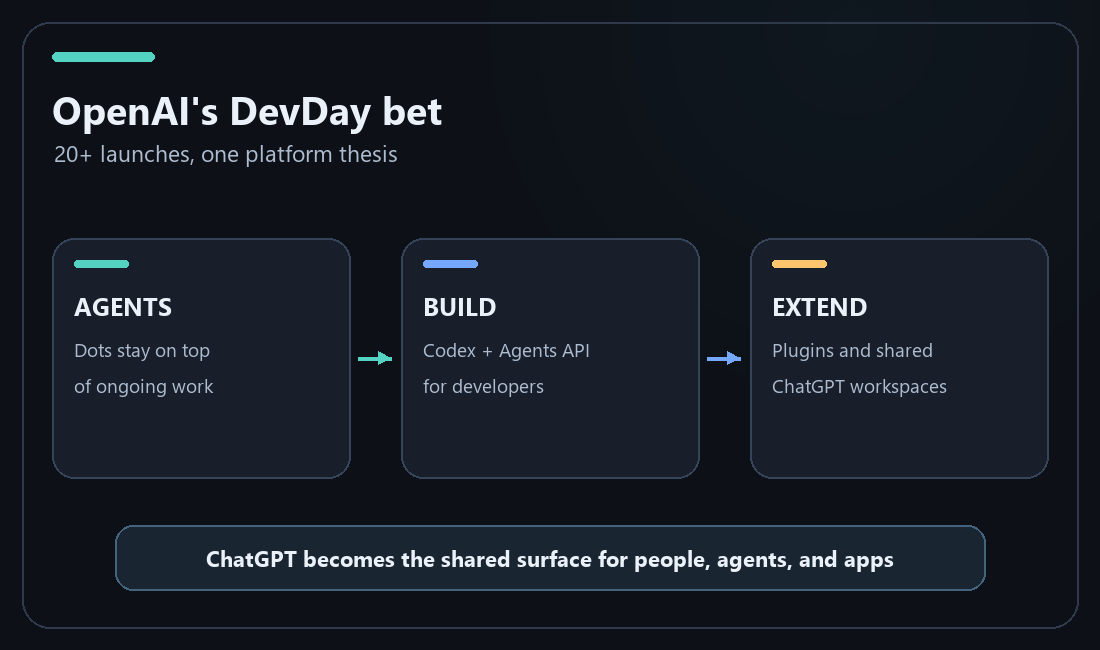
A grouping of the announcements by function, based on OpenAI’s official recap.
What was OpenAI’s real bet at DevDay?
Dots is the clearest sign of that direction: always-on agents powered by GPT-6 Astra, with their own cloud computer, reachable from ChatGPT, Slack, or Teams. OpenAI says its plugin ecosystem connects them to more than 4,000 apps.
OpenAI’s examples are proactive: tracking customer feedback, revising launch materials when plans change, or updating research when new data arrives. Those are company examples, not independent reliability tests.
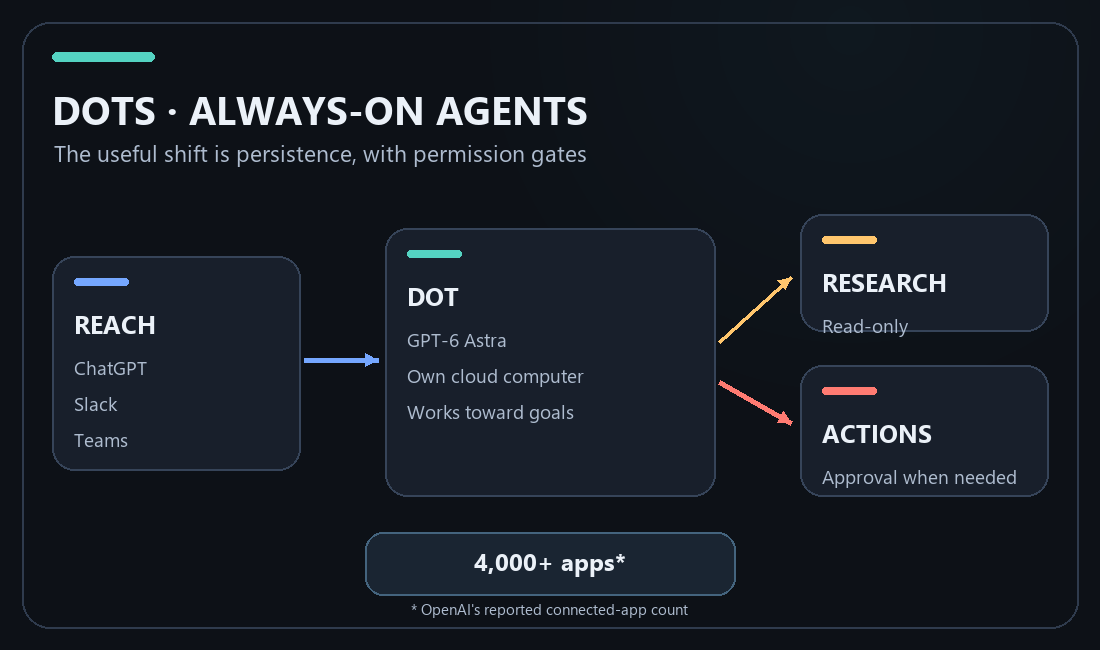
OpenAI says background research is read-only; some account-impacting actions need approval. Source: Introducing dots.
OpenAI says proactive research cannot send messages or change connected apps. Actions that could affect an account or share information can require approval; sensitive tasks like password changes stay with the user. It also warns that Dots can make mistakes.
Rollout starts with Pro and Business Premium in eligible markets. Enterprise, Education, and Healthcare users can try a beta only after an administrator enables it. Dot conversations do not count toward ChatGPT usage limits, but tasks in Codex or ChatGPT Work do.
What changed for developers?
GPT-6.1 Sol has the clearest cost headline. OpenAI says it approaches GPT-6 Astra on agentic coding, computer use, and professional work at one-fifth of Astra’s standard input and output token prices. API rates are $2 per million input tokens, $0.10 cached input, and $10 output. These comparisons are OpenAI evaluations, not an independent benchmark audit.
Sol is available through the API and in ChatGPT Work and Codex for Plus, Pro, Business, Enterprise, and Education users. It is not yet in Chat. GPT-6 Astra Ultrafast is live for API and Work/Codex on Pro 500 and eligible Enterprise plans; Sol Ultrafast is coming.
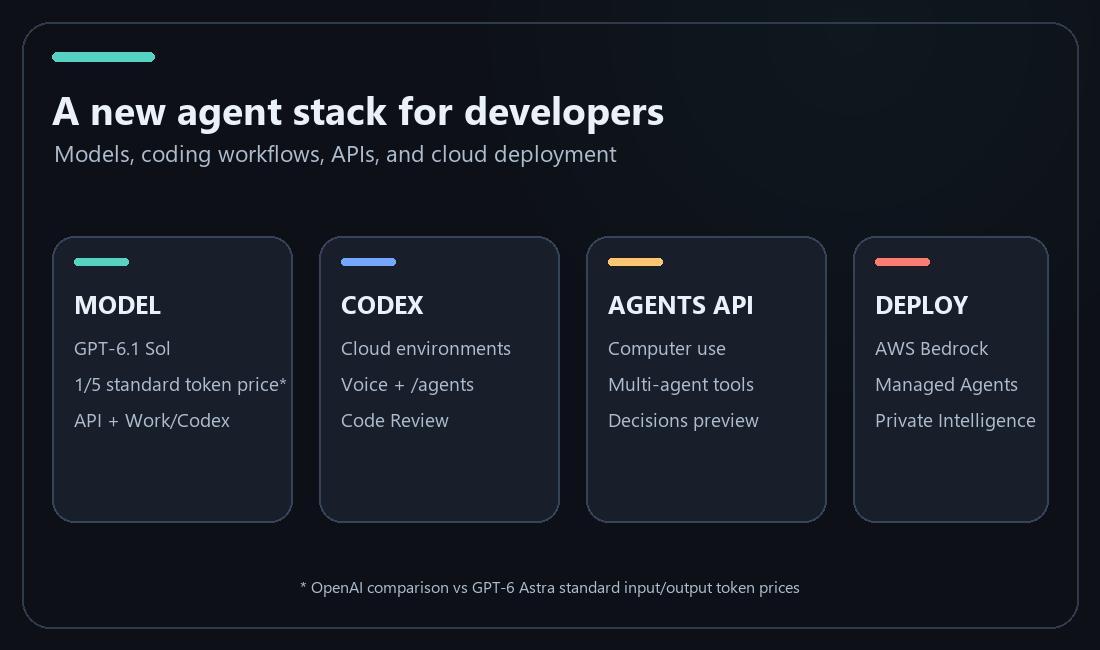
A map of the model, Codex, API, and cloud launches. Pricing details: GPT-6.1 Sol.
Codex adds reusable cloud environments, voice input in the CLI, an /agents view, and Code Review; OpenAI lists the CLI and review tools for all plans. The Agents API adds computer use, multi-agent coordination, tool search, and context compaction. Decisions API is in limited preview, and Bedrock Managed Agents brings OpenAI-powered agents to AWS.
Is ChatGPT becoming a shared work surface?
Plugin extensions can add interactive panels beside a ChatGPT conversation, while MCP events can trigger work when a connected app changes. Both features are listed for all plans. Sites can host supported plugins on Business, Enterprise, Healthcare, and Education.
ChatGPT Space gives a team a shared place for people, ChatGPT, and a Dot. Pages are collaborative documents for writing, research, and charts. Both are listed for Pro, Business, and Enterprise. Mobile users can find, read, and share Pages now; creation and editing are coming. Collaborative slides are planned for the coming weeks.
OpenAI calls ChatGPT a shared surface for developers to reach its “collective 1.2B weekly users.” That is the company’s figure. My read is that ChatGPT is becoming both a place to use AI and a channel where outside products can meet users.
What can you actually use now?
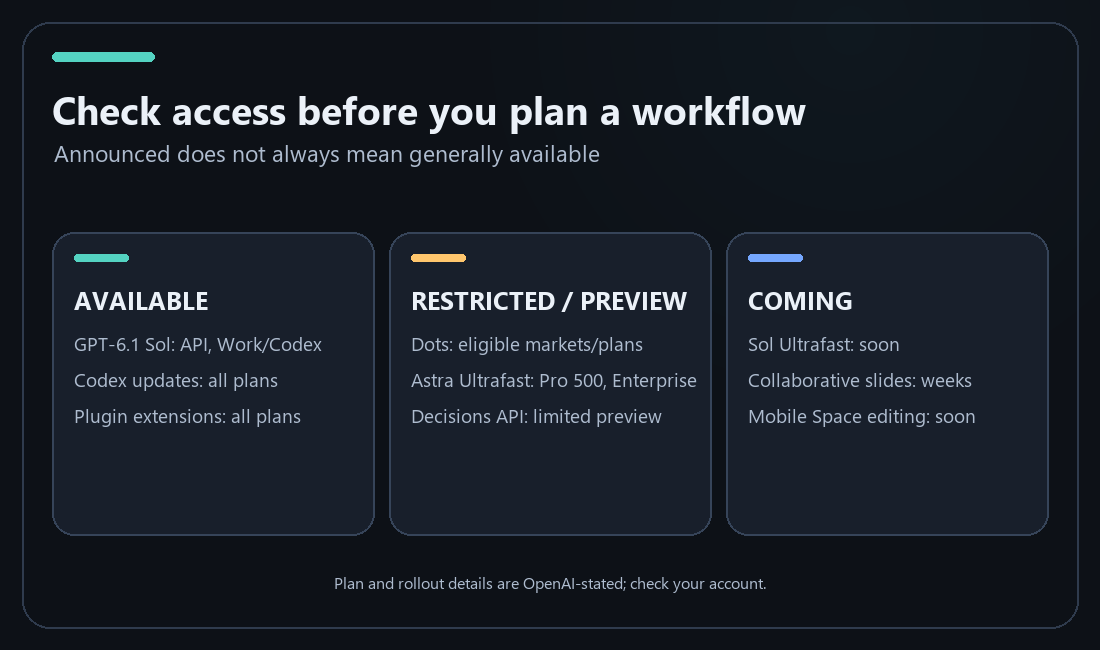
The recap mixes live products with previews and future rollouts. See OpenAI’s announcement for current scope.
- Available now: GPT-6.1 Sol in API and Work/Codex; Codex CLI updates and Code Review; plugin extensions.
- Limited or gated: Dots by plan and market; Astra Ultrafast by plan; Decisions API in preview.
- Coming: Sol Ultrafast, collaborative slides, and mobile Space editing.
The longer list also includes Codex Security Cloud, team and recurring tasks, @ChatGPT in Slack and Teams, a Meetings beta, Sign in with ChatGPT, privacy tools, and an enterprise marketplace with 32 launch partners.
My take
DevDay connects persistent agents, developer tools, and shared ChatGPT spaces into one working environment. If it works, the practical question shifts from “Which model should I ask?” to “What can I safely hand off, and where do I review it?”
Access is uneven, some announcements are previews, and an always-on agent needs clear permissions and human review. I’ll watch real rollout and reliability, then follow up when Sol Ultrafast and collaborative slides are broadly available.
For the earlier safety story, see my breakdown of the 53-image incident.
Comments
Post a Comment