Sol-H3: 5 Seconds of Video in 1.65 Seconds
Sol-H3: 5 Seconds of Video in 1.65 Seconds
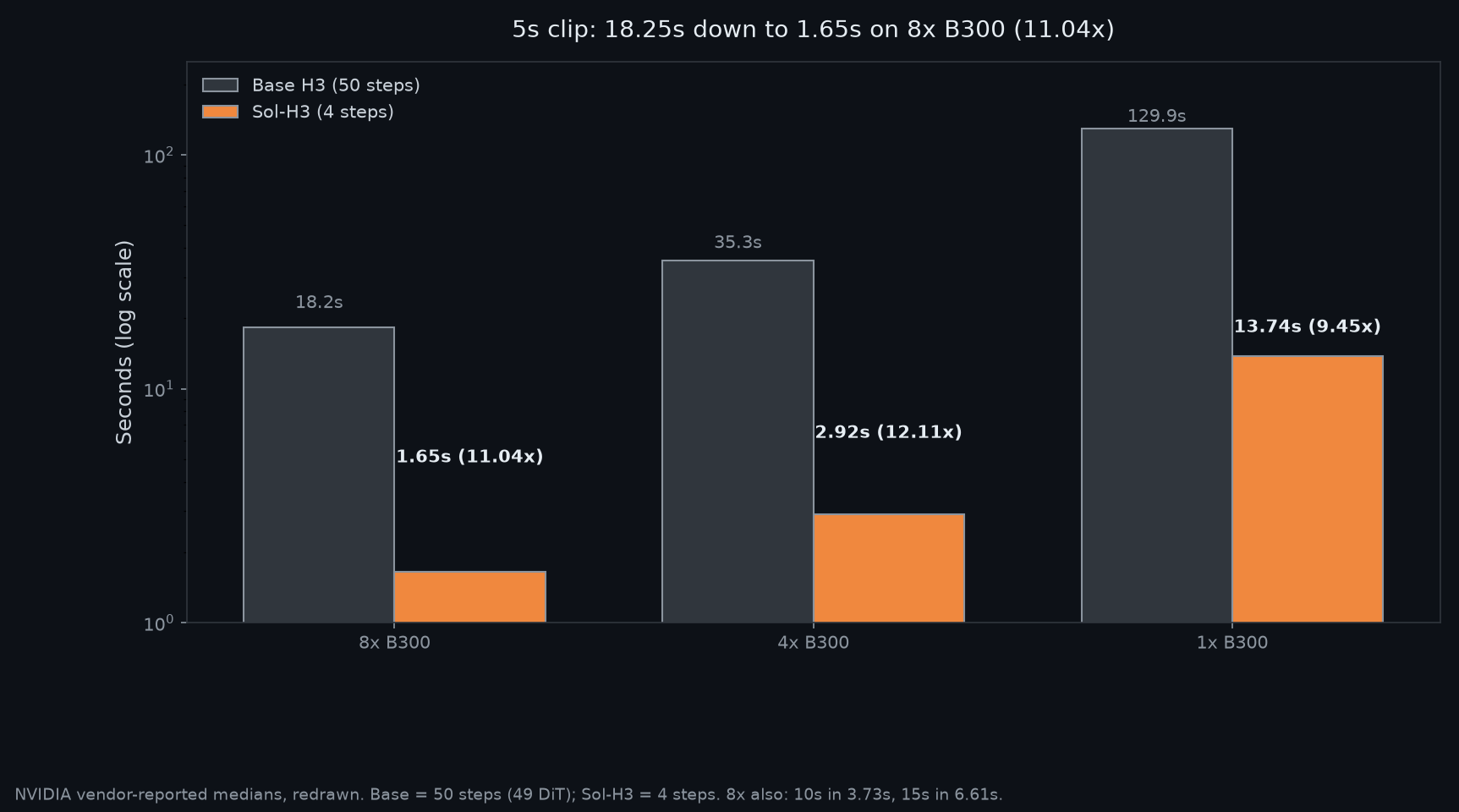
NVIDIA's Enze Xie posted two numbers that stopped my scroll: five seconds of world, 1.653 seconds to infer. The release is Sol-H3, NVIDIA Research's fastest end-to-end MiniMax-H3 inference stack, and it generates video faster than you watch it. On a single 8-GPU B300 system, a 5-second 1344x768 clip with stereo audio renders in 1.653 seconds. That is roughly 3x realtime, and it is the moment video generation crosses from fast rendering into streaming territory.
One paragraph of context before the numbers. Sol-H3 is not a new model. It is NVIDIA's Sol-Engine and Sol-Attn runtime wrapped around MiniMax's open-weight H3, running a 4-step profile instead of the 50-step base. The weights are still MiniMax's under their community license; the stack code is Apache 2.0. And the headline 11x mixes two things, fewer steps plus a faster engine, which NVIDIA states openly. Keep that split in mind and the numbers below read honestly.

What was actually released?
Sol-H3 landed as a project page plus an X announcement from Xie, who leads efficient video generation work at NVIDIA, with day-zero API serving through a partner called Reactor. The stack unifies six optimizations in one runtime: on-the-fly sparse attention with no retraining, fused norm-RoPE-MLP kernels, INT8/FP8 multi-GPU exchange across eight cards, fused sparse-attention setup, parallel tiled VAE decoding, and precomputed AdaLN conditioning. Measured internals NVIDIA published: sparse-attention setup 1.206 down to 0.285ms, VAE decode 7.55 down to 0.602 seconds, roughly 24GB freed per GPU.
The default 4-step profile uses the community FastH3 Preview adapter, and any MiniMax-H3 few-step LoRA plugs into the same engine. That composability matters because it means Sol-H3 is infrastructure, not a fork: take any short-step H3 recipe and the runtime makes it faster without touching the weights.
How fast is it, exactly?
| Clip | Base H3 (50 steps) | Sol-H3 (4 steps) | Speedup |
|---|---|---|---|
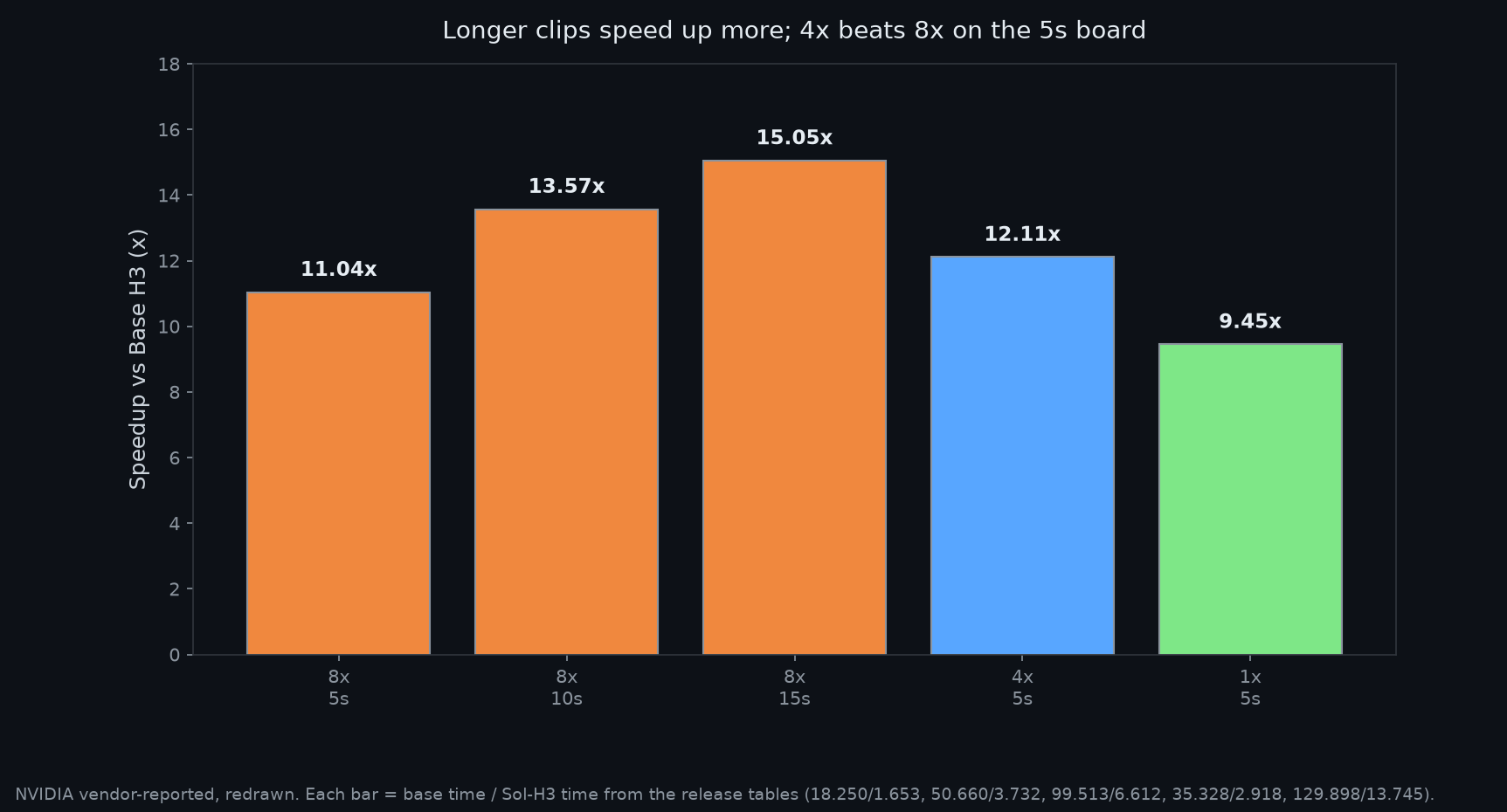
| 5s | 18.250s | 1.653s | 11.04x |
| 10s | 50.660s | 3.732s | 13.57x |
| 15s | 99.513s | 6.612s | 15.05x |
That table is the 8-GPU configuration, medians of three runs after warmup, timing that includes text encoding, denoising, and VAE decode while excluding model loading and MP4 encoding. Two patterns worth naming. Longer clips speed up more, because attention dominates long sequences and attention is where the sparsity wins. And the 4-GPU setup beats the 8-GPU setup on the 5-second board, 12.11x against 11.04x, which smells like communication overhead eating the extra cards on short work.
The skeptic reply in X said the quiet part out loud: eight GPUs, of course it is fast, add a hundred and get near-zero. Fair as far as it goes, and the per-GPU normalization answers it. Single-B300 Sol-H3 renders the 5-second clip in 13.745 seconds, which already beats the eight-B300 base at 18.250 seconds. One card of stack beats eight cards of brute force. The stack is doing the work, not just the silicon count.
Where does it sit in the H3 speed ladder?
This blog has covered the H3 family before, so here is the ladder with Sol-H3 on top. My H3 Max post measured fal's post-trained variant at a 5-second clip in under 3 seconds at 768p. Sol-H3 does the same 5 seconds in 1.653 at 1344x768, roughly 1.8x quicker on paper, but the lanes differ: fal is a served API endpoint you call today, Sol-H3 is a datacenter stack you deploy. LTX-2.5's 10-seconds-in-6.8 remains the consumer-hardware reference on this blog, and the community RTX 5090 ports of the VDN route (around 2 minutes for comparable work) show how far the datacenter numbers are from a desk. Different rungs, honest labels.

What it is not
Three caveats, blended in rather than boxed. First, quality deltas are eyeball-assessed. The Sol-H3 page shows paired showcase clips but carries no LPIPS or VBench table against 50-step dense, unlike the earlier near-lossless Sol-Engine line that published perceptual distances. A 4-step sampling path is a different image than a 50-step one; near-identical is a viewing claim until measured. Second, the license split. Stack code under Apache 2.0 is genuinely deployment-friendly, but the H3 weights underneath keep MiniMax's community license with its excluded territories, Korea and the US and EU and UK among them. If you are in an excluded region, the fast stack does not unblock the weights. Third, the hardware. An 8-GPU B300 system is not a workstation, and NVIDIA's own prior lines (3.95x on GB200, 3.56x on H100) plus the complementary VDN-H3 work all assume datacenter cards. The path to a desk runs through community ports, which exist but run minutes, not seconds.

My take
This is the most significant H3 release since the weights dropped, and it is infrastructure rather than a model, which is exactly why it matters more than another leaderboard point. A runtime that makes any few-step H3 recipe faster without touching weights compounds with every adapter the community trains, and the faster-than-playback crossing turns video generation from batch rendering into something you can stream, preview live, and eventually interact with. NVIDIA says continuous 24 FPS and real-time interaction are next; the 15-second clip at 6.6 seconds says that is a roadmap, not a fantasy.
The honest version of the headline: 5 seconds of world in 1.653 seconds of inference, on eight datacenter GPUs, through four steps instead of fifty, with quality judged by eye and weights licensed everywhere except the biggest markets. Every clause in that sentence is doing work, and none of them erases the achievement. I will re-run these charts the moment independent replications land outside NVIDIA's lab, because vendor medians deserve the same verification I demand everywhere else on this blog. Until then: the fastest H3 stack yet, by a distance, and the gap is the stack, not the silicon. Related on this blog: H3 Max post · H3 open-weight impressions · LTX-2.5 · H3 text-encoder swap.
Sources: NVIDIA Sol-H3 release page (specs, tables, methodology); Enze Xie X announcement (headline numbers, Reactor day-zero API, Apache 2.0 note); NVIDIA Sol-Engine H3/Super-Acceleration/DataCenter pages (prior lines); OpenVDN VDN-H3 page + model card (complementary work, 11.23s figure, license note); MiniMax H3 model card (33B, community license); ComfyUI Wiki VDN-H3 (community port figures); fal H3 Max page (sub-3s context). Images: NVIDIA showcase stills (self-extracted frames), MiniMax/HF thumbnail, charts self-rendered. Prices checked Sept 7, 2026.
Comments
Post a Comment