Waymo vs Cybercab: 220 Million Miles vs $0.20 a Mile
Waymo vs Cybercab: 220 Million Miles vs $0.20 a Mile
Two weeks ago I closed my Cybercab launch post with a promise: I'd watch the fleet count and post again when it moved. The count moved — from 45 registered Cybercabs to 49. That is the least interesting thing that has happened since.
In the same stretch, Waymo opened Denver, San Diego and Tampa — 14 cities now — crossed 4,000 vehicles and half a million paid rides a week, and watched its safety dataset roll past 220 million driverless miles. Tesla, meanwhile, still runs a fleet small enough that community trackers can count it car by car, and started selling Cybercabs to other companies instead of driving them all itself. Two companies, two completely different bets, and for the first time both bets have receipts.
So here's my answer, up front, because you came for one: Waymo is winning 2026 by every scoreboard that exists. Even so, I'd still bet the next five years on the Cybercab. Not because of Elon Time — because of arithmetic. And because of something the videos keep showing: Waymo's failure mode is to stop and think when the world gets weird, and "stop and think" is the one thing a taxi can't do.
The scoreboard says Waymo, and it isn't close
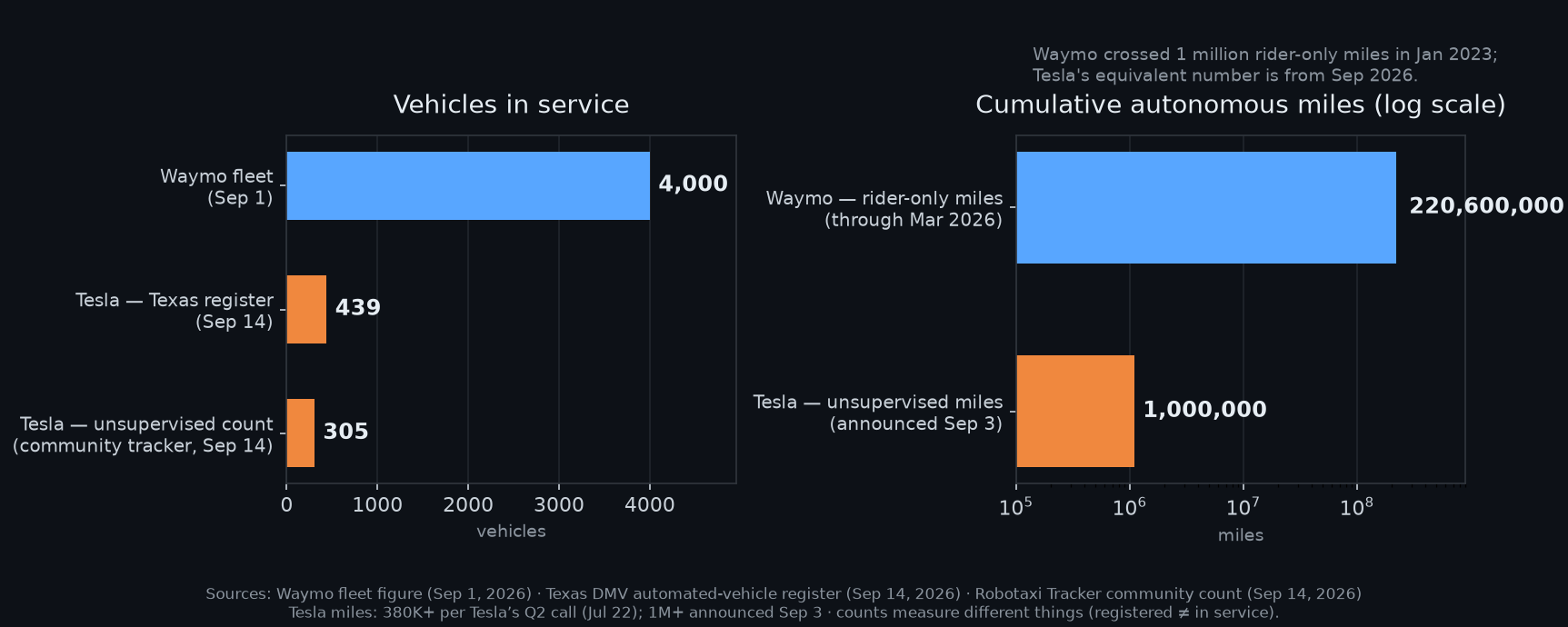
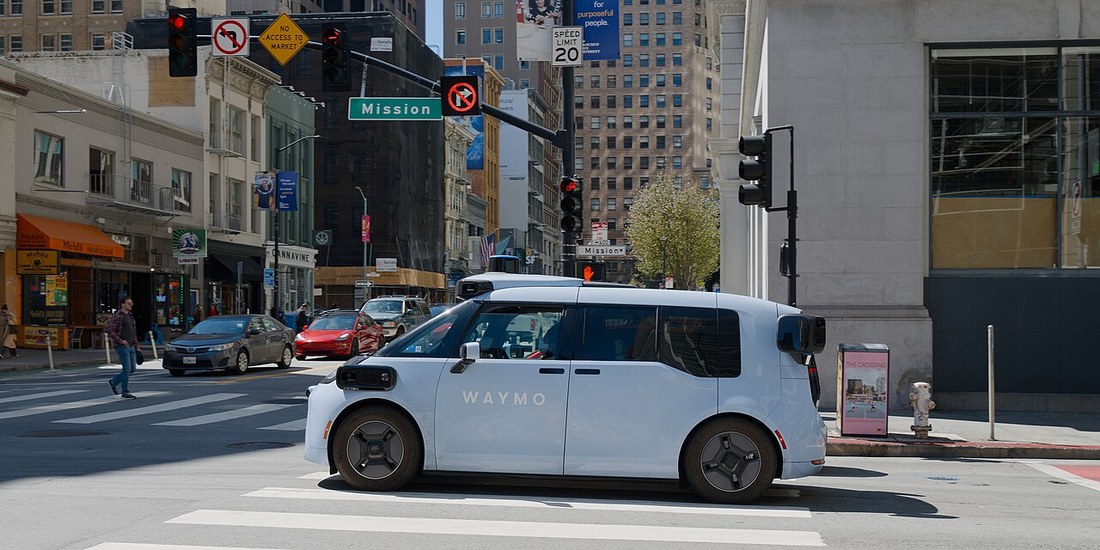
Start with the part nobody can argue with. Waymo's service is live, driverless and open to the public in 14 US metros, from Phoenix to Nashville, with London announced as its first overseas market. The fleet passed 4,000 vehicles on September 1, about 300 of them the new Zeekr-built Ojai. Paid rides run 500,000+ per week against a stated goal of one million by the end of the year, which works out to roughly four million rider-only miles a week. Its published safety comparison — the only one in the industry with a real mileage base — claims on the order of 90% fewer serious-injury crashes than the human benchmark over 220 million-plus rider-only miles.
Tesla's numbers deserve context, not dismissal. Texas's public register shows 439 Tesla autonomous vehicles as of mid-September — 390 Model Ys and 49 Cybercabs — up 258 in a month, the fastest the program has ever grown. Community trackers count about 305 cars running unsupervised, around 260 of them seen actually driving within 30 days. Tesla announced it crossed one million cumulative unsupervised miles at the launch; the officially confirmed figure at July's earnings call was 380,000+.
Put those in one frame and a single sentence does the work: Tesla's all-time unsupervised mileage is about two days of Waymo's current fleet mileage. Waymo crossed its first million rider-only miles back in early 2023.
| Metric | Waymo | Tesla Robotaxi |
|---|---|---|
| Driverless cities | 14 US metros; London planned | 6 driverless metros + Bay Area (safety driver required by CA law) |
| Fleet | 4,000+ vehicles (~300 next-gen Ojai) | 439 on the Texas register; ~305 counted unsupervised |
| Paid rides per week | 500,000+ (target: 1M by year-end) | Not disclosed |
| Cumulative autonomous miles | 220M+ rider-only | 1M+ unsupervised (380K+ as of July call) |
| Published safety data | Yes — 220M-mile dataset, ~90% fewer serious-injury crashes | None published |
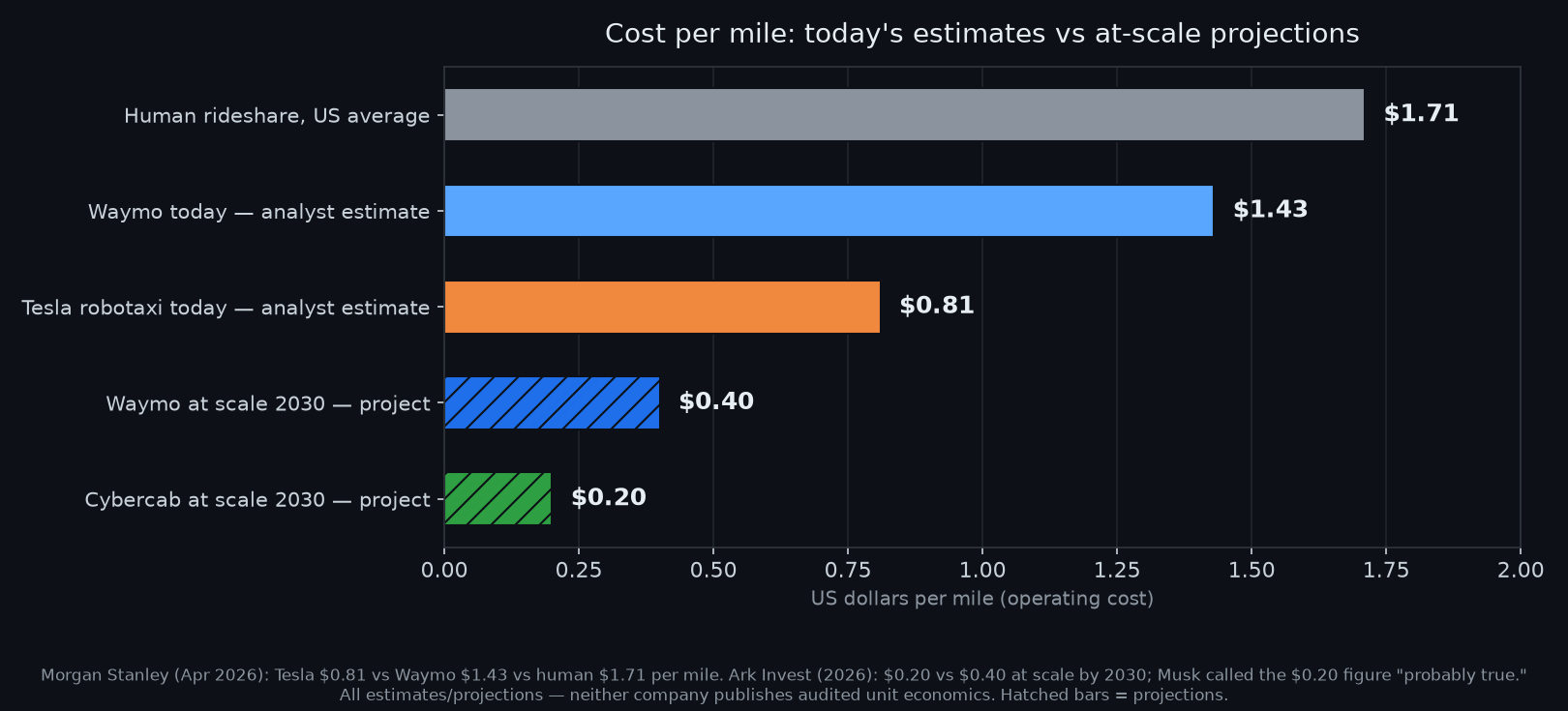
| Est. operating cost per mile | ~$1.43 (Morgan Stanley) | ~$0.81 (Morgan Stanley) |
| Vehicle cost | $50K–$125K est. (Ojai) | $18K–$30K (target / landed-est.) |
Why Waymo cars freeze when the world gets weird
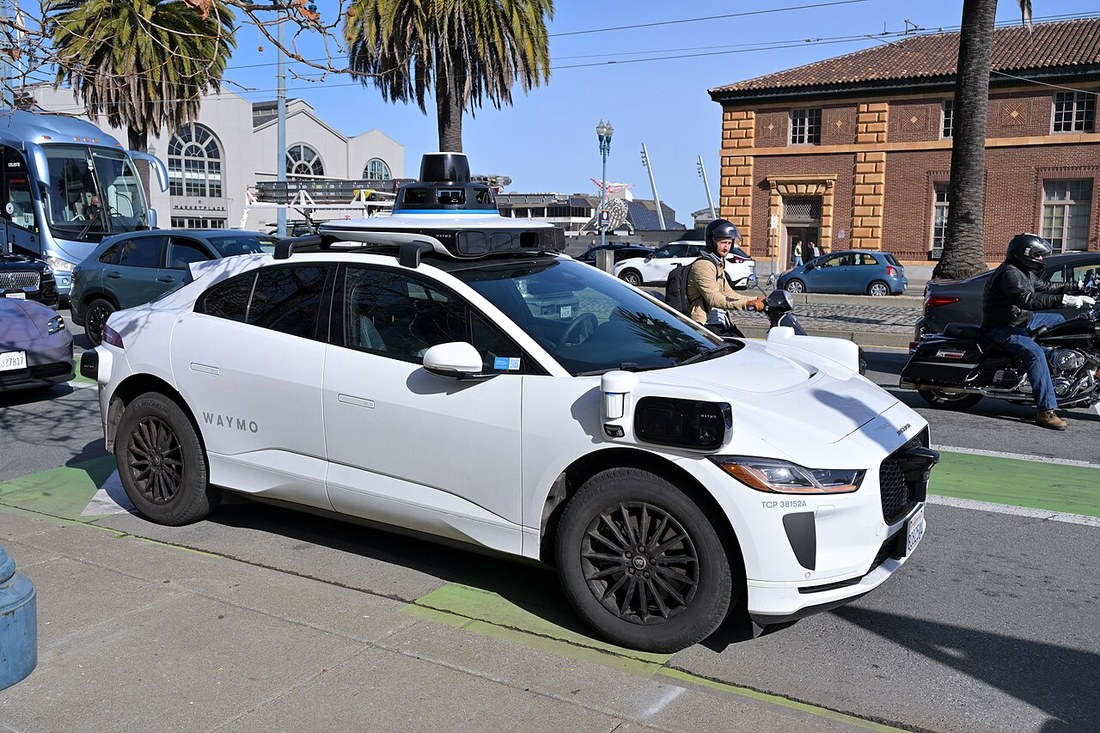
If you spend an evening in the clip compilations — and I have — the pattern is remarkably consistent. Waymo's cars don't crash much. They stop. A few from this year alone:
- In May, floodwater incidents got frequent enough that Waymo suspended driverless service in five cities, including Austin and Dallas.
- In February, two Waymos were filmed stranded in LA floodwaters — and in a separate viral clip, multiple Waymos deadlocked at a single intersection.
- This week, a Phoenix Waymo spent ten-plus minutes in an "AI loop" on a flooded street, rocking forward and back — at one point nearly backing into another car — while human drivers went around it.
- Across the year: a mid-turn freeze in a Chandler intersection, two Waymos blocking a Miami Beach intersection in a standoff with each other, a Dallas car that sat and blocked fire trucks after an apartment explosion, and a San Francisco Waymo that caught fire after driving over lit fireworks on the Fourth of July.
You can hear the objection already — these are edge cases. Right, and edge cases are the entire ballgame in autonomy. Waymo's system is built around high-definition maps of streets it has already surveyed. When reality matches the map, it drives beautifully. When reality doesn't — a flood where the map says road, a fireworks box where the map says lane — its designed instinct is caution: stop, phone home, wait. About 70 remote assistants worldwide handle those moments, and Waymo's own framing for them is "advice, not control."
Honestly? That is the safest failure mode there is, and it's a big reason Waymo's safety numbers look the way they do. A car that refuses to guess is a car that rarely guesses wrong. But it's also why a ride can quietly become a twenty-minute standstill while traffic crawls around you — and for a taxi, the passenger experience is the product.
The Cybercab's first two weeks: more gawking than fireworks
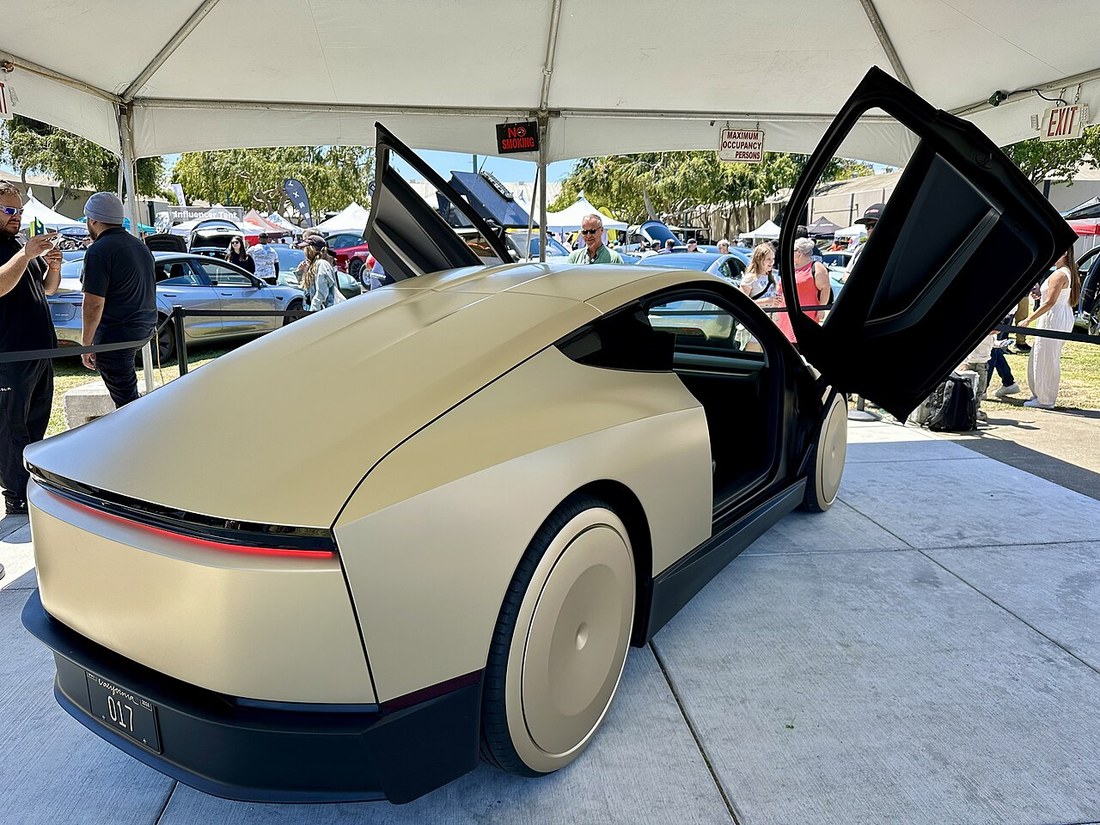
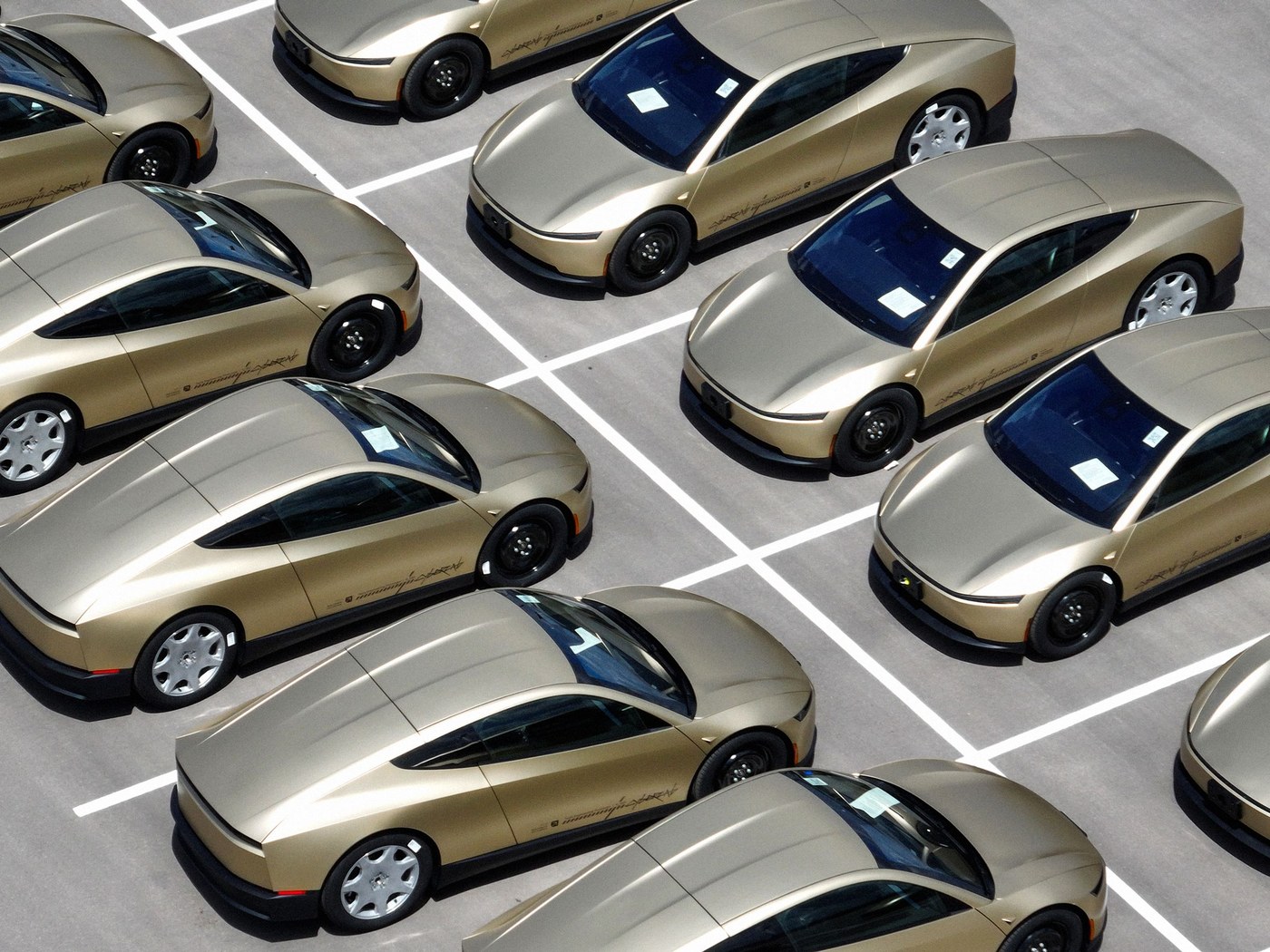
Meanwhile in Austin, I went looking for the Cybercab's own bad-day compilation and couldn't find one. Two weeks in, the clips are people filming the gold car, riders showing off the no-steering-wheel cabin, and the occasional butterfly door refusing to close. Reviewers who actually rode it describe the driving as smooth and, in The Verge's words, "welcomely smooth" and "zippy" — interrupted by moments where the car drove like "a slightly stoned teenager," second-guessing lane decisions, after a 45-minute wait for a ride under two miles.
I want to be careful here. Forty-five cars, one corner of one city, two weeks: that's a sample size of nothing, and I'm not going to claim the Cybercab out-drives Waymo based on tourist videos. What I am saying is narrower and more defensible: the freeze pattern is Waymo's signature bug after 220 million miles, and Tesla's new robotaxi hasn't shown it yet.
Where the math isn't close — in the other direction
Now the part that decides decades instead of quarters. Morgan Stanley ran the only apples-to-apples cost model anyone outside the two companies has: Tesla's robotaxi at $0.81 per mile, Waymo at $1.43, human ride-hailing at $1.71. Goldman Sachs took the next step this month — if the Cybercab hits its $20,000–$30,000 cost target at scale, Tesla operates 5 to 30 cents per mile cheaper than vehicles costing $50,000 to $100,000 up front. Ark Invest's projection goes further: $0.20 per mile for Cybercab versus $0.40 for Waymo's Gen-6 fleet by 2030. Musk's reaction to that one: "probably true."
Why does the Cybercab math work? No lidar — Tesla's camera set costs a few hundred dollars, where Waymo has disclosed roughly $25,000 for its Gen-6 sensor hardware. No HD mapping bill — Waymo surveys every street before it operates there; Tesla's cars are trained on fleet data and go where they're sent. Cheaper manufacturing — "unboxed" parallel assembly, body panels that skip the paint shop, a target price under $30,000, in a factory tooled for 125,000+ Cybercabs a year. And efficiency: the Cybercab is rated around 165 Wh per mile — about a sixth the energy of the I-PACE robotaxis it will replace, one of which a widely shared dashboard photo showed sipping 104 kWh per 100 miles with the autonomy stack onboard.
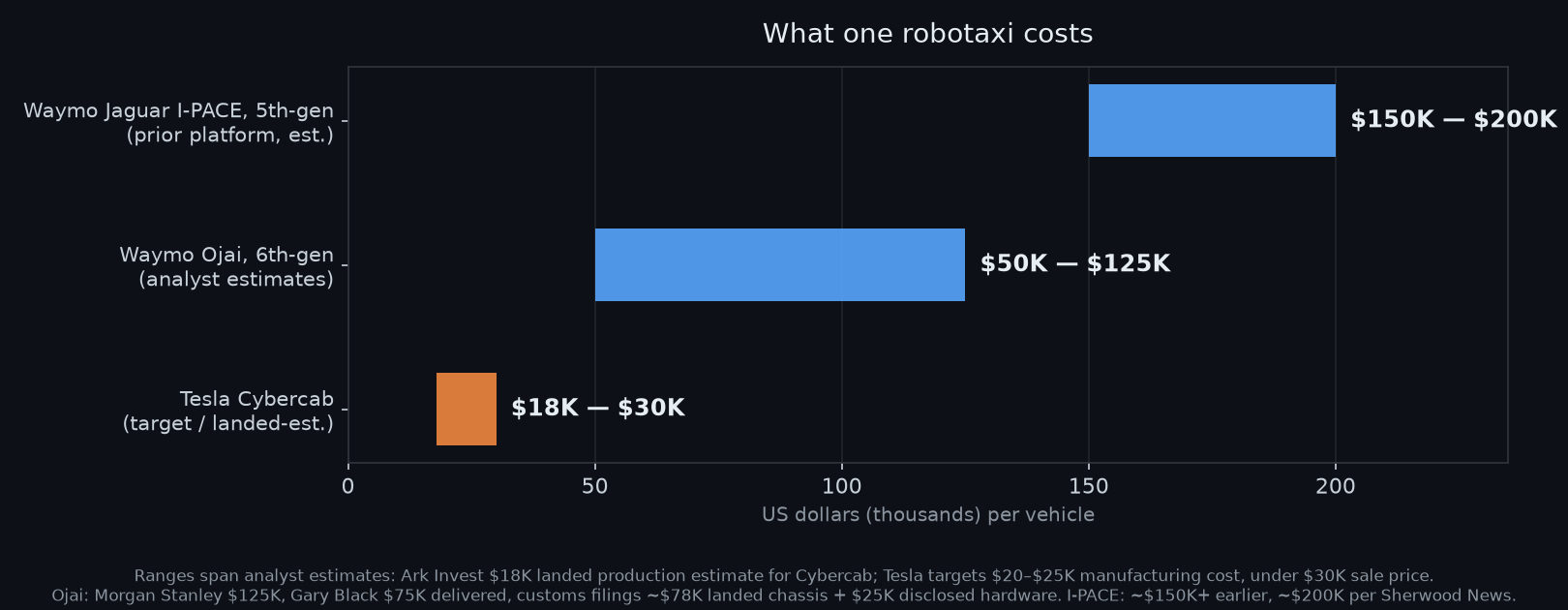
Now the caveat, and it's real: Morgan Stanley's own stress test notes that the $0.81 assumes a safety and insurance profile Tesla hasn't demonstrated yet, and Waymo's cost curve is falling fast too — the Ojai cut per-vehicle cost roughly two-thirds from the I-PACE era, and lidar prices have collapsed industry-wide. A cost model isn't a bank statement. But between the two curves, one company is starting from a cheaper car, a cheaper sensor set, and no mapping bill.
Two robotaxi businesses wearing the same word
There's a structural difference here that gets less attention than it deserves. Waymo owns its fleet: 4,000 cars of Alphabet capital — cleaned, charged, maintained, insured by Waymo. Tesla is quietly building the Uber answer instead. The same week Cybercab rides started, it opened a "Help Us Build Our Robotaxi Network" form inviting companies to buy Cybercabs, deploy them in regions of their choosing, and run them on Tesla's network — with Tesla taking a cut of every fare.
The buyer carries the car payments and the depreciation. Tesla carries the software, the dispatch, and the manufacturing margin. It's exactly how Uber grew without owning cars, with one upgrade: Uber can't sell you the vehicle too. And it changes the scaling math completely — if fleet buyers show up, "flooding the streets" stops depending on Tesla's balance sheet and starts depending on an order form.
So what could actually stop the Cybercab?
Plenty. This is the section where I talk myself out of my own prediction. First, the law: NHTSA opened Audit Query AQ26002 within hours of the first paid rides, examining whether Tesla's self-certification — that a car with no steering wheel, pedals or mirrors meets federal safety standards — holds up. Zoox took the other road, a formal exemption granted in July, and that's the safer, slower path. If the audit goes against self-certification, the expansion math changes overnight.
Second, today's product is rough in ways riders notice. Austin Cybercabs avoid highways and at-grade railroad crossings — partly tied to an active federal probe into FSD at rail crossings — which turned one 10-minute trip into a 70-minute, $20 "tour" this month. Waits run 40 minutes. Butterfly doors occasionally jam. And Tesla publishes no fleet-level safety data at all: 17 reported incidents in Austin since last summer, a couple of remote-operator oopsies — including a teleoperator steering one into a tree stump in July — and no usable denominator. Waymo, freezing problem and all, built the only public safety dataset in the industry.
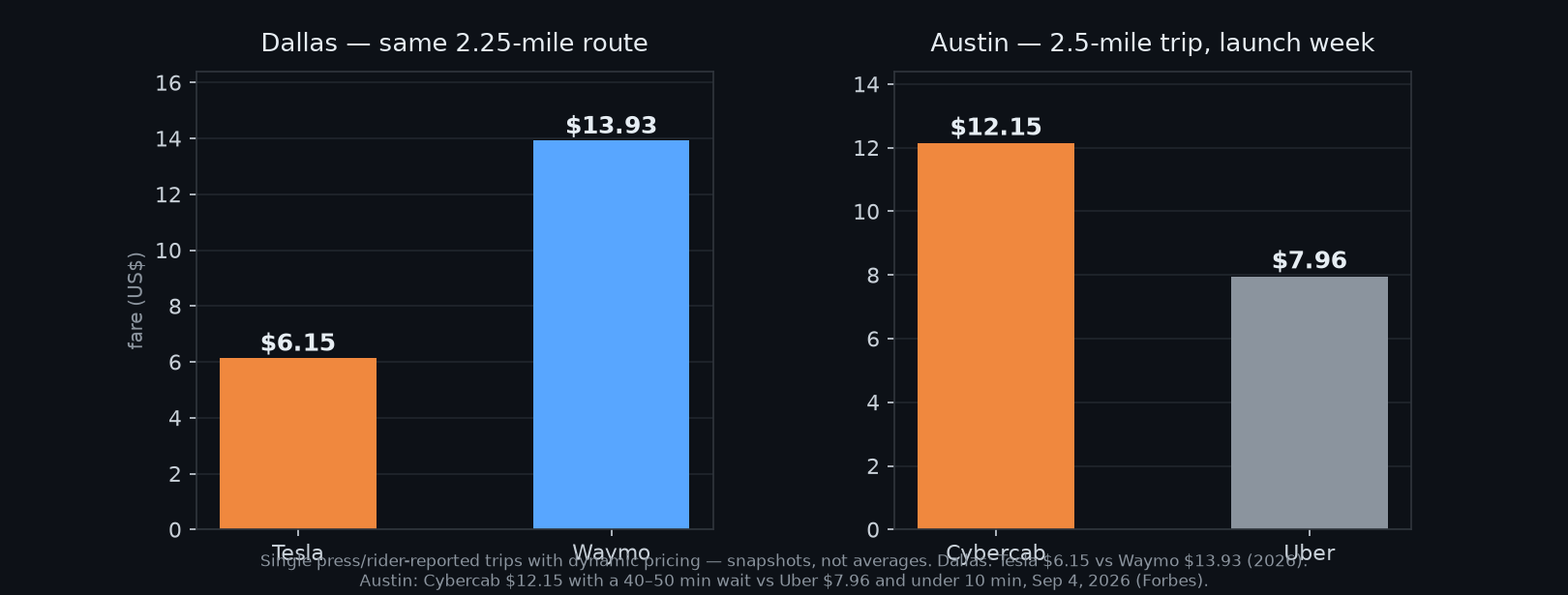
Third: on the street today, Tesla isn't even the cheap option. Launch-week snapshots in Austin put the Cybercab above Uber on price with a 40-minute wait, while in Dallas a Tesla robotaxi took the identical 2.25-mile route at $6.15 against Waymo's $13.93. City by city, the reality is messy in both directions.
So who actually wins?
Three answers, depending on your question. If you want a driverless ride today: Waymo, and it isn't close — 14 cities, half a million rides a week, and a safety record nobody else has bothered to match on paper. If you're betting on 2030: the arithmetic favors the car that costs a fraction as much to build and about a sixth as much to run — provided two things happen, the audit question resolves Tesla's way and the driving data starts looking like Waymo's. Both are real ifs. And if you want the uncomfortable version: robotaxi economics are still unproven for everyone. Analysts estimate Waymo loses money per mile at current fares, and Tesla's cost advantage is a projection until the fleet is big enough to test.
My take
I'm not going to spin the scoreboard. Waymo is the better robotaxi service today, by a margin measured in years, and anyone telling you otherwise is selling something. But "ahead" and "winning" aren't the same thing in a hardware race. Waymo's model scales with capital: every new mile needs a $50K-plus car and a pre-mapped street. Tesla's scales with a factory: an appliance-grade car and a neural net. If both approaches keep working, the cheaper one wins — the way it has in every hardware market I've ever watched.
And the freeze videos are the tell for me. A robotaxi that stops in rain, floods and construction hasn't solved the boring last mile of driving — and Waymo, with all its polish, still does that about as often as its press team would like. The Cybercab, two weeks in, mostly just drives. That could be the sample size talking. It could also be the entire thesis: no HD map to fall off, no sensor conflict to reconcile, no six-figure hardware to amortize.
So here's the call: Waymo wins the first half of this decade, and I'd take the Cybercab for everything after. Not because Tesla deserves it — because at $18K to $30K a car against $50K to $125K, it doesn't have to be better. It has to be good enough. That's the annoying thing about cost advantages: they don't care who was first.
I said I'd be back when the fleet count moves. It moved by four cars, so I'm setting a higher bar this time: expect an update when the NHTSA audit resolves, when the Cybercab register passes 100, or when the first named fleet buyer shows up — whichever lands first.
• TechCrunch — Waymo expands to Denver, San Diego, Tampa (Sep 1)
• The Charge Port — US Robotaxi Status tracker · The Driverless Digest — Waymo stats
• Forbes — Tesla opens Cybercab fleet sales as NHTSA audits paperwork (Sep 9)
• The Verge — One hour inside the Cybercab (Sep 11)
• Electrek / Gadget Review — the 70-minute Austin detour (Sep 15)
• Fox Business — Waymo stuck in "AI loop" in Phoenix (Sep 17)
• Benzinga — Goldman: Cybercab cost edge (Sep 2026) · Tesorb — Morgan Stanley cost analysis
• Eletric-vehicles — Musk's $1M fleet graphic · fleet-count clarification (Sep 14)
• Wikipedia — Waymo · Tesla Robotaxi · NY Post / Miami New Times (flood & standoff clips)
• Photos: 4300streetcar, Daniel Lu, Steve Jurvetson via Wikimedia Commons (CC) · Reuters via WIRED · charts self-rendered
Comments
Post a Comment