Tesla's Cybercab Is Finally Carrying Passengers — What the Quiet Launch Really Means
Tesla's Cybercab Is Finally Carrying Passengers — What the Quiet Launch Really Means
Thursday night in Austin, Tesla did something that would have been unthinkable a decade ago: it put the Cybercab — the two-seater with no steering wheel, no pedals, no mirrors — into its paid robotaxi service. Real cars, real passengers, nobody in the driver's seat, on public streets. That's a genuine first for a major automaker, and it's worth pausing on regardless of how you feel about Tesla.
The launch itself was oddly subdued, though. An invite-only party at ACL Live, no livestream despite earlier hints, no Elon Musk on stage, no consumer price, no big roadmap reveal. Fans who tuned in expecting a spectacle got radio silence, and the stock gave back its pre-event gains in after-hours trading. There's a reading where this looks like an anticlimax. There's another where it looks like a company that finally learned to under-promise. I think the truth is somewhere in the middle — and that middle is more interesting than either extreme.
What the Cybercab actually is
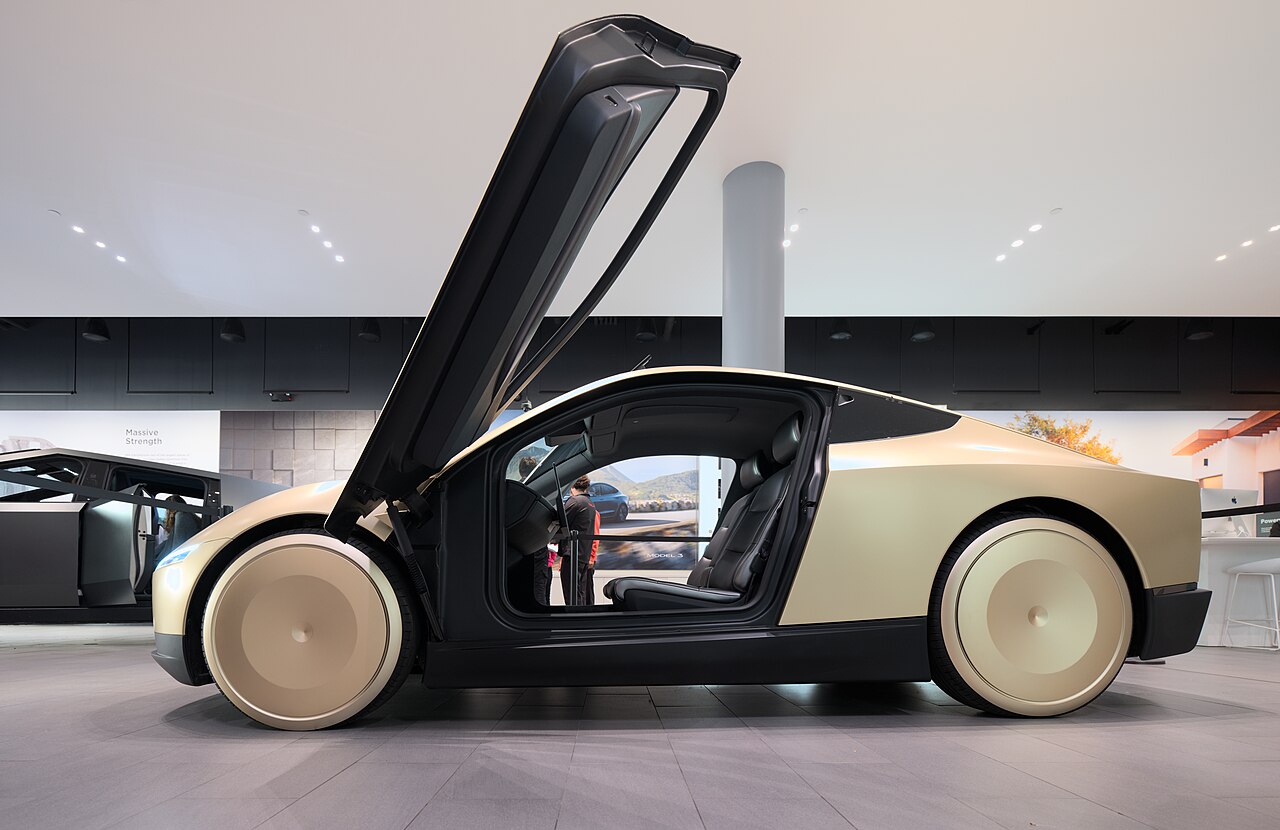
The hardware is genuinely interesting. A 2-seat coupe with butterfly doors, single front motor making 219 hp (163 kW), 47.6–48 kWh battery, EPA-estimated range around 293 miles, and a light 1,412 kg curb weight. It's engineered obsessively around cost: 48V architecture, injection-molded body panels that skip the paint shop, a radical "Unboxed" parallel manufacturing process, and a design goal of a car off the line every 5–10 seconds at full scale — ambitious, and worth remembering Tesla has never hit a production-rate goal on the first try.
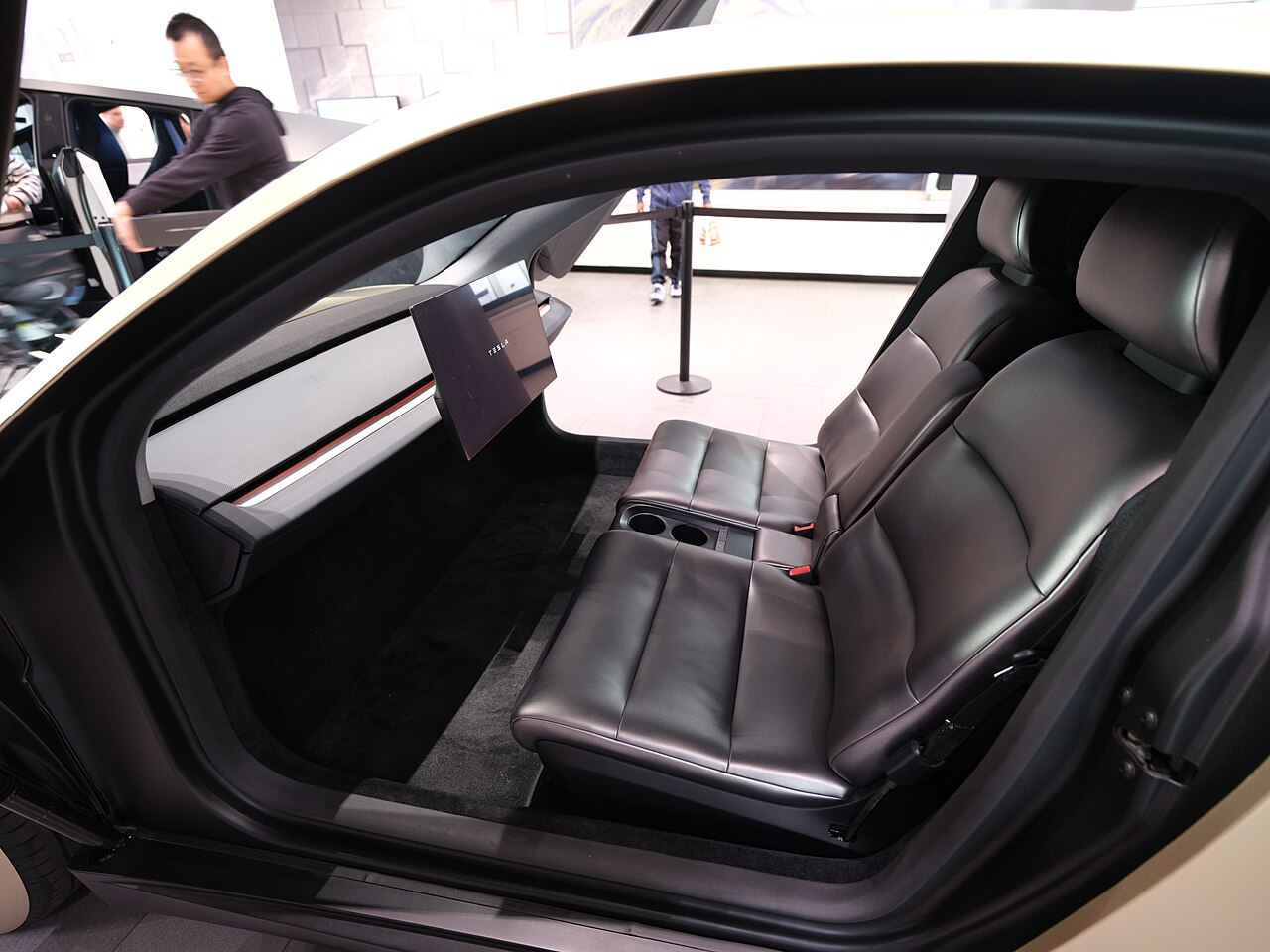
The cabin is where the concept lands. No steering wheel, pedals or mirrors; two lounge-style seats, a 22-inch screen running Unreal Engine, 43.4 inches of legroom — more than a Model Y. Nine cameras plus a ceiling radar that detects whether a seat holds a child seat or an adult and switches airbags accordingly. Wireless charging, native Starlink. Tesla's engineering director pitched it simply: "You can choose to be entertained or choose to be productive... Anything you can possibly do as long as you have your seatbelt on."
The autonomy approach remains the company's biggest bet and its biggest open question: vision-only, no lidar, no HD maps, running on the same AI4 computer as today's Model 3/Ys, with an end-to-end neural network trained on Tesla's fleet — now past 22.5 billion kilometers of assisted driving. Tesla's argument is that cameras plus neural nets at fleet scale beat expensive sensor stacks. Rivals like Waymo, Zoox and Aurora disagree publicly, and NHTSA has open probes into whether camera-only systems are adequate in reduced visibility. The next few years will settle which side is right, and the Cybercab is where Tesla is putting its money on the answer.
Launch night: the quiet version
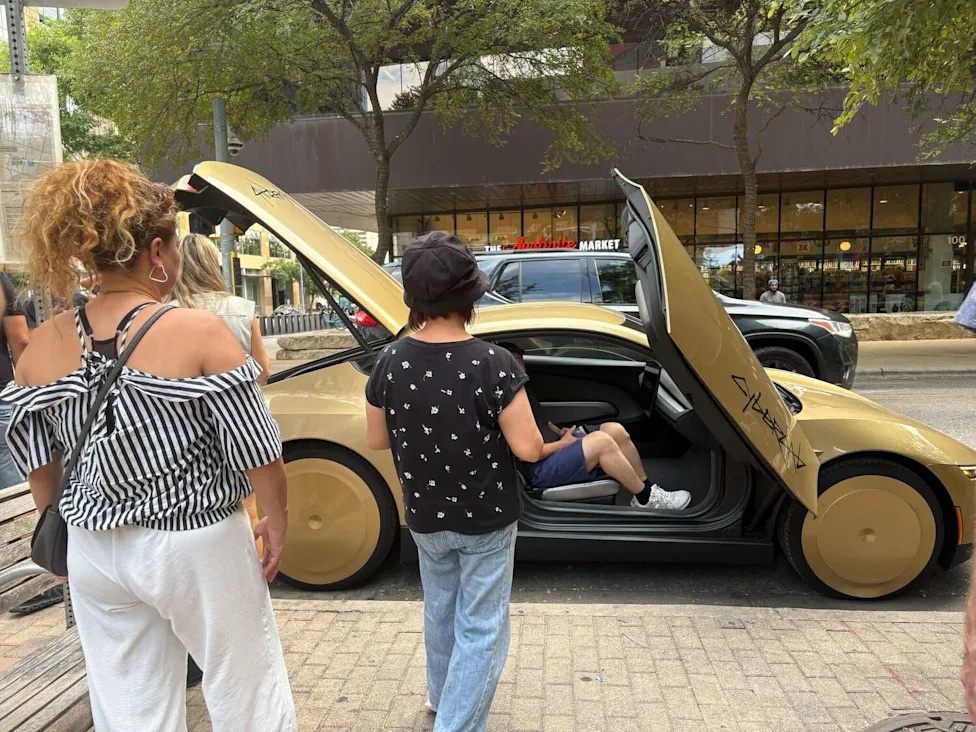
The event itself had classic Tesla touches. Invite-only at ACL Live in downtown Austin, the 2,700-seat venue. Attendees dressed in gold to match the car. The "golden ticket" was literally a molded piece of the Cybercab's body panel — a nice detail. A Cybercab was trucked in and unloaded on the sidewalk, and attendees piled in for the first public rides, right there on Austin streets.
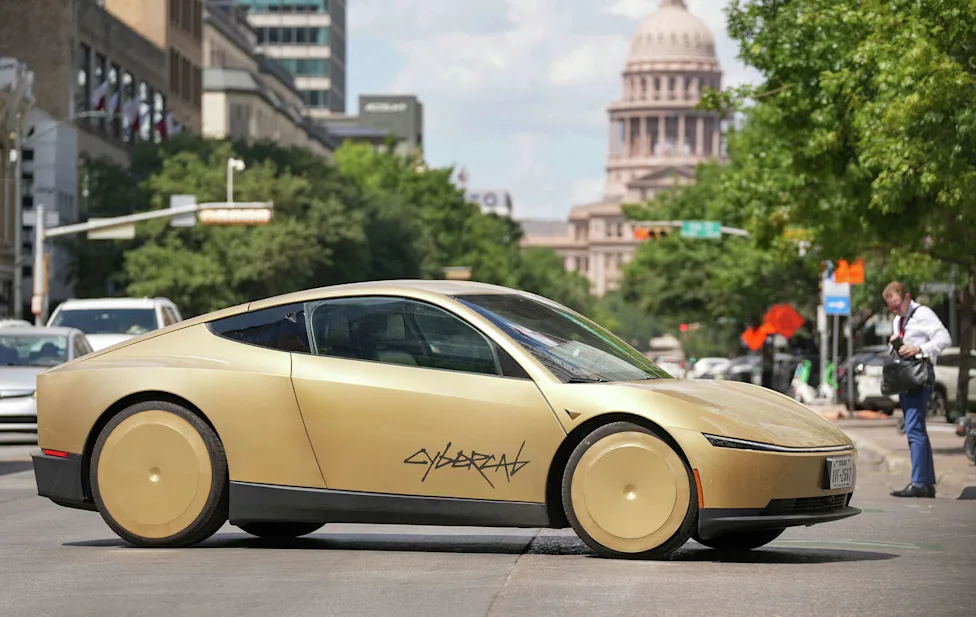
But the parts that were missing mattered to people who'd waited two years for this. No livestream — WIRED reported invitees were barred from posting for hours after the event started. Musk wasn't there. No consumer price, no delivery timeline; the "under $30,000" figure from the 2024 unveiling remains a goal rather than an order page. Tesla did publish updated rider guides and some engineering details on X, but the substance was thin for an event Bloomberg described as "little splash or detail."
My read on the quiet: after the 2024 unveiling set expectations the company then missed for two years, keeping this launch small was probably deliberate — and probably smart. It's also fair to note that Tesla fans and investors have heard "next year, for real" enough times that a modest event reads more like caution than confidence. Both things can be true: restraint is a reasonable strategy, and it doesn't make the moment less anticlimactic for the people who showed up expecting more.
The fleet: 45 cars, and what that number does and doesn't say
The most-cited number from launch day is 45 — Cybercabs registered for commercial use in Texas, out of 420 Tesla autonomous-vehicle registrations in the state and roughly 200 Tesla vehicles nationwide with an "unsupervised" designation. It's small, and it's worth being clear-eyed about that: this is a pilot-scale deployment in a limited part of one city, joining a Model Y robotaxi network that itself has only expanded to a handful of geofenced Texas and Florida areas.
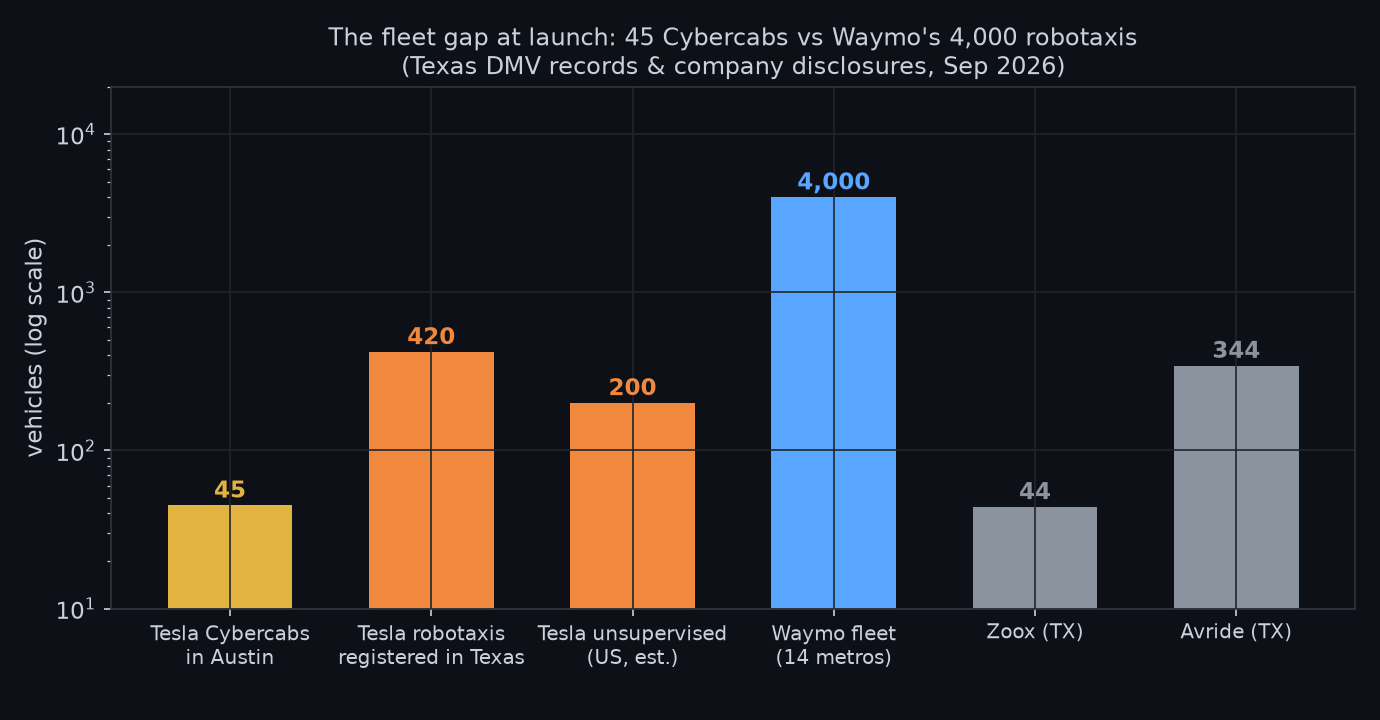
The charitable reading is also legitimate. Musk has said repeatedly that a single injury would bring "worldwide headline news" and regulatory whiplash, and Tesla's own Q2 call framed the slow ramp as deliberate caution. The company's stated approach — prove it in a limited geofence, expand only after it holds — is how it went from one Austin zone in June 2025 to several Texas and Florida cities with Model Ys, and the Cybercab is joining that proven network rather than starting cold. The app now lets riders choose between a Cybercab and a Model Y.
The less charitable reading deserves airtime too. Tesla crossed 1 million fully unsupervised miles on Thursday — a milestone Waymo hit back in January 2023 with rider-only miles now past 220 million, so the safety sample remains thin relative to the leader. Tesla's own Q2 disclosures showed paid robotaxi miles actually moving backward in July. And the fleet's public stumbles — a Model Y robotaxi pushing through bollards in Austin, routing complaints from riders — show the edge cases are still being found. That's exactly why a small fleet is defensible. It's also why claims about "scale" should stay modest until the number starts climbing.
The economics: the strongest part of the story
What makes the 45-car number feel less like the point is the cost structure underneath it. Tesla's long-term target is $0.20 per mile operating cost — roughly a tenth of the claimed industry average — and riders are already seeing the pricing power of a driverless fleet even before the cheaper-to-build Cybercab scales:
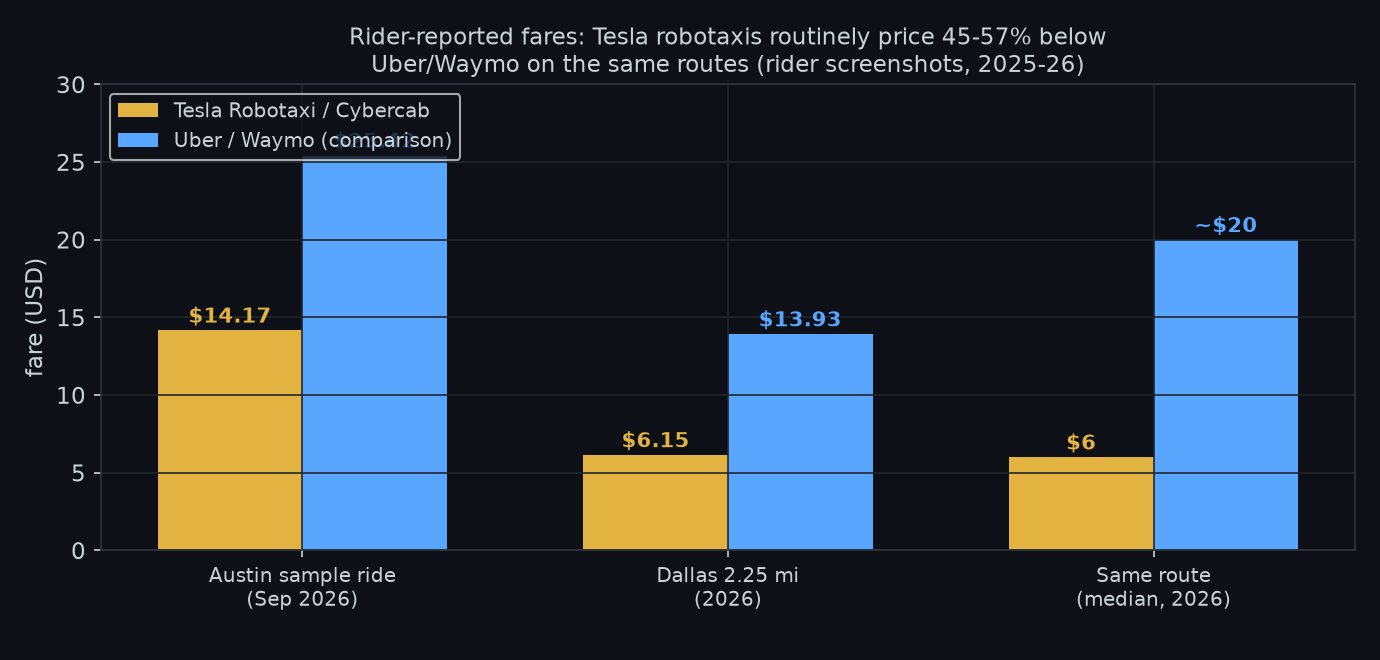
The logic is straightforward. Ride-hailing economics are dominated by driver pay, typically 50–70% of every fare. Remove the driver, build the car cheaper than anyone, run it on ~10.2 kWh per 100 km, and you can undercut human-driven services on price while keeping margin. Tesla is also signaling beyond rides: the "robotaxi interest form" published this week targets businesses that want to buy Cybercab fleets, pointing toward a second revenue line selling the car to fleet operators.
The caveat is the word "if." Those cost targets assume the software is reliable enough to run without teleoperator help at scale, that utilization stays high, and that the regulatory door opens. The fares riders see today are partly introductory. The unit economics are the strongest bull case Tesla has — but they're a projection until the fleet proves them over years, not weeks.
The regulatory question that still looms
This is the part that will shape everything, and it's genuinely unresolved. Federal rules still require steering wheels and pedals; the first-ever exemption for a purpose-built driverless vehicle went to Amazon's Zoox last month, not Tesla. Tesla hasn't filed its own exemption request — executives say it isn't needed for its deployment model — and NHTSA says it's "in contact with Tesla and evaluating the situation." California, the biggest robotaxi market, hasn't granted Tesla driverless permits. The China debut next week is display-only.
The direction of travel, though, favors Tesla: Washington said this summer it intends to fast-track rules making it easier for no-wheel autonomous vehicles to deploy, and the Zoox exemption established a precedent. So the Cybercab is legally on firmer ground in Texas than it would be almost anywhere else, and the federal picture is improving — but slowly, and with real uncertainty about the timeline. Anyone treating the Cybercab's path to national scale as a straight line is ignoring how much still has to go right, both technically and legally.
My take
I've been skeptical of Tesla's autonomy timelines for years, so let me be balanced about this one. What happened Thursday is real progress: a purpose-built driverless car in production, carrying paying passengers, at fare levels that undercut the competition. The factory capacity is visible at Giga Texas, the economics are the most credible in the industry, and the decision to launch quietly after years of loud promises shows a maturity that Tesla hasn't always displayed.
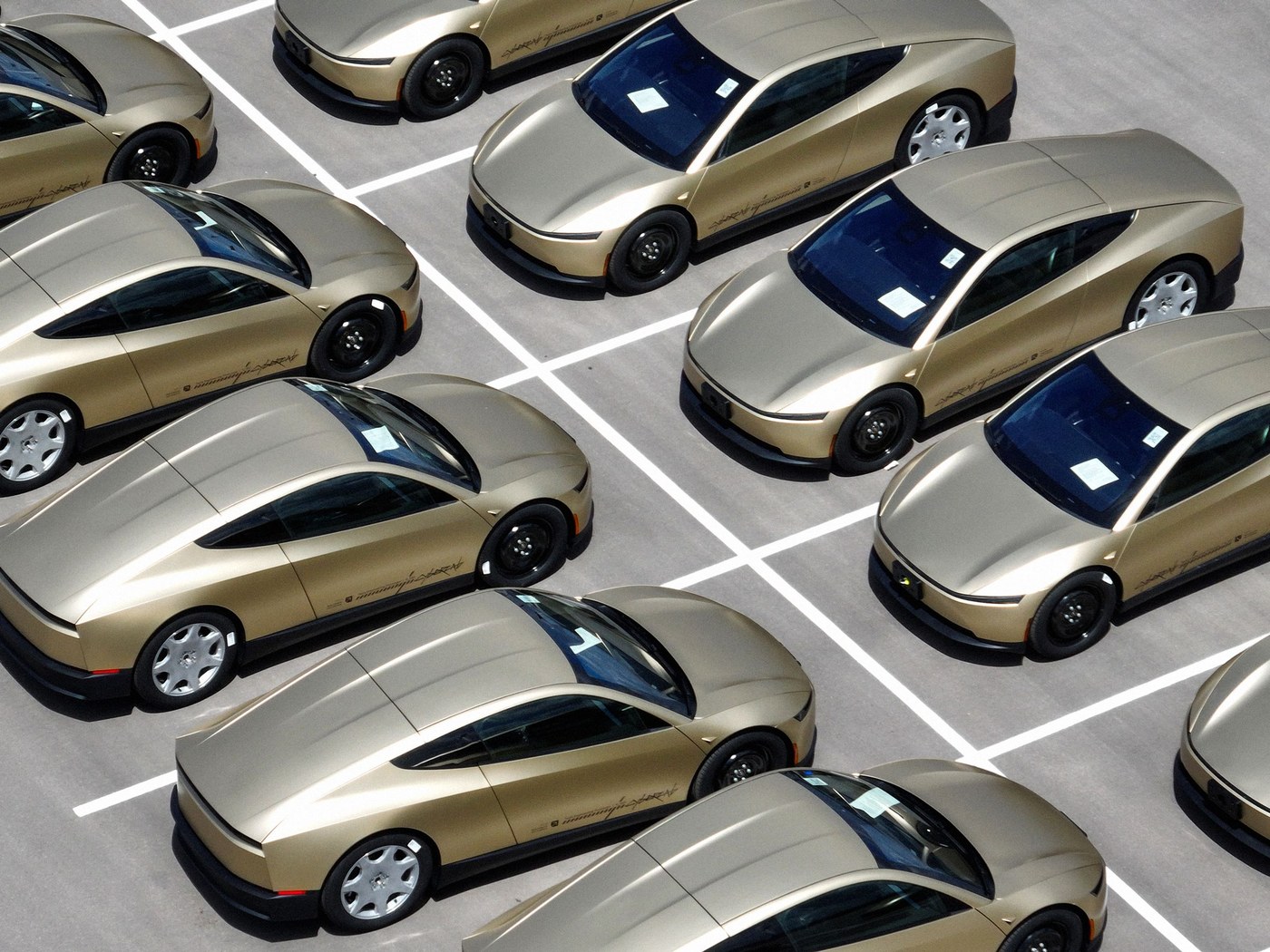
What I won't do is pretend the small things don't matter. Forty-five cars is a pilot. The safety record, while clean so far, is statistically young next to Waymo's. The consumer price is unconfirmed and legally complicated. The software has yet to prove itself outside carefully chosen geofences. Those aren't reasons to dismiss the launch — they're reasons to watch the next twelve months rather than declare a winner today.
If the fleet number starts climbing and the exemption question resolves, the Cybercab could be exactly the inflection point Tesla has been promising for a decade. If it stalls at 45, the quiet launch will look less like wisdom and more like a preview. Either way, the Cybercab is no longer a concept or a promise — it's a car on Austin streets with passengers in it, and that alone makes this launch worth remembering. I'll be watching the fleet count, and I'll post again when it moves.
• Reuters — Tesla starts Cybercab rides in Austin (Sep 3)
• WIRED — Tesla's Make-or-Break Cybercab Had a Quiet Debut (Sep 3)
• Austin American-Statesman via Yahoo — Cybercab launch live updates (Sep 3)
• Bloomberg — Cybercab Joins Robotaxi Fleet in Quiet Launch Event (Sep 3)
• TechCrunch — The Cybercab is Tesla's fork in the road (Sep 3)
• Forbes — Cybercab Launches With Closed Event (Sep 3)
• CnEVPost — Cybercab begins US operations; China debut set (Sep 4)
• Wikipedia — Tesla Cybercab specifications
• Photos: Wikimedia Commons (CC BY-SA) · Austin American-Statesman · Reuters via WIRED · charts self-rendered
Related on this blog: a million AI satellites, all running on NVIDIA · the $7,000 humanoid and open physical AI
Comments
Post a Comment