Tesla Roadster's Flight Demo: Which Car Was Shown?
HARDWARE & DESIGN
Tesla Roadster's Flight Demo: Which Car Was Shown?
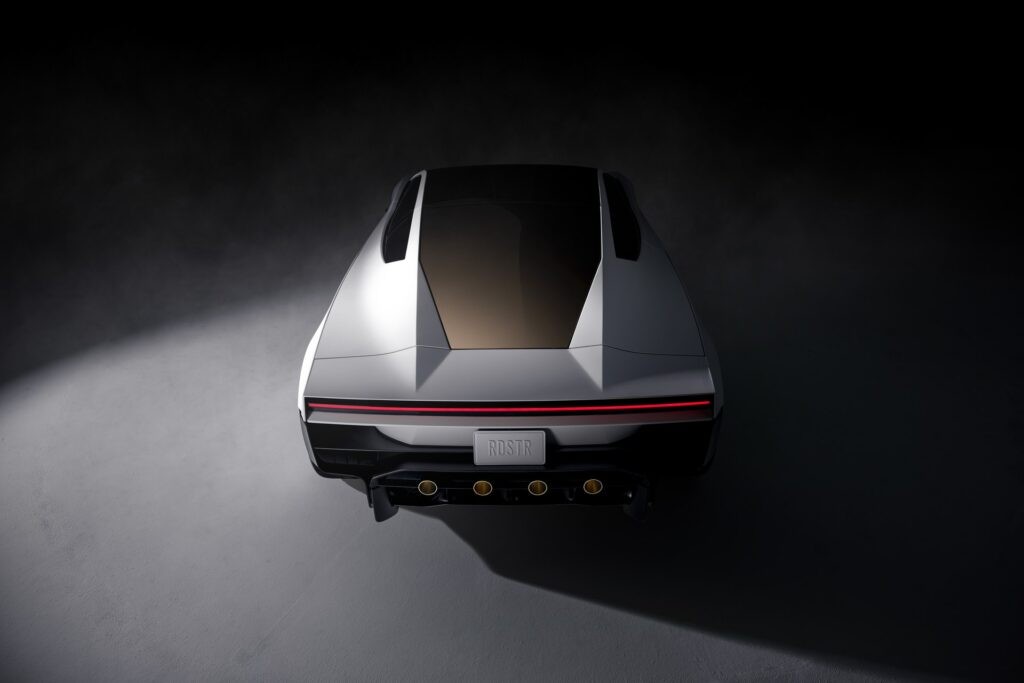
The Roadster footage shows more than a jump: the car changes its orientation after leaving the ramp. Before carrying that spectacle into a buying decision, check the configuration. Tesla describes the flight-capable Rocket as an invite-only single-seater without public-road approval.
In this article
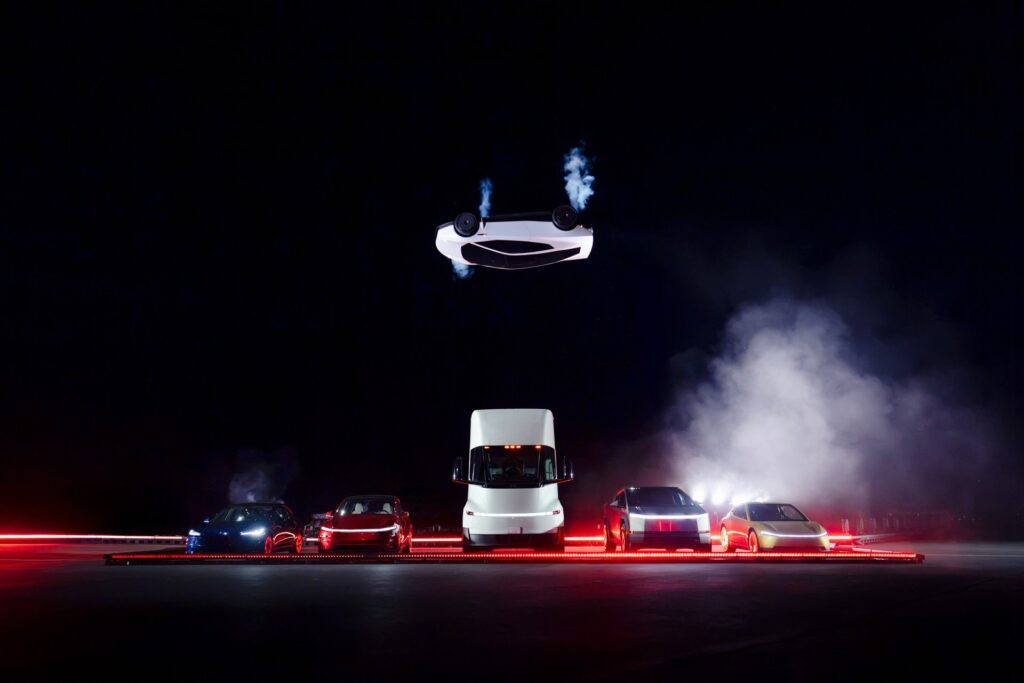
The two demonstrations
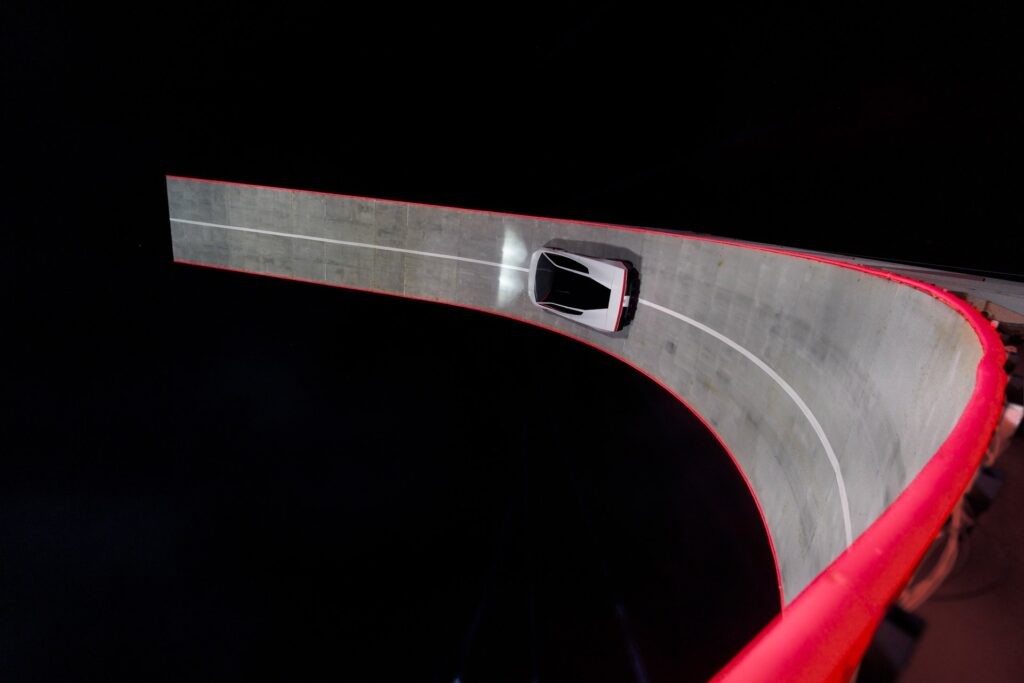
The first demonstration gives the second one its context. In Tesla’s “The Ramp” clip, the car climbs a steep curved structure until the road surface is effectively overhead. It leaves that structure, corrects its orientation and comes down beside the ramp. Thruster plumes make the transition from attached driving to motion through the air unusually easy to see.
In the kickflip, the car launches toward the parked lineup, rotates and lands beyond it. Leaving a ramp is familiar stunt territory. Changing the car’s orientation in the air is the part that needs explanation: the footage shows thrusters acting while the tires have no contact with the ground.
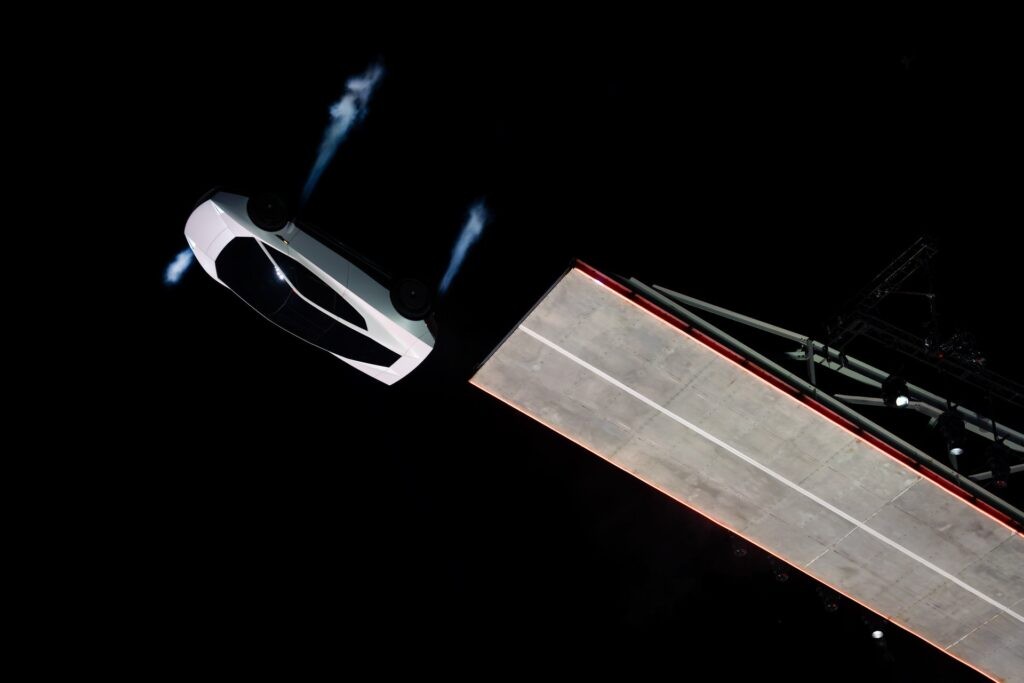
I would describe what the footage shows as a short, staged flight demonstration. It does not establish a useful airborne range, sustained cruising or a commuting route above traffic. That does not make the stunt less striking. It makes the word “flies” specific enough to mean something. These are Tesla’s own demonstrations; they are not an independent certification test.
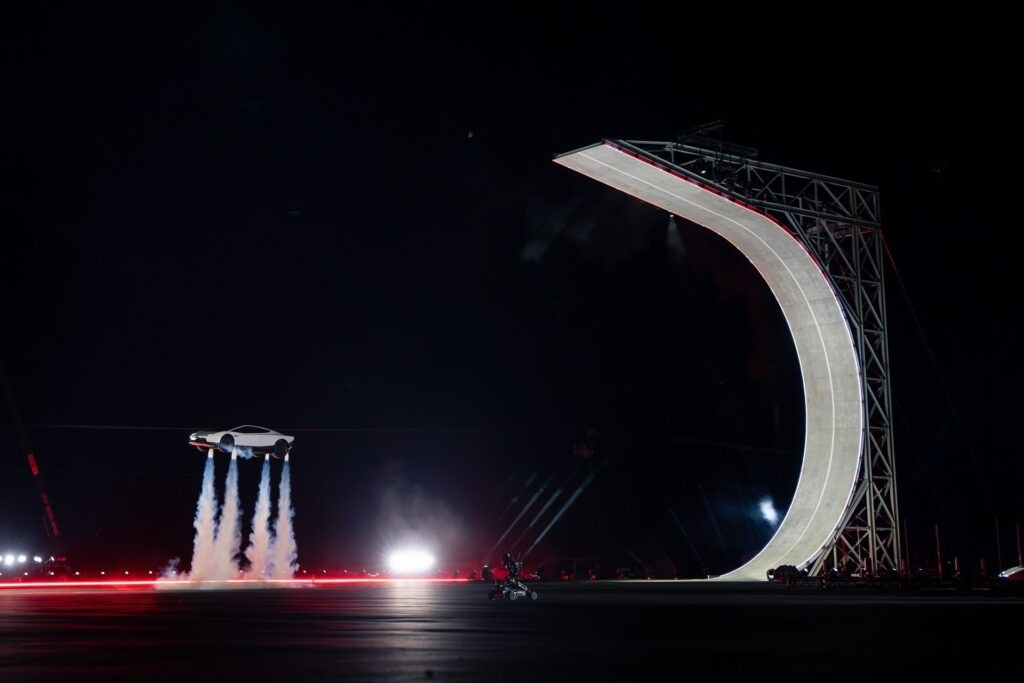
Tire contact, thrusters and rotation
Two systems do different jobs. Tesla describes fans and a sealing system that remove air from beneath the vehicle, generating downforce even at zero speed. It separately describes cold-gas thrusters that stabilize flight. In plain language: one system pulls the car toward a nearby surface, while the other expels stored gas to push the vehicle and control its orientation.
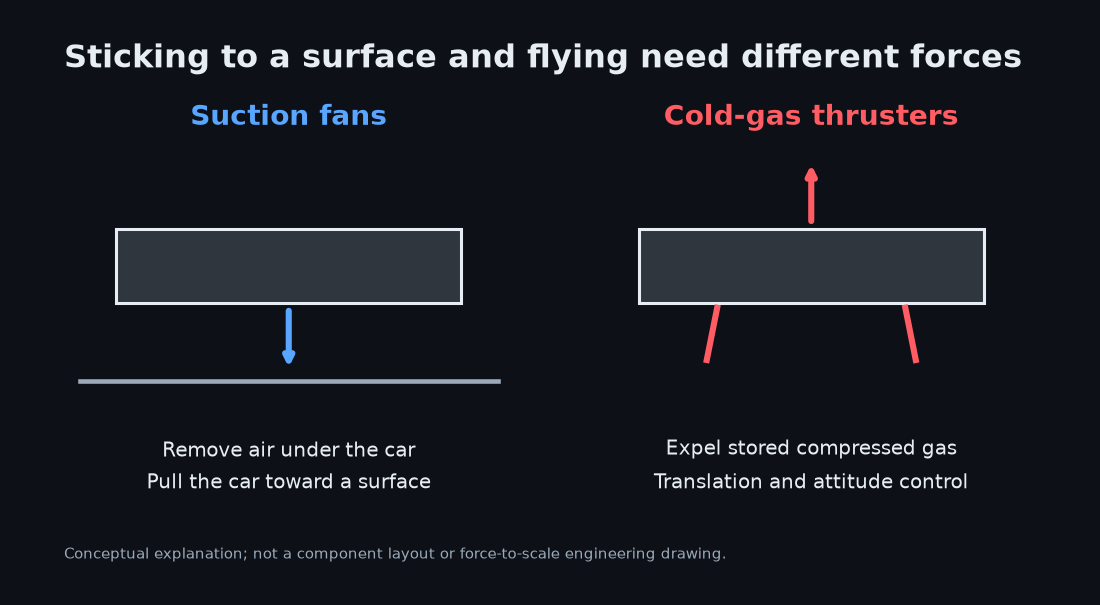
A wing relies on airflow, so its contribution changes with speed. Powered suction gives an engineer another way to create a pressure difference without waiting for the car to build speed. Once the vehicle is clear of the surface, that sealed-gap explanation no longer does the same job. Thrust and attitude control become the relevant ideas. Neither step needs a claim that physics has been broken.
Cold gas also does not mean a miniature combustion rocket is burning underneath the seat. The basic mechanism is stored compressed gas leaving through nozzles. That is still a finite supply. Recharging it, controlling the valves and managing repeated use matter just as much as making one spectacular pass. The reveal clips do not tell a buyer how many consecutive maneuvers are practical or how long a refill takes.
Reading the 0.81-second claim
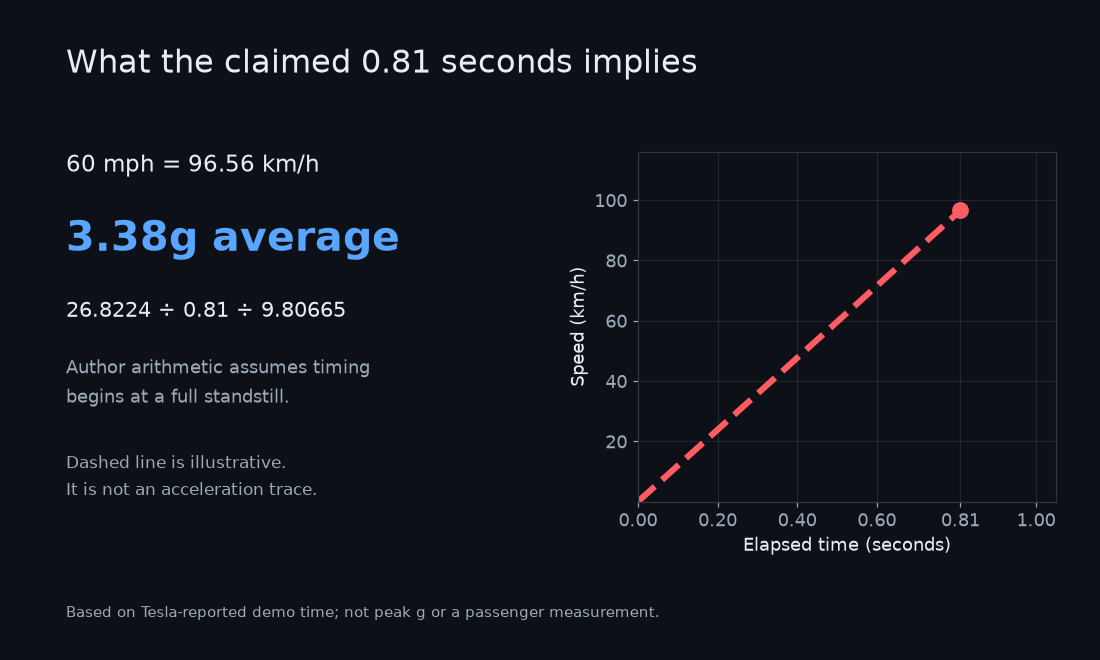
Tesla also announced a 0–60 mph time of 0.81 seconds during the reveal replay at about 23:08. I am treating that as a Tesla-reported demo result. It is not an independently measured record, and it is not a 0–100 km/h figure: 60 mph equals 96.56 km/h.
Here is my arithmetic. Sixty miles per hour is 26.8224 meters per second. Divide that speed change by 0.81 seconds, then by standard gravity, and the average is about 3.38g. That calculation assumes the clock covers the full change from a standstill. A rollout allowance would change what the published time means. We need the timing protocol before treating the arithmetic as a reconstruction of the run.
This is why the flight and acceleration stories belong together. Once a vehicle can apply thrust without relying entirely on the tires, a familiar stopwatch number can come from unfamiliar hardware. Comparing it with a conventional road-car test needs the same starting rules, surface conditions and equipment disclosure. A smaller number alone does not answer those questions.
Reservation choices and road approval
The configuration names are the part to read carefully. Tesla uses Performance as the road-ready car and lists Thrust and Rocket as augments. A reservation for the first configuration does not buy the flight system shown in the showcase. The following is the U.S. reservation-page snapshot checked on October 16, 2026; these amounts are deposits, not final vehicle prices.
| Configuration | Seats | What Tesla lists | Reservation status |
|---|---|---|---|
| Performance | 2 | Active aero and suction system | $5,000 now + $45,000 within 10 days |
| Thrust | 2 | Adds acceleration thrusters | Limited; $5,000 now + $245,000 within 10 days |
| Rocket | 1 | Adds a full flight system | Invite only; not approved for public road use |
The product page describes sub-one-second 0–60 performance for the Thrust option and warns that the page’s displayed features and specifications reflect that optional upgrade. It also says Rocket is not available in every region. I would not silently apply a flying-car clip or an option headline to the base reservation.
Musk’s stated production target in the replay is 2028. A target is a future plan; it is not an actual delivery date. The U.S. reservation screen I checked gives deposit terms, rather than a final selling price. The spectacle has arrived. The finished purchase proposition still has gaps.
The demonstration gives the thruster concept something concrete to discuss. It still comes from Tesla, under Tesla’s chosen conditions. Independent runs would need to show the control limits and how often the maneuver can be repeated.
For an owner, usable gas capacity, refill time and the equipment included in the delivered car matter as much as the maneuver. Those details determine whether the flight hardware has repeatable use. Production timing and road approval remain separate questions.
There is also a fascinating contrast with Tesla’s Cybercab passenger launch: one product removes the driver from the everyday journey; this one makes a driver’s car as extraordinary as possible. The Roadster does not need to solve ordinary transport to be interesting. It does need the final product to support the spectacle.
Comments
Post a Comment