Claude's November Abuse Rule: Read the Exceptions
AGENTS & WORKFLOWS
Claude's November Abuse Rule: Read the Exceptions
A frustrated customer still needs to be able to challenge a wrong answer. Anthropic's November 12 provision addresses repeated, purposeless abuse, with exclusions for ordinary disagreement, testing and other uses. Those exclusions are central to understanding what the published rule says.
In this article
Anthropic announced the update on October 8, 2026, with the revised policy effective November 12. It targets extreme, repeated abuse without a discernible purpose. Ordinary frustration, disagreement, dark creative themes, testing and research are excluded from this provision. The main response remains ending the conversation. Source: Anthropic's announcement.

The provision taking effect November 12
The revised Usage Policy includes “sustained and needless abusive or cruel behavior” toward Anthropic's models among prohibited conduct. Read the adjectives together. There is no published swear-word counter or precise message threshold in the documents reviewed here.
Conversation ending has a longer history. On August 15, 2025, Anthropic described it for Opus 4 and 4.1. That historical announcement presented it as a last resort after unsuccessful attempts to redirect an interaction, or when a user explicitly requested an end. The October update places a related conduct rule in the policy; it does not mark the feature's debut.
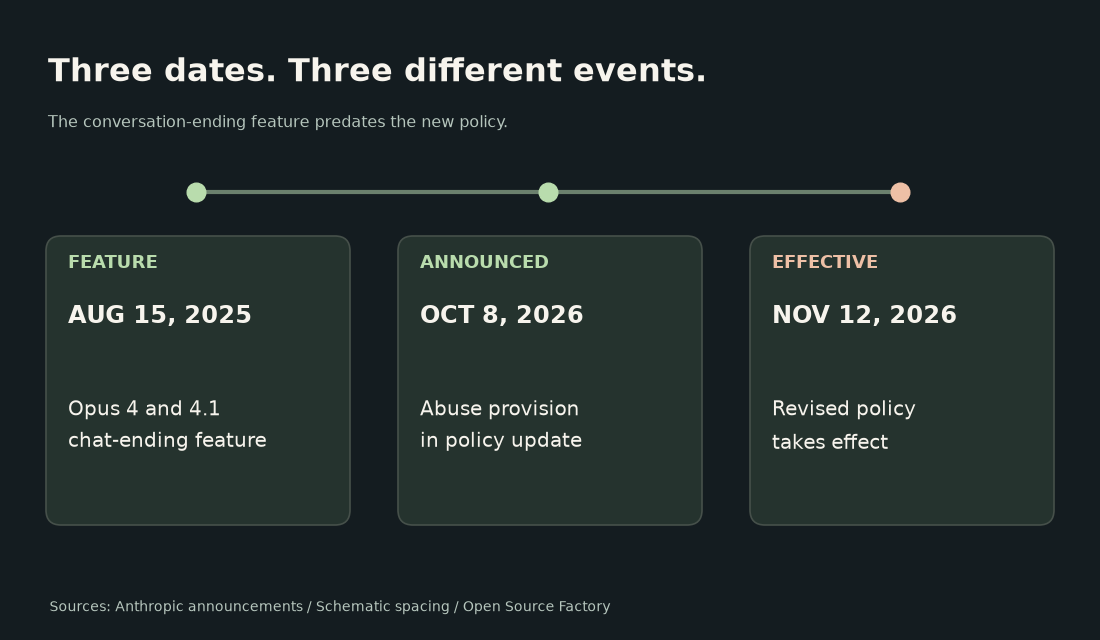
That distinction matters when reading a headline. A policy revision describes permitted use and enforcement. A feature announcement describes something the product can do. Neither document tells us how frequently a current account will encounter that behavior.
Can you still criticize Claude?
Yes. The explicit exceptions leave room for criticism. I would read that as permission to keep demanding accurate work, rather than turning every correction into a small performance of gratitude. A useful tool has to tolerate being corrected.
The examples below are my illustrations of the distinction, not Anthropic's test cases or a guarantee about a model's response. Each keeps a task in view.
| Situation | A task-focused way to respond |
|---|---|
| A script still fails | Point to the failing test and ask for a fix that preserves the requirements. |
| An answer appears invented | Challenge the claim, request the source, and identify the unsupported sentence. |
| A difficult fictional scene | Explain the creative purpose and the limits of the scene. |
For me, the useful distinction is what the interaction is trying to accomplish. Direct criticism can improve a result. Repeatedly trying to humiliate the system can become the entire activity. That is my reading of the boundary, not an automatic classifier readers should rely on.
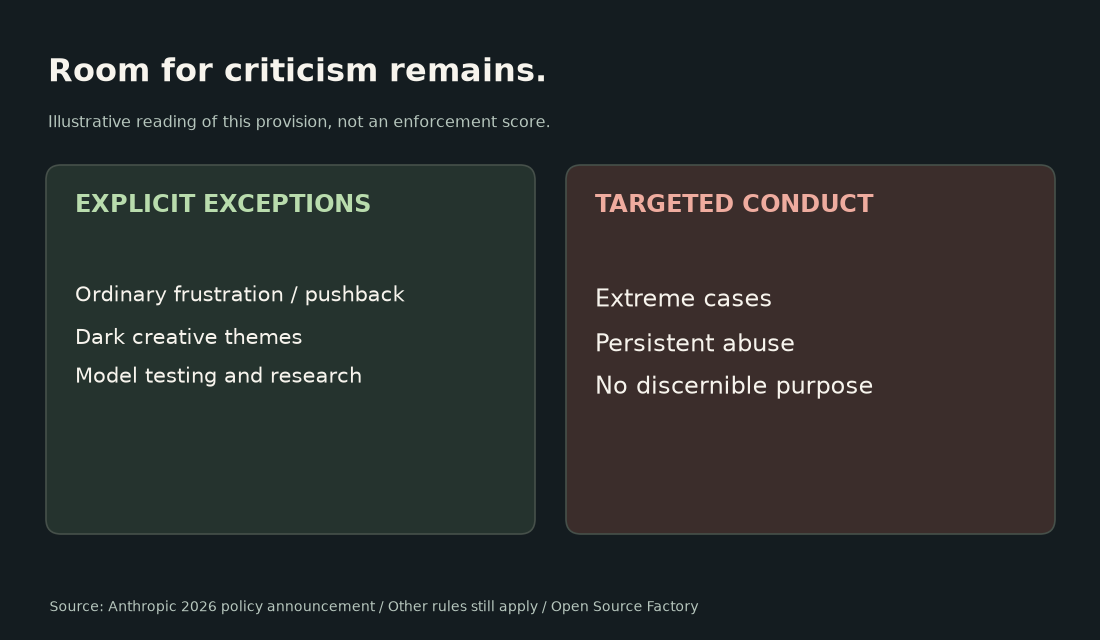
There is also a practical limit to the exceptions: being outside this particular abuse provision does not put an activity outside the rest of the policy. Calling something research is not a blanket authorization to conduct harmful activity.
Conversation endings and account actions
The October announcement identifies ending rare abusive interactions in Claude.ai and Claude Code as the main enforcement mechanism for this provision. The broader Usage Policy separately allows warnings, access limits, suspension and termination. It also says a blocked output alone does not establish a policy violation.
The August 2025 feature documentation describes a narrower product action: the ended thread stops accepting new messages, while other conversations remain available. Users could start a new chat or edit and retry earlier messages to branch the conversation. Those are documented historical behavior details, not a hands-on verification of every current model or integration. Source: original feature description.
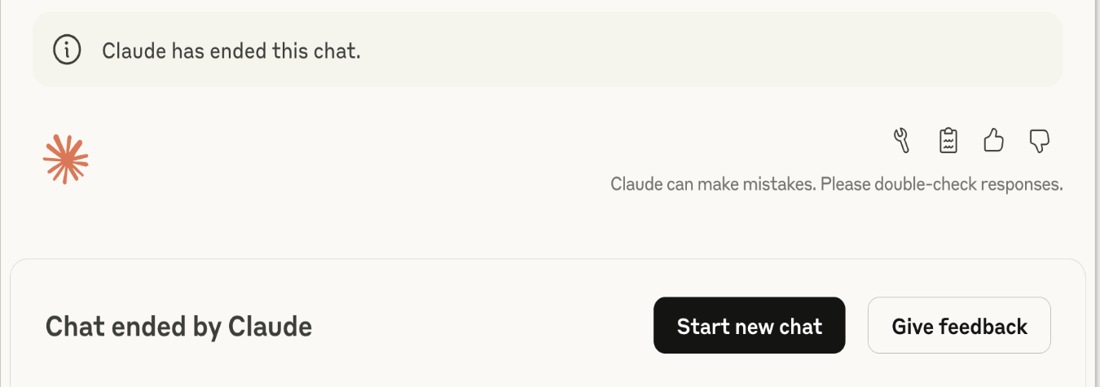
Policy coverage is broader than one chat app. It includes API developers, businesses, cloud and reseller customers, and downstream users. That scope does not establish identical controls in every integration. A developer should verify the interface they actually ship. Source: policy scope.
What the rule says about model welfare
The policy cannot answer that question. Anthropic's April 2025 model-welfare research post describes scientific and philosophical uncertainty. Its current constitution also treats Claude's consciousness and moral status as unresolved. A rule about how a service may be used does not settle whether the model experiences suffering.
I can see a practical argument for letting a deliberately abusive exchange end without first solving consciousness. I also understand the concern: a system that writes as if it has personal boundaries can encourage people to infer a person behind the text. The product needs to communicate its behavior carefully.
For a paying user, there is another question. Could the rule make legitimate complaints harder to express? That is where the exceptions and the behavior people actually see become more useful than the philosophical branding around the announcement.
Checking mistaken endings
I would look for specificity, proportionality and a usable way forward. These are my evaluation criteria, not a scorecard published by Anthropic. Specificity means explaining the relevant conduct. Proportionality means choosing a response suited to the situation. A usable way forward means making clear what the user can still do.
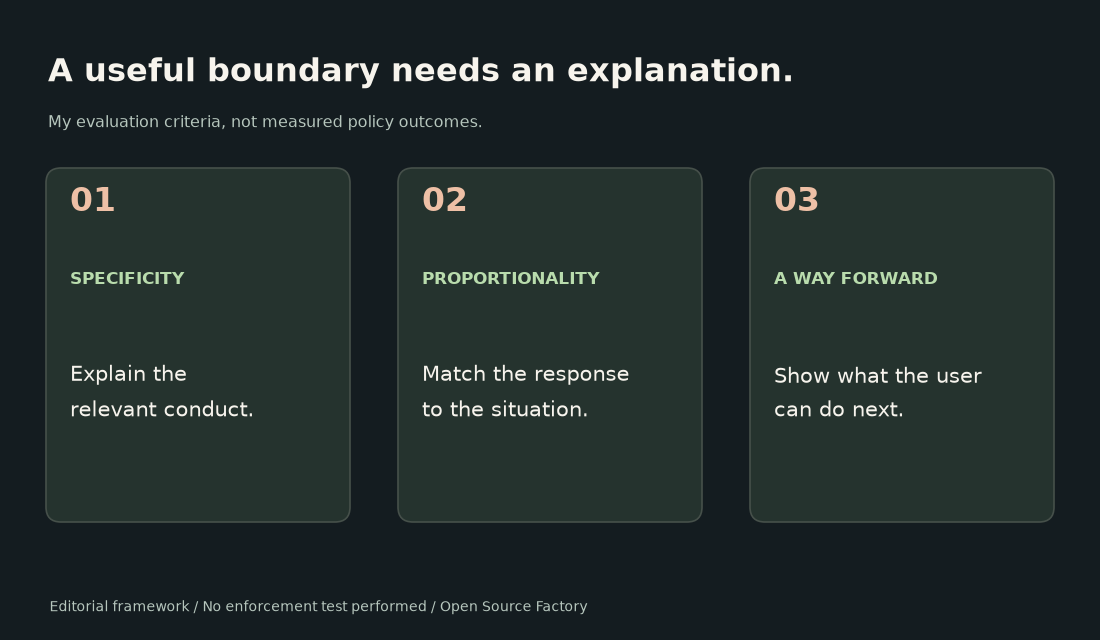
Suppose a developer says, “That still fails. You ignored the constraint.” I would want the system to return to the constraint and the failing example. If a conversation ends unexpectedly, a clear explanation and accessible feedback would matter more to me than an emotional farewell.
We previously examined Claude Code's subscription limits, another place where expectations depend on clear rules. Our separate AI-agent safety article concerns unintended actions. This story concerns how a service responds to users. Keeping those questions distinct helps us ask for the right evidence.
Ending a persistently abusive exchange can be a reasonable product boundary. Its implementation also needs to preserve criticism, error reports and requests for a remedy. A clear policy is only part of that job; mistaken conversation endings would affect customers directly.
The announcement provides no rate of mistaken endings, and this article does not test the triggers. The documented exclusions support continuing to correct Claude directly and supplying evidence of the error. Whether the product consistently honors those exclusions requires separate observation.
Sources and scope
2026 policy announcement · October 8
Usage Policy · effective November 12, 2026
Conversation-ending feature · August 15, 2025
Model-welfare research · April 24, 2025
Claude constitution · uncertainty about consciousness and moral status
This analysis reviews primary documents. No hands-on enforcement test was performed. Scenarios and evaluation criteria are editorial judgments. Source dates are shown above; policies and interfaces can change.
Comments
Post a Comment