Google Suncatcher: Orbit Is the Start of the Test
HARDWARE & DESIGN
Google Suncatcher: Orbit Is the Start of the Test
Getting a compute prototype into orbit answers a launch question. Sustained useful work raises others: heat rejection, radiation errors, links and replacement cost. Google's Suncatcher announcement is a reason to examine those engineering conditions rather than assume that solar energy makes orbital computing economical.
In this article
On October 1, 2026, Google announced that its first Project Suncatcher prototype had launched with Planet on SpaceX’s Transporter-18 mission. The team confirmed contact and said it was operating as expected. The question now is whether the sunlight advantage can pay for the hardware, cooling and networking needed to do useful AI work up there.
I went through the launch update, the engineering notes and the public technical report. The part that caught my attention was the gap between getting a chip into orbit and making an orbital computer worth buying time on.

Suncatcher uses Google’s Tensor Processing Units, or TPUs: chips designed to run machine-learning workloads. The orbital prototype is there to collect evidence about hardware survival and operation. Google has not announced a public orbital AI service or a price for one.
| Milestone | What the official updates say | How I read it |
|---|---|---|
| October 1, 2026 | Prototype launched; contact confirmed | A hardware experiment is now in orbit. |
| The following weeks | Collect radiation and thermal data | Operating as expected is a starting status, not a published performance result. |
| 2027, planned | Two-satellite laser-link test | Coordinated compute still needs an orbital networking demonstration. |
The timing matters. Planet’s 2025 announcement described a two-satellite mission targeting early 2027. Google’s newer updates separate this first hardware flight from the later link test. The October launch does not tell us that the two-satellite experiment has already happened.
Using sunlight where it is collected
An orbital AI system would use solar electricity where it is generated and send data back. A power satellite serving Earth would instead have to transmit its energy. That difference changes the communications problem; it does not remove the need to move useful results reliably.
Google’s system-design proposal points to near-continuous sunlight in suitable orbits. It says an equal-area panel could receive up to eight times more solar energy per year than a panel at Earth’s mid-latitudes. That is a comparison of annual energy under favorable conditions. It is not eight times the instantaneous sunlight, eight times the compute, or a measured result from this prototype.
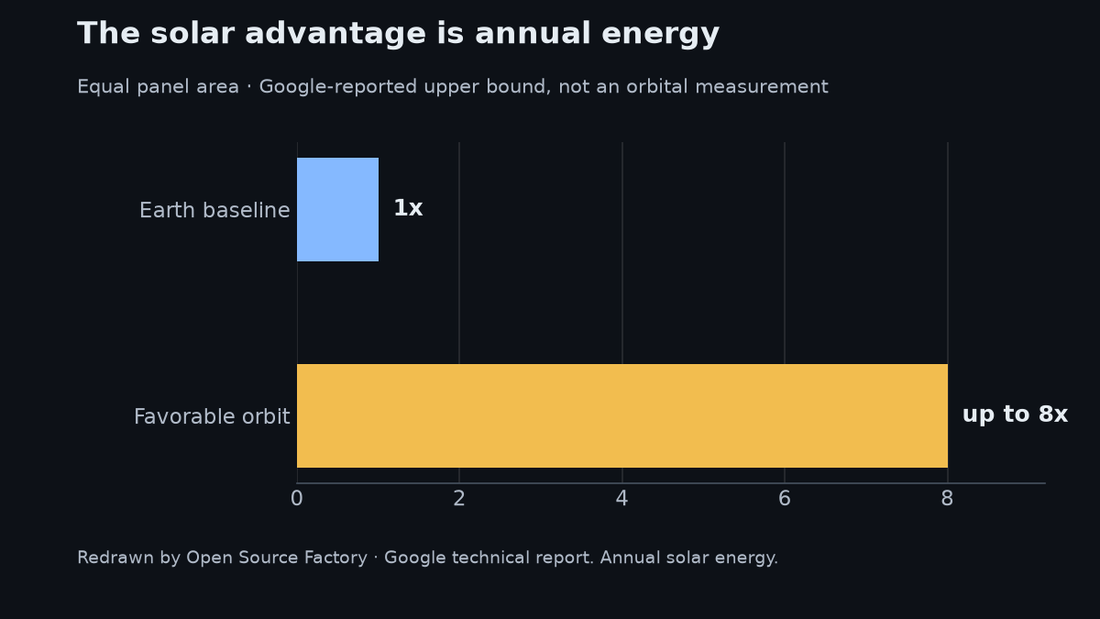
That advantage is worth investigating. More hours of illumination can improve how much useful energy a panel produces over its lifetime. It could also reduce the amount of storage needed to bridge darkness. The actual benefit depends on the orbit, panel orientation, conversion losses and the power needed to run the spacecraft itself.
My first question would be energy delivered to working chips per kilogram launched. A large panel that looks impressive in a rendering is only part of that answer. Its support structure, deployment mechanism and power electronics travel on the rocket too. The design has to earn back the cost of bringing all of them.
Heat rejection in vacuum
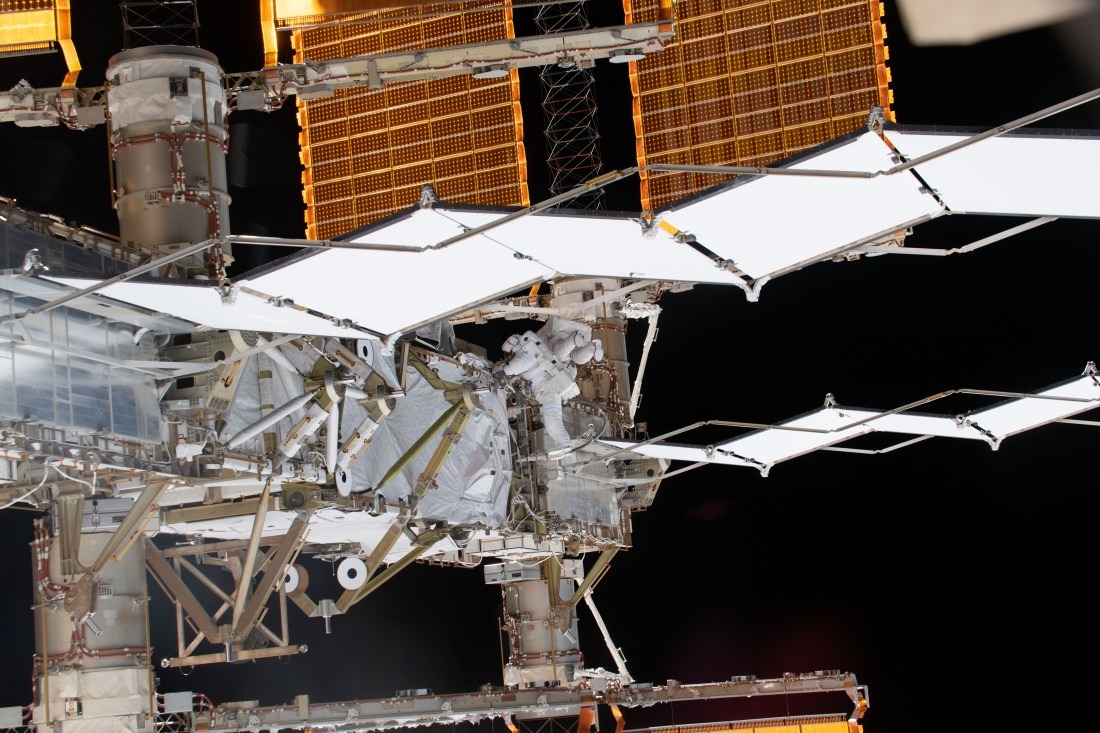
Space is cold, but a vacuum does not give a hot chip a cold breeze. NASA’s thermal-control reference explains that spacecraft move heat internally through conductive paths, then reject it to the external environment through radiation. Heat pipes and radiators are physical hardware, with area and mass that have to fit into the spacecraft.
I did a deliberately simple calculation to get a feel for the scale. Suppose a system has to reject 1 MW of heat. Assume an emissivity of 0.9 and a perfect view of cold space, with no incoming sunlight, Earth radiation or reflected heat. The Stefan–Boltzmann relation gives the emitting area as A = Q / (εσT⁴).
At a radiator surface temperature of 300 K, about 27°C, that works out to roughly 2,419 m². At 350 K, about 77°C, it falls to 1,306 m². At 400 K, about 127°C, it is roughly 765 m². Those are my scenario calculations, not Google’s radiator sizes or proposed chip temperatures.
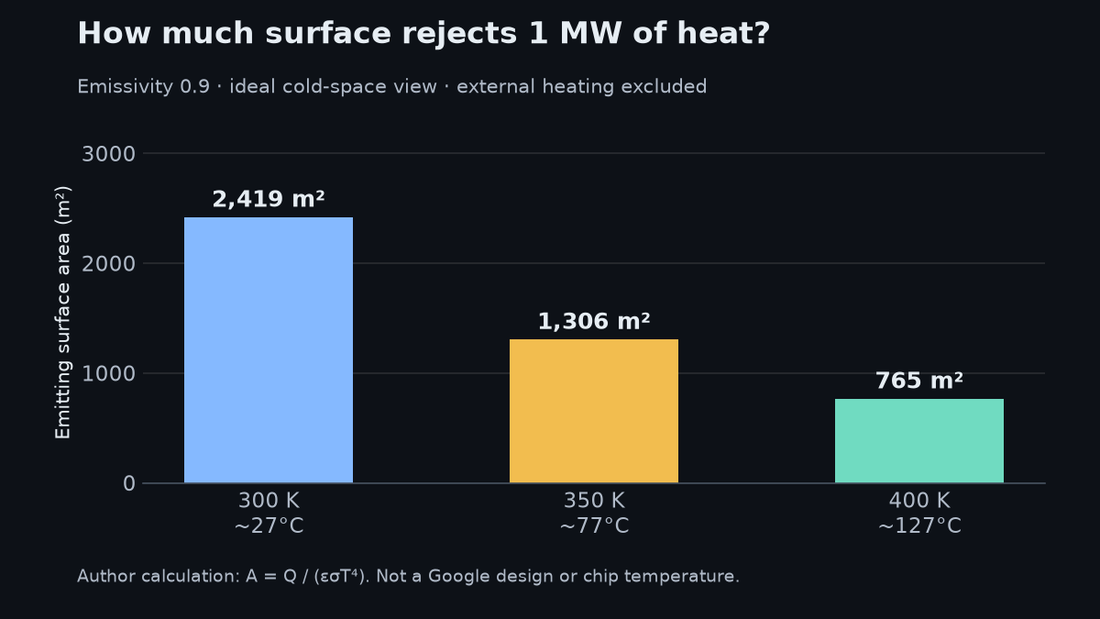
A radiator can emit from more than one surface when the geometry allows it. That changes the relationship between emitting area and physical footprint. Real surfaces also absorb outside heat and can have restricted views of space. This is an illustration of the heat budget, not a finished spacecraft design.
The higher-temperature result does not offer an easy escape. The chip, coolant and thermal interfaces all have operating limits. Raising the radiator temperature means the rest of the cooling path must support it. I would want to see stable workload results and temperatures together before calling the system successful.
Links between computing satellites
Keeping individual chips alive is useful. Getting them to work together is a different hurdle. If a workload has to exchange data frequently, an accelerator can spend too much time waiting for its neighbors. A collection of fast chips can still make a slow system.
The public technical report describes a short-path laboratory optical demonstration at 800 Gbps in one direction, or 1.6 Tbps when both directions are counted. It explores much higher bandwidth using parallel optical channels. These are lab results and design possibilities, not speeds measured between the prototype and another satellite.
For a sense of scale, 800 gigabits per second is 100 gigabytes per second before protocol overhead. Moving 1 TB across that one-way link would take at least 10 seconds in decimal units. That is my arithmetic; a real workload’s communication pattern and overhead would determine whether the link is sufficient.
Google’s September engineering update describes close-flying clusters connected by precisely aimed lasers, with an orbital link test planned for 2027. The part I would watch is sustained useful throughput while both spacecraft move. A peak link number alone cannot tell us how often a training job waits, retries or loses synchronization.
Radiation adds another reason to look beyond peak performance. Google reports promising ground tests of Trillium TPUs. An accumulated radiation-dose test, however, does not certify every possible fault or prove years of reliable operation in flight. I would look for recoverable error counts, restart behavior and lost workload time in the next results.
Launch costs in the cost model
This is where the sunlight story meets the spreadsheet. Solar energy does not carry a utility bill in orbit, but collecting and using it requires equipment. That equipment has to be built, launched, operated and eventually replaced.
The technical report models launch prices reaching around $200 per kilogram or less by the mid-2030s, under assumptions about reuse and cumulative launch activity. It explicitly stops short of a comprehensive economic feasibility study. I read that as a condition the project hopes to benefit from, not a current quote or a promised date for cheap orbital AI.
Here is a small sensitivity exercise. Take a hypothetical 1,000 kg payload. At an assumed launch rate of $200/kg, lifting it costs $200,000. At $1,000/kg, it costs $1 million. At $5,000/kg, it costs $5 million. The payload mass and the two higher rates are illustrative choices; none are presented as Suncatcher’s actual budget or today’s market price.
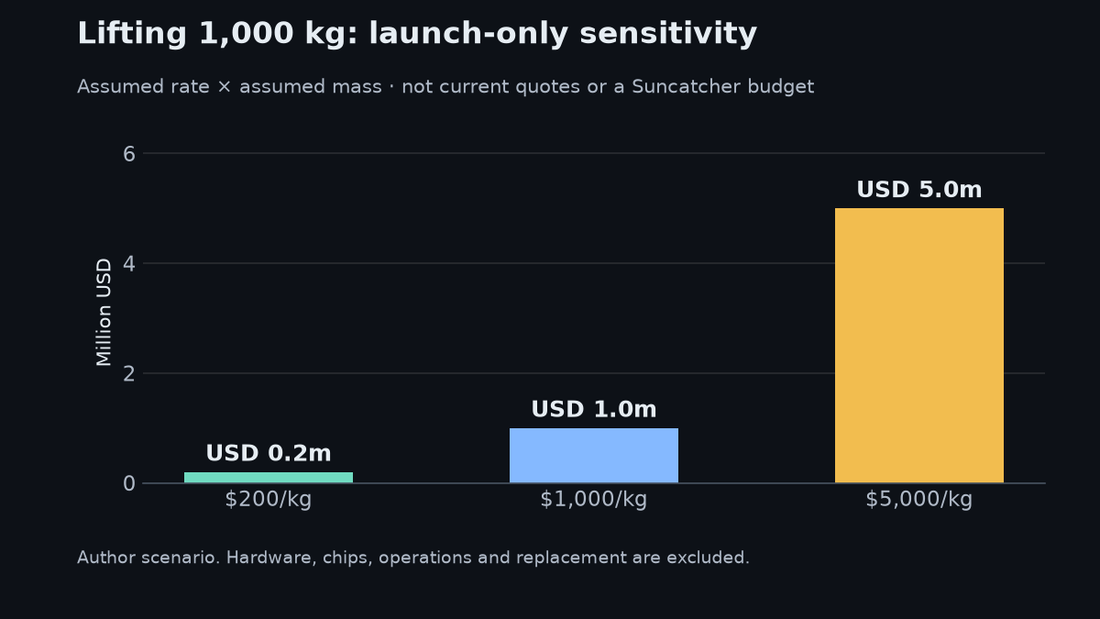
The arithmetic explains why launch price matters, but it does not settle the comparison. A cheap flight can still carry an expensive computer that is difficult to upgrade. A hardware failure can erase useful capacity long before the solar panels wear out. A complete comparison should price the compute customers actually receive over the system’s working life.
I would compare cost per completed workload at the same quality and reliability target. That brings cooling losses, idle time, communication stalls and replacement into the answer. Power availability is a good reason to start the experiment. It is not enough to declare the eventual service cheaper.
The launch moves Suncatcher into a more useful stage: the team can gather evidence from a real orbital environment. I am interested because the project turns a broad infrastructure idea into questions that experiments can answer. That is a better reason to follow it than a dramatic image of servers circling Earth.
The next useful results would report a sustained AI workload, its temperatures and the work lost to errors or interruptions. A multi-spacecraft system also needs the planned laser link to keep a demanding job moving. Feeding those measured values into the cost model would make the economic comparison more convincing.
We previously covered another proposal for orbital AI infrastructure. Suncatcher is worth following on its own because Google now has a flight experiment to learn from. For now, a successful launch has earned the next experiment.
Comments
Post a Comment