Mac Studio 512GB: Can It Run a 1T-Parameter AI Model?
Mac Studio 512GB: Can It Run a 1T-Parameter AI Model?
A trillion-parameter coding model on one Mac was the first thing I wanted to check. Kimi K2.7 Code makes that a plausible project: one published Q3 package, including its vision projector, is about 419.8GB. The catch is in the word “package.” That number leaves out the operating system, working buffers and conversation cache.
The 512GB Mac Studio opens a serious door for giant local AI. I narrowed this comparison to five models with roughly 480 billion to one trillion parameters, rather than filling it with smaller models that miss the point. I checked downloadable weights, exact file sizes and documented runtime routes. This is a capacity and compatibility analysis; I have not benchmarked these models on a 512GB Mac.
Which 512GB Mac Studio is actually available?
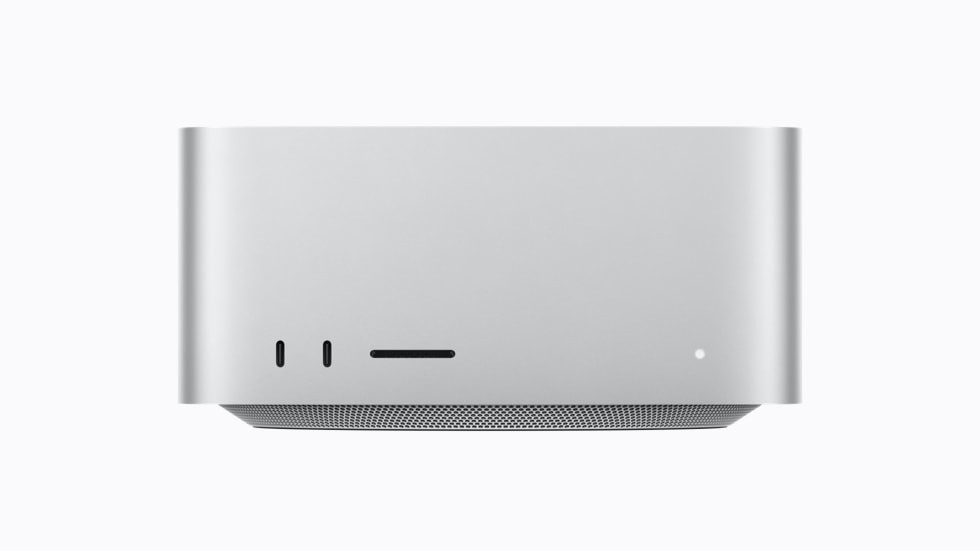
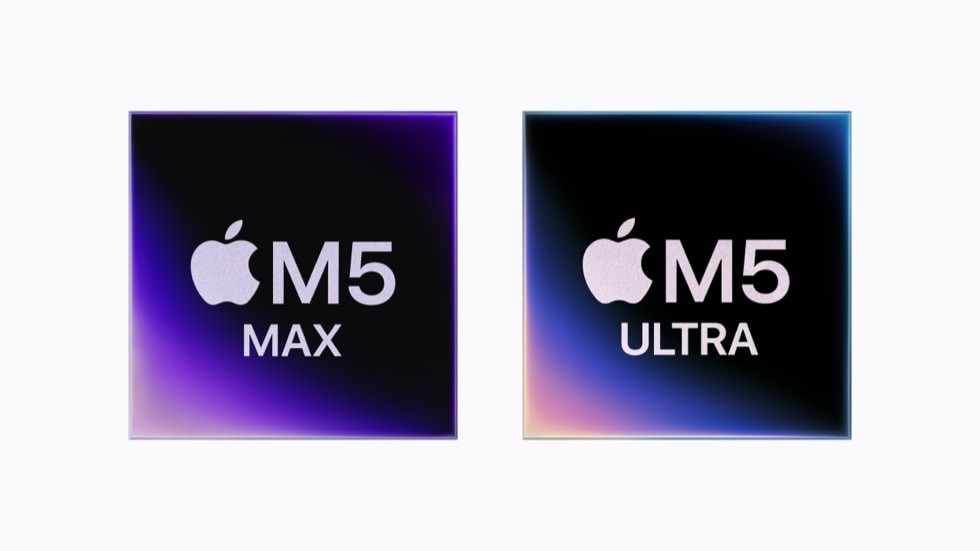
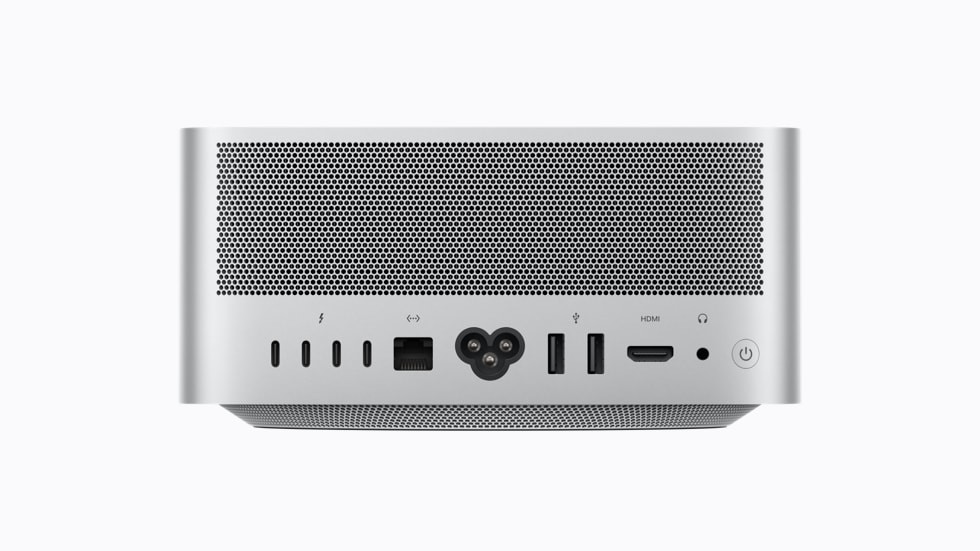
Apple's current option is the M5 Ultra with a 36-core CPU and 80-core GPU. Its listed memory bandwidth is 1.2TB/s. The generation was announced on August 25, 2026, with general availability from September 22; Apple scheduled the 512GB configuration separately for late October. It is now selectable in the US store. Apple specifications · launch announcement.
On October 29, the US Apple store showed US$22,299 before sales tax for that chip, 512GB unified memory and a 1TB SSD. That is the actual selected configuration, not a starting price attached to a memory upgrade it does not include. Delivery estimates change, so I would check the store again before buying. Apple US configurator.
This is a new availability story for the M5 Ultra configuration, not the first 512GB Mac ever: M3 Ultra already offered that capacity in 2025. My earlier Mac Studio runtime analysis covered the hardware case. Here, the interesting question is which enormous checkpoints belong on the download list.
Which giant models make the shortlist?
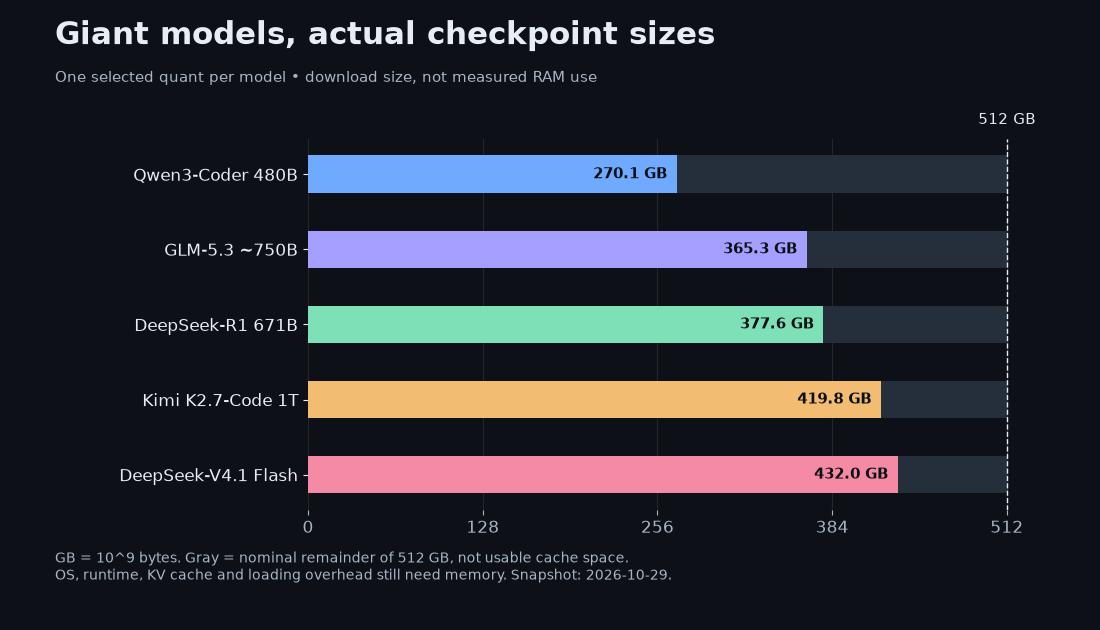
Every size below comes from adding the selected repository's actual weight-file bytes, not multiplying a parameter headline by four bits. These are downloadable-file totals in decimal GB, rounded to one decimal. They are candidates for local inference, not promises of full GPU residency, maximum context or a particular speed.
| Model and scale | Selected checkpoint | Files | Mac route / reason to try |
|---|---|---|---|
| Kimi K2.7 Code 1T total / 32B active | UD-IQ3_S + BF16 vision projector | 419.8GB | llama.cpp / trillion-parameter coding and vision |
| GLM-5.3 About 750B | UD-IQ4_XS | 365.3GB | llama.cpp / complex coding and extended tasks |
| DeepSeek V4.1 Flash-1017 552B backbone + 196.6B Engram | oQ4e-mtp mixed MLX | 432.0GB | Compatible MLX/oMLX stack / recent reasoning, coding and vision |
| DeepSeek R1-0528 Full 671B / 37B active | MLX 4-bit | 377.6GB | MLX LM / full reasoning model, historical reference |
| Qwen3-Coder-480B-A35B 480B total / 35B active | MLX 4-bit | 270.1GB | MLX LM / giant coder with the most memory room here |
GLM's deployment guide uses 744B, while the model repository reports 753B; “about 750B” avoids treating those counts as identical. DeepSeek's 432.0GB package includes its Engram tables, vision components and MTP head. None of these rows is a distilled small model.
Kimi K2.7 Code: the trillion-parameter headline is real
This is the row that changes the scale of the conversation. The official model is a 1T-parameter MoE with 32B active, built for coding and agent workflows, with visual input. Unsloth documents a llama.cpp route and discusses Mac Studio use. That gives us an actual software path alongside the capacity calculation.
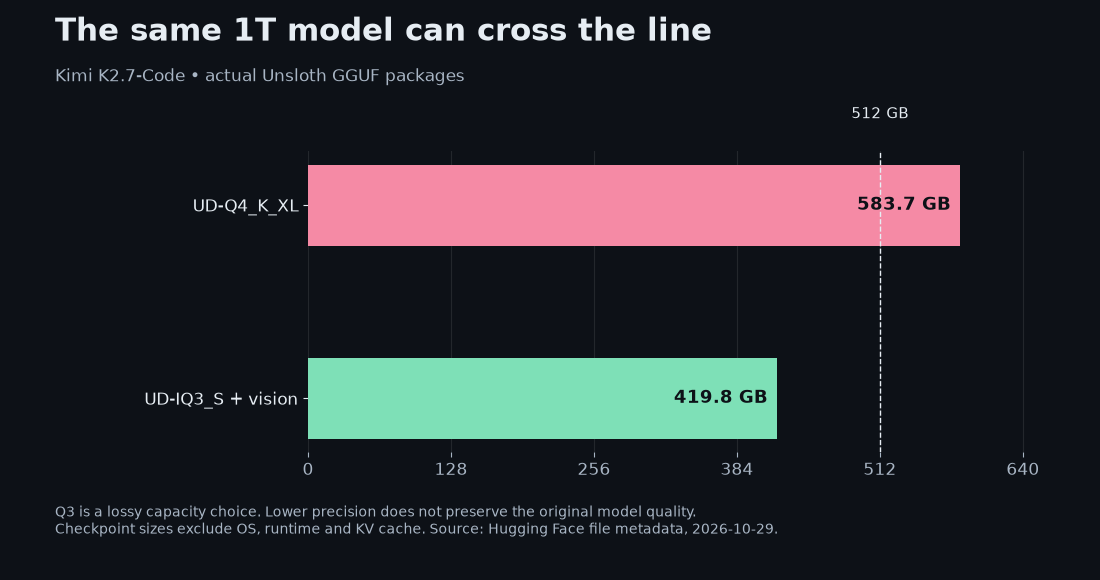
The selected IQ3_S shards total 418.807GB. Adding the 0.954GB BF16 vision projector gives 419.761GB. I would start with one session and a modest context, then measure memory pressure and output quality on my own repository. A long coding conversation adds cache and tool output; the advertised context window is not a guarantee that the largest setting fits.
The same repository's UD-Q4_K_XL files total 583.7GB, already beyond the nominal memory capacity before runtime overhead. Q3 is therefore a lossy compromise, not a way of getting native-quality Kimi for free. Its modified MIT license also deserves a read before deployment.
GLM-5.3: a roughly 750B coding model with a less cramped option
The useful selection here is UD-IQ4_XS at 365.3GB. The larger UD-Q4_K_XL is 467.3GB, which leaves a much tighter nominal margin for the system and actual work. Those labels are different quantization recipes; “4-bit” alone does not tell you what will happen. GLM quantization repository.
I would put GLM on the list for complex code changes and tasks with several dependent steps. Its deployment guide supplies the llama.cpp path. That is a reason to test it, not evidence that it beats the other rows on this Mac. The GLM-5.3 license is model-specific; I would not casually label the weights MIT or Apache.
DeepSeek V4.1 Flash: count the memory tables too
The word “Flash” hides a very large download. This checkpoint combines a 552B backbone with 196.6B Engram tables, plus vision and prediction components. The component breakdown from the publisher totals about 763.2B logical weights and 432.0GB of stored tensors.
This mixed-precision oQ4e conversion is the specific candidate. An ordinary “4-bit” conversion is not interchangeable. I would verify support for both the DeepSeek architecture and this packed format in the chosen MLX/oMLX release before committing a huge download. The source card's MLX-VLM example is a deployment lead, not a successful run recorded for this article.
Full R1 and Qwen Coder are still interesting at this scale
DeepSeek R1-0528 is the full 671B model here, rather than a distilled 8B or 32B relative. Its 377.6GB MLX conversion makes it a useful reasoning reference. It is an older release, so this is a deliberate baseline, not a claim that it is the newest DeepSeek. R1 conversion and MLX example.
Qwen3 Coder 480B has the largest nominal memory margin among these five at 270.1GB. That is why I would start the first coding experiment there, then move up. Its non-thinking design also makes it a different workflow choice from a thinking-only model. This is a memory-based starting order, not a throughput ranking. Qwen model card.
Why doesn't 512GB make every giant model practical?
Unified memory is shared by the CPU, GPU and operating system. It is not a separate 512GB graphics card alongside another pool of system RAM. MLX documents both shared memory and device working-set information. The application still needs its cache, temporary tensors and loading buffers. I would inspect the actual machine with python -c "import mlx.core as mx; print(mx.device_info())" rather than assume a fixed percentage is available to every backend. MLX unified memory · MLX allocation limits.
MoE adds another common trap. “32B active” describes the part used for a token's computation; it does not shrink Kimi's complete weights to a 32B download. In a fully resident setup the experts still occupy memory. Runtime-specific offloading changes that tradeoff, with its own performance costs.
Apple's 1.2TB/s bandwidth matters, but it does not produce a reliable tokens-per-second ranking from this table. Prompt processing, output generation, active experts, memory access, quantization kernels and context length all matter. Dividing bandwidth by the whole checkpoint size would be especially misleading for these MoE models. I have left invented speed figures out.
There is also a boundary beyond this shortlist. the Qwen3.8 2.4T release would need about 1.2TB for an idealized four-bit weight payload alone. Kimi K3 is 2.8T; an IQ1_S package is about 594GB. More extreme files exist, but a file below 512GB is not enough evidence of useful quality or a working Mac configuration. Neither belongs on my straightforward single-Mac recommendation list.
What would I actually load first?
I would start with Qwen Coder 480B to establish a repeatable coding task and memory baseline. Then I would try GLM-5.3 for the same task, Kimi for the trillion-parameter coding-and-vision experiment, and DeepSeek V4.1 once its exact runtime support is confirmed. R1 stays as a full-size reasoning reference.
For each run I would record the checkpoint revision, runtime version, context setting, peak memory, prompt-processing rate, generation rate and whether the final code passes the task's tests. The repository and backend names matter as much as the model's marketing name. A successful short prompt establishes a starting point; it does not establish multi-user serving or full-model training.
My take
The exciting claim is specific: a single 512GB Mac now has credible paths toward a trillion-parameter Kimi and several 480B–750B-class models, using carefully selected quantizations. That is a much more interesting use of this machine than another list of small chatbots.
At US$22,299 before sales tax, I would want repeatable results before treating it as a good purchase. The files and software routes justify the experiment; they do not settle speed, quality after quantization or value. My first real test would be simple: take the same code task through those giant models and see which one actually finishes it.
Research checked October 29, 2026. File sizes are sums of published weight shards, not downloaded-and-run results. GB = 1,000,000,000 bytes; runtime tools may report GiB. All model capability descriptions come from their publishers; no vendor benchmark scores are reused as Mac performance measurements. Original comparisons and charts: Open Source Factory. Product photography: Apple Newsroom.
Comments
Post a Comment