Kimi K3.1 Pro: 104B Active, 1.56 TB to Download
Kimi K3.1 Pro: 104B Active, 1.56 TB to Download
The number I checked first was the download size. Kimi K3.1 Pro’s official repository lists 96 weight shards totaling about 1.56 TB. The weights are publicly accessible, and there is a license to read. This has moved beyond a promised release date.
That is a meaningful change for anyone who wants to deploy or adapt the model. It also needs some scale: “104B active parameters” does not describe a workstation-sized download. I checked the official files, configuration, license and serving recipes on November 5, 2026, Korea time. I have not run the model.

What can you actually download?
The destination is moonshotai/Kimi-K3.1-Pro on Hugging Face. Its API reports a public, ungated repository. I counted the .safetensors files and summed their listed sizes: 1,561,293,160,568 bytes, or 1.561 TB in decimal units and about 1.420 TiB in binary units. Those totals cover the weight shards, not every accompanying file.
I also requested the first 16 bytes of the first and last shards. Both returned HTTP 206 partial content with the expected total file sizes. That is a small accessibility check; it does not establish the integrity of all 1.56 TB. The saved audit uses revision 6d0a020. A repository’s creation date is not necessarily the moment its files became public, so I would not date the release from that field alone.
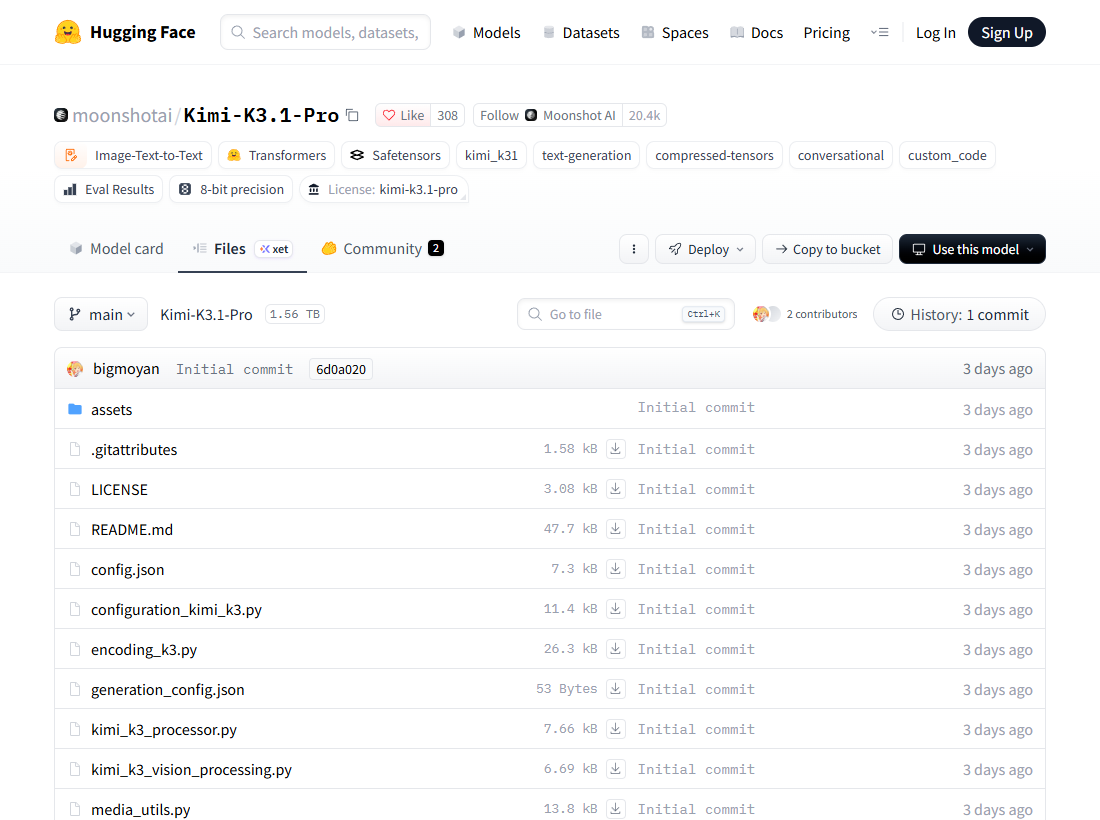
Moonshot’s model card describes a 2.8-trillion-parameter mixture of experts, with 104 billion parameters active per token, text and image input, and a 1,048,576-token context window. “3T-class” is the marketing scale; 2.8T is the stated total. This is a language-and-vision model, not a native text-to-video generator.
The released checkpoint uses MXFP4 weights with MXFP8 activations, according to the card, with quantization-aware training. It is an official low-precision release, rather than a community GGUF conversion. The configuration’s BF16 fields do not turn the packed expert weights into a full BF16 download.
Why doesn’t 104B mean a 52GB model?
MoE makes the arithmetic tempting: take 104 billion active parameters, multiply by half a byte for four-bit weights, and get 52GB. The problem is that the active subset can change with each token. The other experts still belong to the model and must be stored somewhere.
Using Moonshot’s rounded parameter counts, 104B is about 3.71% of 2.8T. That describes the active-parameter fraction, not the percentage of the download you can keep. It also does not promise a corresponding speedup over a dense model; routing, attention, memory traffic and communication still matter.
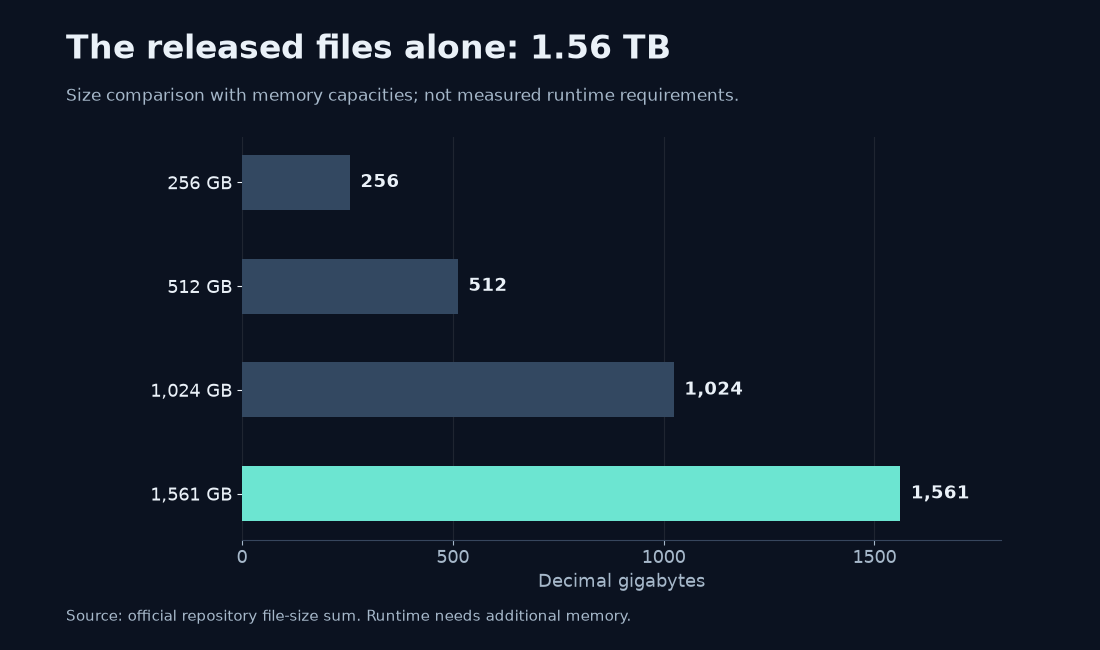
Even a basic calculation using all 2.8T parameters at four bits gives 1.4TB before extra precision, scales and packaging. The listed payload is larger, at 1.56TB. A 256GB or 512GB system therefore cannot hold the released weight payload entirely in that memory. Offloading or other compression may change a deployment, but that is a separate setup requiring its own compatibility and speed checks.
The architecture has changed from K3 too: the card lists 69 Kimi Delta Attention layers and 24 Gated DeepSeek Sparse Attention layers. Moonshot says the latter replace K3’s full-attention Gated MLA layers for more efficient long-context modeling. That is useful design context, not a measured long-context result from this article.
What does running it involve?
The card points to vLLM, SGLang and TokenSpeed. The vLLM recipe describes a baseline tensor-parallel group of eight GPUs: one B300 node or two GB300 trays. It also says that baseline throughput was not tuned. This is an actual documented route, but I have not installed it or verified its performance.
A recipe is more useful than dividing the weight bytes by an accelerator’s advertised memory. Runtime buffers, cache format, parallelism and context length affect what fits. Supporting a million-token window does not mean every hardware layout can serve that window at a useful concurrency. The SGLang cookbook distinguishes deployment shapes and verification status; those labels deserve attention.
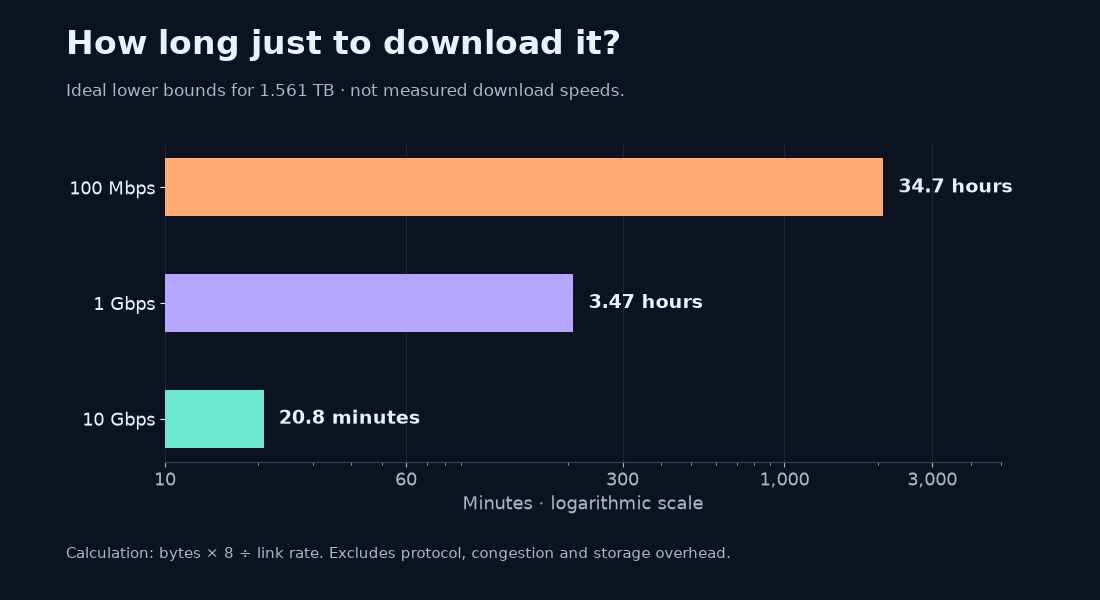
Just moving the weights has a cost in time. At an uninterrupted 1Gbps, the shard payload needs at least 3.47 hours; at 100Mbps, about 34.7 hours. Even 10Gbps takes roughly 20.8 minutes. Real transfers can take longer. Storage for the download also does not replace memory for serving it.
Downloading the checkpoint will not reproduce the whole Kimi website. An agent needs tools, a sandbox, conversation handling and an application around the model. The model card specifically requires preserving complete assistant messages, including reasoning content and tool calls, in multi-turn API conversations. Integration details can change the result long before a benchmark score becomes relevant.

What does the custom license allow?
The Kimi K3.1-Pro License grants broad rights, including deployment, modification, fine-tuning and redistribution, subject to its conditions. I would describe this as an open-weight release with a custom license. Calling it MIT or Apache-2.0 would hide conditions that matter to some operators.
| Provision | What the published text says |
|---|---|
| Basic obligations | Retain the copyright and permission notices in copies or substantial portions, and comply with applicable laws. |
| Model-as-a-Service trigger | If the licensee or an affiliate operates a Model-as-a-Service business and their aggregate revenue exceeds US$20 million over any consecutive 12 months, a separate Moonshot agreement is required before any commercial use of the software or derivatives. |
| Brand display | A commercial product or service using the model or derivatives must prominently display “Kimi K3.1-Pro” if it has more than 100 million monthly active users OR more than US$20 million in monthly revenue. |
| Section 2 and 3 exemptions | These requirements do not apply to defined internal use, or use through Moonshot’s official products or certified inference partners. |
The annual threshold is easy to misread. It refers to aggregate revenue of the licensee and affiliates once the Model-as-a-Service condition applies, not simply revenue earned from this particular Kimi endpoint. The license defines that service around third-party control over inference or fine-tuning inputs, parameters or training data. It excludes narrowly embedded end-user features or harnesses and mere relaying to someone else’s hosted models.
“Internal use” also has a specific definition: the software, its outputs and underlying capabilities are not made available to third parties. An internal deployment that sends outputs to clients should not automatically be treated as covered by that exception. These are the distinctions I would take to the actual license text before designing a commercial service.
Does the capability justify that much infrastructure?
The release makes the capabilities available for operators to test on their own infrastructure. It does not turn the launch table into a universal win. In Moonshot’s table, K3.1 Pro scores 65.7 on Terminal-Bench 4.0, close to Claude Opus 5.5 at 66.4 and ahead of GPT-6 Astra at 58.2. It leads those two models on SWE Marathon v1.1, at 51.7.
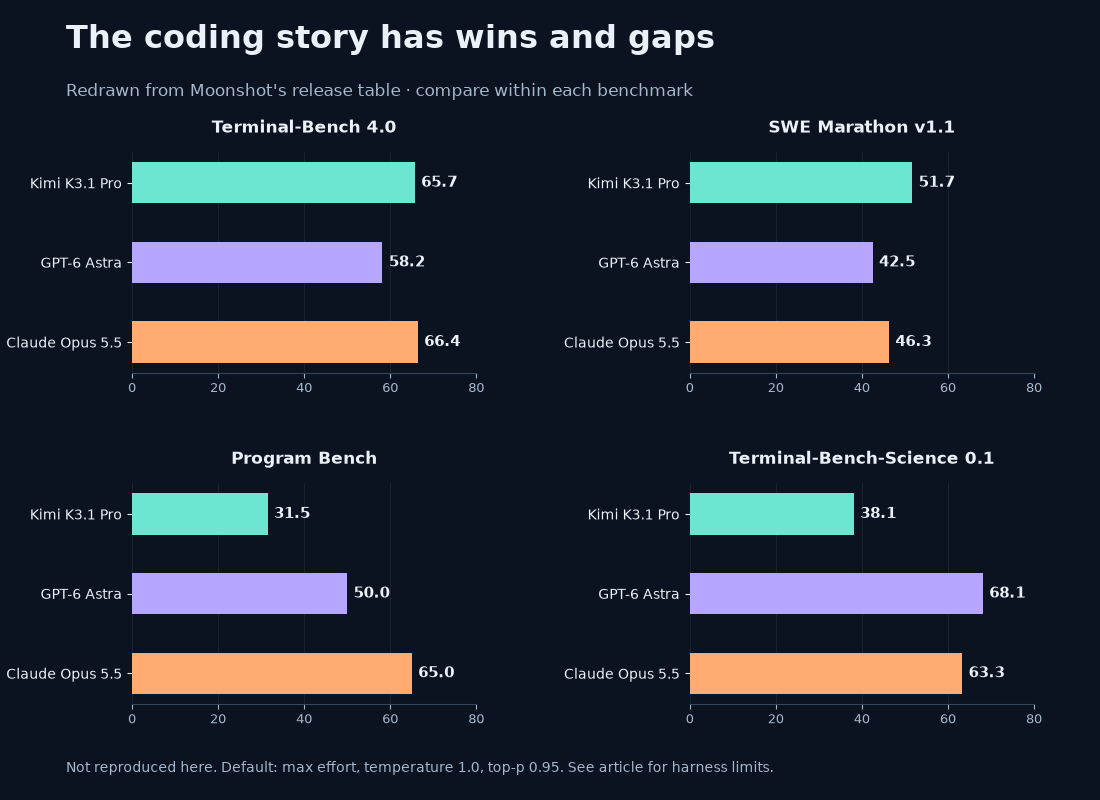
The gaps are substantial elsewhere. Kimi scores 31.5 on Program Bench, against 50.0 for Astra and 65.0 for Opus. On Terminal-Bench-Science 0.1, it records 38.1, against 68.1 and 63.3. Those rows make a much more useful story than “open weights caught everything.”
The default settings reported for Kimi are maximum reasoning effort, temperature 1.0 and top-p 0.95. The footnotes mix vendor evaluations and externally reported scores, with different harnesses and some fallback behavior for proprietary models. Program Bench is reported as a binary metric using a 95% task threshold. These are not controlled, identical-environment measurements made for this post.
Moonshot also describes removing cyber-related data during training for the open release. That is the company’s account of its training controls, not an independent audit here. Separately, I found no Highspeed-named checkpoint in Moonshot’s public Hugging Face model list at the check time. The hosted Highspeed offering should not be treated as a separately verified weight download.
My take
What changes today is the ability to hold and adapt the checkpoint. Teams that need control over deployment, data flow or post-training now have something concrete to evaluate. The custom license and the serving stack become part of that evaluation, alongside answer quality.
For an individual wanting a coding assistant or 3D help, I would start with hosted access and a small set of repeatable tasks. For a team that already operates suitable infrastructure, the interesting question is whether tuning this model improves its own workload enough to justify running it. “Free to download” does not answer that.
My earlier K3.1 Pro article examined its 3D claims and the need to check physical fit. This follow-up answers a different question: the weights are accessible, but 104B active parameters do not make the released model small. A reproducible deployment measurement would be the next useful piece of evidence.