Microduck: What You Can Build With a $399 Robot Duck
Microduck: What You Can Build With a $399 Robot Duck
The beak is a gripper. The waddle comes from a learned control policy. Microduck makes those two facts look like a character introduction.
That is a good way to get me interested in a robot. Pollen Robotics, Hugging Face’s robotics team, has built a small biped around a useful idea: make experimenting with physical movement approachable. You can play with its existing behaviors, then work on your own in simulation. The appeal is the path between those two experiences. The team’s introduction explains that intention.
My take: Microduck is interesting as a movement-learning platform. I would judge it by how easily a new behavior can be trained, inspected and transferred, and how recoverable the mistakes are. A charming demonstration earns attention; a repeatable development process earns a place on the workbench.
Research report, checked November 2, 2026. I reviewed the official documentation, repositories and file licenses, and calculated the package totals and mapping coverage below. I have not operated a physical Microduck, trained its policies, or independently reproduced the team’s measurements.
Why is a little robot duck getting attention?
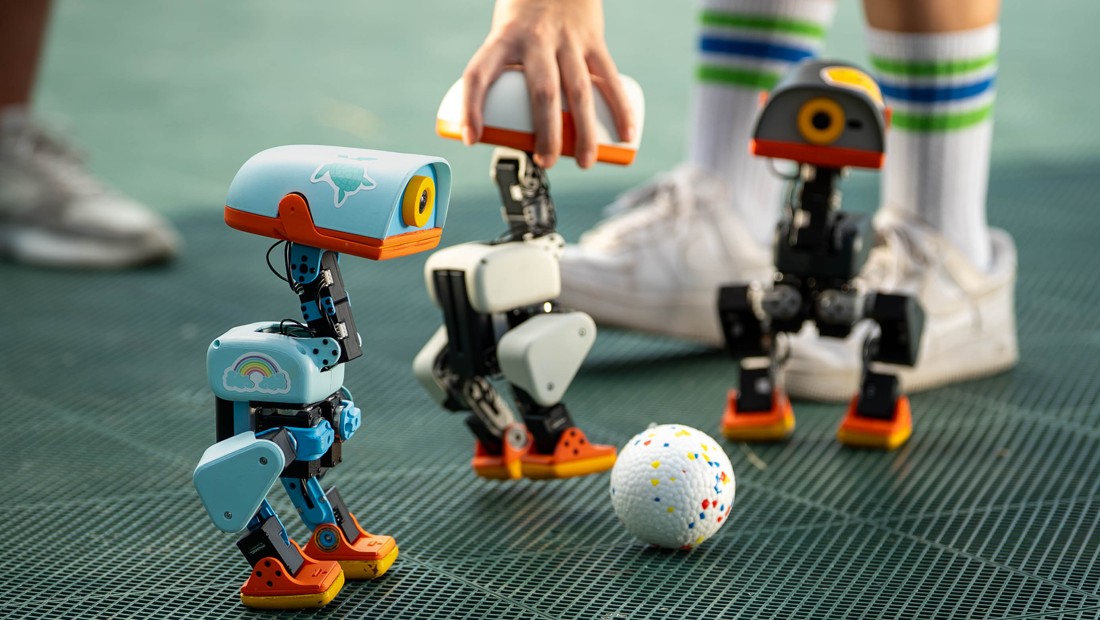
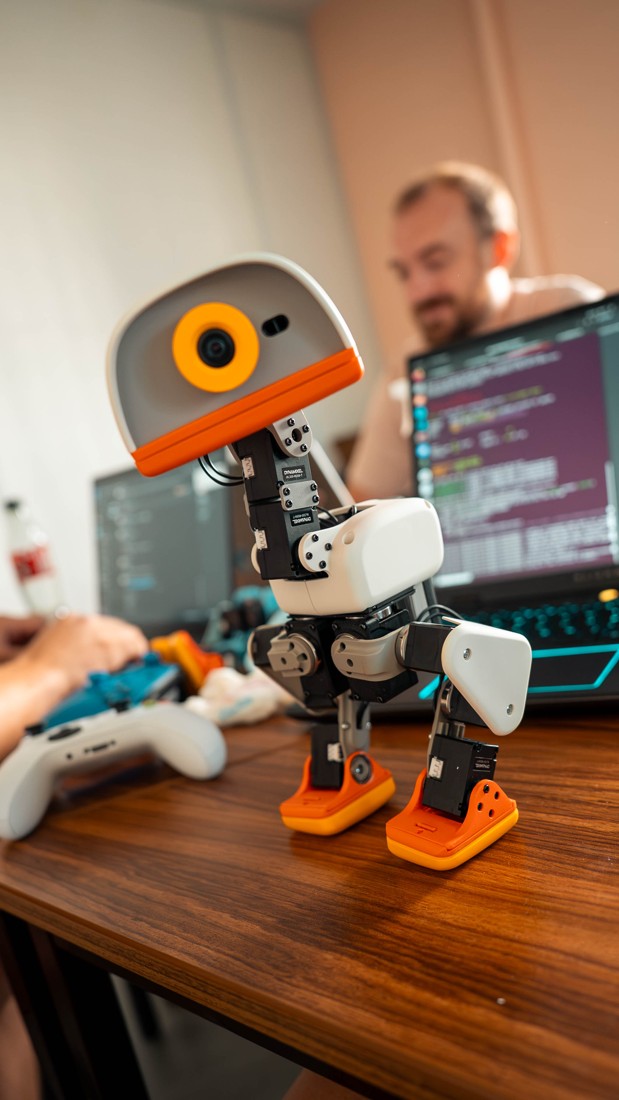
First, the scale makes the experiment imaginable. Microduck is about 25 cm tall and roughly 0.8 kg. A jointed neck, broad feet and a large camera face give it plenty of expression without hiding that it is a machine. The articulated beak gives it a way to interact physically despite having no arms.
Second, there is a concrete entry point: an introductory US$399 before taxes and shipping. This is an existing pre-order, opened on August 27, 2026. It is not a November launch. The official press materials target first deliveries before Christmas 2026; that remains a target, not evidence that customers have received units. Launch dates and delivery target.
There is also visible developer interest. The GitHub API snapshot saved for this article showed 13,311 stars and 1,662 forks for the main repository. Those counters establish attention to the code. They do not tell us how many robots were sold, how many people trained a successful policy, or whether interest is rising this week. Main repository.
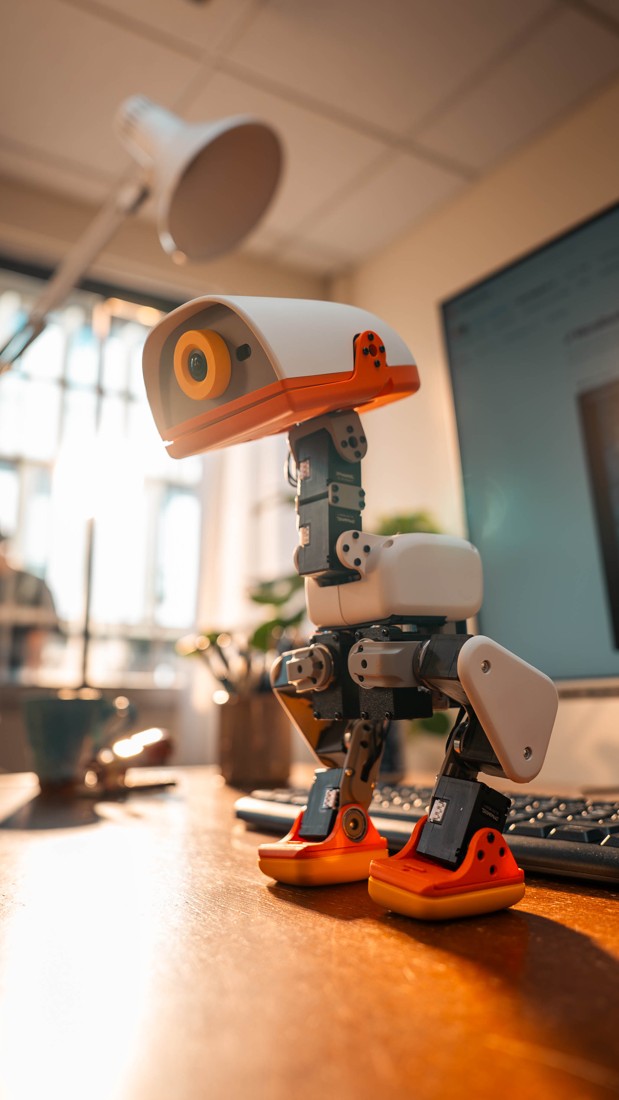
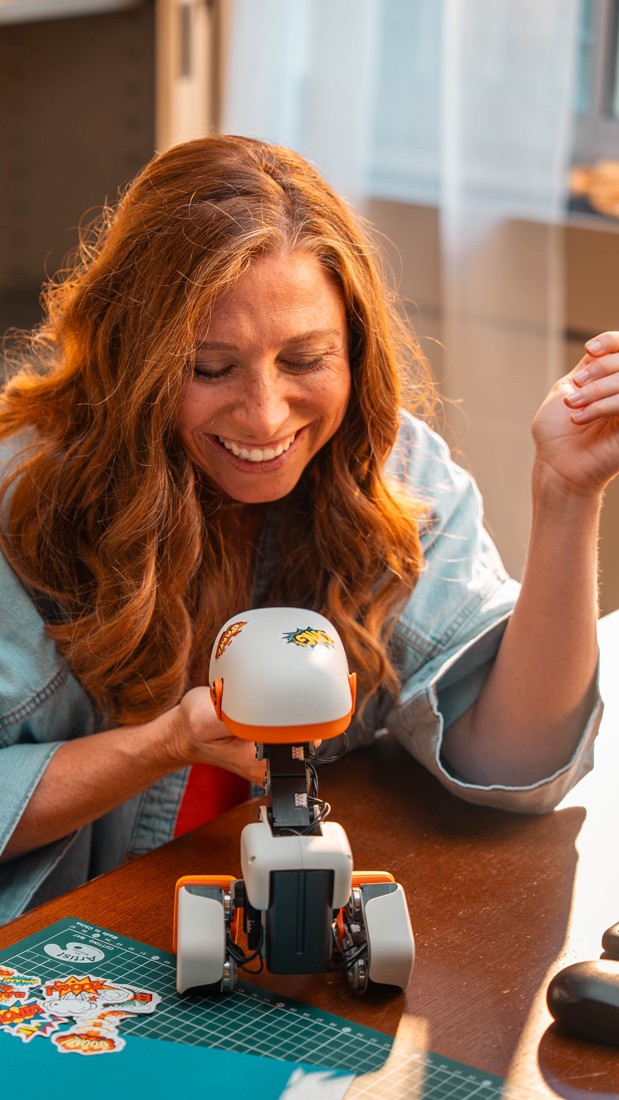
I think the combination matters more than any single trick. A small, expressive robot gives people a reason to keep experimenting after the first evening. The published training workflow gives that curiosity somewhere to go.
What do you actually get to control?
The store lists 15 motors, a front camera, a compact 8 × 8 time-of-flight depth sensor, two IMUs, microphones, a speaker and two NFC antennas. The computer is a Rockchip RK3566 with an AI accelerator, 1 GB RAM and 32 GB storage. A gamepad is included. These are manufacturer specifications, not measurements from this article. Current product listing.
| Part of the platform | What it makes worth exploring |
|---|---|
| Legs, articulated neck and grasping beak | Gaits, body poses, recovery and small-object interaction. |
| Joint feedback and inertial sensing | How a controller reacts to the robot’s physical state. |
| Camera and short-range depth sensing | Perception experiments, with sensing limits to understand. |
| Gamepad and published software | A starting behavior to inspect and change, rather than beginning with an empty project. |
The product demonstrations include walking, crouching, recovering from common falls, using the beak and skating with attachments. Treat those as demonstrations of specific behaviors. They do not establish that the robot can cope with every floor, recover from every fall, or understand any household task you describe. The official product page is a useful tour of what the team shows.
That distinction also applies to the word “AI.” Here, a useful AI behavior can be a compact policy that turns sensor observations into joint commands. It does not have to be a conversational assistant. The team explicitly presents Microduck as an action-focused counterpart to its interaction-focused Reachy Mini.
How does a behavior get from simulation to the duck?
The published workflow has two separate computing jobs. Policies are trained with PPO in the MuJoCo-based mjlab / MuJoCo Warp environment. The training quickstart requires a CUDA GPU; it also documents a hosted training route through Hugging Face Jobs. The resulting policy is exported to ONNX and loaded by the robot software. Training repository and quickstart.
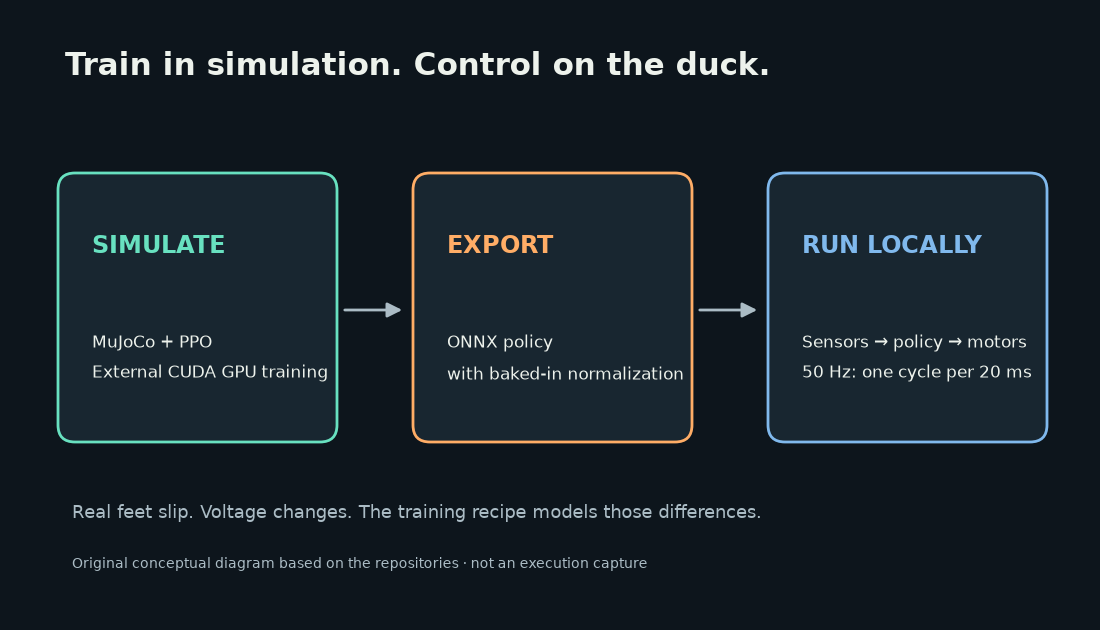
The robot’s main control loop runs at 50 Hz. That is a nominal cycle period of 1,000 ÷ 50 = 20 ms. It does not mean every command completes within 20 ms, nor that a language model thinks fifty times per second. The runtime architecture puts motor access and the safety layer inside robotd; other clients send requested actions to that service. Runtime architecture.
The hard part is getting the simulated behavior to survive the real machine. A perfect simulated motor can make an unrealistic policy look excellent. The training repository instead describes actuator modeling and variation in voltage, delay and friction. It also models gear play in dedicated task variants. Those details are more informative than a vague claim that the duck “learns by itself.”
My first project would be deliberately narrow: compare an existing behavior with one modified version under the same conditions. I would record completion, interruptions and recovery before trying to chain tricks together. A reproducible small improvement is a better starting point than an elaborate routine whose failures are hard to explain.
What does the recent mapping work actually show?
The October 23 engineering posts are a good reason to revisit the project. The team describes onboard mapping using leg odometry and an 8 × 8 depth sensor. The mapper collects useful observations at stops; its reported experiments cover two sessions in one room. This is developer-reported evidence, not our reproduction. Mapping report and odometry explanation.
The denominator matters. In those sessions, the mapper reported a location for 60% and 63% of the time. When localized, it was within 15 cm for 99% and 94% of that time. Multiplying the rounded figures gives about 59.4% and 59.2% of total session time both localized and within 15 cm.
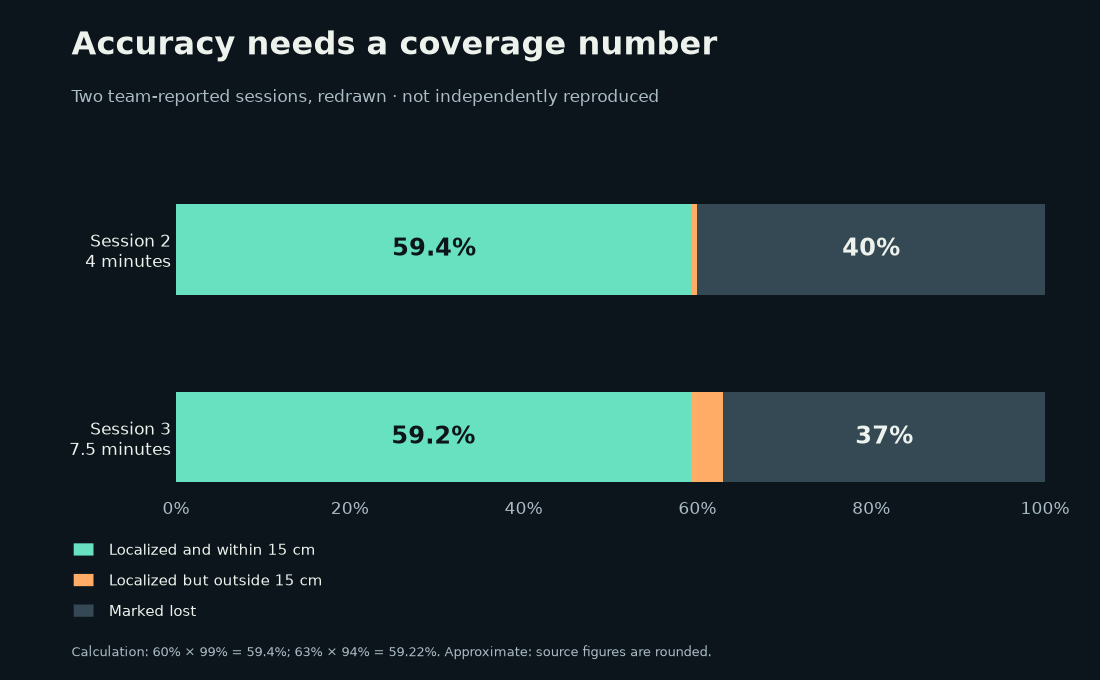
That is useful progress, with an honest boundary. The team also describes difficulties with unfamiliar rooms and identifies autonomous exploration as future work. I would not turn this into a claim that the shipping duck already navigates an entire home.
What should you know before paying $399?
Open software has specific file boundaries
The main software is Apache-2.0 licensed. The press kit explicitly says the open-source claim covers software and should not be read as an open-hardware claim. There is an extra detail in the training repository: the listed simulation STL meshes are under CC BY-NC-SA 4.0, while its XML descriptions and other listed files use Apache-2.0. The separate model-file license spells out that split.
A downloadable simulation mesh therefore is not evidence of a complete, permissively licensed manufacturing package. For a project that changes the software, the published stack is a substantial starting point. For a project that remakes or commercializes the physical design, inspect the exact files and their terms instead of assuming one repository-wide label answers everything.
Choose the pack around the experiment
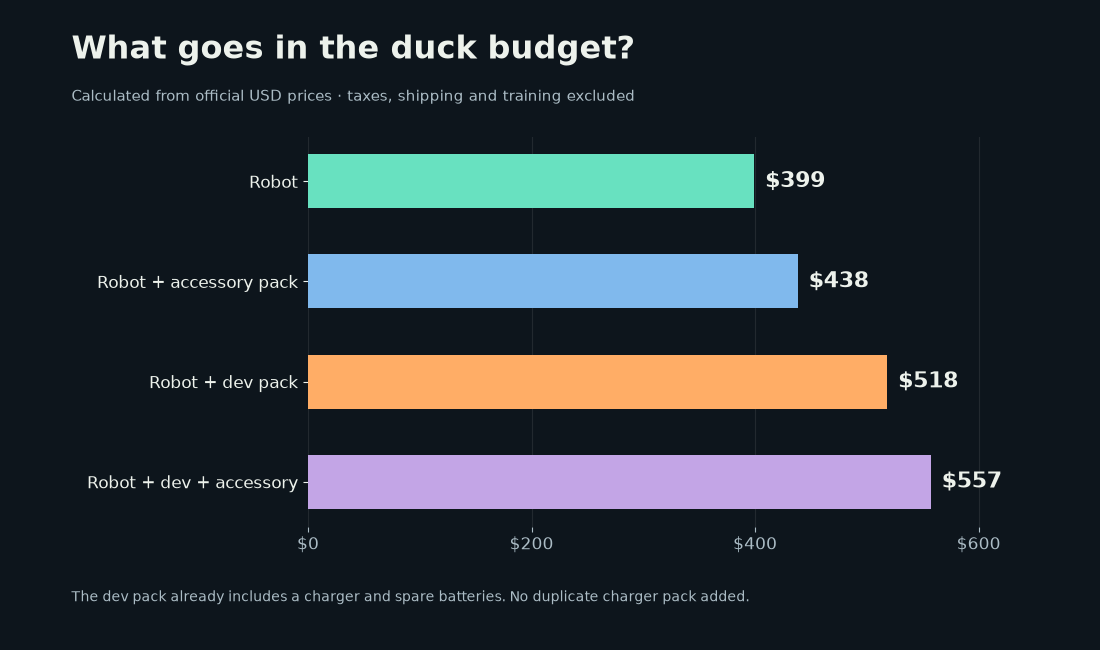
The official USD prices are $39 for the accessory pack and $119 for the dev pack. The latter already includes a charger and spare batteries, along with spare motors and other development supplies. The chart adds the listed prices; it does not estimate import charges, GPU time or replacement costs. Official pack contents and prices.
There is a regional wrinkle for Korean readers. The current store lists South Korea among launch destinations, while the press kit still describes North America and Europe. That is a mismatch between official pages. A country appearing in a store selector does not confirm a delivery date to that country. Check the final shipping terms for the destination before treating the Christmas target as a local promise. Store availability and press-kit wording.
The battery estimate is around an hour depending on use, according to the manufacturer. Some specifications remain provisional in the press kit. Those details make this a pre-order decision about a developing platform, with documentation and software already available to explore.
Is Microduck a good first robotics project?
I would start with the official browser simulator and the training documentation. Pick one goal: a particular movement, a recovery scenario, or understanding how the observation-to-action loop works. That gives the hardware a clear job if you later decide to buy it.
The strongest argument for Microduck is that the cute character sits on top of inspectable engineering. You can follow the path from a simulated task to a deployed policy, and read how its makers measure the mistakes. That is an appealing way to learn robotics. I still want evidence from delivered units and repeated community experiments before judging the complete ownership experience.
For another example of reading a robot demonstration carefully, see our Unitree H2-X demonstration analysis. Scale changes the hardware problem; the need to distinguish a shown behavior from a general capability remains.
Frequently asked questions
Has Microduck just launched?
No. Pre-orders opened August 27, 2026. This article checks the project on November 2, including its October engineering updates. The stated first-delivery target remains before Christmas 2026.
Can I use it without training a policy?
The manufacturer says it includes learned behaviors and a gamepad. Developing a new learned behavior is a separate workflow, with simulation and training resources.
Does “open source” mean I can print the entire robot?
It does not establish that. Software, simulation meshes and manufacturing designs have different scopes and terms. The press kit does not describe Microduck as open-source hardware.
Does the 50 Hz loop prove fast AI reasoning?
It specifies the robot control-loop rate. The calculated 20 ms cycle period is not a language-model speed result or a measured end-to-end command latency.
Sources and verification
- Pollen Robotics — Meet Microduck, August 27, 2026
- Official press kit — dates, specifications and hardware disclosure
- Official store — current specifications and destination list
- Robot runtime repository
- Robot runtime architecture
- RL training repository — simulation, training and export
- Separate license for simulation mesh files
- Team mapping report, October 23, 2026
- Team odometry report, October 23, 2026