Unitree H2-X: What the Demonstration Shows
HARDWARE & DESIGN
Unitree H2-X: What the Demonstration Shows
Unitree's H2-X film is easy to remember: a high landing, vehicle bodywork and a rescue scene. The quieter detail is the claim of roughly eight hours standing. Standing endurance tells a buyer much less than runtime while walking, carrying or working.
In this article
Unitree revealed H2-X on October 21, 2026 under the name “Kung Fu Legend Guardian.” It is an impressive physical showcase. It is also a promotional reveal with major unanswered questions about configuration, control and availability. The headline number does not establish an eight-hour working shift.
I checked the official announcement and video, compared the current H2-family product pages, and read the initial public discussion. This is a source-based analysis, not a hands-on review. Here is what I would keep—and what I would leave out—when describing this robot.
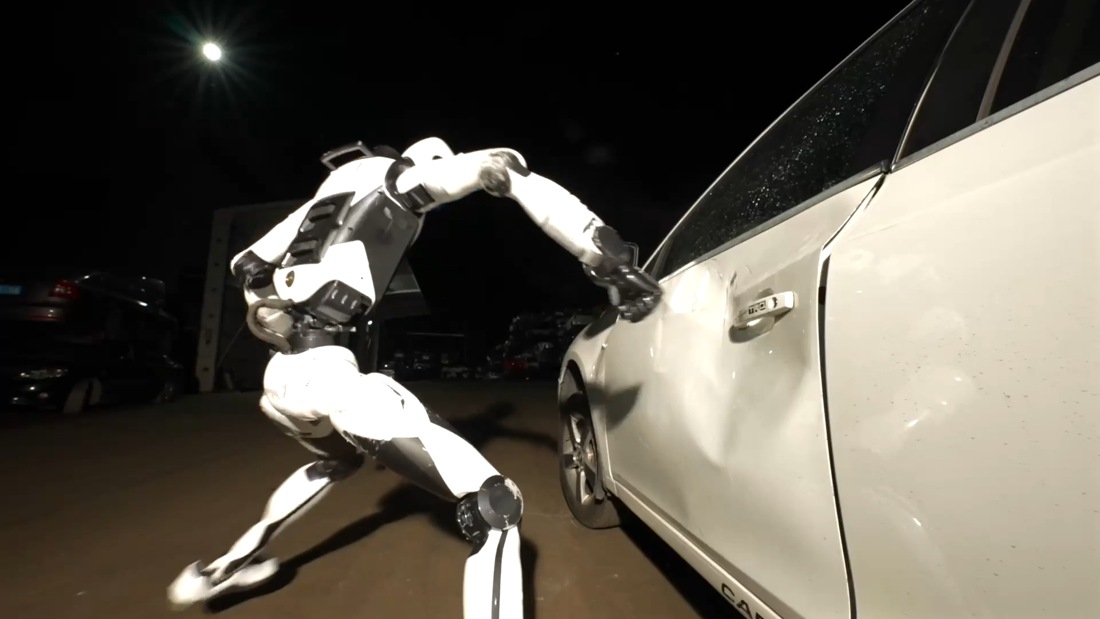
What did Unitree actually show?
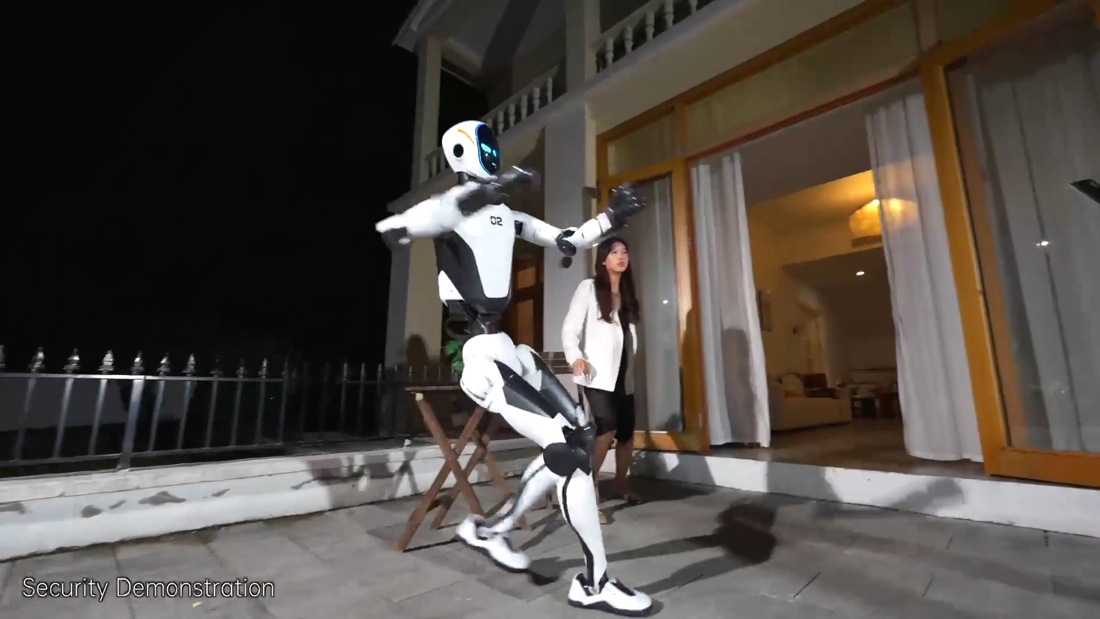
The official one-minute video moves from acrobatics into staged protection and rescue. Its most useful distinction is between an action visible in a shot and a capability validated across situations. A machine can execute a difficult movement while the surrounding scene, timing and choice of action remain carefully arranged.
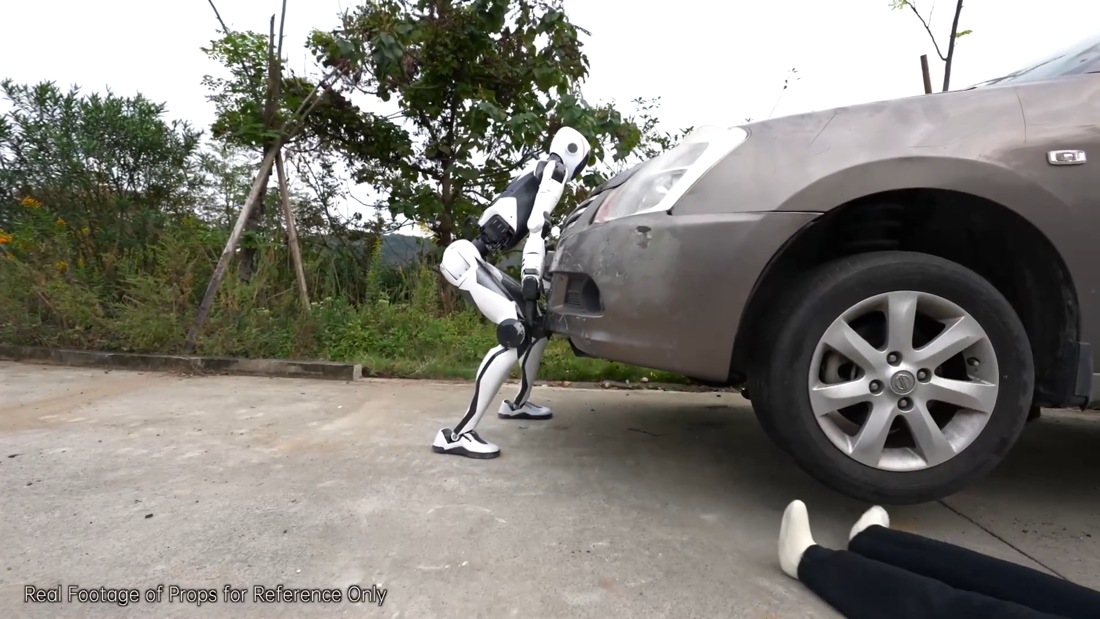
The vehicle shot is easy to oversell. Raising the front of a car is different from lifting the whole vehicle. Without its mass, support points and preparation, the image cannot tell us a rated lifting capacity. I would describe the motion and stop there; assigning it a tonnage would manufacture a specification.
The same care applies to the height sequence. The manufacturer labels a 4-meter-high platform, followed by a landing and roll. That is a platform-drop demonstration, not a four-meter vertical jump. The reveal does not supply a repeat count, failure rate or a standard landing surface. Those missing details matter if the question is durability rather than whether a striking shot exists.
Does “eight hours” mean a full patrol shift?
No such conclusion follows from the launch material. The social post uses a maximum-endurance figure; the video makes the condition more specific: “Standing for Approximately 8 Hours.” It is a manufacturer claim about that condition, not a measured patrol, continuous walking or repeated lifting workload.
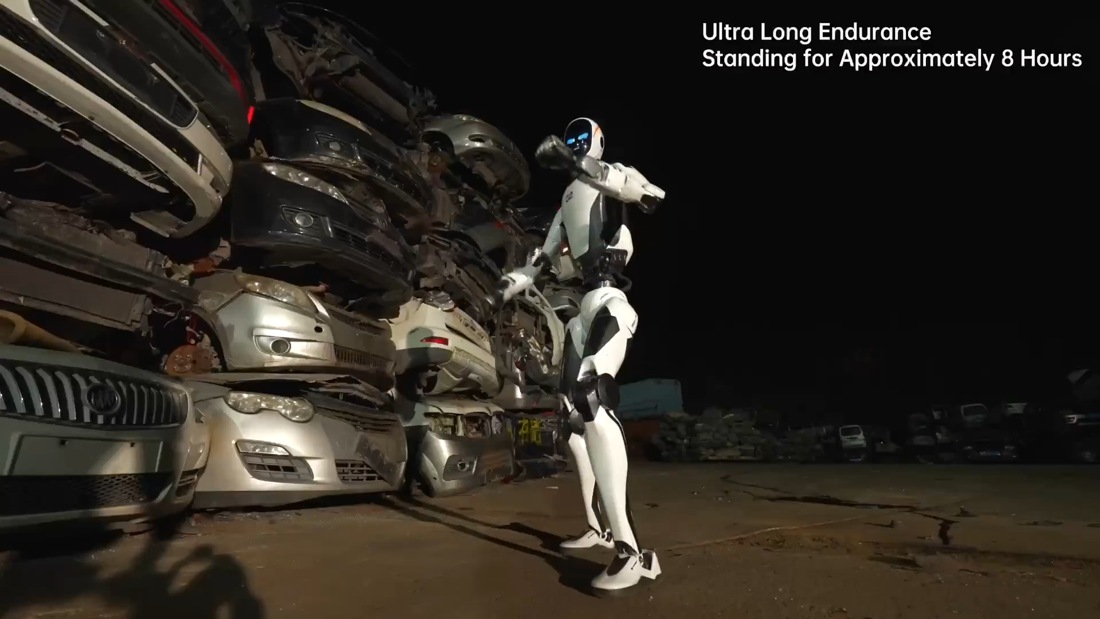
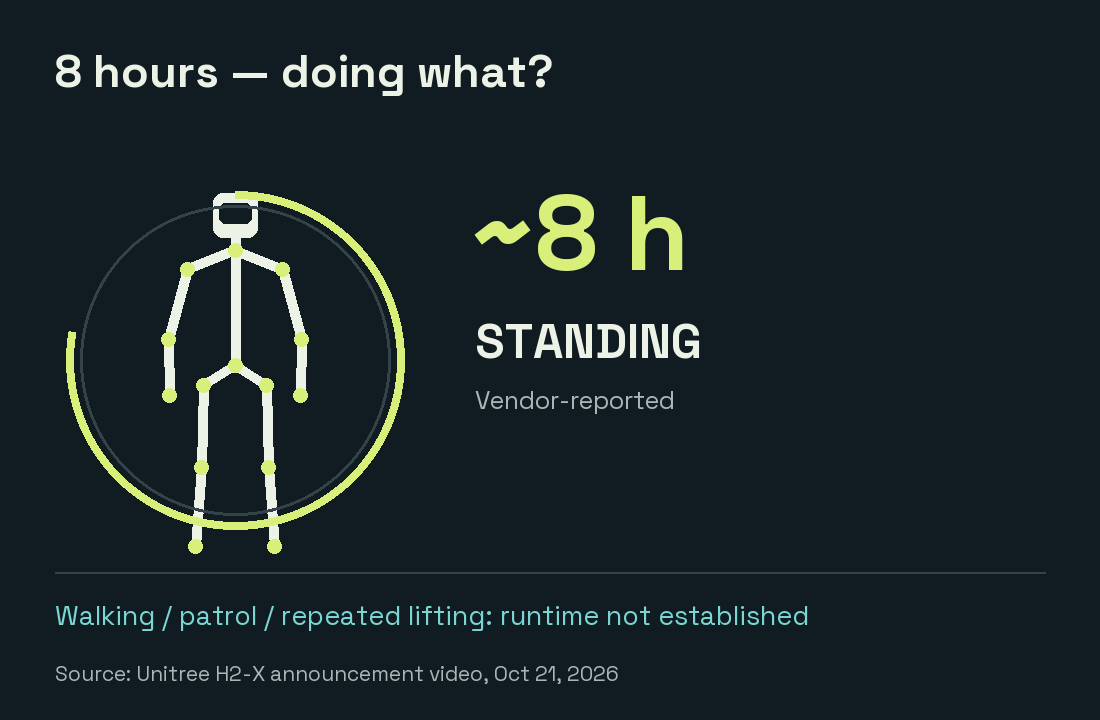
For an operator, the useful next measurement would be a defined job cycle: time moving, time waiting, payload, onboard computation and the point at which charging is required. A robot waiting beside a desk and one repeatedly moving objects are serving different jobs. One maximum figure cannot answer both questions.
That is why I would not turn the H2 page’s roughly three-hour figure and this eight-hour standing claim into a “2.7 times better” chart. The published conditions are not matched. A longer-looking bar would imply a comparison the sources have not supplied.
H2, H2 Plus and H2-X are different references
The names invite specification drift. Unitree’s H2 product page has a detailed table and a base price. H2 Plus is a research-oriented configuration. H2-X is the subject of the new reveal. Keeping the model name attached to each number prevents the older product pages from becoming an imaginary H2-X datasheet.
| Model | What is documented | What belongs to H2-X? |
|---|---|---|
| H2 | 182 cm; 31 body joints; about 3 h; $29,900 base price, before tax and shipping | These are H2 figures, not H2-X specifications. |
| H2 Plus | Research reference design; Jetson T5000; 31 body joints and 75 total body-and-hand DOF | This is another configuration. Its compute and hands are not confirmed for H2-X. |
| H2-X | October 21 promotional reveal; about 8 h standing claimed in the video | Full configuration, price and order date were not identified in the reveal materials. |
The H2 and H2 Plus entries above are manufacturer-listed specifications checked on October 22. H2 Plus’s total includes the hands; it is not a count of 75 body joint motors. The table is an identity check, not a ranking of the three machines.
As of that check, I did not find an H2-X price, order date or complete configuration in the announcement and official product materials examined. In particular, H2’s $29,900 starting price is not an H2-X quote. Likewise, a computer or dexterous hand offered on a related configuration does not establish what the new variant contains.
Can it decide when to protect someone?
The reveal does not establish that. A protection task contains several distinct problems: recognizing what is happening, deciding whether intervention is appropriate, and executing a movement without causing another harm. A film can show the last part clearly while leaving the first two unresolved.
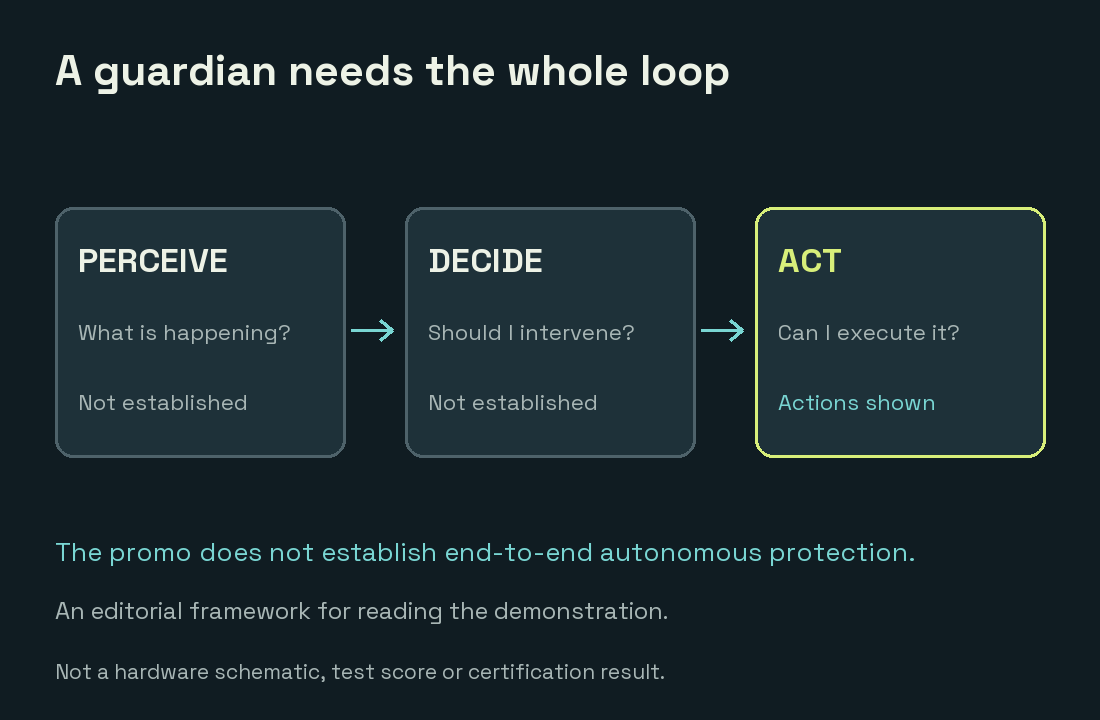
Remote operation, a rehearsed routine and autonomous behavior can produce superficially similar edited sequences. The material checked does not identify the control mode for every scene. That does not prove any particular method was used; it means we should leave the answer open. A visible successful action is not enough to fill in the missing control story.
Unitree’s own end card asks customers to keep people at least two to three meters away and describes extreme testing that should not be imitated. That guidance matters when interpreting the close-contact “Guardian” theme. It is a manufacturer precaution, not evidence that a consumer bodyguard has passed a certification process.
There is a useful connection to Atlas’s new hands and their design tradeoffs: a dramatic mechanical capability becomes more meaningful when its limits and intended job are explicit. The H2-X clip gives us a compelling starting point for that discussion, but not the finished operating envelope.
What are viewers reacting to?
The early r/singularity discussion contains both admiration and a practical objection. One commenter praised the progress in movement. Another wanted to see a simple task performed smoothly and reliably. Those reactions point to two different viewing habits: watching an athletic demonstration and evaluating a machine for useful work.
These are selected audience comments, not owner reports, a representative survey or independent test results. I found no basis in the launch material for calling them real-world H2-X customer feedback. For a newly revealed robot, that distinction is more useful than collecting a row of enthusiastic quotes.
Look for a continuous working task
The interesting part is the attempt to connect a capable moving body with a useful role. I would take the motion seriously while keeping the “Guardian” role provisional. The next persuasive evidence would be less cinematic: an uncut ordinary task, repeated attempts, disclosed control mode and runtime under the same defined workload.
I would also want to know what happens when the robot cannot finish. That question connects this reveal to Flourish 1’s approach to teaching household jobs. A task is easier to judge when the required setup and human help are visible. A good demonstration should make those dependencies easier to see.
H2-X is worth following. I would return to it when a model-specific spec sheet, purchase details or a documented continuous task appears. Until then, keep three phrases intact: standing endurance, staged demonstration, and control mode undisclosed. They make the story more precise without taking anything away from the movement on screen.
Comments
Post a Comment