Atlas's Four-Finger Hand: Tools, Grip and Maintenance
HARDWARE & DESIGN
Atlas's Four-Finger Hand: Tools, Grip and Maintenance
Boston Dynamics removed a finger and added degrees of freedom. The GR3 hand's design is easier to understand through the jobs it must do: hold tools, make contact reliably and return to service after a repair. A human-looking silhouette is a less useful target.
In this article
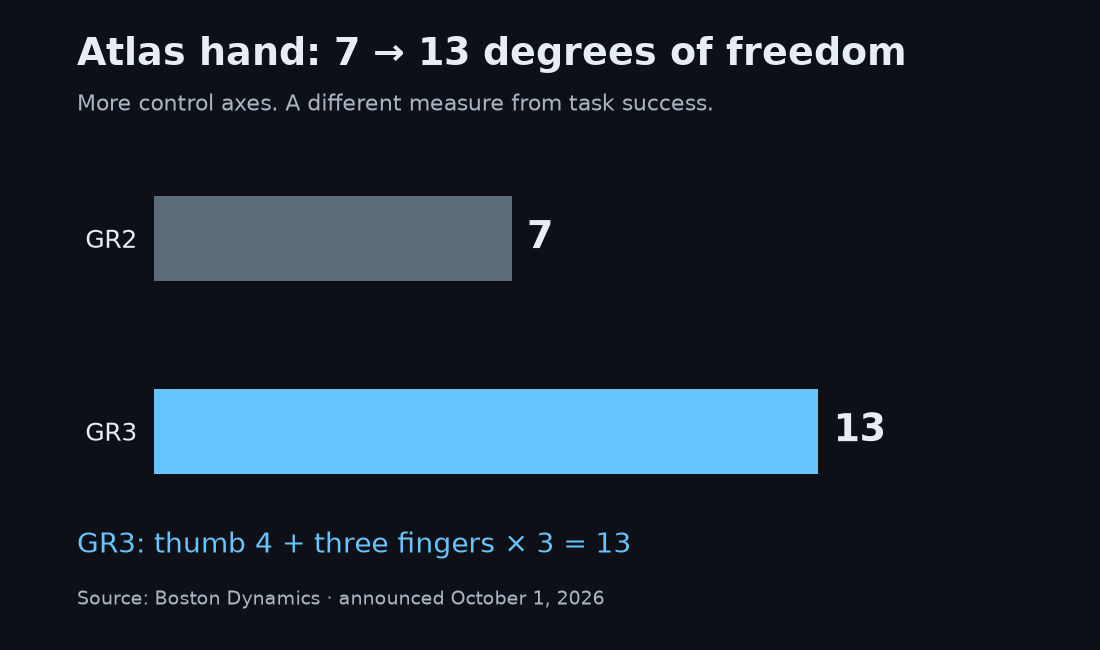
Announced on October 1, the GR3 hand has four fingers and 13 degrees of freedom, up from seven in GR2. The company is aiming for capable tool use, practical maintenance, and manufacturing at scale. Those goals make the missing finger much more interesting than a cosmetic detail. Boston Dynamics’ technical explanation lays out the design.
The design is easier to judge by the work a factory hand must do: grip useful tools, tolerate contact and return to service after a part wears out. A human-like finger count is only one possible route to those goals.
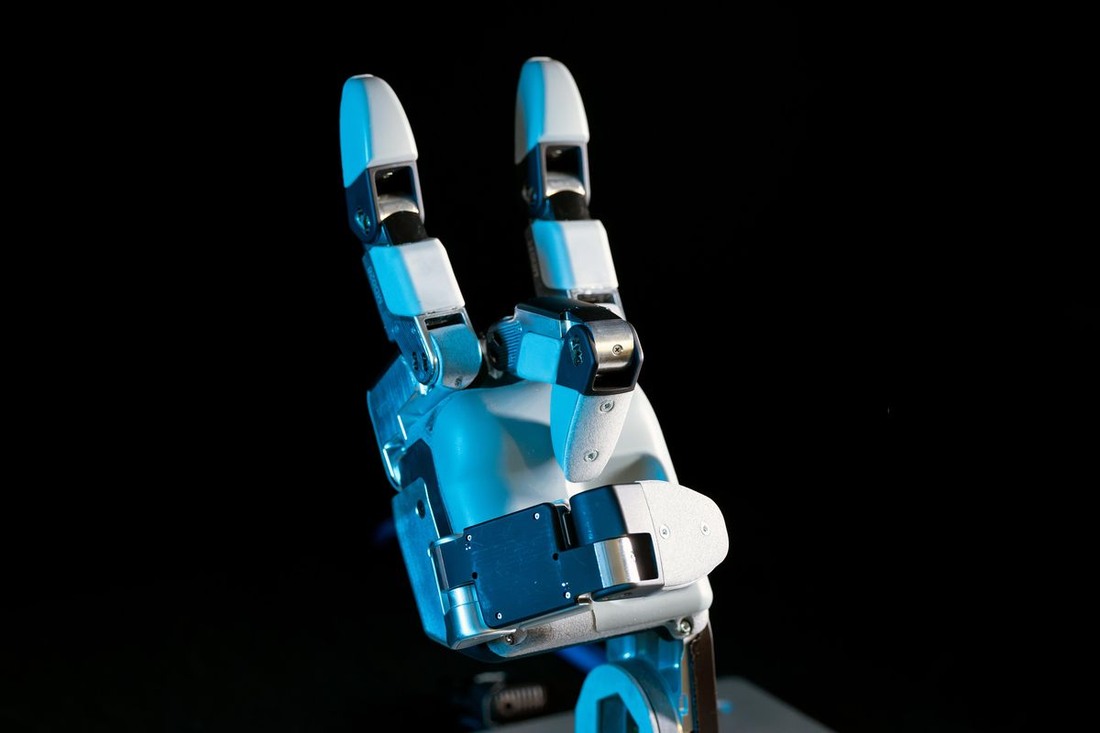
Leaving out the pinky
The team tested the idea in a surprisingly ordinary way: engineers spent a day with their pinkies taped to their ring fingers. They judged the lost capability against the added machinery. A fifth finger would bring three additional actuators and extra size, cost, and failure opportunities. They chose four. That account appears in Evan Ackerman’s interview with Alberto Rodriguez.
I like the question behind the experiment. A factory does not buy a hand because its silhouette is reassuring. It needs the hand to handle the assigned parts, survive contact, and return to service when something wears out. A feature earns its place by helping those jobs.
That still leaves a real compromise. Imagine a task needing several simultaneous contact points around an awkward part. An extra finger might help. For another task, that finger could crowd the tool handle. I would judge the choice against a particular work cell, rather than treat four fingers as the universal answer.
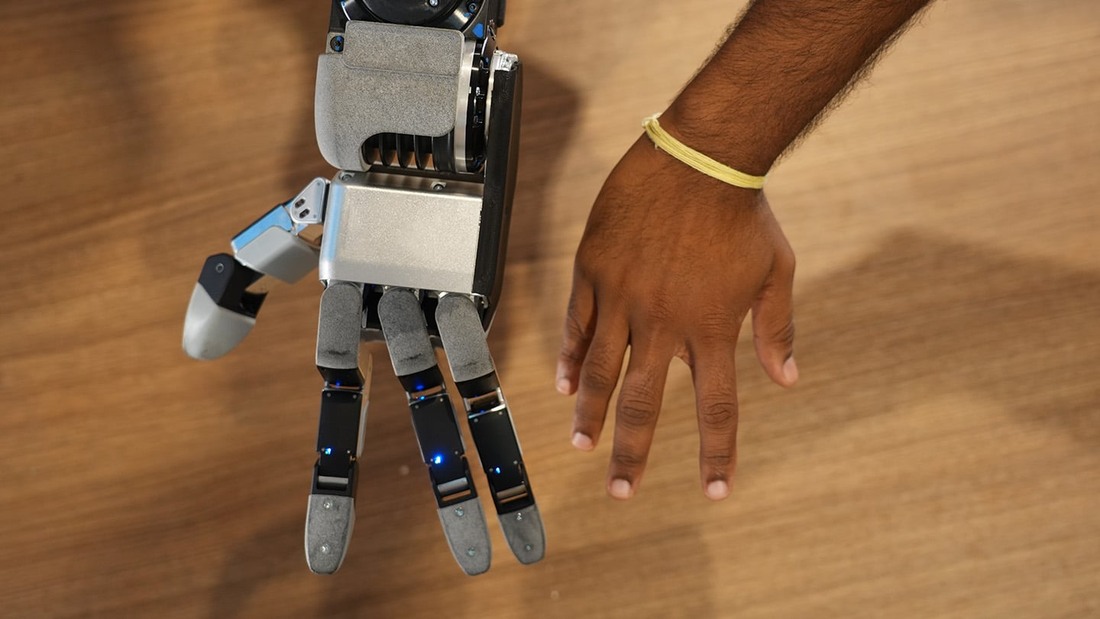
The move from seven to 13 DOF
A degree of freedom is an independently movable axis. The new thumb has four; each of the other three fingers has three. 4 + 3 + 3 + 3 = 13. The fingers can spread apart, helping the hand hold a tool while a finger operates its trigger. The architecture also includes pressure sensors across the fingertips and palm. These are manufacturer-described features. Hand architecture source.
Here is the everyday distinction I care about. Picking up a screwdriver is one problem. Keeping it in the hand while adjusting the grip and lining up its tip is another. A grip can be secure enough to carry something and still be clumsy when the next step needs fine adjustment.
More axes give a controller more ways to make those adjustments. They also give it more choices to coordinate. Going from seven to thirteen does not tell us how often a screw gets seated correctly. That requires a task, a test, and results.
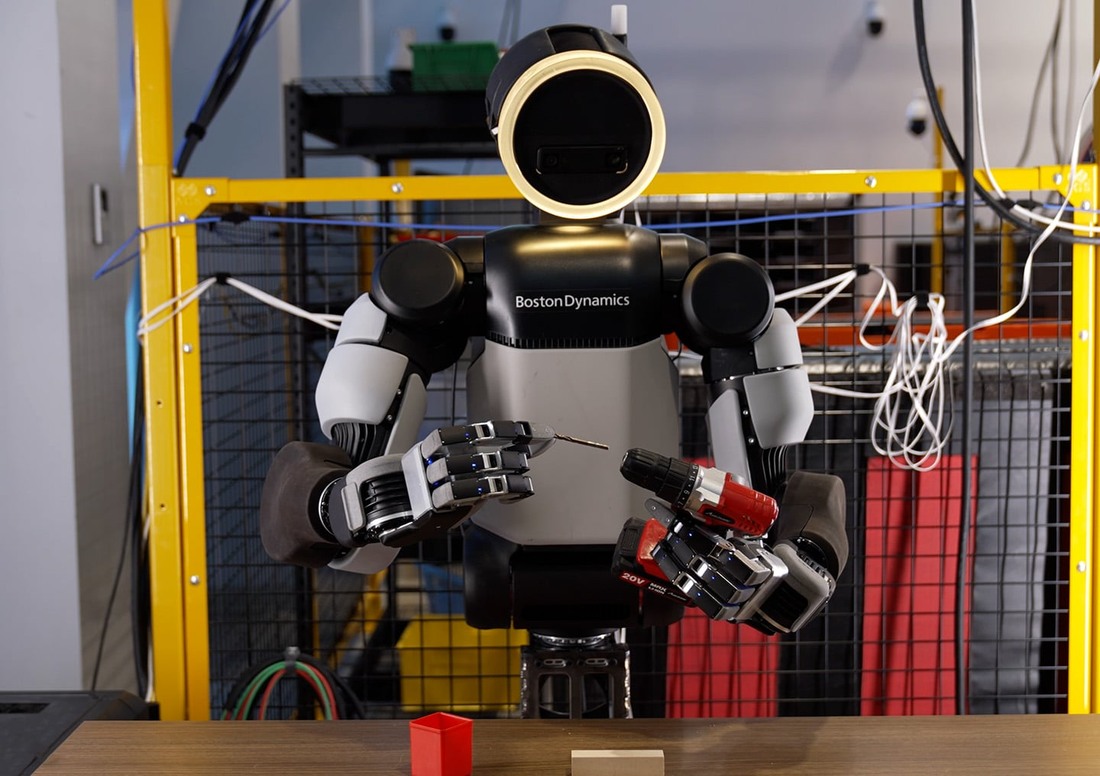
Autonomy in the drill demonstration
The drill sequence is labeled “Teleoperated.” Other segments are labeled “Fully Autonomous.” I checked the labels in the official launch film, because they change what the footage supports.
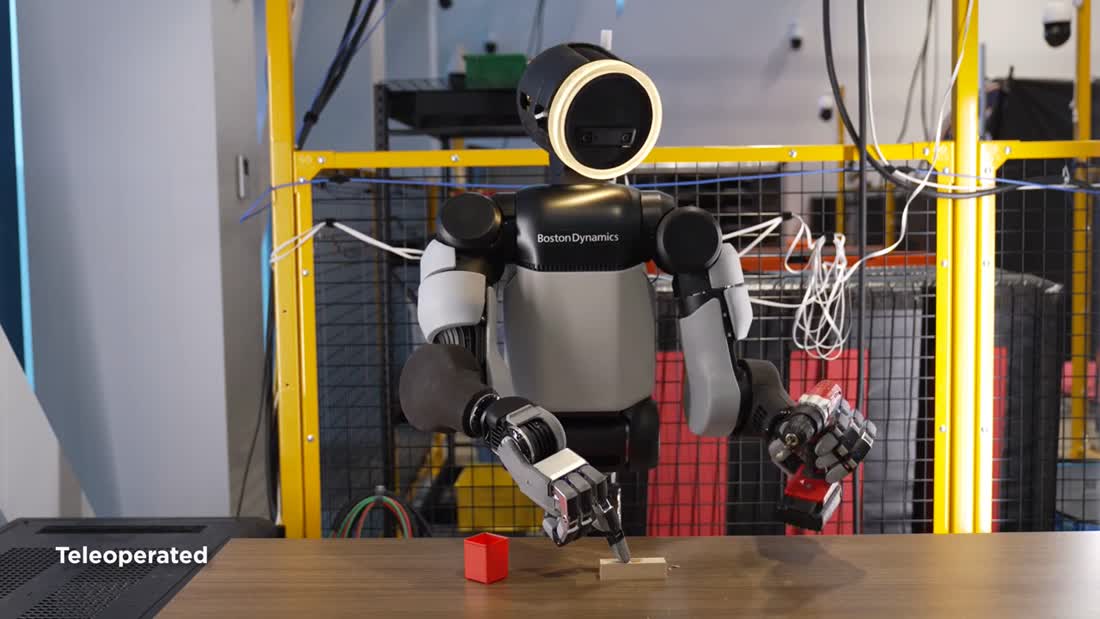
Remote operation is useful evidence. It shows that this arrangement of fingers can perform a demanding sequence when supplied with suitable commands. It also provides a way to gather demonstrations. It does not, on its own, establish that a robot can plan and finish the same job unattended.
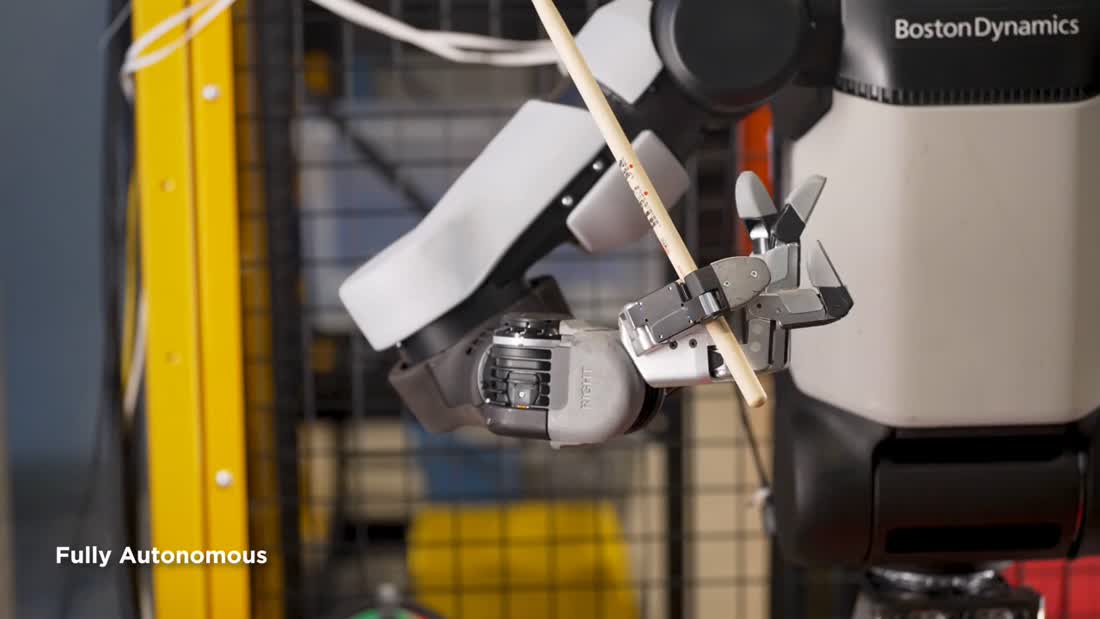
For me, the sensible follow-up is a complete run: pick the right part, prepare the tool, perform the operation, notice a mistake, and recover. A short clip can reveal a skill without supplying that whole chain. Keeping those two levels separate makes the demo more useful to assess.
Learning through contact
The engineers describe a hand built to simulate accurately. Joint geometry, friction, torque, and contact all matter. They also emphasize backdrivability: an external force can move a joint, helping it yield under an impact. Proprioception supplies feedback about joint motion and effort. These design explanations come from the engineers in the launch film.
Think about a drawer that catches halfway open. Repeating the planned motion harder is a poor strategy. You need feedback that something changed. A robot hand faces the same general control problem: a part touches sooner than expected, slides, or ends up angled differently.
A simulation is valuable when those small surprises produce useful training rather than misleading lessons. If its contact behavior differs greatly from the real mechanism, a controller can become excellent at the wrong problem. Hardware that is easier to model therefore helps the learning process.
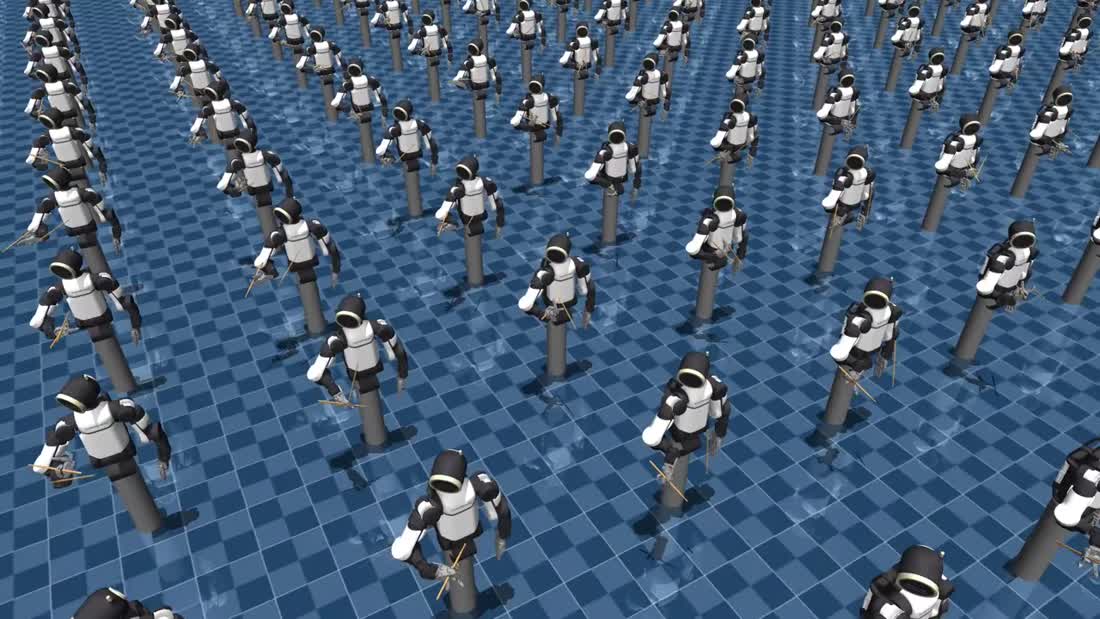
In its earlier whole-body training explanation, Boston Dynamics describes varying object mass, friction, and position while teaching Atlas to carry a fridge. That example also clarifies the load claim: a 100-pound-plus fridge involves the robot’s body and multiple contact surfaces. It is not a published 100-pound rating for one new hand.
Maintenance on a factory floor
Rodriguez told IEEE Spectrum that the team is examining the design details needed if it wanted to make 100,000 hands a year. The interview also describes replaceable actuator packs. That is a manufacturing design question, not confirmation that a factory already produces that quantity. Read the original interview.
Once you picture many hands working every day, repair becomes part of the product. I would want to know how long a worn component takes to diagnose and replace, how consistently replacement units behave, and whether the repair needs a specialist visit. Those are questions for future evidence, not results supplied by this announcement.
| Question I would test | Evidence that would answer it |
|---|---|
| Can it finish the assigned job? | Complete autonomous runs, with attempts and failures counted. |
| Can it handle ordinary variation? | Repeated trials with different part positions, surfaces, and tolerances. |
| Can it stay productive? | Operating hours, wear, repair time, and maintenance requirements. |
This table is my proposed evaluation framework. It contains no measured Atlas results.
Hand DOF versus whole-robot DOF
No. Here it describes each new hand. It should not be read as Atlas’s total number of movable axes.
Standalone availability
The hand announcement does not provide a standalone retail price or ordering route. I would not build a purchase comparison around an invented price.
The limits of the dexterity claim
The useful claim is narrower: this design targets industrial manipulation and tool use. Success across the full variety of human hand tasks needs much broader testing.
The hand design raises practical factory questions: what does each mechanism contribute, how does it behave in contact, and how quickly can a technician replace it? Those are more useful checks than finger count alone.
Four fingers and the revised thumb give those questions a specific design to examine. Repeated autonomous work, with ordinary failures and maintenance intervals reported, would show how well the approach transfers from a demonstration to a production task.
For another view of practical robot design, my Flourish 1 article looks at a much smaller home-robot promise: teaching specific chores by phone. Different setting, same question about completing useful work.
Comments
Post a Comment