MiniMax H3 went open-weight, so I did the math on whether my PC can run it
MiniMax H3 went open-weight,
so I did the math on whether my PC can run it
On July 31, MiniMax dropped H3 (aka Hailuo 3.0). One model that produces 2K video and stereo audio in a single pass — it took #1 on the Artificial Analysis video-editing leaderboard, and #2–3 in text-to-video and image-to-video.
But the sentence that actually made me stop was the next one: "weights coming within days." In this space, Sora, Kling, and Runway are all closed APIs. Someone throwing open weights into that ring is kind of a big deal.
Okay, so what can it do
· Length: 5–15 seconds
· Audio: dialogue, SFX, and BGM generated together with the video (stereo)
· Input: text + up to 9 images + 3 videos + 3 audio = 12 references in one context
· Modes: text→video, first/last frame, reference→video, natural-language video editing
· Prompt: up to 7,000 characters
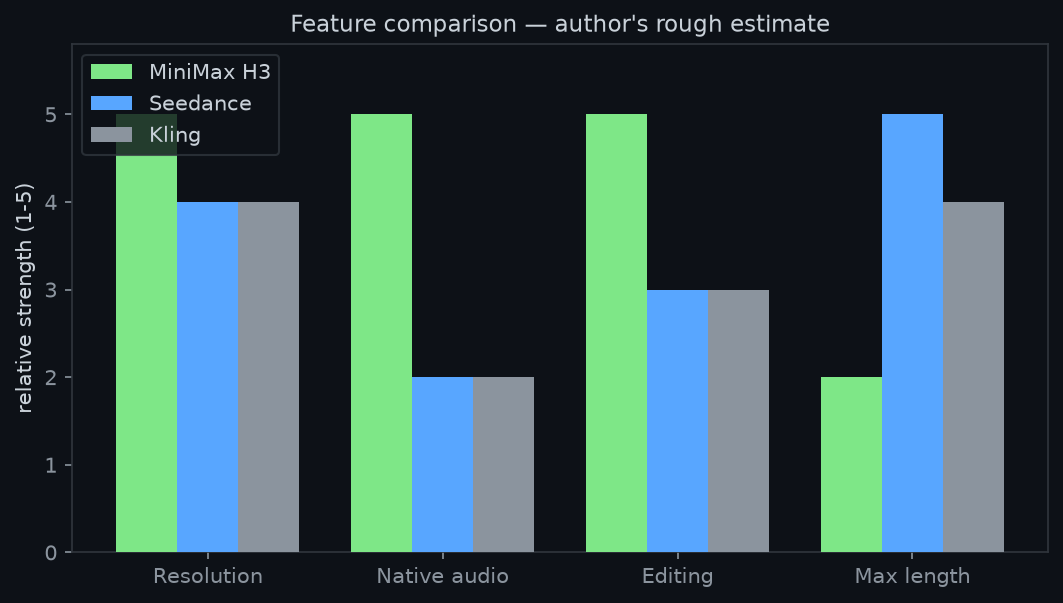
The key is the "12 references at once" part. Before, you'd feed a character image to one model, a motion video to another, a voice to a third, then stitch it all together. H3 handles it in a single call — "follow the Hitchcock camera move from Video 1, have the character from Image 2 sing with the voice from Audio 3," that kind of thing.
The pricing is kind of blatant
$0.13 per second at 2K — about $1.95 for a 15-second clip. Versus competitors:
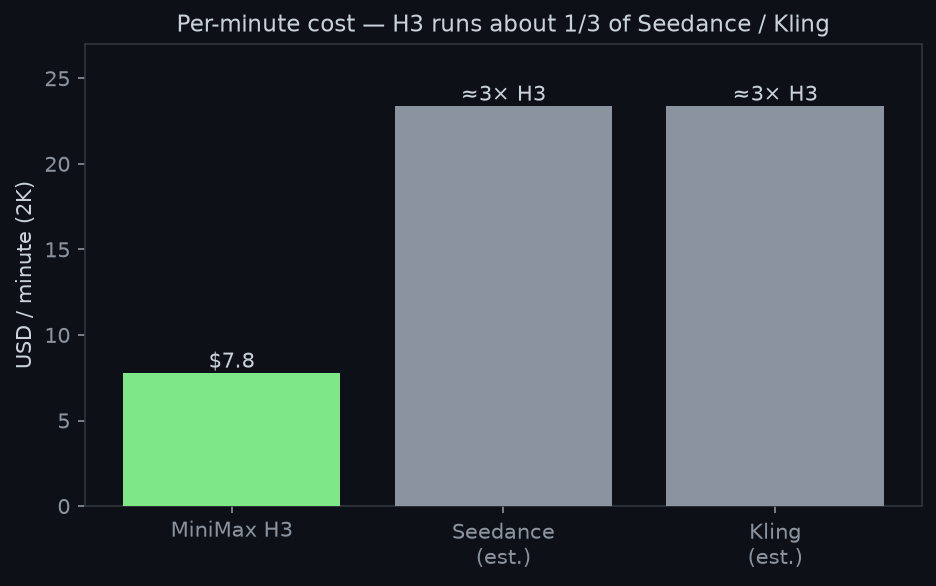
One trap: the length of any reference videos you feed in is added to the billed time. Make a 5s video with a 3s reference and you're billed for 8s. Don't forget this when you're budgeting.
Now the real question — will MY computer run it
Let me be upfront: MiniMax hasn't revealed the parameter count. Weights weren't out as of Aug 2 either. So everything below is my guess — I'll correct it the moment the official model card drops.
The estimate does have a basis though. The company's own text model, M3, was a 428B-total / 23B-active MoE. Video models are usually smaller, but running 2K natively won't be cheap. I split it into a few scenarios:
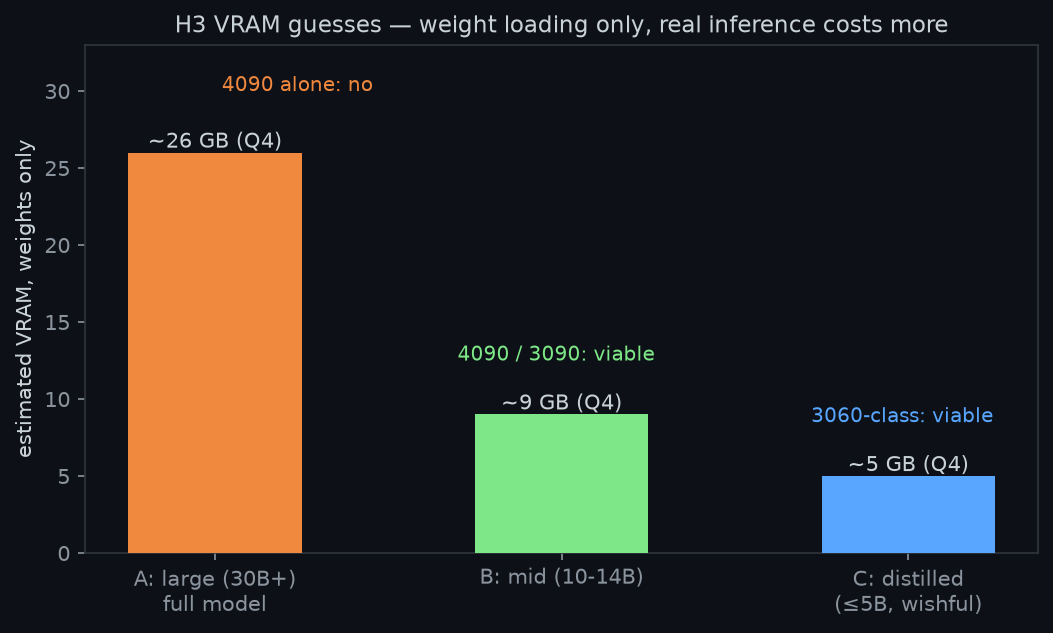
My expectations, in three scenarios:
My personal bet: the full model lands around scenario A, with a separate light version heading toward C. Video generation burns VRAM per frame, so judging by "weight file size" alone — "oh, this'll fit in 24GB" — gets you burned. The real inference overhead is the actual boss.
For reference: the text model M3 was ~143GB even Q4-quantized, effectively unrunnable in a normal home setup. A video model won't be that bad, but let's not get optimistic.
The word "open" — take it with a grain of salt
The license turned out to be the MiniMax Community License: commercial use only for organizations under $20M annual revenue, with attribution required. That's not OSI-certified open source — it's "source-available," the same shape as Meta's Llama.
Practically free for individual creators, indie studios, and early startups. But a bigger ad production? Maybe not. And as of Aug 2, there still aren't any downloadable files — it's a "within days" promise.
Conclusion
If you want to try it right now, the API is the way. A 15s 2K clip at $1.95 is less than lunch money — testing with your own prompts beats a hundred reviews.
For local runs, wait until the weights drop and the model card arrives. Until parameter count, quantization options, and real inference VRAM are all confirmed, hold off on the "my 4090 can handle it" judgment. My guess: the full model is heavy for a single consumer GPU, and a distilled light version is what makes local use realistic.
When the weights actually drop, I'll come back with a "yep, it runs / nope, it doesn't" follow-up. For now, half excitement, half skepticism feels like the right attitude.
Related on this blog: MiniMax's open music model · my first impressions of those open weights
Hardware estimates are my speculation and will be updated against the official model card.
Open Source Factory · opensourcefactory1.blogspot.com
Comments
Post a Comment