DeepSeek Flash-1017: Does the Update Reduce Rework?
MODELS & COSTS
DeepSeek Flash-1017: Does the Update Reduce Rework?
DeepSeek changed Flash without changing its API rate. That gives existing users a straightforward reason to revisit a difficult job. The useful comparison is whether the October checkpoint needs fewer rescue prompts, failed calls and extra tokens to finish the same work.
In this article
The update is DeepSeek-V4.1-Flash-1017, announced on October 17. DeepSeek says it performs better while finishing tasks sooner and producing less output. The interesting question is how much unnecessary work disappears between the prompt and a usable result. This is a source-based analysis; I haven’t run a controlled before-and-after test. DeepSeek’s changelog confirms the rollout and unchanged pricing.
I covered the September V4.1 Flash launch here. This follow-up concerns the October checkpoint. Repeating the architecture pitch would miss the point: existing users need to know whether the same tool now gets through the work more cleanly.
What changed in the patch?
The official website, app and API have moved to the new version. The API name remains deepseek-flash, and the old deepseek-v4-flash and deepseek-v4-flash-vision-exp names still route to the current Flash model. A familiar identifier therefore does not preserve the old model’s behavior. That matters if a prompt you tuned last month suddenly behaves differently.
For anyone maintaining a coding workflow, I’d save one successful run before changing prompts or configuration. Keep the repository revision, task, model identifier and date together. Otherwise, a model update and a prompt edit can happen at the same time, and you lose a useful explanation for either improvement or regression.
There is also a specific integration recommendation: DeepSeek asks Harness users to move to v0.2.1-rc.1 or later. Its release announcement emphasizes project development and reinforcement learning with self-feedback. That gives the patch a fairly clear audience: people asking an agent to carry a project through several steps.
Where do the published scores actually move?
The largest changes in the rows below are Terminal-Bench 4.0, from 31.2 to 42.3, and ProgramBench, from 20.3 to 29.1. Those are gains of 11.1 and 8.8 percentage points. DeepSWE v1.1 moves from 74.2 to 77.0; NL2Repo-Bench goes from 65.4 to 68.2. Both gain 2.8 points. The official model card supplies both versions’ scores and the evaluation notes.
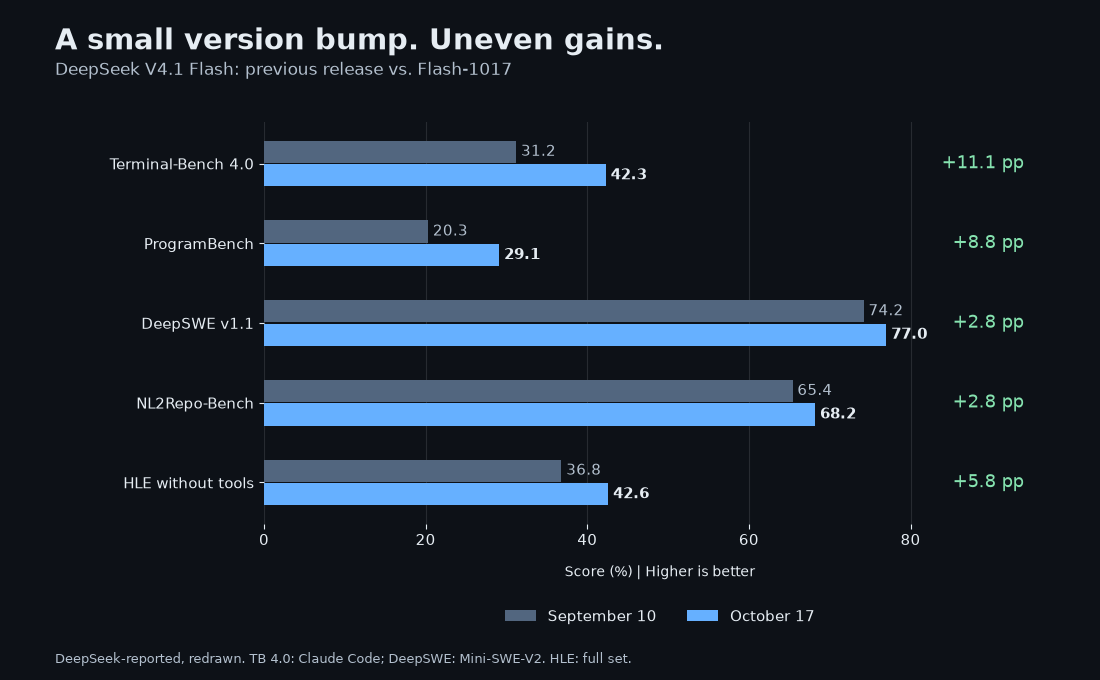
I like that the comparison includes the old Flash on the same benchmark versions. It lets us ask a useful question about the patch itself. Pulling a much older Terminal-Bench score into this chart would make the bars more dramatic and the comparison less useful.
The uneven gains help set expectations. A workflow that already succeeds most of the time may improve modestly. A workflow that exposes the model’s weaker planning or execution may have more room to gain. That is an interpretation of the score pattern, not a diagnosis of what changed inside the model.
The numbers still come from DeepSeek. An agent result includes the harness, available tools and evaluation setup. I would use this table to choose work to retest, then judge the update on whether the resulting code builds, passes relevant checks and meets the request.
Will the same price produce a smaller bill?
DeepSeek’s direct API rates are below. These are token rates, not a subscription allowance or an OpenRouter-wide promise. The official pricing page lists them; OpenRouter’s DeepSeek provider row also shows the $0.15 input, $0.60 output and $0.003 cached-input rates.
| Per 1M tokens | Off-peak | Peak |
|---|---|---|
| Cached input | $0.003 | $0.006 |
| Uncached input | $0.15 | $0.30 |
| Output | $0.60 | $1.20 |
Peak hours are 01:00–04:00 and 06:00–10:00 UTC, Monday through Friday, excluding Chinese public holidays. In Korea, that is 10:00–13:00 and 15:00–19:00. The current policy makes weekends and Chinese public holidays off-peak throughout. Prices were checked on October 18, Korean time.
Here is a deliberately simple calculation. With 100 million uncached input tokens and 20 million output tokens, the model bill is $27 off-peak or $54 at peak rates. If output fell by an assumed 20%, while input stayed fixed, those totals would become $24.60 and $49.20. The saving is 8.9%, because input still costs money.
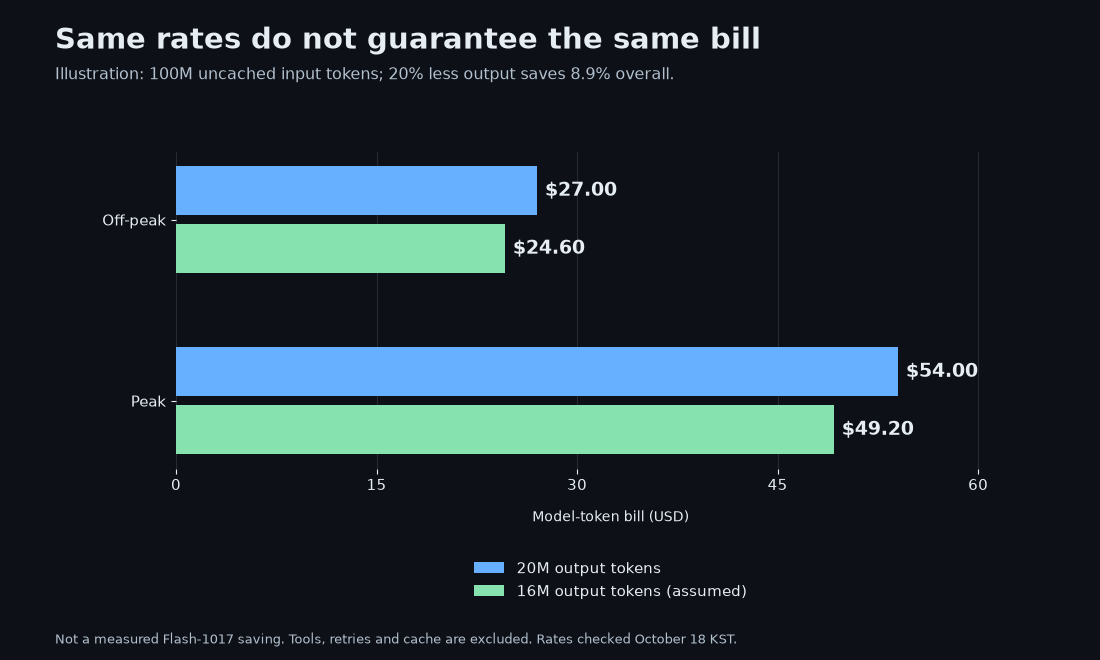
That 20% is an illustration, not a measured reduction from this release. Shorter output can help, but so can fewer failed runs. Conversely, extra searches, repeated file reads or a wrong solution that needs another attempt can swallow the saving. My preferred number would be total spend per accepted task, with a short record of why each rejected attempt failed.
Why are there game demos and a search API in this release?
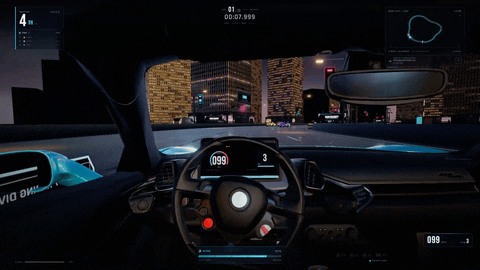
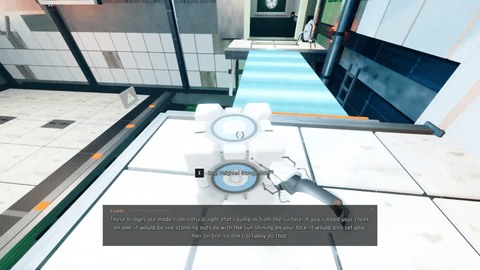
DeepSeek’s examples include a browser racing game, a Godot recreation of Portal 2 and a scene showing a town across different eras. They help explain the intended use: getting from an idea to a running project. A selected demo leaves plenty unanswered, including how many retries it took and what was fixed afterward. I’d want that history before treating a polished scene as evidence of dependable delivery.

The separately documented Search and Fetch APIs give agents web results and page content. Each costs $0.75 per 1,000 successful calls. Under the announced temporary arrangement, server-side Search and Fetch tool calls through DeepSeek Harness, Claude Code and Codex are free for DeepSeek API users until billing begins on October 31 at 16:00 UTC, or November 1 at 01:00 KST.
That distinction deserves a line in a project budget. The temporary arrangement concerns the specified server-side tool calls; model tokens remain a separate charge. At the listed tool rates, one successful Search and one successful Fetch add up to $0.0015. A long research run can repeat that pair many times.
Search helps an agent find material. It doesn’t decide whether the source is correct, whether a dependency is maintained, or whether a copied example fits the project. Those checks remain part of getting useful work out of the model.
What should existing users do with it?
Do I need to change the model name?
For DeepSeek’s direct API, continue using deepseek-flash. If another service sits between you and DeepSeek, check that service’s model entry before assuming it has switched. The direct API rollout does not document every third-party route.
Can the new checkpoint be downloaded?
Yes. DeepSeek has published the weights under the MIT license on Hugging Face. The repository includes inference instructions. Download availability is useful for teams operating their own infrastructure; it doesn’t establish that the model fits a particular consumer computer.
What would make a useful retest?
I’d start with a small feature touching several files, a bug with a clear reproduction, and a task needing current documentation. Keep the starting state and acceptance checks fixed. Record elapsed time, the whole token bill, tool calls and manual corrections. Three completed jobs say more about your workflow than three attractive screenshots.
Retry a job that needed too much help
Flash-1017 is worth another run if September’s model came close but took too many detours. The published gains give existing users a reason to revisit unfinished work without accepting a new token price.
I’m especially interested in the rejected attempts. A cheaper successful run is welcome; needing fewer rescue prompts would change how often I trust an agent with a longer job. For now, the release makes that worth testing. A repeatable task log would make the case much stronger, and that is the evidence a follow-up should examine.
Sources and prices checked October 18, 2026 (KST). Benchmarks are DeepSeek-reported; charts are original redraws. No controlled hands-on test was performed. Related: the September V4.1 Flash launch. · MiniMax M3.1 Flash and cost per finished task
Comments
Post a Comment