MiniMax M3.1 Flash: Price the Finished Task
AGENTS & WORKFLOWS
MiniMax M3.1 Flash: Price the Finished Task
A low token rate makes an agent cheap to start. It can still spend the saving on repeated searches, long answers or failed attempts. For MiniMax M3.1 Flash, the useful calculation follows the entire job through to an accepted result.
In this article
MiniMax M3.1 Flash is worth trying for work that can run in the background. Its official API rates are low, and an outside analytics evaluation gives it a credible result. But the bill for a completed job depends on how much work the agent creates along the way. That is the part I would check before moving a daily workflow over.
This is an analysis of published sources and my own cost arithmetic. I have not run a model benchmark for this article. The calculations below are reproducible examples, with assumptions shown.
What can you actually use today?
MiniMax announced M3.1 Flash on October 19. It is available through its API, M Plan and MiniMax Code. The company identifies the anonymous Space Bunny model as an earlier version. Model weights are promised for later; that does not give us a downloadable release or a license to evaluate today.
The access route matters. The OpenRouter free listing was live when checked on October 21. That is a separate, rate-limited route. I would use it to explore the model, while budgeting a production workload at the paid route I intend to use. A free listing today is a weak basis for an annual budget.
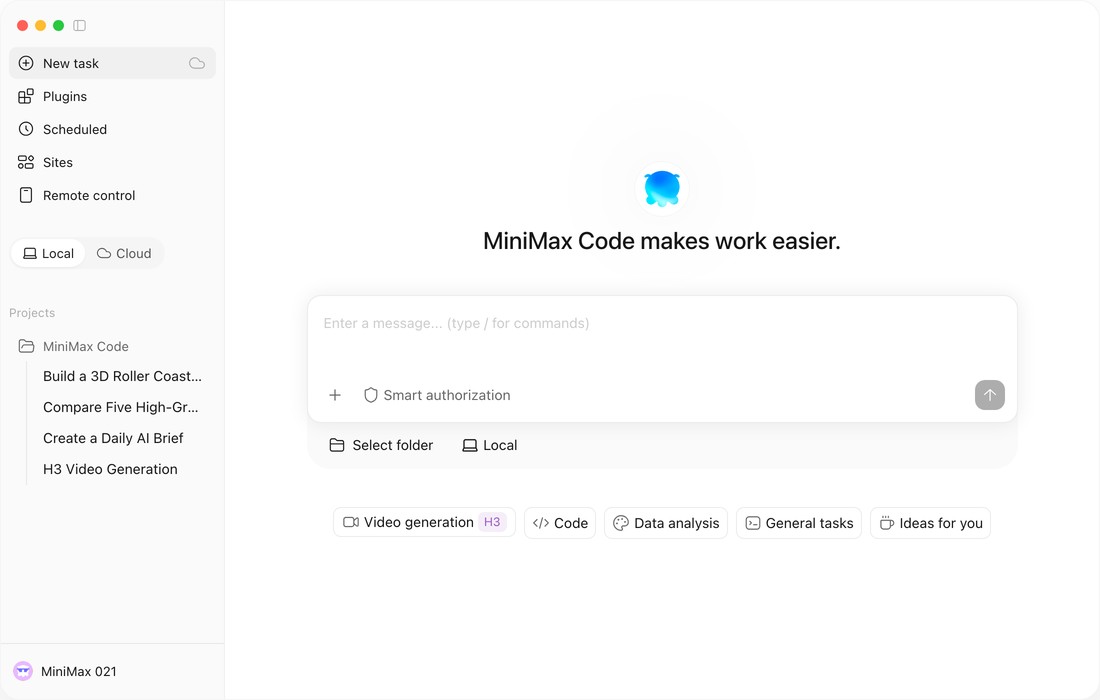
MiniMax Code is the application around the model. Its interface and available tools affect what a user can finish. A result obtained inside one application should therefore be read as evidence about that setup. Swapping the model name in another coding agent may produce different behavior.
What does the rate card buy?
The official MiniMax API charges $0.15 for uncached input, $0.60 for output and $0.015 for cached input, per million tokens. Those are usage rates, separate from a subscription allowance. The output rate is four times the uncached-input rate, so a long reasoning or generation run deserves attention even at this price.
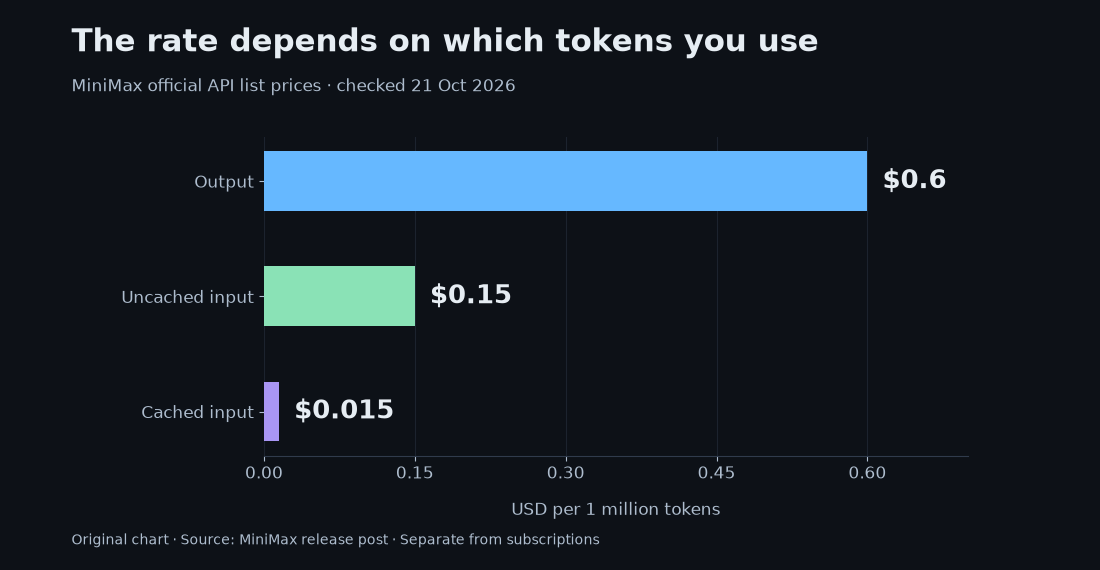
I would calculate a job from the provider's usage record. The visible answer can be short while the full run contains repeated context, tool exchanges and additional output. Count the billed tokens, including any reasoning tokens the selected route bills as output.
Token bill in USD =
  uncached input / 1,000,000 × 0.15
+ cached input   / 1,000,000 × 0.015
+ output         / 1,000,000 × 0.60
Here are three deliberately simple workloads. Each row represents the sum of tokens across an entire run. The second price assumes exactly 80% of input tokens qualify for the cached-input rate. It does not assume that 80% of requests are free.
| Assumed whole-run tokens | No input cached | 80% input cached |
|---|---|---|
| 100,000 input + 10,000 output | $0.021 | $0.0102 |
| 1,000,000 input + 20,000 output | $0.162 | $0.054 |
| 1,000,000 input + 100,000 output | $0.210 | $0.102 |
The middle row falls from $0.162 to $0.054, a two-thirds reduction. Nothing about the model's answer changed in that calculation. Only billing treatment changed. That is why I would separate a cold run from a warm run when testing an agent that repeatedly sends the same repository or documents.
These are token bills before external tools, taxes and human review. A browser session, search service or another model called by the agent can add costs through its own billing route. A run that hits an output limit also needs to be counted, even if it never delivers a usable answer.
Does cheap pricing survive a whole task?
Plotly's October 20 evaluation provides a useful example. M3.1 Flash passed 41 of 43 questions, with the exam valued at $4.09 using MiniMax list prices. Median time was about three minutes per question. Its earlier Space Bunny result was 38 passes, $0.82 and 36 seconds.
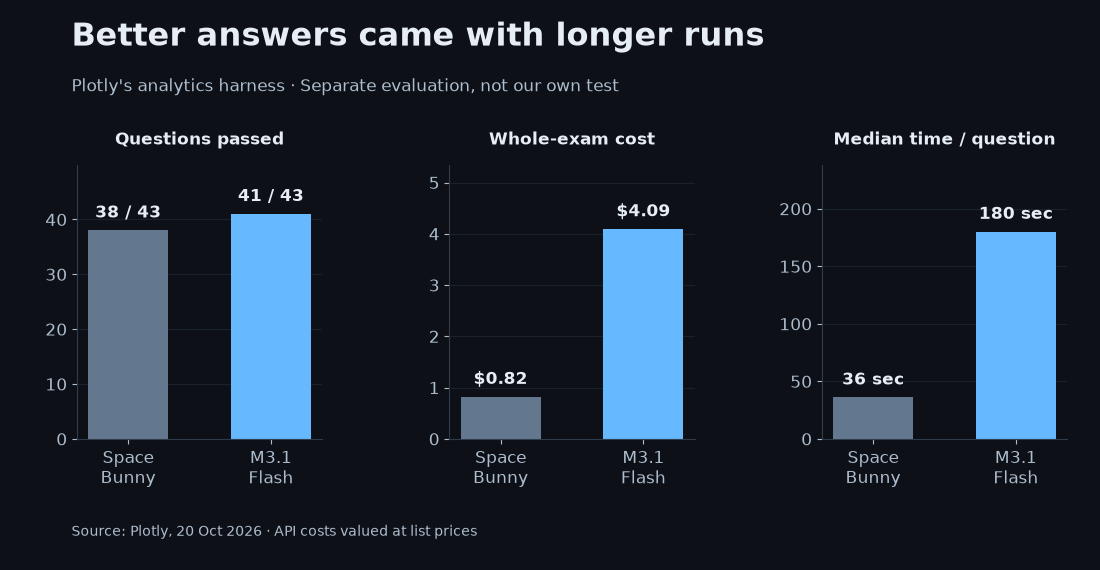
The benchmark's method matters here: synthetic wind-farm data, a private question set and Plotly's own read-only analytics tools. It tests a particular agent workflow. It does not establish a success rate for arbitrary software projects.
That tradeoff can be sensible. An unattended investigation has room to spend longer checking assumptions. A customer waiting in a chat window has a different deadline. I would decide which of those experiences I am buying before choosing a model from a speed figure.
I would also keep the baselines separate. MiniMax's launch claim of 70% lower agent-task costs compares against its predecessor under its evaluation. Plotly compares its own earlier Space Bunny run with the released model. The workload and reference point differ, so the two percentages cannot be substituted for each other.
For an internal trial, I would write the acceptance conditions before reading the answer. A successful result must survive a check of the actual query, code or artifact. Polished prose is a poor substitute for the missing calculation or incorrect file it describes.
How would I test it on my own work?
I would start with a small queue of jobs whose answers can be checked cheaply. Keep the files, tool access, timeout and instructions fixed. Save the exact model identifier and provider with every run. That makes a later comparison possible when the endpoint changes.
- A repository fix: use a reproducible bug and a regression check. Require the check to pass, and inspect unrelated edits.
- A messy spreadsheet: include a duplicate row, a missing date and a question with a known answer. Require the calculation and its assumptions.
- A document comparison: seed several known changes. Check whether the answer identifies each one and links it to the right passage.
- A structured extraction: validate required fields and types in code. Count malformed and incomplete responses as failed runs.
For each job, record the first result and any retries. Then measure total spend, elapsed time and review effort per accepted result. Keep the cost of failed jobs in the total: they used resources too.
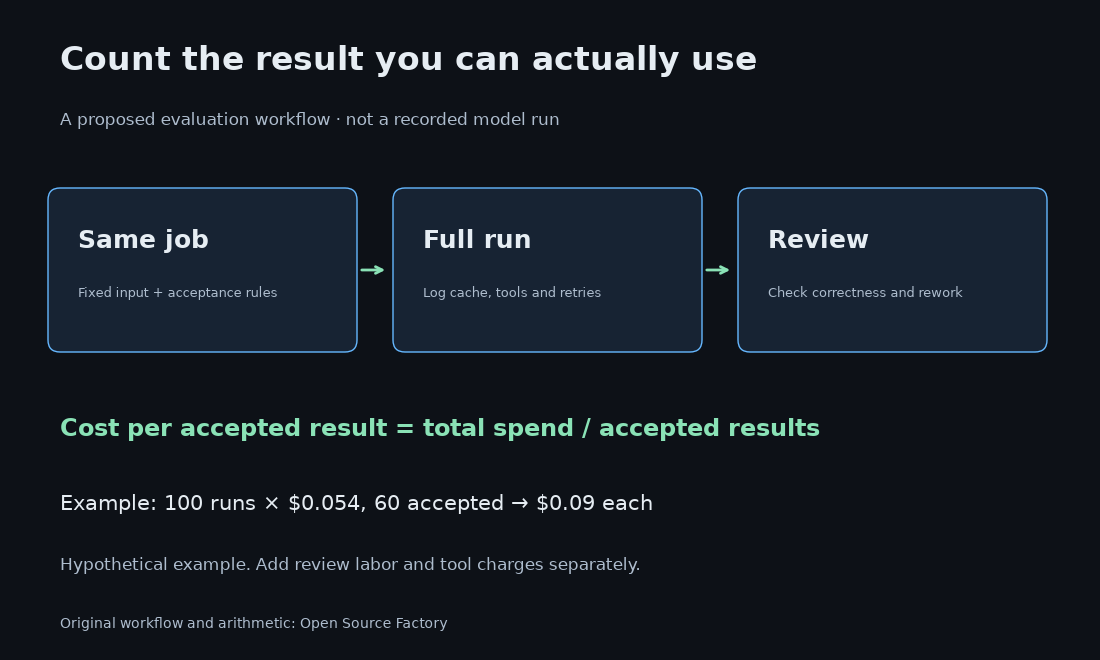
For example, suppose 100 runs each cost the hypothetical $0.054 from the table. The token spend is $5.40. If 60 results pass inspection, each accepted result carries $0.09 in token costs. If 90 pass, that falls to $0.06. The rate card stayed identical.
Human review can be the larger item. At an assumed $30 an hour, three minutes of checking costs $1.50. This is a budgeting illustration, not a measured review time or a wage recommendation. It shows why an agent that needs a little less correction can be worth more than a tiny reduction in its API bill.
I would run the first trial with reversible tasks and limited tool access. Once the outputs pass, expand the scope. That gives the next test a concrete question: which extra permissions or longer runs improve the accepted result enough to justify their cost?
Count the work after the first call
M3.1 Flash makes the candidate list on price, and the external analytics result gives me a reason to look beyond the launch charts. I would begin with read-only analysis that can finish in the background. The first thing I would measure is how much checking it leaves for me.
For another example of why the full run matters, see my DeepSeek Flash-1017 analysis. If running locally is the goal, the Muse Spark Open memory breakdown covers a different, already released set of weights. M3.1 Flash still needs its own release, license and hardware evidence before it belongs in a local installation guide.
I'll revisit the local-running question when the weights and license are available. For this release, a small trial with clear pass conditions tells me more than another ranking.
Comments
Post a Comment