Muse Spark Open: The Memory Behind a Two-Mac Setup
MODELS & COSTS
Muse Spark Open: The Memory Behind a Two-Mac Setup
Two Mac Studios sound like a compact home for an 816B model. The configuration matters: Meta's documented recipe uses specific memory capacities, a mixed-precision checkpoint and MLX. A count of two computers is not enough to price or reproduce that setup.
In this article
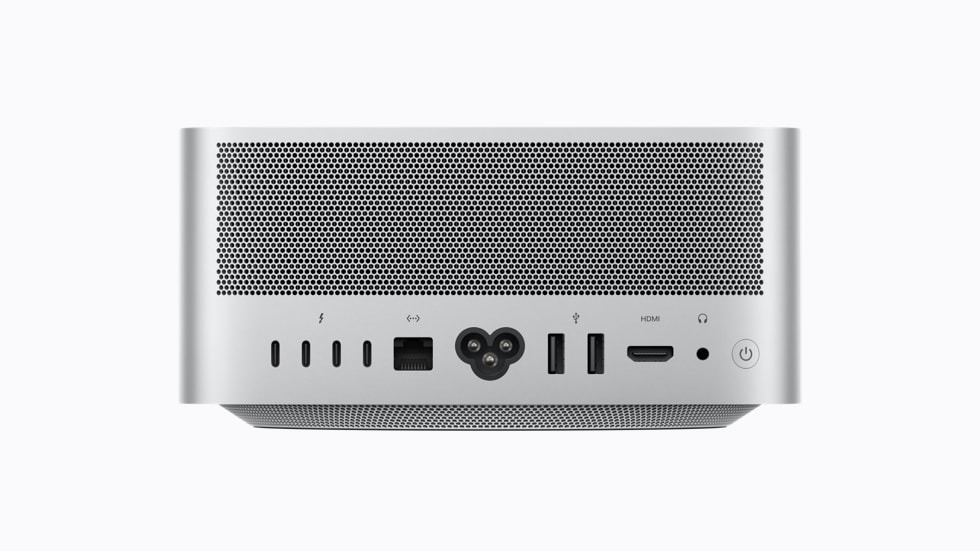
Meta documents two M5 Ultra Mac Studios with 512GB each, or four with 256GB each, using its mixed-precision NVFP4 checkpoint and MLX. There is a buying wrinkle: Apple still lists the 512GB option as coming in late October. This is a source-based analysis checked on October 19, 2026; I have not run this model locally.
What did Meta actually release?
Muse Spark Open arrived on October 15 with downloadable weights and hosted API routes. It accepts text, images, video and audio, and produces text. Think of an agent reading a repository or inspecting a video, rather than an image or video generator.
The architecture has 816B total parameters and about 42B active per token, with a context window of roughly one million tokens. Meta describes coding and extended tool use as central uses. Its release examples include changes to the Ice Cubes iOS app and a DaVinci Resolve editing workflow. Those are Meta’s demonstrations; I have not independently reproduced them.
For a developer, the interesting part is control over the weights and deployment. You can choose a host, alter the serving stack or investigate a failure in ways a closed chatbot does not allow. Whether that is worth operating the system depends on the work it can finish for you.
Why does a 42B-active model need so much memory?
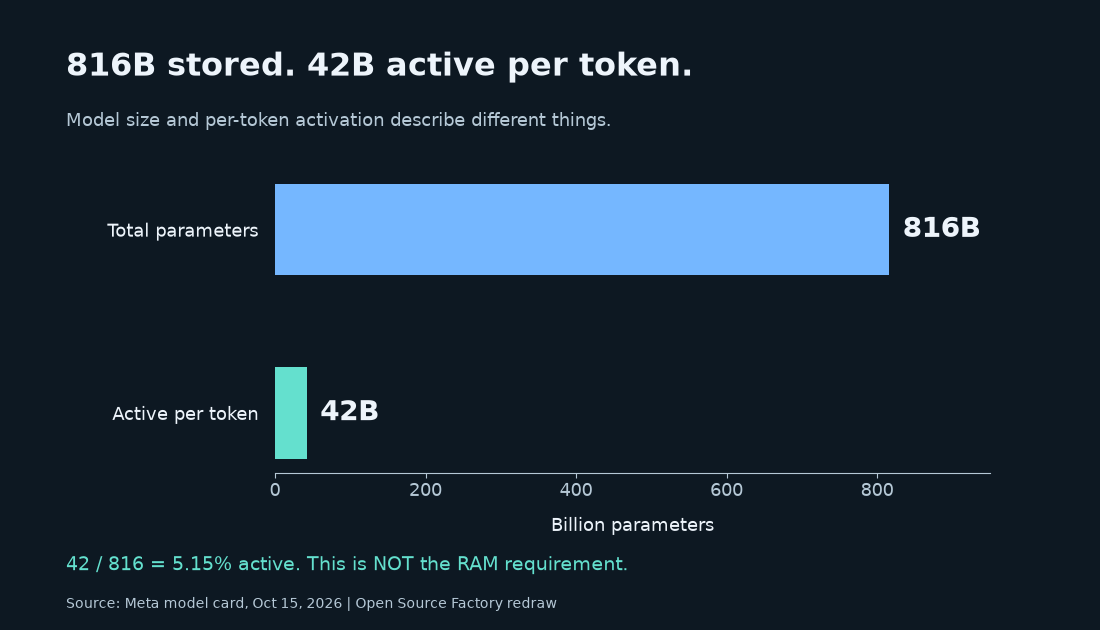
Active parameters describe which parts participate in a token’s computation. They do not tell you how many weights must remain available. A later token may need a different set of experts. In the documented Mac setup, each machine keeps its share of the model; intermediate results cross the link.
The active share is 42 ÷ 816 ≈ 5.15%. That is useful architectural context, but multiplying a full-model memory estimate by 5.15% would give the wrong hardware budget. I use the same distinction in the MoE memory-planning guide.
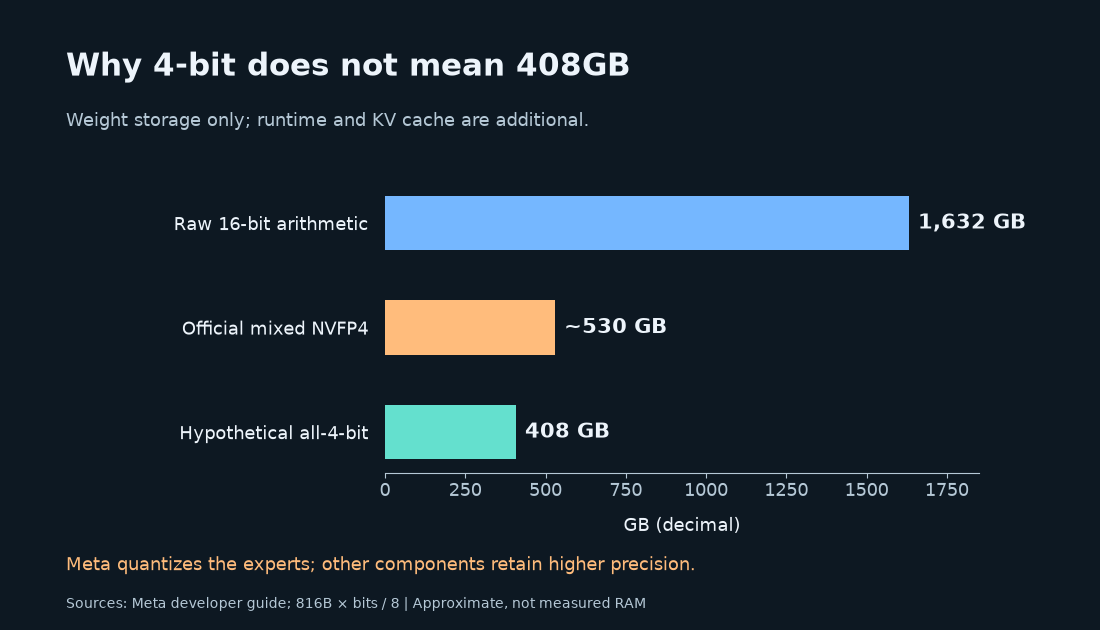
There is a second trap in the word “4-bit.” If every parameter were stored at exactly four bits, the simple arithmetic would be 816 billion × 4 ÷ 8 = 408 billion bytes, or 408GB in decimal units. Raw 16-bit storage would be 1,632GB before runtime overhead.
Meta’s actual NVFP4 checkpoint is about 530GB. Its experts are quantized while other components retain higher precision. That is roughly 122GB more than the all-4-bit calculation. A format label is not a substitute for checking the files you will load.
Neither number includes the complete running workload. The operating system, runtime buffers and attention’s KV cache also need memory. A one-million-token capability is not a promise that your available configuration can use the entire window at a comfortable speed. Keep decimal GB, binary GiB and the runtime’s reported memory units separate when comparing a download with a machine.
Can you buy the two-Mac setup today?
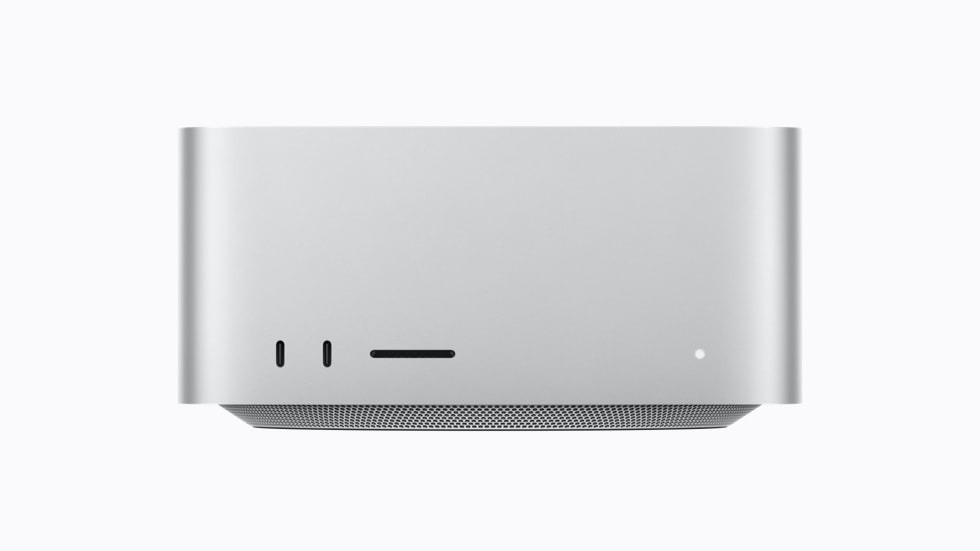
The memory option is the detail I would check first. Apple’s current Mac Studio page still says the 512GB M5 Ultra option is coming in late October. The launch announcement says the same. Meta’s documented two-machine setup should not be read as a pair you can necessarily order for immediate delivery on October 19.
| Documented configuration | What to check |
|---|---|
| 2 × M5 Ultra, 512GB each | 512GB option listed for late October; obtain a current configuration quote. |
| 4 × M5 Ultra, 256GB each | More machines, cabling and power; check regional stock and the complete software requirements. |
Both rows add up to 1,024 advertised GB, but the usable budget and performance depend on the deployment. Meta’s Mac cookbook calls for macOS 26.2 or later, MLX 0.30.1 or later, direct Thunderbolt 5 links and RDMA. Every machine also needs disk space for the full NVFP4 checkpoint, even though its working share is distributed.
For four machines, the guide calls for direct connections between every pair. That is a small cluster to administer, rather than a bigger laptop. I would check software availability, cable compatibility, sustained throughput and power use before ordering hardware. The cookbook is a setup recipe, not an independently measured performance guarantee.
Apple’s launch price of $5,499 for an M5 Ultra Mac Studio is a starting price, not a quote for the 512GB configuration. Doubling it does not price the demonstrated pair. The real ownership calculation needs the memory upgrades, SSDs, connections, electricity and time spent maintaining the system.
What if you do not own a terabyte of memory?
There are lower-bit GGUF alternatives. Unsloth’s own guide says its named UD-IQ2_XXS quant fits a 256GB memory setup. This is a different quantization route from Meta’s official NVFP4 example. It should be tested for answer quality, tool-call reliability and usable context before treating the smaller footprint as an equivalent replacement.
For an initial evaluation, hosted inference is easier to budget. OpenRouter lists Muse Spark Open at $1.25 per million fresh input tokens and $4.25 per million output tokens, checked October 19. Cached-input pricing is separate, and provider support can differ.
| Billed tokens: input / output | Cost (USD) |
|---|---|
| 10M / 2M | $21.00 |
| 100M / 20M | $210.00 |
These are arithmetic examples, not my usage history or fixed monthly plans. The formula is input millions × $1.25 + output millions × $4.25. Count all billed output, including reasoning where charged, and tokens spent on retries. The examples exclude cache discounts, separately billed tools and taxes.
I would give the API a few representative tasks before buying equipment: one repository fix with tests, one task that needs several tools, and one multimodal input that matters to the intended job. Record completed tasks, errors and the full bill. That produces a useful comparison with self-hosting; dividing hardware cost by an invented flat monthly allowance does not.
Does “open” mean you can use it without conditions?
The weights use the Muse Model License. It requires the attribution phrase “Built with Muse Spark Open”. Its $20 million revenue provision concerns businesses providing models as a service and aggregates the licensee’s and affiliates’ revenue over a consecutive twelve-month period. The text expressly exempts internal use, research and specified other commercial/product-component uses from that section. It is not a blanket ban on every company above $20 million, and it is not an Apache-2.0 release.
Capability also needs a narrower reading than the launch headline. In Meta’s model card, Muse Spark Open at xhigh scores 89.0 on GPQA Diamond, 60 on DeepSWE 1.1 using the preferred harness, and 76.4 on Terminal-Bench 2.1 with the Terminus 2 agent. These are Meta-reported results under the stated evaluation setups. They do not establish the score of a lower-bit local quant or a universal rank across different benchmark versions.
Verify the complete Mac configuration
The release is interesting because the model can leave an API provider’s rack and become something a small team can operate. The two-Mac example makes that tangible. It also makes the remaining costs visible: memory, the distributed runtime, storage on every host and a configuration that is still waiting for a retail memory option.
For a first encounter, I would test the API and keep the bill. For a team that needs control over its weights and data path, the Mac recipe deserves a closer look after the actual configuration and throughput are verified. The check I want next is a repeatable test of the same tasks across the official checkpoint, a named smaller quant and the hosted route.
Related on this blog: M5 Ultra: Apple’s claims and reviewers’ measurements · A practical local-AI hardware buying checklist. · MiniMax M3.1 Flash: hosted task-cost analysis
Comments
Post a Comment