Meta's 100g VR Glasses Cost $1,299.99 — What You Get for the Weight
Meta's 100g VR Glasses Cost $1,299.99 — What You Get for the Weight
Meta's Connect keynote ran Wednesday evening in Menlo Park, and the company's first new VR hardware since 2024 turned out to be a pair of glasses that weighs about as much as a deck of cards. I spent last week tracking this exact device while it leaked out of Meta's own app store under the codename Project Phoenix. The reveal did something rare for a leak that good: it confirmed nearly all of it, gave the thing a name — Meta VR Glasses — and then priced it at $1,299.99, more than any Quest Meta has ever sold.
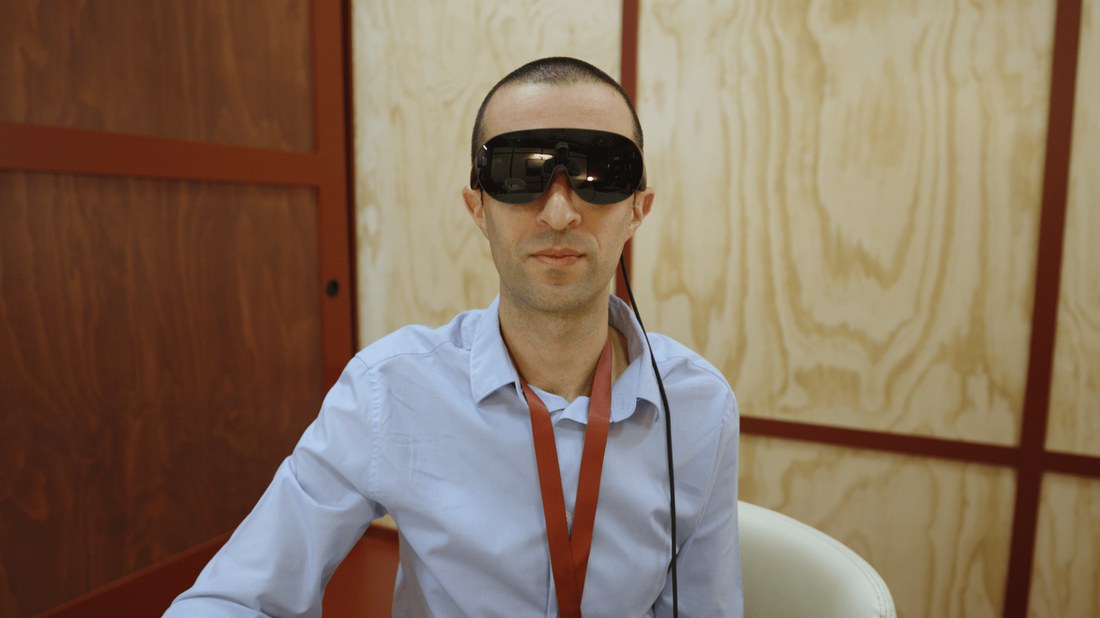
So here is the deal in numbers. About 100 grams on your face, against 515 for the Quest 3. A 300-gram puck in your pocket that holds the processor and the battery. Up to three hours of playback per charge. And a field of view of 70 degrees horizontal, where the Quest 3 gives you about 110. The weight is real, the sharpness is real, and so is the bill. This post is about what you actually hand over for those 100 grams.

What Meta actually announced
One clarification first, because the comment sections are already arguing about it: this is not a Quest. Meta dropped the Quest branding entirely, and the "Quest 4" some people were waiting for did not appear. If you want the shape of the product in one sentence: it is a mixed reality headset whose battery, chip and storage all live off your head, tethered by a cable to a puck that clips to a pocket or belt.
| Meta VR Glasses | What you get |
|---|---|
| Price | $1,299.99 (128GB) |
| On sale | Spring 2027 — 25 markets including the US, UK, Canada, most of Western Europe, Japan, Korea, Taiwan, Singapore and Australia |
| Weight | About 100 g on your face; about 300 g puck (compute + battery + storage) in a pocket, connected by an optical tether |
| Display | 2,412 × 2,288 micro-OLED per eye ("5K Infinite Display"), up to 120 Hz, 37 pixels per degree, pancake lenses, Dolby Vision |
| Field of view | 70° horizontal × 66° vertical (about 87–88° diagonal) — the Quest 3 is roughly 110° × 96° |
| Chip and memory | Snapdragon Reality Elite (XR2 Gen 3), 12GB RAM |
| Storage | 128GB internal plus a microSD slot (up to 1TB, card not included) |
| Battery | Up to 3 hours of continuous high-resolution media playback; 45W charging, and it charges while you use it |
| Input | Eye tracking plus hand gestures (look, pinch, thumb swipe). No controllers in the box — Touch Plus works if you buy them or already own Quest 3 controllers |
| Sensors | Full-color passthrough at 26 PPD with autofocus and depth sensing; four eye-tracking cameras; face tracking; iris unlock |
| Sizes | Standard and Large — two separate SKUs at the same price |
| Content | The entire Quest app catalog, plus more than 75 hand-gesture-optimized titles at launch; first IMAX Enhanced certified VR device; Dolby Atmos audio |
The lineage is worth one line, because I spent a whole post on it: this is the device the community has been tracking as Project Phoenix since firmware strings appeared in late 2025. Meta has never used that codename publicly, so treat the connection as the leaks' bookkeeping rather than the company's story. What matters is that the shape matches almost exactly what leaked — and I'll score the leaks properly further down.
What 100 grams buys you
Start with the number Meta is proudest of: five times lighter than a Quest 3. That is 515 grams versus about 100, and because the puck is on a cable, the fairer comparison is everything you are carrying — around 400 grams in total, which is still less than a Quest 3's head unit by itself.
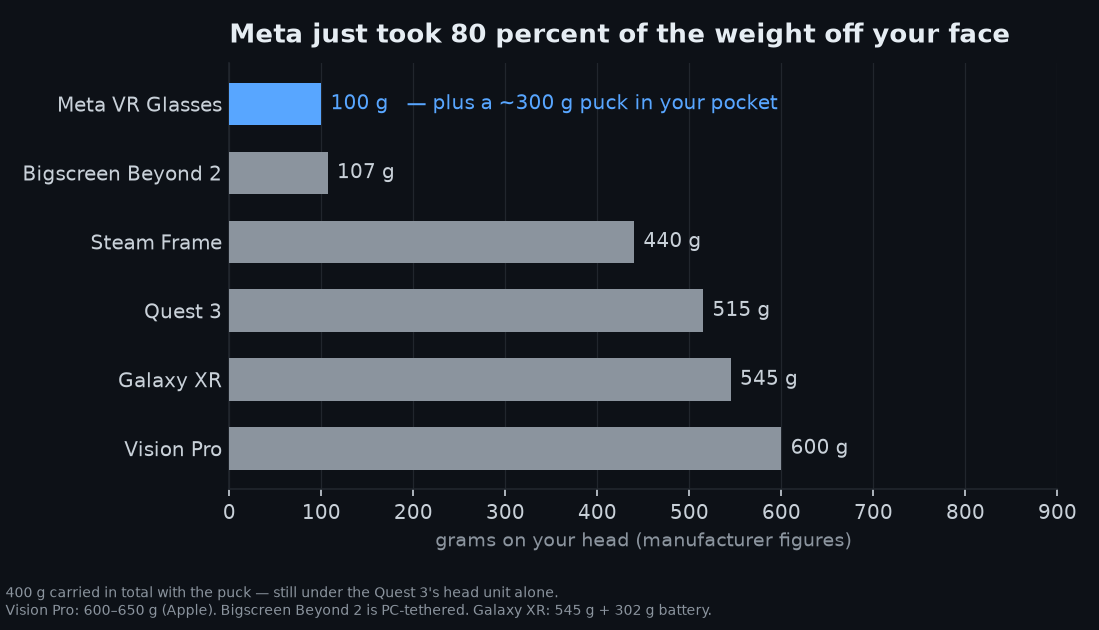
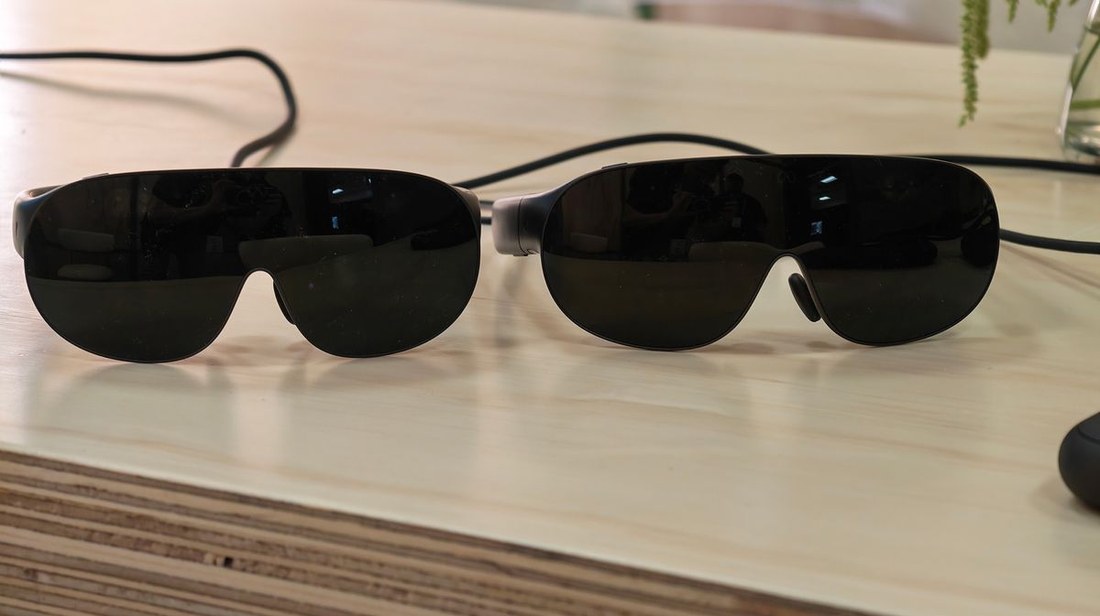
Getting to 100 grams took more than shaving plastic off a Quest. The frame is magnesium alloy, the optics are pancake lenses, the visor does no computing at all — UploadVR notes there is not even a tracking coprocessor on board — and the open periphery means your face is never sealed inside a light-proof box. On stage, Meta's line was blunt: "the weight is over."
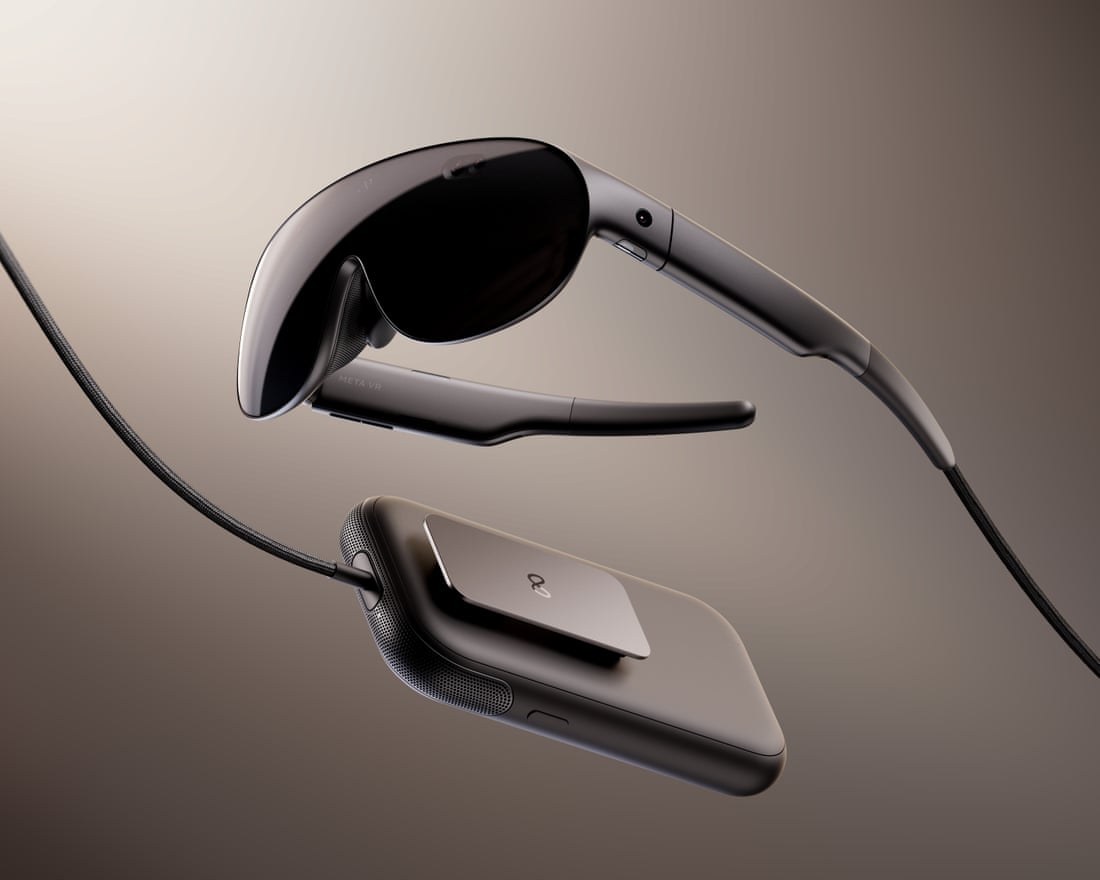
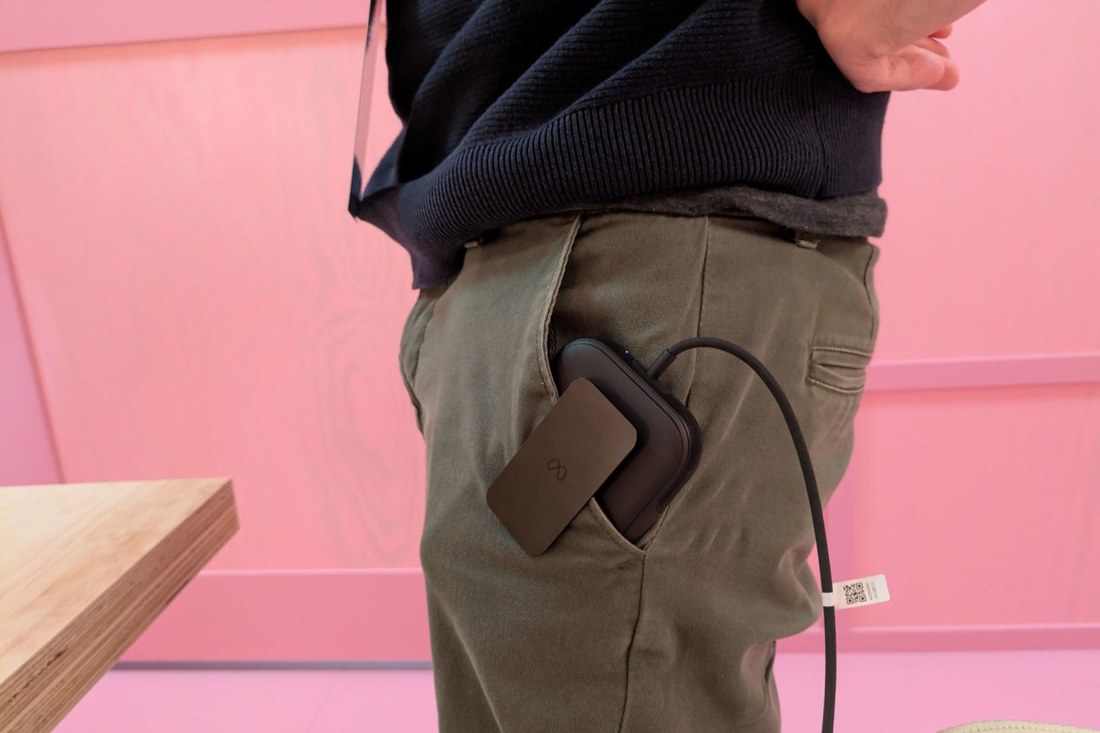
The puck is the part I keep thinking about, because it is the honest reveal of this design. It is roughly phone-sized, 300 grams, actively cooled through a vented top, and it lives in a pocket or on a belt clip. Engadget, after a half-hour demo, could feel heat radiating off the unit without even touching it, and wondered how that feels against a thigh on a long flight. Road to VR's note is the practical counterweight: the puck charges from an included 45W USB-C supply while you use it, so three hours is only a hard ceiling when you are nowhere near a wall outlet.
The field of view is the bill
Now the number Meta buried under the sharpness story: 70 degrees horizontal. The Quest 3 gives you about 110, and if you multiply the advertised angles out, the VR Glasses' window is roughly 56% smaller in visual area — that is my arithmetic, not Meta's. Road to VR called it "noticeably smaller than Quest 3's 110-degree FOV, which some may find frustrating on the face of things." Engadget hit the same wall from the workflow side: while testing a three-window desktop setup, the reviewer "had to physically turn my head around to see the contents of each window."
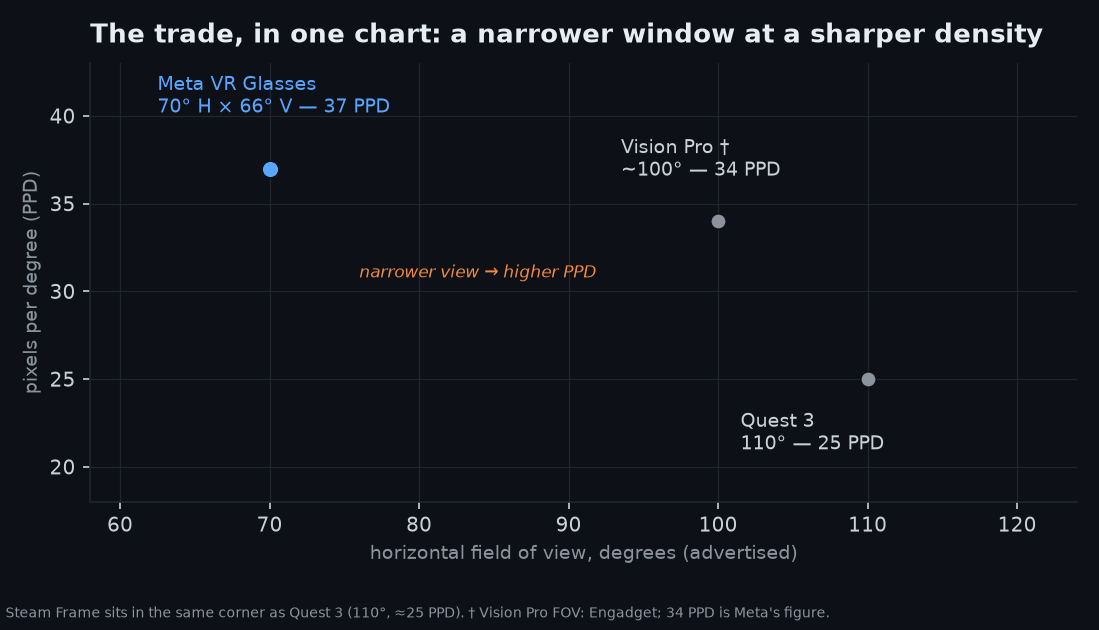
Here is the important part, though: the narrow view is not an accident, it is the mechanism. Those panels are lower-resolution than the Vision Pro's on paper, and they still beat it on pixels per degree, because the pixels are packed into a tighter cone. It is the difference between a movie theater and a periscope: a smaller window, with everything inside it sharper.
It is also a deliberate bet about who this device is for. Meta is pitching the VR Glasses as "a cinema, a courtside seat, and a workspace in one device that fits in your bag" — a private screen that coexists with the room around you, not a scuba mask. With the optional light blockers clipped in for full immersion, the narrow window is the weakness reviewers keep circling back to. Without them, in passthrough, your real peripheral vision fills in the sides, and that is the design working as intended. Road to VR called the color passthrough the best it has seen on a standalone headset, and that half of the story never makes it into the FOV number.
What the price doesn't include
Controllers are not in the box. That is a real change of posture for a VR platform, and Meta's answer is that the device is designed gesture-first — but if a game needs sticks, you are buying Touch Plus controllers separately, or pairing the ones from an existing Quest 3 or 3S. UploadVR notes a controller bundle will exist "in some retail channels," which is a sentence worth reading twice before you order.
The three-hour battery figure is Meta's own wording of "continuous high-resolution media playback," not a gaming estimate — expect less when the Reality Elite chip is actually working. Storage starts at 128GB, and while there is a microSD slot for up to 1TB, the card does not ship with the device. The magnetic light blockers that make it a proper dark cinema are an optional accessory, not box contents. And the two available sizes are separate SKUs, which means you are picking Standard or Large before you have ever worn one; Road to VR, who tried both, found the small clamping too hard and slipping off his nose, and put the risk in one sentence: "I would be pretty miffed if I bought the small and I had no reasonable way of finding out before buying." Wait for a hands-on, or at least a sizing guide, before ordering either.
One more structural caveat, and it is the one nobody at a launch event likes to say out loud: spring 2027 is still months away, and every spec on this page is a plan until units ship. The Wi-Fi and Bluetooth generations are literally listed as "TBD" in the spec sheets handed to press this week.
What you're actually buying
The flip side is that this is the most capable display Meta has ever put in a product. It is the company's first non-LCD headset since the original Quest — after years of LCDs, the micro-OLED panels finally arrive, and every hands-on I read came away from the optics impressed. Engadget called it "the sharpest mixed reality display I can remember seeing." Add the full Quest library (your existing purchases included), more than 75 games relit for hand tracking at launch, Xbox Cloud Gaming on top, and the install base math works differently than it did for the Vision Pro: you are not buying a new library, you are buying a new window into the one Meta has spent a decade building.
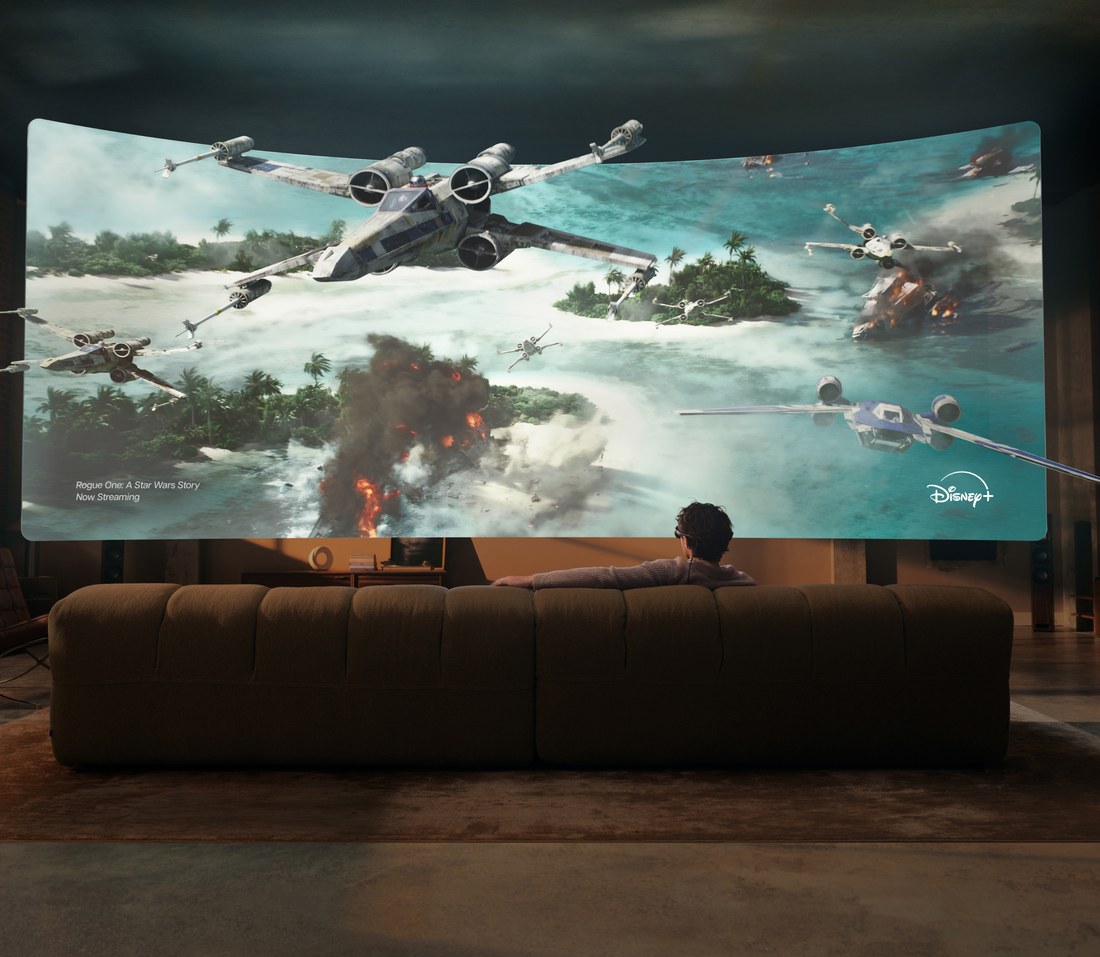
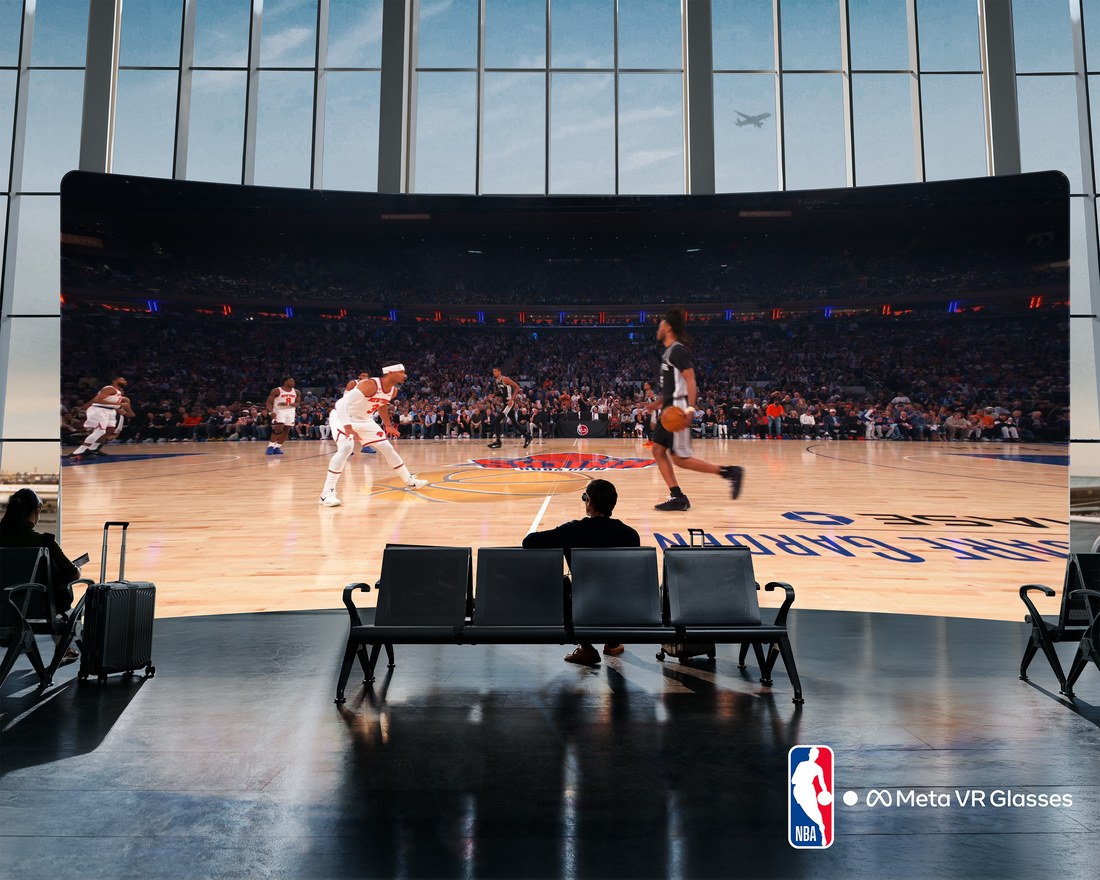
Where I think this thing actually lands is content. It is the first IMAX Enhanced certified VR device, with Dolby Vision and Dolby Atmos built in, and Meta lined up the streaming decks properly this time: Disney+ in 3D from November, first-time 3D catalogs from Peacock, HBO Max and Paramount+, plus the usual suspects. On the sports side, Meta is promising over 100 immersive live events a year across MLB, NBC Sports, TNT Sports, UFC and ESPN after launch.
For work, the VR Glasses mirror multiple windows from a Mac or PC, turn any flat surface into a keyboard and touchpad, and accept a straight DisplayPort feed from laptops, consoles and handhelds — Android Central plugged in a Steam Deck and got a 5K screen out of it. The Verge's reviewer typed a full comment on the virtual keyboard and called it "actually good," which is higher praise than it sounds. The Hologram avatar system is the one feature to keep expectations low on: at launch it is a front-angle, 2.5D video stream of your face rather than a full 6DoF avatar, with the real thing promised later.
Leak versus reality: the scorecard
My post last week on the Phoenix leaks ended with a checklist of things to validate at Connect: the weight, the field of view, the price, the name. So here is that checklist, graded against the actual announcement.
| What the leaks said | What Meta announced |
|---|---|
| Under 110 g worn | About 100 g — confirmed |
| Field of view around 90° diagonal | 87–88° diagonal (70° × 66°) — confirmed |
| 2,560 × 2,560 micro-OLED per eye | 2,412 × 2,288 — close, but a different panel |
| Snapdragon Reality Elite, Zenni prescription inserts, compute and battery in the puck, Quest store compatibility | All confirmed |
| Price under $1,000 (Meta's internal hope, reported in 2025) | $1,299.99 — missed |
| Possible retail name: "Pegasus" | "Meta VR Glasses" — missed |
| Launch in the first half of 2027 | Spring 2027 — on schedule |
Hardware leaks were mostly right; the two misses were both about money and naming, which is exactly where leaks are weakest — supply-chain sources see parts, not price tags. And to be fair to Meta: it never confirmed the Phoenix name, so the "leak" was really a puzzle assembled by dataminers. The company simply walked on stage and told us the answer.
What people are saying
The r/OculusQuest threads answered the announcement faster than any review. The loudest one is titled, and I am quoting the title verbatim, "A 70° FoV is really low." The comments there split along a line I find useful:
"I tried the Vision Pro in an Apple store and felt quite let down by the FOV, it was restricting. That's 100° horizontal x 73° vertical. This at 70° x 66° is going to feel awful, I'm sorry to say it." a comment in the r/OculusQuest thread "A 70° FoV is really low"
"It's fine for watching a movie coz u can push it further out but for using a desktop it's gonna be a real struggle." same thread, on the productivity pitch
"The FoV is 70x66. That might be adequate for mixed reality applications since you want to see the real world around you. But for VR it kills the immersion." a comment in the r/OculusQuest thread reacting to the Quest 4 question
The fairest comment I found in either thread is the one that reframes the whole argument: "it's not a VR headset that is replacement for the Quest line, it's a different category of device." Which lines up with what the press, who actually wore it, came away saying. Road to VR titled its hands-on "What Apple Vision Pro Probably Should Have Been." Stuff wrote that it hopes readers "didn't rush out to buy a Galaxy XR or Apple Vision Pro." The Verge called it "a lightweight Vision Pro" — while also saying the flat part out loud: "I don't think they will transform the landscape of VR," especially with Meta itself having pulled back from VR software. Both things can be true. This is a great device for a specific person, and a strange one for a VR enthusiast.
So who should want one?
If your Quest mostly watches movies, streams sports, or sits in a drawer because it is heavy and hot — this is the first mainstream device actually designed for you, and the 100 grams are the entire reason. If you play roomscale VR, swing controllers, and treat immersion as the point, the 70-degree window is going to feel like watching a movie through a mail slot, and nothing else on this spec sheet will change your mind. The price sits deliberately between those two worlds too:
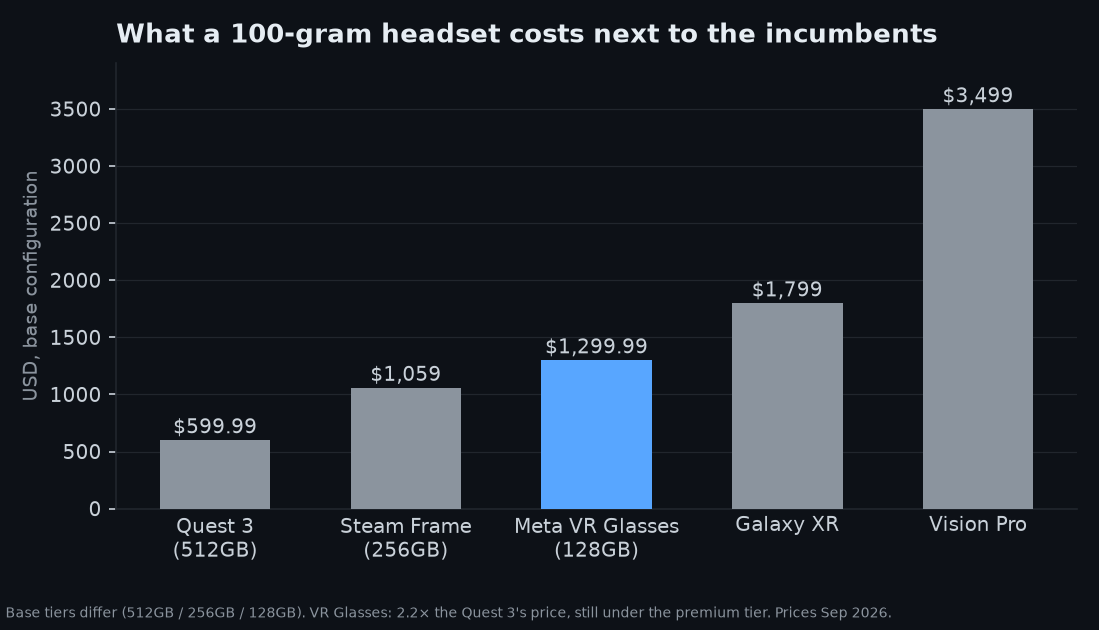
Two comparisons matter here. Against the Quest 3, the VR Glasses cost a little over twice as much, and they are not trying to replace it — they are trying to be the device you take with you. Against the Vision Pro and Galaxy XR, they undercut both while beating them on weight, pixel density, and the size of the software library. That is the actual pitch, and it is a coherent one.
My take
Meta spent a decade asking people to strap a brick to their head, and the fix turned out to be embarrassingly simple: stop putting the computer on your face. The 100 grams are real, and they are not free. You pay for them in field of view, in a cable you now manage like a headphone cable circa 2012, and in $1,299.99. Of the three, the price is the one I keep turning over — a device that is less capable than a Quest 3 in two important ways (immersive span and controller-included gaming) costs more than twice as much, and that gap only closes if you are the specific person the product was built for.
I am not ready to call it either way, and I suspect that is the correct position until people have worn these things for weeks instead of 30 minutes. The demo units impressed everyone who touched them; the questions that decide this product's fate — heat in a pocket on hour three, the real-world battery curve under games, whether a 70-degree screen really works for eight-hour workdays — do not get answered at a launch event.
What I will say is that this is the first XR device in years that I want to be wrong about. The "5x lighter" line is marketing, but the weight problem was never marketing — it was the actual, physical reason my own headset lives in a drawer. I am watching two dates now: the first independent full reviews, and whatever XREAL prices its Aura at, because it uses the same puck-based formula and ships sooner. I will update this post when the first one lands.
Related reading on this blog: Project Phoenix: Under 110 Grams, Leaked by Meta Itself · URXR One vs Quest 3: I put the 93-gram glasses next to the 515-gram headset
Sources: Meta's announcement (about.fb.com, Sep 23, 2026) · Road to VR (announcement and hands-on) · UploadVR · Engadget (hands-on and comparison) · The Verge · Android Central · Stuff · CNBC · Mashable · r/OculusQuest announcement threads. Figures labeled by source where they differ. I have not worn the VR Glasses — every hands-on impression above belongs to the outlet that reported it, and the charts are my own renderings of the published numbers.
Comments
Post a Comment